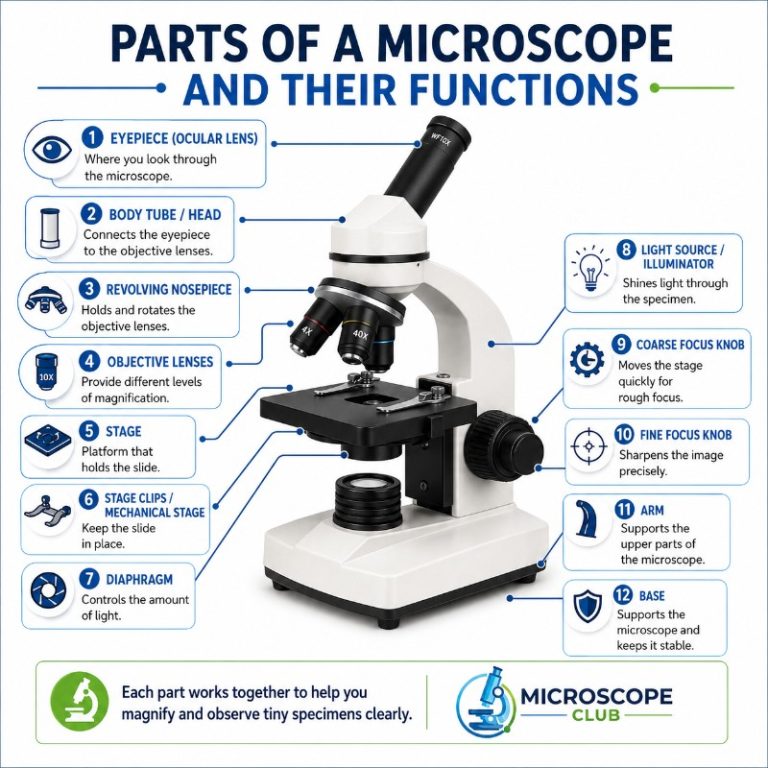
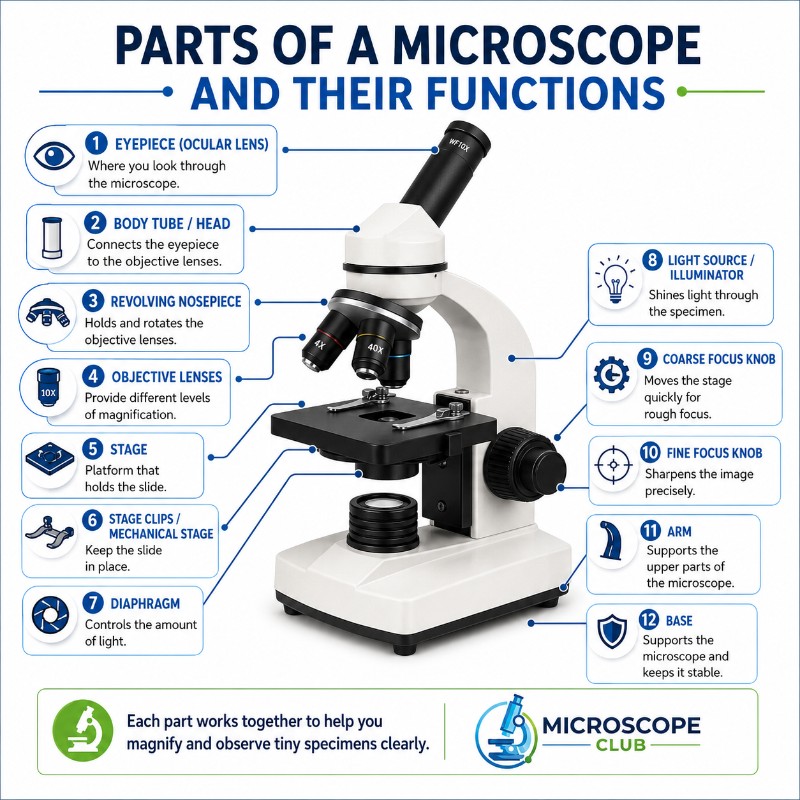
Understanding the parts of a microscope and their functions starts with recognizing that a compound light microscope has roughly 14 named components in three systems: structural (mechanical) parts that hold everything in position, optical (magnifying) parts that enlarge the image, and illuminating parts that deliver light through the specimen. Knowing what each part does — and what happens when you misuse it — is the fastest way to go from fumbling with a new instrument to getting crisp, well-lit images every time.
What Are the Parts of a Microscope?
The table below covers all 14 major parts of a standard compound light microscope, grouped by function. Keep this as a quick-reference when you’re at the bench.
| Part | Category | Function |
|---|---|---|
| Eyepiece (Ocular Lens) | Optical | Magnifies the image produced by the objective; standard 10× |
| Body Tube (Head) | Structural | Holds the eyepiece at the correct distance above the objectives |
| Arm | Structural | Connects base to head; correct grip point for carrying |
| Base | Structural | Provides stability; houses the illuminator |
| Nosepiece (Revolving Turret) | Structural | Rotating mount that holds and switches objective lenses |
| Objective Lenses | Optical | Primary magnifying lenses (4×, 10×, 40×, 100×) |
| Stage | Structural | Flat platform that holds the glass slide over the light path |
| Stage Clips / Mechanical Stage | Structural | Hold the slide in place; mechanical stage adds precise X-Y movement |
| Aperture | Structural | Hole in the stage that allows transmitted light to reach the specimen |
| Coarse Adjustment Knob | Structural | Rapid stage movement for initial focusing at low power |
| Fine Adjustment Knob | Structural | Tiny movements for sharp focus at high magnification |
| Illuminator / Light Source | Illuminating | LED or halogen bulb that sends light up through the specimen |
| Condenser | Illuminating | Focuses light from the illuminator onto the specimen |
| Diaphragm (Iris) | Illuminating | Controls the amount and cone angle of light; adjusts contrast |
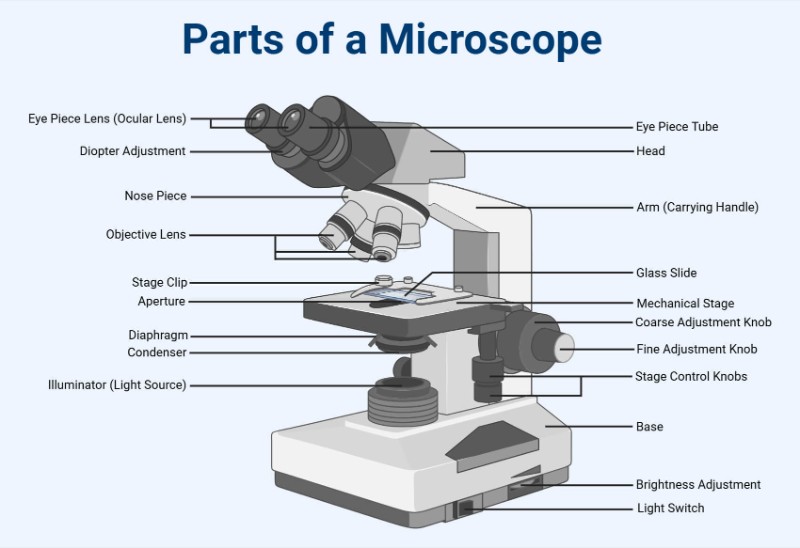
The 3 Main Categories of Microscope Parts
Every part of a microscope belongs to one of three systems. Understanding the system each part belongs to makes it easier to troubleshoot problems: if your image is blurry, the issue is usually in the optical or structural system; if your image is washed out or too dark, the problem is in the illuminating system.
Structural (Mechanical) Parts
These are the frame of the instrument. They hold every other component at the precise distance and angle it needs to be in order to form a useful image. Without rigid structural parts, your optical and illuminating components would shift every time you nudged the microscope — no image would stay in focus. Structural parts include the base, arm, body tube, stage, nosepiece, and both adjustment knobs.
Optical (Magnifying) Parts
The optical system contains only two elements — the eyepiece and the objective lenses — but they do all the magnification work. The objective captures light coming through the specimen and forms an initial magnified image. The eyepiece then re-magnifies that image for your eye. Total magnification is the product of both: eyepiece power × objective power.
Illuminating Parts
Transmitted-light microscopy depends on a controlled beam of light passing up through the specimen. The illuminating system generates that beam (illuminator), shapes it (condenser), and regulates how much reaches the specimen (diaphragm). All three work as a unit — adjusting one often means tweaking the others to maintain optimal image quality.

Structural Parts and Their Functions
For a visual diagram of all these components in context, see our detailed guide to the parts of a compound microscope.
Head / Body Tube
Function: Holds the eyepiece at the correct optical distance above the objective lenses so both lenses work together as a matched system.
Monocular microscopes have a single vertical tube. Binocular heads have two tubes with an adjustable interpupillary distance so both eyes can be used simultaneously. Some advanced heads are trinocular — the third port accepts a camera.
Beginner mistake: Pulling the eyepiece fully out of the tube to “see better.” This breaks the focal relationship between eyepiece and objective and you lose the image entirely.
Arm
Function: Connects the base to the head; provides a rigid curved handle for carrying the microscope.
Always carry a microscope with one hand on the arm and the other supporting the base. Gripping the head or the stage can dislodge the eyepiece or jar the objectives.
Beginner mistake: Carrying the microscope by the body tube or nosepiece — both of which are not designed to bear the weight of the full instrument.
Base
Function: The broad, flat bottom of the microscope that keeps the instrument stable on a bench surface; in modern scopes it also houses the LED illuminator and power controls.
A wider, heavier base generally means better vibration resistance, which matters at high magnification where even a light footstep can blur your image.
Stage and Stage Clips
Function: The stage is the flat platform where you place the glass slide. Its central aperture allows light from below to pass up through the specimen. Stage clips are spring-loaded arms that hold the slide flat and prevent it from sliding around during observation.
A mechanical stage is an optional upgrade (standard on better student scopes) that replaces simple clips with two fine-threaded knobs controlling precise left-right and forward-back (X and Y) movement of the slide. This is invaluable for scanning a slide systematically at high power.
Learn how to prepare microscope slides correctly — a poorly mounted specimen makes even the best stage useless.
Beginner mistake: Pressing the slide onto the stage too hard and cracking it, or losing your position by moving the slide with your fingers at 400× instead of using the mechanical stage controls.
Nosepiece (Revolving Turret)
Function: A rotating metal disc that holds all the objective lenses and lets you switch between magnifications with a single twist. It clicks into a detent at each objective position to ensure the lens is perfectly centered over the aperture.
For a deep look at this component, see our guide on nosepiece functions.
Beginner mistake: Rotating the nosepiece while looking through the eyepiece and crashing the high-power objective into the slide — always look from the side when switching objectives, or bring the stage down first.
Coarse Adjustment Knob
Function: The large knob on the arm that moves the stage (or tube, depending on the scope design) rapidly up and down to bring the specimen into the rough focal range. Use it only at low power (4× or 10× objective).
Beginner mistake — the #1 error in any microscopy lab: Using the coarse adjustment knob with the 40× or 100× objective. The working distance at high power is less than a millimeter. One over-enthusiastic turn can drive the objective straight into the slide, cracking the coverslip, the slide, and potentially the front element of a very expensive lens.
Fine Adjustment Knob
Function: The smaller knob (usually nested inside or adjacent to the coarse knob) that produces very small, precise stage movements for achieving sharp, crisp focus. Once you’ve roughed in focus with the coarse knob at low power, use the fine knob exclusively for every magnification change above 10×.
Beginner mistake: Ignoring the fine knob entirely and fighting the coarse knob to get a sharp image at 400× — it’s essentially impossible. The fine knob isn’t optional at high magnification; it’s mandatory.
Optical Parts and Their Functions
Eyepiece (Ocular Lens)
Function: The lens at the top of the body tube that you look through. It magnifies the real image already formed by the objective. Standard student eyepieces are 10×, though 5× and 15× versions exist.
Binocular scopes have two eyepieces. The interpupillary distance (the gap between them) is adjustable — set it so both circles of light merge into one comfortable image. Many eyepieces also have a diopter adjustment ring to correct for differences between your two eyes.
Beginner mistake: Looking through the eyepiece with glasses on when the scope has a diopter ring — the ring is designed to compensate for most prescription needs without glasses, which can smudge the optics and reduce field of view.
Objective Lenses
Function: The primary magnifying lenses, mounted on the nosepiece and positioned directly above the specimen. These do most of the optical work — the eyepiece simply re-magnifies what the objective has already resolved.
A standard compound microscope comes with four objectives, color-coded for quick identification:
| Objective | Power | Color Band | Use |
|---|---|---|---|
| Scanning | 4× | Red | Initial orientation; find the specimen |
| Low power | 10× | Yellow | General survey of the slide |
| High power (high-dry) | 40× | Blue | Detailed cell-level observation |
| Oil immersion | 100× | White | Bacteria, sub-cellular detail — requires immersion oil |
The 100× oil immersion objective requires a drop of immersion oil placed between the front lens and the coverslip. Oil has the same refractive index as glass (~1.515), which eliminates light refraction at the glass-air boundary and allows more light to enter the objective — dramatically improving both brightness and resolution at maximum magnification. Never use immersion oil on the 40× dry objective — it will permanently cloud the lens coating. For a comprehensive overview of objective lens types and their uses, see Britannica’s microscope article.
Beginner mistake: Starting a new slide at 400× rather than scanning at 40× first. Always start at the lowest power, center the specimen, then step up through the magnifications.
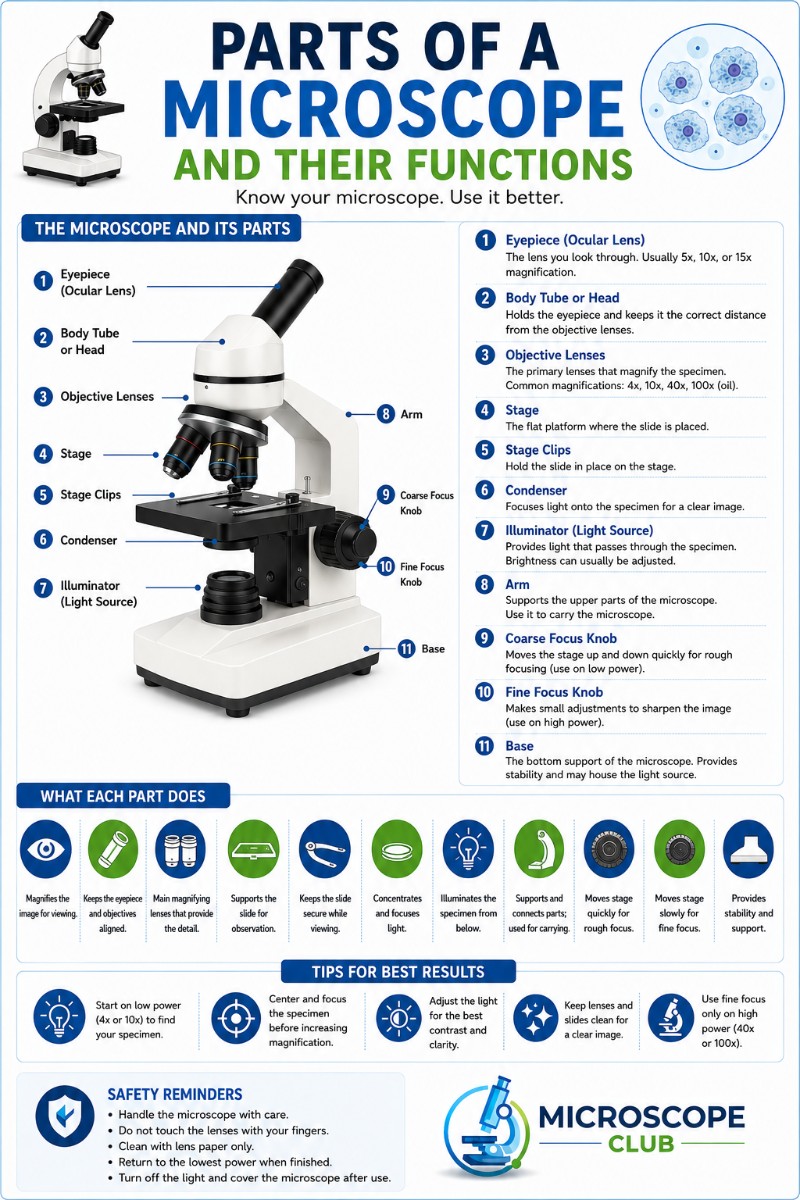
How to Calculate Total Magnification
Total magnification = eyepiece power × objective power.
With a standard 10× eyepiece:
- 4× objective → 40× total
- 10× objective → 100× total
- 40× objective → 400× total
- 100× objective → 1,000× total (maximum for a student compound scope)
An important distinction: more magnification is not automatically better. Magnification and resolution are not the same thing. The numerical aperture of the objective and the wavelength of light govern resolution — the ability to distinguish two closely spaced points as separate — not the eyepiece setting. “Empty magnification” is what you get when you zoom in beyond what the optics can resolve: a bigger image, but not a sharper one. Understanding depth of field is equally important when moving between magnification levels. Khan Academy’s microscopy guide covers magnification and resolution limits clearly for beginners.
Illuminating Parts and Their Functions
Illuminator / Light Source
Function: Provides the transmitted light that passes up through the specimen. Modern microscopes use a low-voltage LED (cool, energy-efficient, long-lasting) or a halogen bulb (warmer color temperature). Many older or budget models use a mirror instead — a concave or flat mirror mounted in the base that the user angles to reflect ambient or lamp light up through the condenser.
Brightness is typically controlled by a rheostat or a simple dial. For most specimens, a moderate brightness level combined with a properly adjusted diaphragm gives better results than full intensity.
Condenser
Function: A lens system mounted directly beneath the stage that gathers diverging light from the illuminator and focuses it into a sharp cone aimed precisely at the specimen. The most common type found on student and laboratory scopes is the Abbe condenser. Florida State University’s Molecular Expressions resource has an excellent deep-dive on how condensers work.
The condenser matters most at high magnification (400× and above). At low power, many microscopists rack the condenser down slightly or ignore it entirely. At 400×, a poorly aligned condenser — too low, too high, or off-center — noticeably degrades image brightness and evenness. For a detailed look at how this component works, see our guide on the condenser of a microscope.
Beginner mistake: Leaving the condenser in its lowest position for all magnifications. Rack it up until it’s just below the stage for 400× work.
Diaphragm / Iris Diaphragm
Function: Located between the condenser and the illuminator, the diaphragm is an adjustable opening that controls the amount and cone angle of light entering the condenser and ultimately striking the specimen. Closing the diaphragm increases contrast; opening it increases brightness.
Budget microscopes use a disc diaphragm — a rotating wheel with a series of fixed-size holes. Better instruments use an iris diaphragm — a lever-controlled mechanism (like a camera aperture) that allows continuous, stepless adjustment of the opening size.
Critically: the diaphragm controls contrast, not magnification. See our deep-dive on the iris diaphragm for a full explanation of Köhler illumination principles.
Beginner mistake: Leaving the diaphragm fully open at all times. A wide-open diaphragm floods the specimen with light, which paradoxically reduces contrast and makes low-contrast specimens (unstained cells, transparent organisms) nearly invisible. Close it about halfway and adjust from there.
How the Parts Work Together
Understanding each part individually is useful. Understanding how they form a single light-and-image system is what makes you competent at the microscope.
Follow the light path from source to eye:
- Illuminator — generates light from the base
- Diaphragm — regulates how much light enters the condenser and its angular spread
- Condenser — focuses that regulated light into a precise cone aimed at the specimen
- Specimen on the stage — light passes through the thin, (often stained) tissue on the glass slide
- Objective lens — captures the transmitted light and forms the first, inverted, magnified real image
- Body tube — carries that image up toward the eyepiece at the correct distance
- Eyepiece — re-magnifies the real image for your eye, converting it into a virtual image you can see comfortably
- Your eye — receives the final virtual image
Notice that the image you see is inverted and laterally reversed: if you move the slide to the right, the image moves left; push the slide away from you, the image moves toward you. This surprises every first-time user and is a direct consequence of how the objective lens bends light to form its real image.
The structural parts — arm, base, body tube, nosepiece, stage, and adjustment knobs — exist entirely to hold the optical and illuminating components in this exact spatial relationship, rigidly and repeatably, while allowing controlled movement only where it’s needed (rotating the nosepiece, moving the stage, adjusting focus).
How Parts Differ on a Stereo (Dissecting) Microscope
A dissecting microscope looks similar to a compound scope at a glance but operates on a fundamentally different optical principle. Here’s how the two compare:
| Feature | Compound Light Microscope | Stereo / Dissecting Microscope |
|---|---|---|
| Light source type | Transmitted (through specimen) | Reflected / incident (from above) |
| Magnification range | 40× – 1,000× | 10× – 50× (zoom) |
| Image orientation | Inverted and reversed | Upright and correct |
| Image type | 2D (flat) | 3D (stereoscopic depth) |
| Specimen type | Thin, transparent mounted slides | Solid, opaque objects (insects, rocks, circuit boards) |
| Condenser | Yes — required | No — not present |
| Diaphragm | Yes | No (or minimal) |
| Optical paths | Single path | Two separate angled paths (gives 3D effect) |
Because a stereo microscope uses reflected light, there’s no need for a condenser or diaphragm beneath the stage — those components only make sense when light travels through the specimen. The stereo scope’s two separate optical paths, aimed at slightly different angles, are what create the three-dimensional effect that makes it so useful for dissection, jewelry work, and electronics repair.
For a broader look at how these two types fit into the wider landscape, see our guide to the types of microscopes.
Common Beginner Mistakes — Quick Reference
These five errors account for the vast majority of problems beginners encounter. Avoid them and you’ll spend far more time actually looking at specimens than troubleshooting a bad image.
- Using the coarse knob at high magnification. At 40× or 100×, the working distance is less than a millimeter. One strong turn can crack the slide and chip the objective lens. Use coarse focus only at 4× or 10×; switch to fine focus for everything above that.
- Leaving the diaphragm fully open. Wide open = maximum glare = minimum contrast. Close it halfway and adjust to taste for each specimen type.
- Starting at high power. Always begin at the lowest objective (4×), center and focus the specimen, then step up through 10×, 40×. Never start at 40× or 100× — you’ll spend ten minutes hunting for something that took three seconds to find at 4×.
- Carrying the microscope by the head or nosepiece. Both hands: one on the arm, one under the base. Always.
- Using immersion oil on the 40× dry objective. Oil on the 40× lens will fog the coating. Immersion oil is exclusively for the 100× oil-immersion objective, and it must be cleaned off with lens paper immediately after use.
Frequently Asked Questions
What are the 3 main parts of a microscope?
The three main functional systems are the structural (mechanical) parts — which hold the instrument together and position the specimen (base, arm, stage, body tube, nosepiece, adjustment knobs); the optical (magnifying) parts — the eyepiece and objective lenses that produce the enlarged image; and the illuminating parts — the illuminator, condenser, and diaphragm that deliver controlled light through the specimen.
What is the function of the objective lens on a microscope?
The objective lens is the primary magnifying lens. Mounted on the nosepiece directly above the specimen, it captures light that has passed through the slide and forms the first real magnified image. A standard compound microscope has four objectives: 4× (scanning), 10× (low power), 40× (high-dry), and 100× (oil immersion). The objective determines most of the instrument’s resolving power — its ability to distinguish fine detail.
What is the difference between the coarse and fine adjustment knobs?
The coarse adjustment knob is the large knob that moves the stage rapidly up and down — used only at low magnification (4× or 10× objective) to bring the specimen into the rough focal range. The fine adjustment knob is much smaller and produces tiny, precise movements used to achieve sharp focus, particularly at high magnification (40× and 100×). Using the coarse knob at high power risks cracking the slide.
What does the diaphragm do on a microscope?
The diaphragm (also called an iris diaphragm) is an adjustable aperture located below the condenser. It controls the amount and cone angle of light that passes through the specimen. Opening the diaphragm increases brightness; closing it increases contrast. Beginners often leave it fully open, which floods specimens with light and reduces contrast — making transparent or lightly stained specimens nearly impossible to see clearly.
What is the function of the condenser on a microscope?
The condenser is a lens system mounted beneath the stage that gathers light from the illuminator and focuses it into a precise cone aimed at the specimen. It is most important at high magnification (400× and above), where even illumination and maximum light-gathering are critical for a bright, sharp image. The most common type is the Abbe condenser. The condenser focuses light; the diaphragm controls how much — these two parts work together but do different jobs.
What are the parts of a compound microscope and their functions?
A compound microscope has 14 main parts: eyepiece (magnifies image 10×), body tube (holds eyepiece in position), arm (structural support and carry handle), base (stability and illuminator housing), nosepiece (rotates to select objective), objective lenses (primary magnification at 4×/10×/40×/100×), stage (holds the slide), stage clips or mechanical stage (secures and moves the slide), aperture (hole for light transmission), coarse adjustment knob (rough focus at low power), fine adjustment knob (sharp focus at high power), illuminator (light source), condenser (focuses light), and diaphragm (controls light amount and contrast).
What is the eyepiece (ocular lens) and what magnification does it usually have?
The eyepiece, also called the ocular lens, is the lens at the top of the body tube that you look through. It magnifies the image already formed by the objective lens. Standard student eyepieces are 10×, meaning they enlarge the objective’s image ten times. Some scopes come with 5× or 15× eyepieces. Total magnification is always eyepiece power multiplied by objective power — with a 10× eyepiece and a 40× objective, total magnification is 400×.
What is the difference between a compound and a stereo microscope?
A compound microscope uses transmitted light (through a thin specimen on a glass slide) at high magnification (40–1,000×) and produces a two-dimensional, inverted image. A stereo (dissecting) microscope uses reflected light (bounced off the surface of a solid object) at low magnification (10–50×) and produces a three-dimensional, upright image. Stereo microscopes have two separate optical paths — hence the 3D effect — and do not use a condenser or diaphragm. They are used to examine whole insects, rocks, coins, circuit boards, and similar opaque objects.
Conclusion
The parts of a microscope form three interlocking systems — structural, optical, and illuminating — each of which has to work correctly for the other two to do their jobs. The structural parts hold everything in precise alignment. The optical parts (eyepiece and objectives) build the magnified image in two stages. The illuminating parts (illuminator, condenser, diaphragm) deliver a shaped, controlled beam of light that makes the image visible in the first place. Understanding that the microscope is a system, not just a list of parts, is what separates a competent microscopist from someone who just points a lens at a slide and hopes for the best.
Have you tried working through the different objective powers on your own scope, or run into any of the classic beginner mistakes we covered? Tell us what you found — or what confused you — in the comments below. If you’re just getting started, we’d also love to hear which part of the microscope gave you the most trouble to figure out.