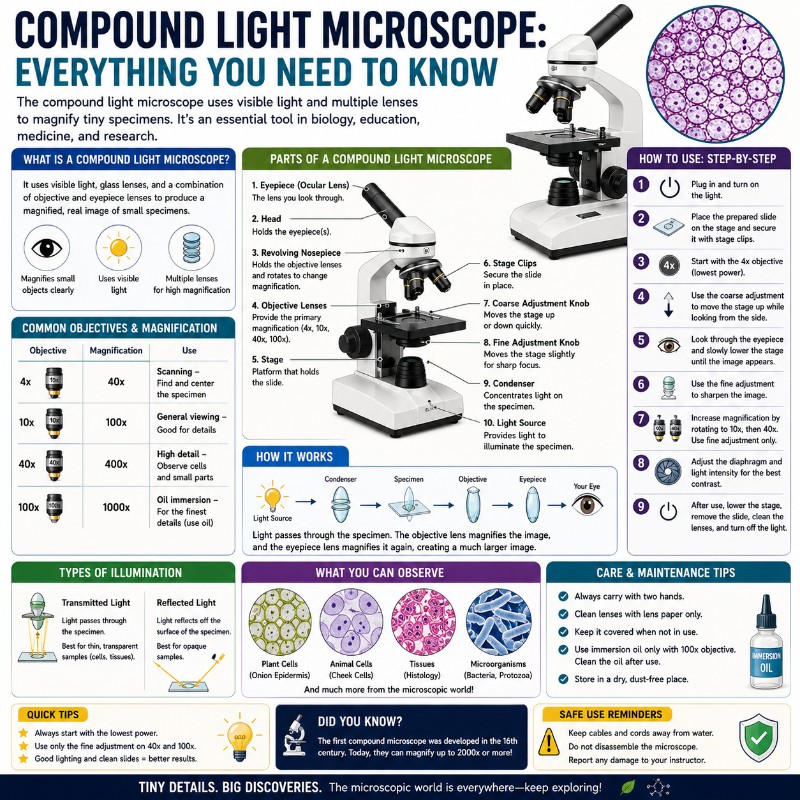
Compound Light Microscope: Everything You Need to Know

Photo of Compound Light Microscope

Pick up any compound light microscope, flip on the LED, and within a minute you’re watching a single drop of pond water teeming with organisms you can’t see with your naked eye. That’s the appeal — straightforward enough to use at a kitchen table, powerful enough for serious biology, and affordable enough that millions of …

Read more

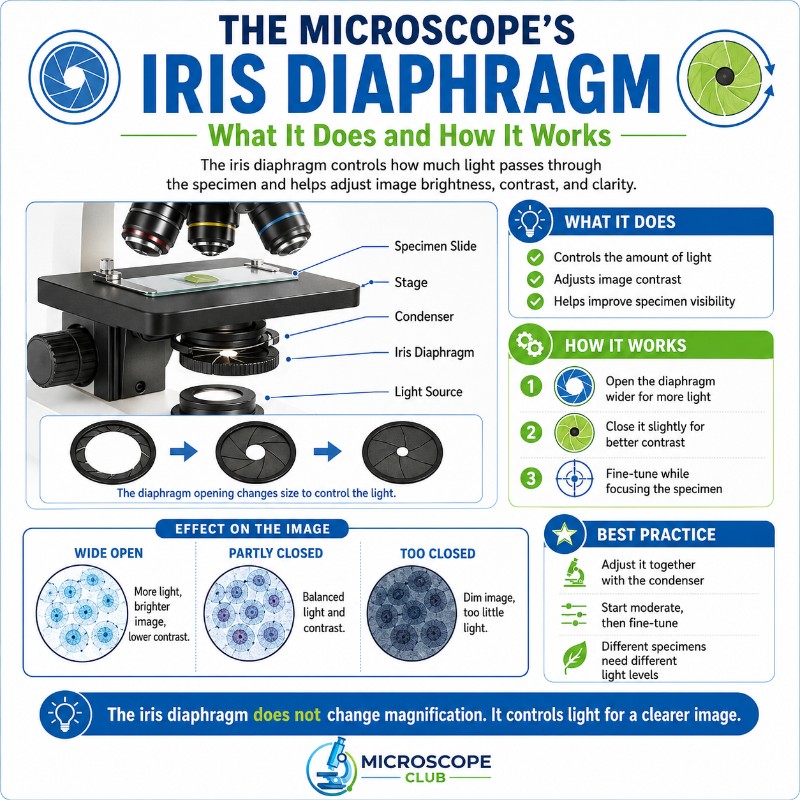
The Microscope’s Iris Diaphragm: What it Does And How it Works

Photo of The Microscope’s Iris Diaphragm_ What it Does And How it Works

The iris diaphragm is one of the most frequently misused controls on a light microscope — and one of the most powerful when you know what it actually does. It sits inside the substage condenser, governs the cone of light that strikes your specimen, and directly determines the balance between contrast, resolution, and depth of …

Read more

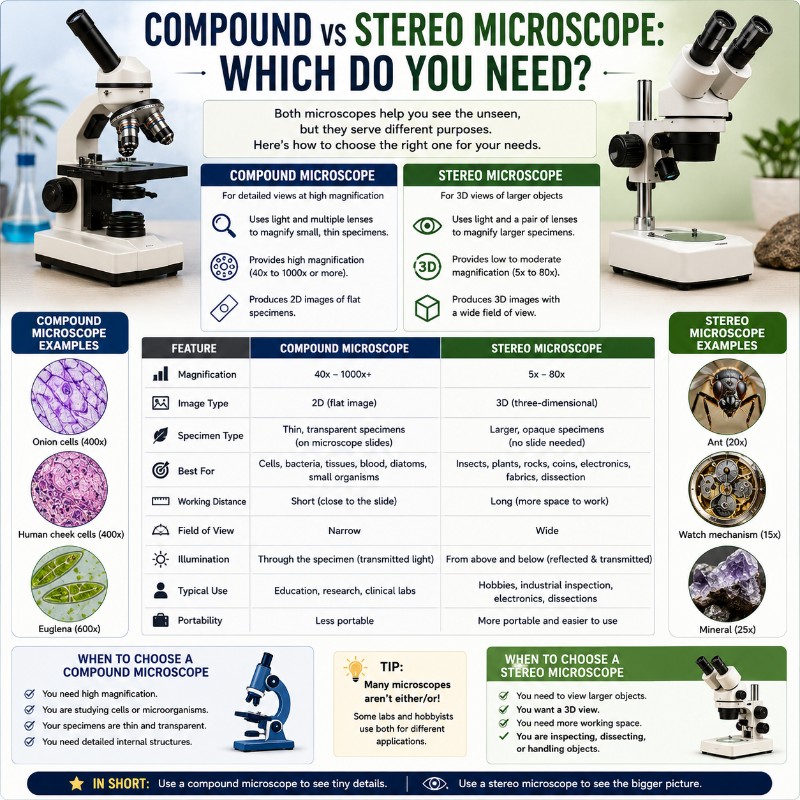
Compound vs Stereo Microscope: Which Do You Need?

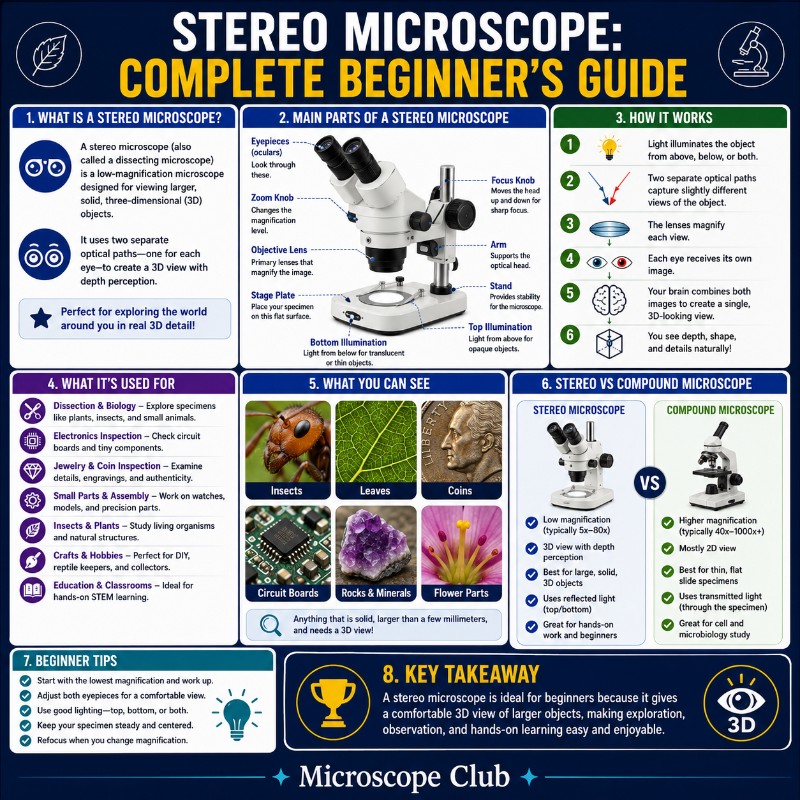
When choosing between a compound vs stereo microscope, the answer comes down to one question: are you looking through something thin on a slide, or at the surface of a solid object? Compound microscopes are built for cells, microbes, and slide-mounted samples at 40x–1000x magnification; stereo (dissecting) microscopes are built for 3D whole objects — …

Read more

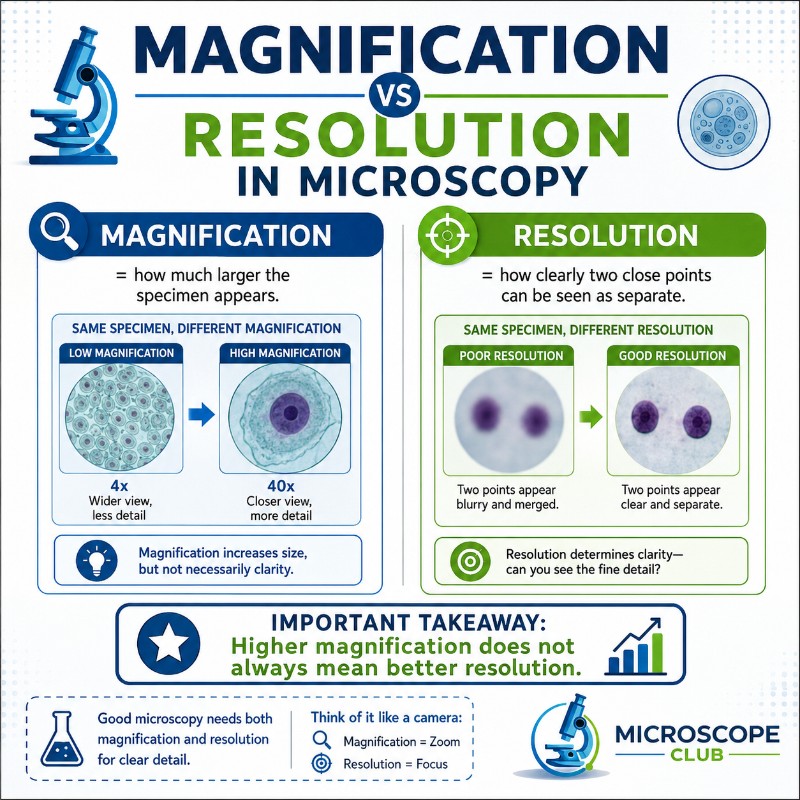
Magnification vs Resolution in Microscopy Explained

Photo of Magnification vs Resolution on Microscopy

Magnification tells you how much larger an image appears compared to the real object. Resolution tells you how much fine detail you can actually distinguish. A microscope can magnify an image 1,000 times and still produce a blurry, useless picture if its resolution is poor. In microscopy, these two properties are independent — and understanding …

Read more

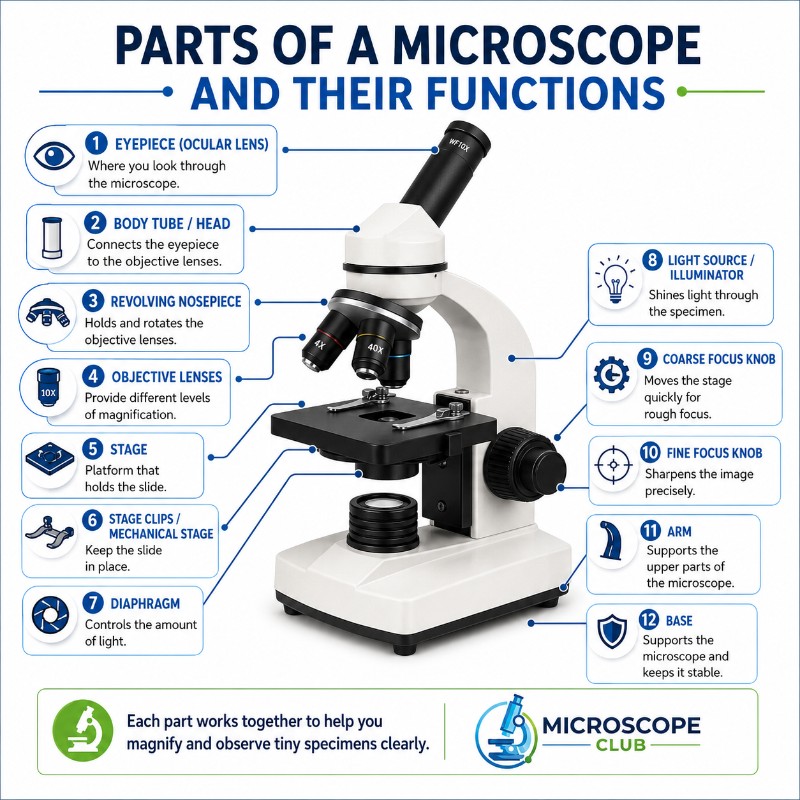
Parts of a Microscope and Their Functions

Photo of Parts of microscope and its functions

Understanding the parts of a microscope and their functions starts with recognizing that a compound light microscope has roughly 14 named components in three systems: structural (mechanical) parts that hold everything in position, optical (magnifying) parts that enlarge the image, and illuminating parts that deliver light through the specimen. Knowing what each part does — …

Read more

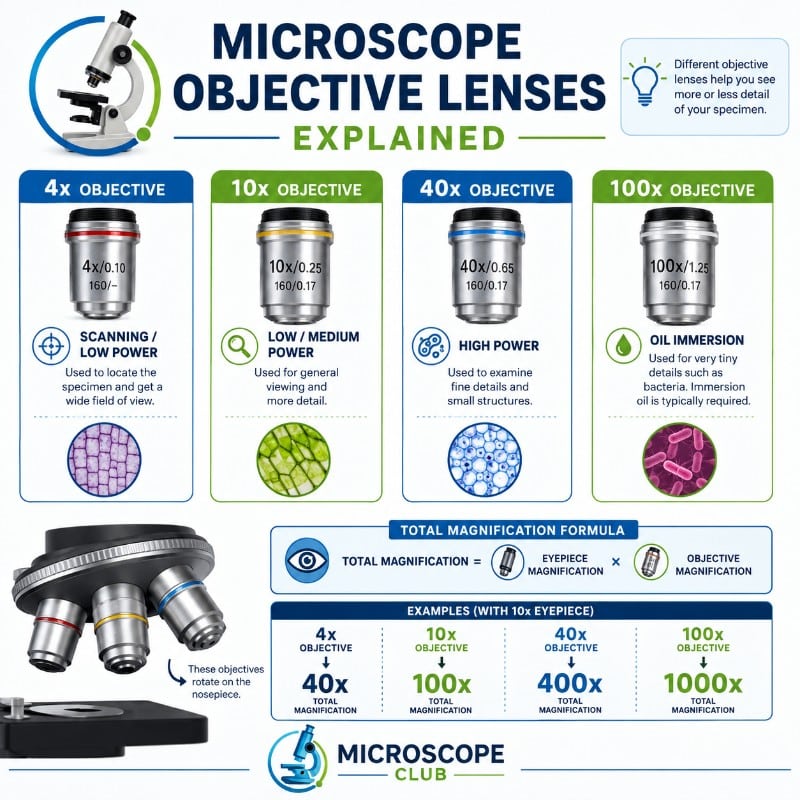
Microscope Objective Lenses Explained: 4x, 10x, 40x, 100x

Photo of Microscope Objective Lenses Explained 4x, 10x, 40x, 100x

Every compound microscope ships with four objective lenses — 4x, 10x, 40x, and 100x — and understanding what those numbers mean (and what they don’t tell you) determines whether you use the instrument effectively or spend sessions chasing blurry images. Each number is the objective’s own magnifying power; multiply it by your eyepiece to get …

Read more

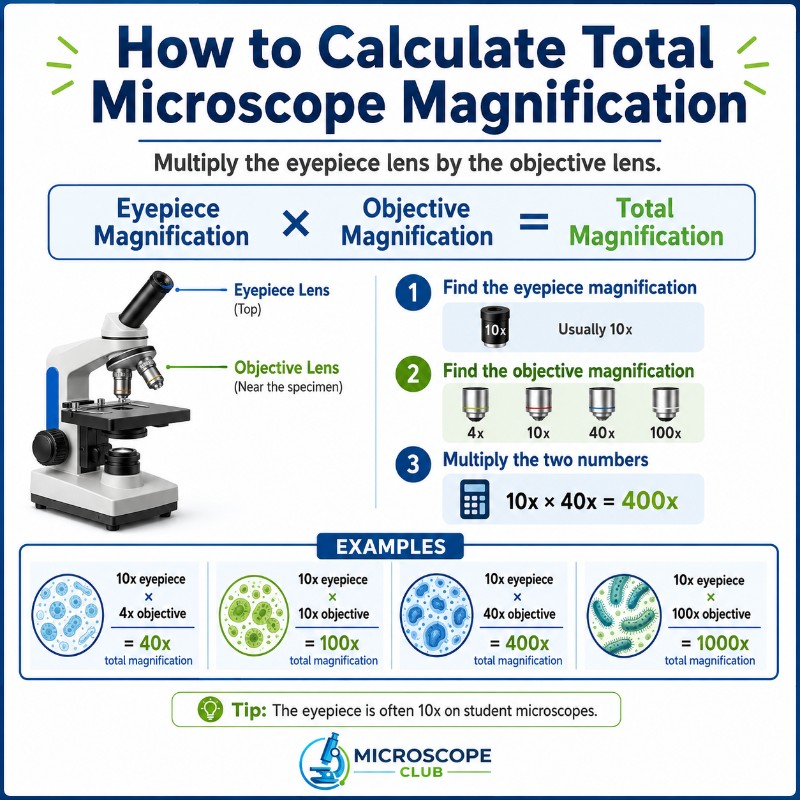
How to Calculate Total Microscope Magnification

Photo of How to calculate total microscope magnification

Total microscope magnification is one of the first things you need to work out in any biology lab — and it comes down to a single multiplication. Multiply the power of your objective lens by the power of your eyepiece lens and you have your answer. Every compound microscope works the same way, whether you …

Read more

What Is Numerical Aperture in Microscopy?

Numerical aperture in microscopy — abbreviated NA — is the single number stamped on every objective lens that determines how much detail you can actually resolve and how much light your lens can gather. Defined by the formula NA = n · sin(θ), it tells you the range of angles over which an objective can …

Read more

What Are The Microscope Nosepiece Functions?

Photo of What Are The Microscope Nosepiece Functions_

The microscope is one of the most critical tools in the scientific world. It allows us to see things too small to be seen with the naked eye and opens up a whole new world of discovery. It started as a simple gadget invented around 1590. Though it is unclear whether it was Hans Lippershey …

Read more