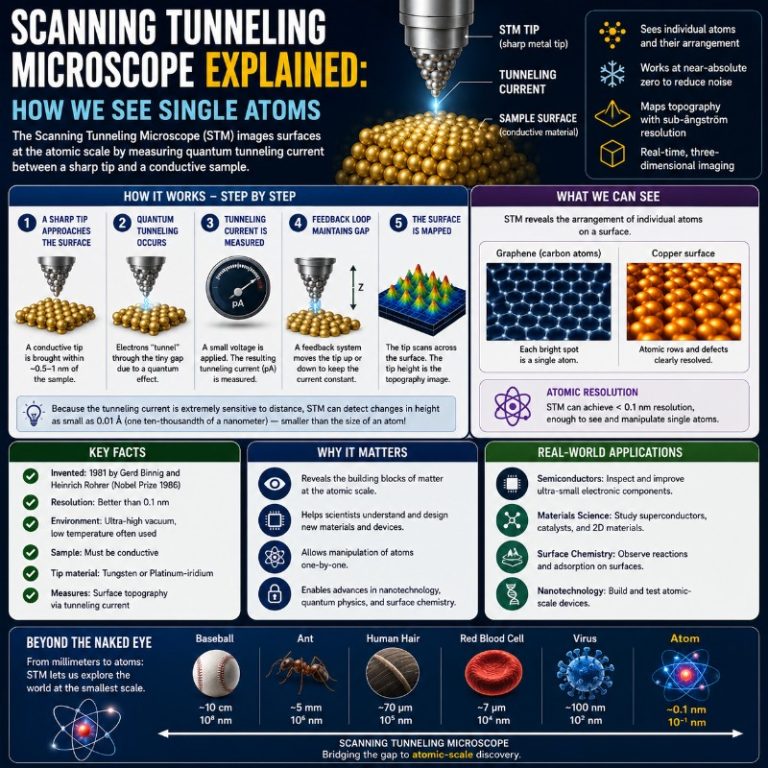
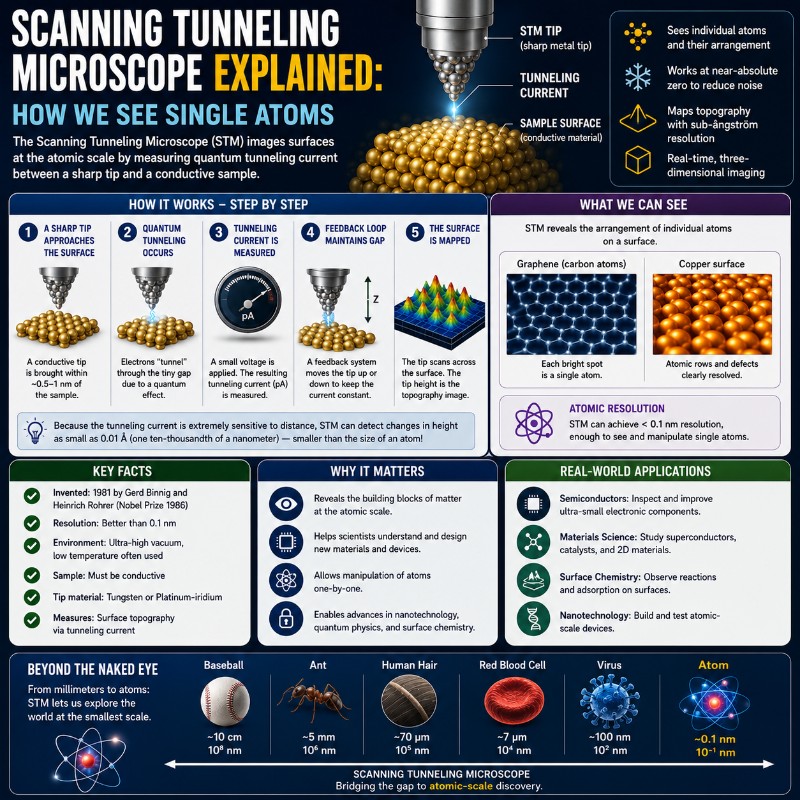
A scanning tunneling microscope (STM) is a device that images surfaces at the scale of individual atoms by measuring a tiny quantum-mechanical current that flows between a sharp metal tip and a conductive sample without the two ever touching. Invented in 1981 at IBM Zurich by Gerd Binnig and Heinrich Rohrer — work that earned them the 1986 Nobel Prize in Physics — the STM was the first instrument in history to image single atoms in real space. Unlike light microscopes or even electron microscopes, the STM uses no lenses, no beam, and no optics; it simply scans a needle across a surface one atom-width at a time and listens to the electrical whisper between them.
How a Scanning Tunneling Microscope Works
The operating principle sounds deceptively simple: bring a sharp conductive tip extremely close to a conductive sample, apply a small voltage, and measure the resulting current. Everything remarkable about the STM flows from just how extreme the word “close” is here — and from the quantum physics that takes over at that scale.
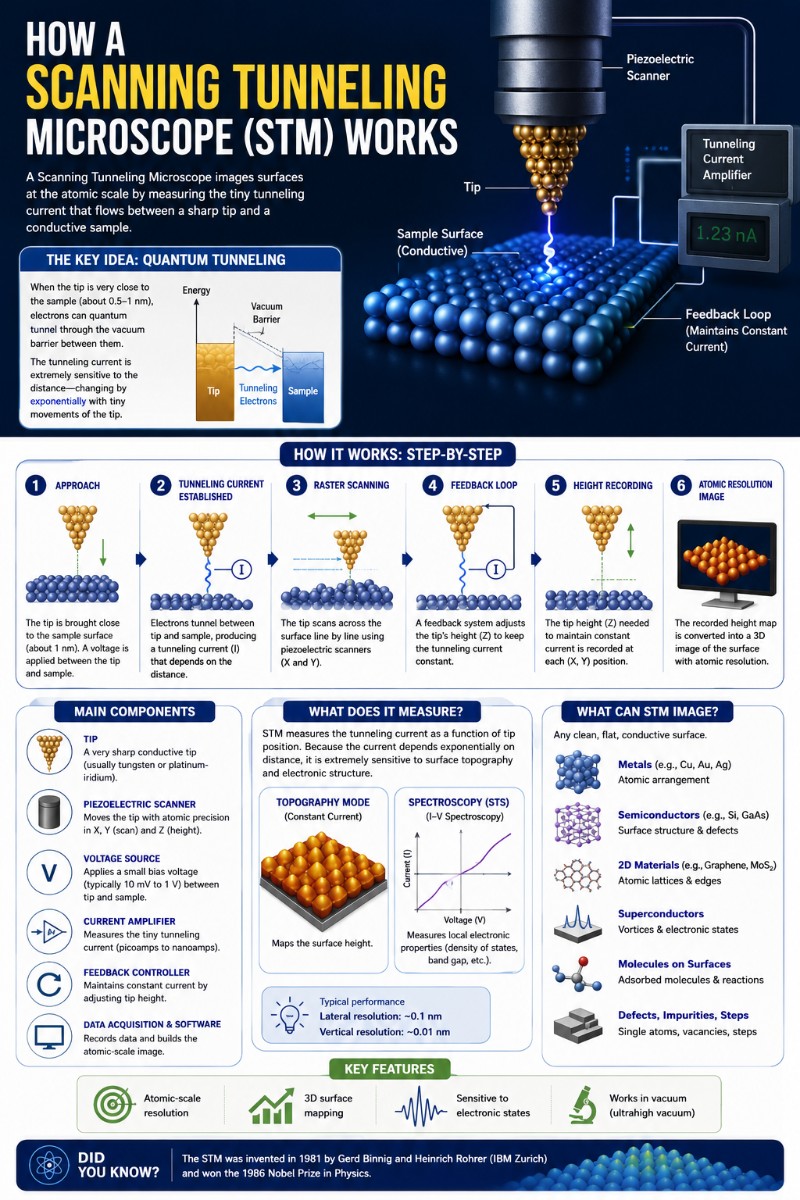
Here is the step-by-step mechanism:
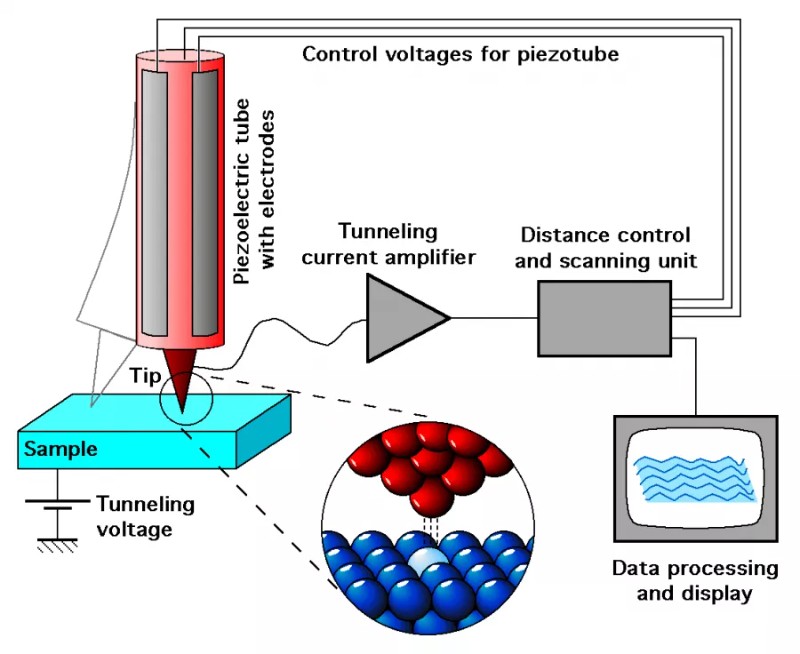
- Coarse approach. The tip (mounted on a piezoelectric scanner) is mechanically driven toward the sample surface to within a nanometer or so using a stepper motor or piezo “inchworm.” Operators watch a current meter, not the tip — there is nothing to see with the naked eye.
- Bias voltage applied. A small voltage — typically a few millivolts to a few volts — is applied between tip and sample. Classically, with a vacuum gap separating them, no current should flow at all.
- Tunneling current appears. Once the gap is roughly 0.4 to 1 nanometer (a few atomic diameters), quantum tunneling kicks in and a measurable current — typically in the picoamp to nanoamp range — begins to flow.
- Raster scan. The piezoelectric scanner sweeps the tip across the surface in a grid pattern (x and y directions) while the feedback system and z-piezo manage the height.
- Image built. The z-position or current value at each x-y point is recorded and rendered as a false-color map — that is the STM image.
The result, displayed on a computer screen, looks nothing like a conventional photograph. It is a false-color height map — typically rendered in orange, gold, or a rainbow scale — where individual atoms appear as rounded bumps or “hills,” like an egg carton or a sheet of bubble wrap viewed from directly above. The famous silicon 7×7 surface reconstruction (Si(111)-7×7) looks like a repeating honeycomb of bright dots, and when you first see it you realize you are genuinely looking at the arrangement of atoms on a solid surface.
The Tip and the Tunneling Gap
The quality of an STM image lives or dies on the tip. STM tips are typically made of tungsten or a platinum-iridium alloy, electrochemically etched or mechanically cut (you snap the wire at an angle with sharp scissors and hope to get a single-atom apex). The tunneling current concentrates at the atom or atoms closest to the surface — the sharper the apex, the better the lateral resolution, because you want exactly one atom doing the tunneling, not a cluster of them.
One experience every STM operator knows well: approaching the tip is nerve-wracking. You creep the tip in using the coarse approach and watch the current display. The moment you see tunneling current appear, you stop — because you are now within one nanometer of the surface, and a fraction of a nanometer too far and you crash the tip. A crashed tip usually means stopping the experiment, re-etching or re-cutting a new tip, and starting the approach procedure again. Speed is the enemy here.

A subtler problem is the “double tip” — when two atoms at the tip apex are both within tunneling range of the surface simultaneously. The image you get looks doubled or ghosted, with every surface atom appearing twice. Beginners often blame the sample (“something is wrong with the surface”) before realizing the tip is the issue. The fix is to deliberately pulse a higher voltage through the tip to reshape its apex, or to gently nudge it against the surface to knock off the offending atom.
Constant-Current vs. Constant-Height Mode
The STM can operate in two distinct modes, and the choice depends on your sample and your priorities:
| Mode | What stays constant | What forms the image | Best for |
|---|---|---|---|
| Constant-current | Tunneling current (feedback loop adjusts z-height) | The recorded z-height map | Most surfaces; safer on rough samples |
| Constant-height | Tip height (no feedback adjustment) | Variations in the current itself | Very flat surfaces; faster scanning |
Constant-current mode is far more common, especially for beginners and rough samples. The feedback loop continuously adjusts the z-piezo to maintain the set current point, so the tip follows the surface contour like a stylus tracing a record groove — just at an atomic scale. Constant-height mode is faster (no feedback lag) but dangerous on rough surfaces: if the surface has a tall feature and the tip cannot move out of the way fast enough, you crash.

Quantum Tunneling, Explained Simply
The heart of the STM — and the reason it achieves resolution impossible with any lens-based system — is a quantum mechanical phenomenon called tunneling. Here is the plain-language version.
In classical physics, if you throw a ball at a wall, the ball bounces back. It cannot pass through unless it has enough energy to go over the wall. In quantum mechanics, particles like electrons do not behave this way. An electron is described by a wave function that does not abruptly vanish at a barrier — it decays exponentially into the barrier. If the barrier is thin enough, the wave function has a non-zero amplitude on the other side, which means the electron has a non-zero probability of appearing there. That is tunneling: the electron “passes through” a barrier it classically cannot cross.
In the STM, the vacuum gap between tip and sample is the barrier. Apply a bias voltage and electrons have a net incentive to travel from one side to the other. A measurable current flows — not because the tip touched the sample, but because electrons tunneled across the gap quantum mechanically.
What makes this extraordinary for microscopy is the sensitivity: tunneling current decreases by roughly an order of magnitude (10×) for every 0.1 nm (1 Ångström) increase in the tip-to-sample distance. This exponential relationship means that a height change of less than the diameter of a hydrogen atom causes a huge, easily measured change in current. That is why the STM’s vertical resolution — approximately 0.01 nm (0.1 Å) — is sub-atomic. No vibration damping is perfect, but even imperfect control over this gap gives you atomic-scale height information.
The piezoelectric scanner that moves the tip exploits a different physical effect: piezoceramic materials expand or contract by tiny, precisely controlled amounts when a voltage is applied to them. A piezo tube can position the tip in x, y, and z with sub-Ångström precision under computer control. Together, quantum tunneling (the signal) and piezo actuation (the positioning) give you the STM.
What an STM Image Actually Shows
This is where most popular explanations go wrong, and getting it right matters for genuine understanding.
An STM image is not a photograph of atoms. It does not show atomic nuclei or even the hard-sphere “billiard ball” picture of atoms you drew in chemistry class. What it shows is a map of tunneling current, which reflects the local density of electronic states at the surface — in simpler terms, where electrons are concentrated near the surface at a given energy (set by the bias voltage).
Most of the time, regions of high electron density do sit over atomic nuclei, so the “bumps” in the image do correspond to atom positions. But not always. A surface atom with different chemistry can appear brighter or dimmer than its neighbors even if it sits at the same physical height. An adsorbed molecule can look like a bump even though its geometric height is tiny. And changing the bias voltage literally changes which electronic states you are probing — you can make atoms appear or disappear in the image by tuning the voltage. A real STM user learns to say “this is what the electron density looks like at this bias” rather than “these are the atoms.”
The clearest illustration of this is the quantum corral experiment. In 1993, researchers at IBM (Crommie, Lutz, and Eigler) arranged 48 iron atoms in a ring on a copper surface using the STM tip as a manipulation tool. Inside the ring, the STM image showed a bulls-eye pattern of concentric rings — a direct visualization of electron standing waves bouncing off the iron atom “walls.” Those rings are not atoms; they are the quantum mechanical wave pattern of the copper surface electrons confined by the iron corral. No other instrument could have shown this. You can explore the IBM quantum corral archive to see the original images.
The key practical takeaway: an STM image is a reconstruction from electrical measurements, rendered as a height map or current map. It is powerful, real, and atomic in scale — but it is not a snapshot in the way a camera photograph is.
STM vs. AFM: What’s the Difference?
The atomic force microscope (AFM) was invented in 1986 — five years after the STM, also by Binnig — specifically to image samples that STM cannot handle. Both belong to the family of scanning probe microscopes (SPM), and both share the same core architecture: a sharp tip, a piezoelectric scanner, and a feedback loop. The difference is what they measure.
| Feature | STM | AFM |
|---|---|---|
| Signal measured | Tunneling current | Mechanical force (via cantilever deflection) |
| Sample requirement | Must be electrically conductive or semiconductive | Works on insulators, conductors, and biological samples |
| Information provided | Electronic structure + topography | Topography + surface force |
| Contact with surface | Never touches (tunneling gap) | Can contact, tap, or hover (different modes) |
| Best for | Metals, semiconductors; electronic states; atom manipulation | Polymers, ceramics, biological cells, insulators |
The STM’s limitation — it only works on conductive or semiconductive materials — is a hard constraint. Try to image a glass slide, a polymer, or a biological cell with an STM and you get noise, because there is no tunneling current through an insulator. This is one of the most common misconceptions about STM: beginners assume it can image anything at the atomic scale. It cannot. For biological samples, polymers, ceramics, and other non-conductors, AFM is the correct tool. For understanding the electronic structure of metal and semiconductor surfaces, STM still reigns. You can read more about types of microscopes and where scanning probe methods fit in the broader landscape.
STM vs. Electron Microscopes
People often ask how the STM compares to electron microscopes — after all, those can also image at very small scales. The comparison reveals fundamentally different technologies:
- How the image is formed: Electron microscopes fire a focused beam of electrons at or through a sample and detect the scattered, reflected, or transmitted electrons to build an image. The STM fires nothing — it rastas a single-atom tip across the surface and reads a current. No lenses are involved in STM at all.
- What they see: SEM shows surface morphology, usually at the nanometer-to-micrometer scale. TEM shows internal structure of thin slices at the atomic level. STM shows the top atomic layer of a surface with true 3D height information — it is the supreme surface technique.
- Sample preparation: TEM requires the sample to be thinned to ~100 nm, which is destructive and laborious. SEM often requires metal coating of non-conducting samples. STM requires the sample to be conductive and the surface to be clean — ideally under ultra-high vacuum — but the sample itself is not destroyed.
- Resolution: TEM and STM both reach atomic resolution (~0.1 nm laterally), but via completely different mechanisms. Among the highest-resolution microscopes ever built, both appear at the top — for different reasons and different use cases.
The short version: if you want to see inside a material or its bulk structure, you reach for TEM. If you want to see and manipulate the top atomic layer of a conductive surface, you reach for STM.
What STM Made Possible
The STM was not just a new instrument — it opened an entirely new chapter in surface science and nanotechnology. Three landmark achievements show what became possible:
The Silicon 7×7 Surface Reconstruction
In 1983, Binnig, Rohrer, and colleagues used their prototype STM to image the silicon (111) surface. Silicon atoms at a cleaved surface rearrange themselves into a complex “7×7 reconstruction” — a repeating unit cell of 49 silicon atoms arranged in a distinctive pattern. Theorists had debated the structure for years. The STM settled the argument in a single experiment by showing the atomic positions directly. It was the first image of individual atoms in real space, and it validated the entire concept of the instrument.
IBM Spells Its Name in Atoms (1989)
In 1989, Don Eigler at IBM Almaden Research Center used a low-temperature STM tip not just to image xenon atoms on a nickel surface, but to push them into specific positions. He spelled out “IBM” using 35 individual xenon atoms. The image — 35 atoms, each about 0.5 nm across, arranged in letters — became one of the most iconic images in the history of science. It demonstrated that the STM was not just a microscope but a manipulation tool, capable of positioning matter one atom at a time. This is the founding experiment of what we now call atom-by-atom fabrication.
The Quantum Corral (1993)
The quantum corral (described above in the image-interpretation section) went further: it demonstrated that the STM could not only see quantum effects but create and visualize them on demand. Forty-eight iron atoms arranged in a ring produced a perfect standing wave pattern of copper surface electrons visible inside the corral — a photograph, essentially, of a quantum mechanical wave function. The experiment became a touchstone for anyone who wondered whether quantum mechanics is “real.” It is, and here was a picture of it.
Modern Applications
Today, STMs are standard tools in semiconductor research labs (checking atomic-scale defects in chip surfaces), materials science (studying superconductors, 2D materials like graphene and MoS₂), and nanotechnology research. They are used to characterize single molecules adsorbed on surfaces, to study catalytic reactions at the atomic scale, and as the basis for single-atom transistor research. The University of Wisconsin’s Materials Research Science and Engineering Center maintains excellent resources on materials science at the nanoscale for those who want to go deeper.
The practical limitation is the operating environment: serious atomic-resolution STM work typically requires ultra-high vacuum (to keep surfaces clean of adsorbed gases) and cryogenic temperatures (to reduce thermal drift and keep atoms where you put them). Vibration isolation is non-negotiable — a truck driving past a building, or footsteps on the lab floor, can smear atomic resolution. STM labs typically sit on massive isolation tables or pneumatic mounts, and some are built on basement floors for extra stability. Thermal drift — the slow creep of the piezo scanner as temperatures equilibrate — can shift an image by several nanometers over minutes, which is a significant problem when you are imaging features 0.3 nm apart. Cryogenic STMs (operated at liquid helium temperatures, ~4 K) almost eliminate drift and are the instruments used for most Nobel-caliber surface science. You can see more about electron microscope images and how they compare to STM images in terms of visual presentation and what they reveal.
Frequently Asked Questions
Who invented the scanning tunneling microscope?
Gerd Binnig and Heinrich Rohrer invented the STM in 1981 at IBM Zurich Research Laboratory. They were awarded the 1986 Nobel Prize in Physics for the achievement, sharing the prize with Ernst Ruska, who had developed the electron microscope decades earlier. The STM was the first instrument to image individual atoms in real space — a fact that makes 1981 one of the landmark years in the history of the microscope.
What is the resolution of a scanning tunneling microscope?
STM achieves approximately 0.1 nm (1 Ångström) lateral resolution and about 0.01 nm (0.1 Ångström) vertical resolution. The extraordinary vertical sensitivity comes directly from the exponential dependence of tunneling current on tip-to-sample distance — a height change of one-tenth of an angstrom causes a measurable current change. For context, a silicon atom is about 0.22 nm in diameter, so the STM can resolve features smaller than a single atom’s width. See our deeper look at resolution in microscopy for how this compares across instruments.
Does a scanning tunneling microscope work on any material?
No — this is one of the most important limitations to understand. The sample must be electrically conductive or semiconductive. Insulators (glass, ceramics, most polymers, biological tissue) cannot carry a tunneling current and simply produce noise. If you need atomic-scale imaging of an insulating sample, atomic force microscopy (AFM) is the correct instrument — it measures mechanical force rather than electrical current and works on any material.
How much does a scanning tunneling microscope cost?
Entry-level research STMs start at roughly $50,000–$100,000 USD. Full ultra-high-vacuum systems with cryogenic capability and atom-manipulation functions run from $500,000 to several million dollars. For comparison, high-end electron microscopes can cost a similar amount. There are DIY STM projects for the enthusiast community — some hobbyists have built functional tunneling microscopes for a few hundred dollars using machined aluminum, piezo buzzers, and a DIY controller — though achieving true atomic resolution without vibration isolation and vacuum is extremely difficult.
Why do STM images use false color?
The raw STM output is a grid of numbers representing height (in constant-current mode) or current (in constant-height mode). False color is applied during rendering to make height differences visible — typically warm colors (orange, yellow, white) for high regions and cool colors (brown, black) for low regions, or a rainbow scale. There is no “true” color to the image; the atoms themselves emit no visible light. The color palette is a visualization choice, which is why the same atomic surface can look dramatically different in different published papers depending on the color map the researcher chose.
Can an STM move atoms as well as image them?
Yes — and this capability was demonstrated spectacularly by Don Eigler’s IBM experiment in 1989–1990. By adjusting the tip voltage and bringing it closer to an adsorbed atom, operators can attract the atom and drag it across the surface as the tip moves. This requires very low temperatures (to prevent the atom from thermally hopping away on its own) and ultra-high vacuum. Modern STMs routinely position single molecules and atoms for experiments in molecular electronics and quantum information research.
Why can’t vibration just be filtered out electronically?
The tunneling gap is typically 0.4–1 nm. A vibration amplitude of even 0.01 nm (smaller than many electronic noise floors) represents 1–2% of the gap distance — enough to completely scramble the image, since the current depends exponentially on distance. Electronic filtering can remove high-frequency noise, but low-frequency mechanical vibrations (1–100 Hz — footsteps, building sway, HVAC) couple directly into the mechanical position of the tip and cannot be filtered electrically without also destroying the signal. The only solution is passive mechanical isolation: heavy granite tables on pneumatic legs, spring-suspended platforms, or building the instrument on a concrete slab on bedrock.
Conclusion
The scanning tunneling microscope works by exploiting one of quantum mechanics’ most counterintuitive features — that electrons can cross a gap they have no classical right to cross — and turning the sensitivity of that effect into an atomic-scale imaging tool. It images a map of electron density, not a photograph of atoms; it requires conductive samples and extreme vibration isolation; and it opened the door to not just seeing atoms but deliberately moving them. From the silicon 7×7 surface to IBM’s xenon letters to the quantum corral, every landmark was reached by the same basic instrument: a sharp tip, a tiny gap, and a very quiet current.
If you have had the chance to work with an STM — or even just explored STM data in a materials science course — we would love to hear what you found. What surface did you image, and what surprised you most about the result? Share it in the comments below.