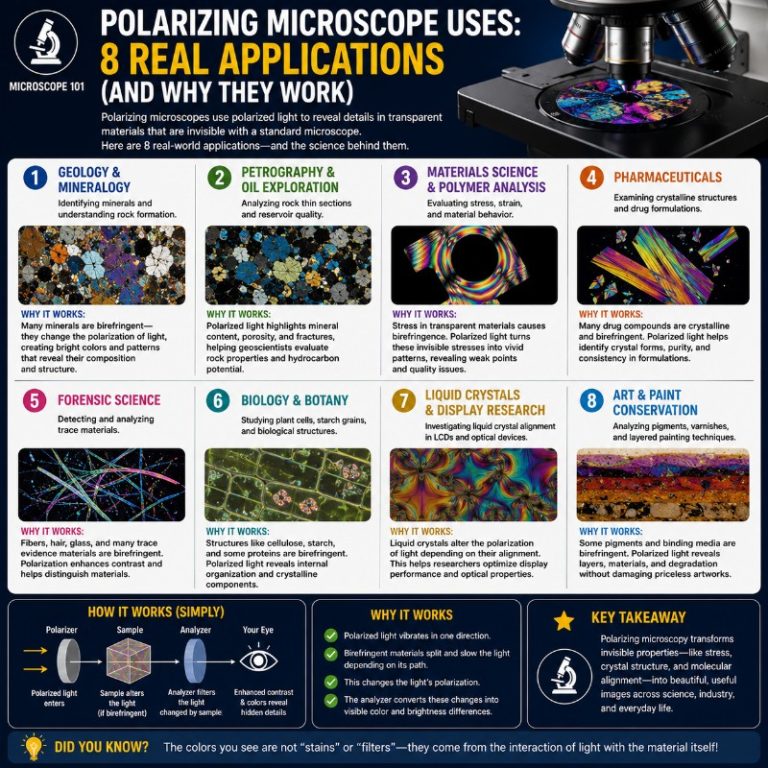
A polarizing microscope is a specialized compound microscope fitted with two crossed polarizing filters and a rotating stage, purpose-built to examine birefringent materials — substances that split light into two rays — which glow with vivid interference colors against a pitch-black background that a standard brightfield microscope simply cannot produce. Understanding polarizing microscope uses matters because almost every field from geology and pharmaceuticals to forensic science and medicine depends on this exact technique to identify and characterize materials that look identical under ordinary light.
What a Polarizing Microscope Is Used For (Applications at a Glance)
Before diving into the mechanism, here is the complete picture: eight distinct fields where polarized light microscopy does work nothing else can replicate.
| Field | What Is Examined | Why Polarized Light Is Needed |
|---|---|---|
| Geology / Mineralogy | Rock thin sections (30 µm) | Minerals identified by interference colors, extinction angle, interference figures |
| Materials Science | Metals, alloys, ceramics | Grain structure and anisotropy in reflected light |
| Polymers / Plastics | Plastic parts, films, fibers | Stress fringes, molecular orientation, spherulite pattern |
| Pharmaceuticals | Drug crystals, powders | Polymorph ID, crystallinity vs amorphous content |
| Forensic Science | Fibers, soil, asbestos | Regulated PLM method for fiber type and asbestos identification |
| Biology / Medicine | Joint fluid, tissue sections | Gout vs pseudogout crystals, amyloid, starch, collagen |
| Gemology | Gemstones | Isotropic vs anisotropic, real vs synthetic, pleochroism |
| Semiconductors / Electronics | Silicon wafers, LCD glass | Mechanical stress detection, thin-film defect inspection |
Each of these applications rests on the same optical phenomenon. The next section explains it so the rest of the article makes immediate sense.
How a Polarizing Microscope Works (Why Polarized Light Reveals More)
Ordinary light vibrates in every plane simultaneously. A polarizing microscope controls that chaos with two filters and exploits how certain materials interact with single-plane light.
The polarizer (mounted below the stage) transmits only light vibrating in one plane — “plane-polarized light.” A second filter, the analyzer, sits above the objectives and is set at exactly 90° to the polarizer. Swap in a blank slide with both filters in place and the field goes inky black — a switched-off screen. That darkness is the baseline. Everything that happens on top of it is the signal.
Birefringent vs Isotropic Materials (What Glows, What Stays Dark)
Here is where it gets interesting. Most people’s first reaction at the microscope is that the empty field goes completely black and they assume something is wrong. Then they slide in a piece of rock thin section and blocks of electric blue, magenta, and gold light up like stained glass.
Birefringent (anisotropic) materials have two different refractive indices along different crystallographic axes. They split incoming polarized light into two rays traveling at slightly different speeds. These rays recombine with a phase difference when they exit the sample, rotating the polarization state so a component now passes through the analyzer — and the sample glows with color.

Isotropic materials — cubic crystals like table salt (halite), unstressed glass, and most simple liquids — have only one refractive index. They do not split light. Under crossed polars they stay dark at every rotation angle. This is not a failure; it is a diagnostic result. Checking the salt vs sugar crystals side by side is the cleanest demonstration: rotate the stage a full 360° and the salt crystal never leaves black while the sugar crystal blazes through shifting pastels and neon bands.
The interference colors you see (called Michel-Lévy colors) depend on sample thickness and the strength of birefringence. Petrographers use a Michel-Lévy chart to map these colors back to actual birefringence values — a critical mineral identification tool.
The Key Parts That Make It a “Polarizing” Microscope
Several components distinguish a true polarizing scope from an ordinary compound microscope. The parts of a microscope that matter here are:
- Polarizer and analyzer — the crossed filter pair. The analyzer usually slides in and out on a drawer so you can switch between plane-polarized and crossed-polar observation.
- Rotating circular stage — graduated in degrees for a full 360°, essential for measuring extinction angles and tracking color changes through rotation.
- Strain-free objectives and condenser — ordinary optics introduce their own weak birefringence that pollutes the dark field. Polarizing-grade optics are manufactured to eliminate this. For casual observation any scope works; for quantitative measurements, strain-free optics are non-negotiable.
- Bertrand lens — inserted into the optical path to view conoscopic interference figures — patterns that reveal whether a crystal is uniaxial or biaxial and its optic sign. Advanced mineralogy territory, but worth knowing it exists.
- Compensators / retardation plates — the most important is the first-order red (lambda) plate, which adds a known retardation to push faint gray samples into vivid color and to determine the sign of birefringence. A blue shift means one thing, a yellow shift means the opposite — and that distinction matters for gout diagnosis.
Transmitted vs Reflected (Incident) Polarized Light
Most polarizing microscopes use transmitted light — light passes up through the stage, through the (usually transparent or thinly prepared) sample, and into the objectives. Geology, pharmaceuticals, forensics, and biology all work in transmitted light.
A reflected-light (incident) polarizing microscope bounces light off an opaque surface — the same geometry used in a metallurgical microscope. This is the setup for examining metal grain structure, ore minerals, and semiconductor wafers that cannot be made transparent.
Geology and Mineralogy
This is where polarizing microscopy was born, and it remains the technique’s defining application. Petrographic thin sections — slices of rock ground and polished to a standard 30 micrometers (0.03 mm) thickness and mounted on a glass slide — allow transmitted light to pass through minerals that look like opaque rock in hand sample.
At 30 µm, most rock-forming minerals hit their characteristic interference color range. Calcite produces blazing high-order whites and yellows. Quartz gives first-order grays and white. Olivine glows in vivid second-order colors. Mica crystals flash through brilliant blues and greens. A skilled petrographer reads these colors the way a sommelier reads wine — interference color plus extinction angle plus pleochroism plus interference figure narrows identification to a single mineral species.
The technique dates to William Nicol (inventor of the Nicol prism polarizer) and Henry Clifton Sorby, who in the 1850s first made thin sections of rocks. Every igneous, sedimentary, and metamorphic petrology course since has run on this platform.
A common beginner mistake: looking at a mineral once and not rotating the stage. The four-point extinction — a crystal going dark exactly four times in a 360° rotation — is one of the most diagnostic behaviors in mineralogy. If you never rotate, you miss it entirely. Rotate a full slow 360° every time you examine a new grain; the color sequence and the extinction positions are the data.
For related context on mineral grains from a hobbyist angle, sand grains under a microscope shows what ordinary beach sand looks like when the optics are set up correctly.
Materials Science and Metallography
In materials science and metallurgy, a polarizing microscope run in reflected-light mode reveals grain structure in anisotropic metals — metals whose crystal grains orient differently and therefore respond to polarized light differently. Aluminum alloys, titanium, copper, and many ceramics show clear grain contrast under reflected polarized light that etching alone cannot always produce.
The technique overlaps substantially with the reflected-light metallurgical microscope. Ceramics and composite materials with anisotropic crystal phases also benefit. In failure analysis, polarized reflected light spots regions of localized stress or anomalous grain orientation that correlate with crack initiation sites — information the engineer needs before post-mortem etching destroys the evidence.
Polymers and Plastics
Place a stressed transparent plastic part — a polycarbonate lens, a corner of a CD case, the shank of a plastic fork near the tines — between crossed polars. The stressed regions explode into rainbow fringe patterns crowded around stress concentrations and near holes where fasteners grip. Engineers call this photoelastic stress analysis, and it visualizes internal stress distribution that no dye or surface technique can reveal.
At the micro scale, semi-crystalline polymers (polyethylene, polypropylene, nylon, PET) crystallize from the melt in spherical domains called spherulites. Each spherulite displays a characteristic Maltese cross pattern — four dark arms aligned with the polarizer directions, a bright disc between them — because the polymer chains radiate outward and the birefringence direction rotates continuously around the center. The same Maltese cross pattern appears in starch granules (see biology section below).
Polymer film manufacturers use polarized light to check molecular orientation: a stretched film becomes birefringent and the degree of birefringence correlates with draw ratio. In quality control of injection-molded parts, residual stress frozen into the part during cooling shows up immediately under crossed polars — non-destructively, before the part has been put into service.
Pharmaceuticals
Many active pharmaceutical ingredients (APIs) exist as more than one crystal form, a phenomenon called polymorphism. Different polymorphs of the same drug molecule can have dramatically different solubility, bioavailability, and stability — which translates directly to clinical efficacy. Polarized light microscopy is a standard tool in pharmaceutical solid-state characterization because birefringent crystals reveal their crystal form through interference color and morphology, while amorphous material (which has no crystal lattice) stays dark under crossed polars like an isotropic material.
A drug powder that should be amorphous for fast dissolution but contains birefringent crystalline particles signals a manufacturing problem. A polymorph switch in a batch — Form I to Form II — may show subtly different interference color or habit under polarized light, flagging a QC problem before dissolution testing. Contamination particles and excipient crystals are also identifiable by their birefringent behavior.
Pharmaceutical polarizing microscopy is typically paired with hot-stage microscopy (observing melting behavior under polarized light) and spectroscopic methods, but polarized light is often the first screen — fast, non-destructive, and visually unambiguous.
Forensic Science
Forensic fiber analysis under polarized light is one of the technique’s highest-stakes applications. Natural fibers (cotton, wool, silk) and synthetic fibers (nylon, polyester, acrylic) differ in birefringence strength and sign. A single fiber recovered from a crime scene can be compared to a reference fiber from a suspect’s clothing — the birefringence value, extinction behavior, and interference color narrow the fiber type and sometimes the specific product.
Soil comparisons use the same principle: mineral grains in soil samples have characteristic optical properties that can tie a soil smear on a shoe to a specific geographic location.
The most regulated forensic use is asbestos identification. The U.S. EPA and NIOSH both specify Polarized Light Microscopy (PLM) as a primary reference method for identifying asbestos fiber types in bulk samples — chrysotile, amosite, crocidolite, tremolite, actinolite, and anthophyllite are distinguished by morphology, birefringence, sign of elongation, and dispersion staining color. PLM asbestos analysis is performed by accredited laboratories under strict protocols; asbestos-containing materials are hazardous and regulated — this is not a hobbyist application, and sampling should never be attempted outside of a properly equipped, licensed facility.
Biology and Medicine
Polarized light microscopy has a specific and important role in clinical diagnosis — and this section describes how qualified clinicians use the technique, not a guide for self-diagnosis. Crystal identification in joint fluid and tissue is performed by pathologists and rheumatologists in accredited laboratory settings.
The most clinically significant application is crystal arthropathy diagnosis. When joint (synovial) fluid is collected and examined under polarized light with a first-order red compensator inserted:
- Gout (monosodium urate crystals): needle-shaped crystals that are negatively birefringent — they appear yellow when aligned parallel to the compensator’s slow axis and blue when perpendicular. The needle shape and negative birefringence together are the diagnostic signature.
- Pseudogout / CPPD (calcium pyrophosphate dihydrate crystals): rhomboid or rod-shaped crystals that are positively birefringent — blue when parallel to the slow axis, yellow when perpendicular. The shape and the opposite color shift distinguish CPPD from urate.
Getting this right requires noting crystal orientation relative to the compensator before reading the color — the color is the diagnosis, and it depends on direction. This information is educational; diagnosis is performed by qualified medical professionals.
Amyloid — abnormal protein deposits found in amyloidosis, Alzheimer’s disease plaques, and other conditions — has a diagnostic hallmark under polarized light: tissue sections stained with Congo red dye show apple-green birefringence under crossed polars, a result specific to the cross-beta sheet structure of amyloid fibrils. This apple-green color under polarized light remains a gold-standard histopathology criterion.
Other biologically relevant structures visible under polarized light include:
- Starch granules — the Maltese cross pattern from their radially organized crystalline structure (the same geometry as polymer spherulites)
- Collagen fibers — positively birefringent; stained with picrosirius red, different collagen types show different colors under polarized light
- Bone and calcified tissue — anisotropic, shows lamellar structure clearly
- Muscle fibers and plant cell walls (cellulose) — both birefringent, useful in botanical and food science microscopy
Gemology
A gemologist’s polarizing microscope (or a polariscope, a simplified version of the same concept) answers a fundamental question: is this stone isotropic or anisotropic? Cubic gemstones — diamond, garnet, spinel, glass imitations — are isotropic and stay dark under crossed polars at all orientations. Doubly refractive stones — sapphire, ruby (hexagonal), tourmaline, topaz (orthorhombic) — show birefringence.
Pleochroism — the property of appearing different colors along different crystal axes under plane-polarized light (analyzer removed) — is a direct identification tool. Tanzanite shows blue, violet, and burgundy in three axes. Alexandrite changes from green to red. Under polarized light these shifts are systematic and measurable, not just aesthetic.
Distinguishing natural stones from synthetic ones sometimes comes down to internal stress birefringence: synthetic stones grown under certain methods show anomalous strain birefringence patterns not present in natural crystals, and glass imitations are isotropic — dead black under crossed polars where the real stone would show color.
Semiconductor and Electronics Inspection
Silicon — pure, single-crystal — is actually cubic and therefore isotropic. But mechanical stress applied to silicon (from clamping, thermal cycling, or thin-film deposition) causes strain that breaks the cubic symmetry locally, introducing measurable birefringence called stress birefringence. This is detectable under a reflected-light polarizing microscope.
Semiconductor manufacturers use polarized reflected light to map stress distributions across silicon wafers, identify defect clusters, and inspect the uniformity of thin films. In LCD glass manufacturing, stress birefringence in the substrate creates display defects — polarized light inspection catches non-uniform glass before it reaches assembly. The technique is fast, non-contact, and non-destructive — important properties when inspecting expensive wafers at production scale.
Frequently Asked Questions
What is birefringence in simple terms?
Birefringence means a material has two different refractive indices along different directions — it bends light differently depending on which way the light is oriented. When polarized light enters a birefringent material, it splits into two rays traveling at different speeds. These rays recombine with a phase difference when they exit, producing color under crossed polarizing filters. Non-birefringent (isotropic) materials only have one refractive index and stay dark.
Can a regular microscope be converted to a polarizing microscope?
Yes, with limitations. You can tape or clip two pieces of polaroid film — one below the stage and one above the objective — and rotate one until the background darkens. You will see birefringence glow in obvious samples like quartz grains, sugar crystals, and stressed plastic. However, standard objectives are not strain-free; they introduce their own weak birefringence that you cannot eliminate. This works fine for demonstration and exploration, but the results are not reliable enough for quantitative measurement. For accurate extinction angles, optic sign determination, or any forensic/pharma result, you need a true polarizing microscope with strain-free optics.
What are the polarizer and analyzer in a microscope?
The polarizer is a filter placed below the stage (between the light source and the sample) that transmits only light vibrating in one plane. The analyzer is a second identical filter placed above the objectives (in the tube between objective and eyepiece), oriented at 90° to the polarizer — “crossed.” Together, they create the dark background that birefringent samples light up against. The analyzer usually slides in and out so you can switch between plane-polarized observation (analyzer out) and crossed-polar observation (analyzer in) without removing it.
How much does a polarizing microscope cost?
Entry-level polarizing microscopes for educational and hobbyist use start around $200–$500; these include polarizer, analyzer, and rotating stage but use standard rather than strain-free optics. Mid-range laboratory models suitable for mineralogy courses and pharmaceutical QC run $1,500–$5,000. Research-grade petrographic microscopes with strain-free objectives, Bertrand lens, full compensator set, and photographic capability start at $5,000–$10,000 and scale up significantly for advanced conoscopy or automated systems. Gemological polariscopes (simplified single-purpose instruments) are available for $50–$300.
Why does my birefringent sample stay dark when I look at it?
Two common reasons. First, the sample may be sitting at an extinction position — the crystal axes are aligned exactly with the polarizer or analyzer, so the dark result is correct. Rotate the stage a few degrees and it should light up. Second, the material may actually be isotropic (cubic crystal or amorphous), in which case it correctly stays dark at every rotation angle. A third possibility: the polars are not fully crossed. With no sample in place, rotate the polarizer until the field reaches its absolute darkest — that confirms your polars are properly crossed before you test any sample.
Is a polarizing microscope the same as a phase contrast or DIC microscope?
No — all three are contrast enhancement techniques, but the mechanisms are completely different. Dark field microscopy blocks direct light so only scattered light forms the image. Phase contrast converts phase shifts (invisible) to amplitude differences (visible). DIC (differential interference contrast) uses a beam splitter and Wollaston prisms to generate contrast from gradients in optical path length. Polarizing microscopy specifically exploits birefringence — the optical anisotropy of crystalline materials — to produce interference colors. The diagnostic information each technique provides is distinct; polarizing microscopy is the only one that measures birefringence strength and sign.
What is the difference between a polarizing microscope and a regular compound microscope?
A polarizing microscope is a specialized compound microscope — it uses the same lens-and-illumination architecture as a standard compound microscope. What sets it apart are the crossed polarizing filters (polarizer below stage, analyzer above objectives), the graduated rotating stage, strain-free objectives, and optionally a Bertrand lens and compensators. A standard brightfield compound microscope can view bacteria, cells, and stained slides — but it cannot reveal birefringence, interference colors, extinction behavior, or optical sign, because none of those phenomena are accessible without controlled polarization. Think of it as a compound microscope that has been given an entirely new sensory channel.
Conclusion
A polarizing microscope turns a fundamental optical property — birefringence — into a diagnostic tool that spans geology, medicine, forensic science, materials engineering, and more. The core principle is elegant: crossed filters make the field dark, and only anisotropic materials break that darkness with color. That one physical fact drives mineral identification from rock thin sections, crystal arthropathy diagnosis in joint fluid, asbestos identification in forensic labs, stress mapping in silicon wafers, and polymorph screening in pharmaceutical QC. The range of microscope types is wide, but the polarizing microscope occupies a uniquely quantitative niche — because the colors it produces are data, not just beauty.
Have you used a polarizing microscope yourself, or improvised one with polaroid film to look at sugar crystals or stressed plastic? We would love to hear what you found — share your results or questions in the comments below.
Originally posted 2026-06-20 06:37:11.