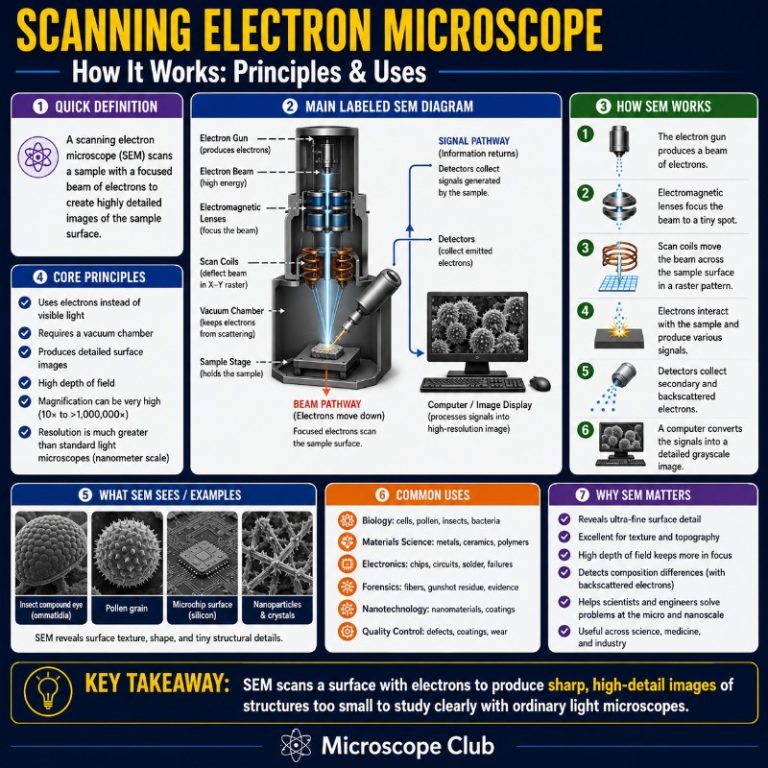
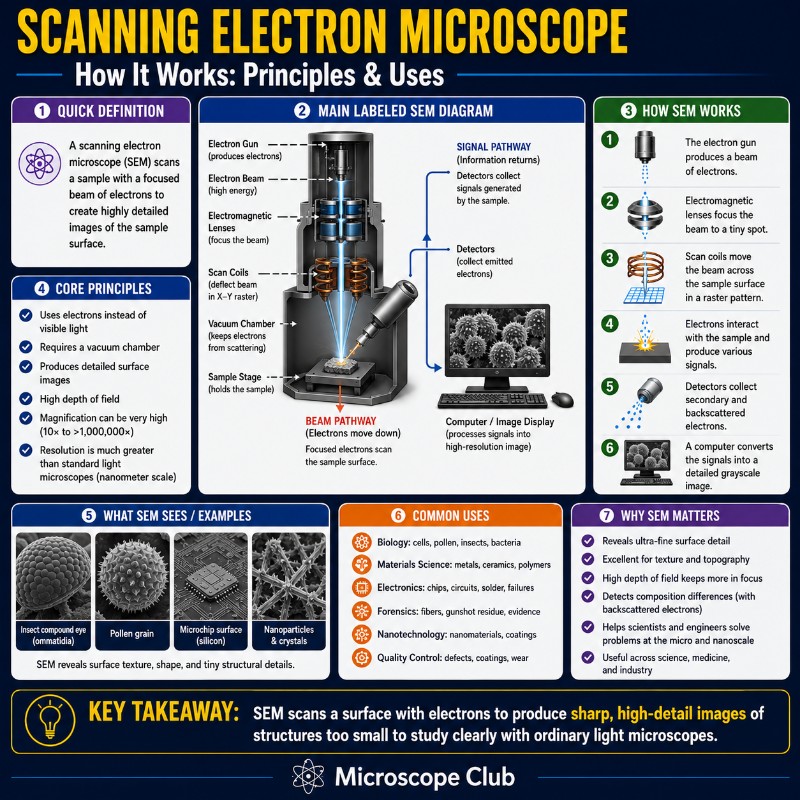
A scanning electron microscope (SEM) works by firing a focused beam of electrons across a sample’s surface in a precise grid, collecting the electrons that bounce or scatter off at each point, and mapping their intensity into a pixel-by-pixel grayscale image — all inside a high-vacuum chamber. That process delivers resolution of roughly 1–10 nanometers: thousands of times sharper than any light microscope. This article walks through the full principle chain — from the electron gun to the final image — and explains what each stage actually does and why.
From Electron Gun to Image: How an SEM Works
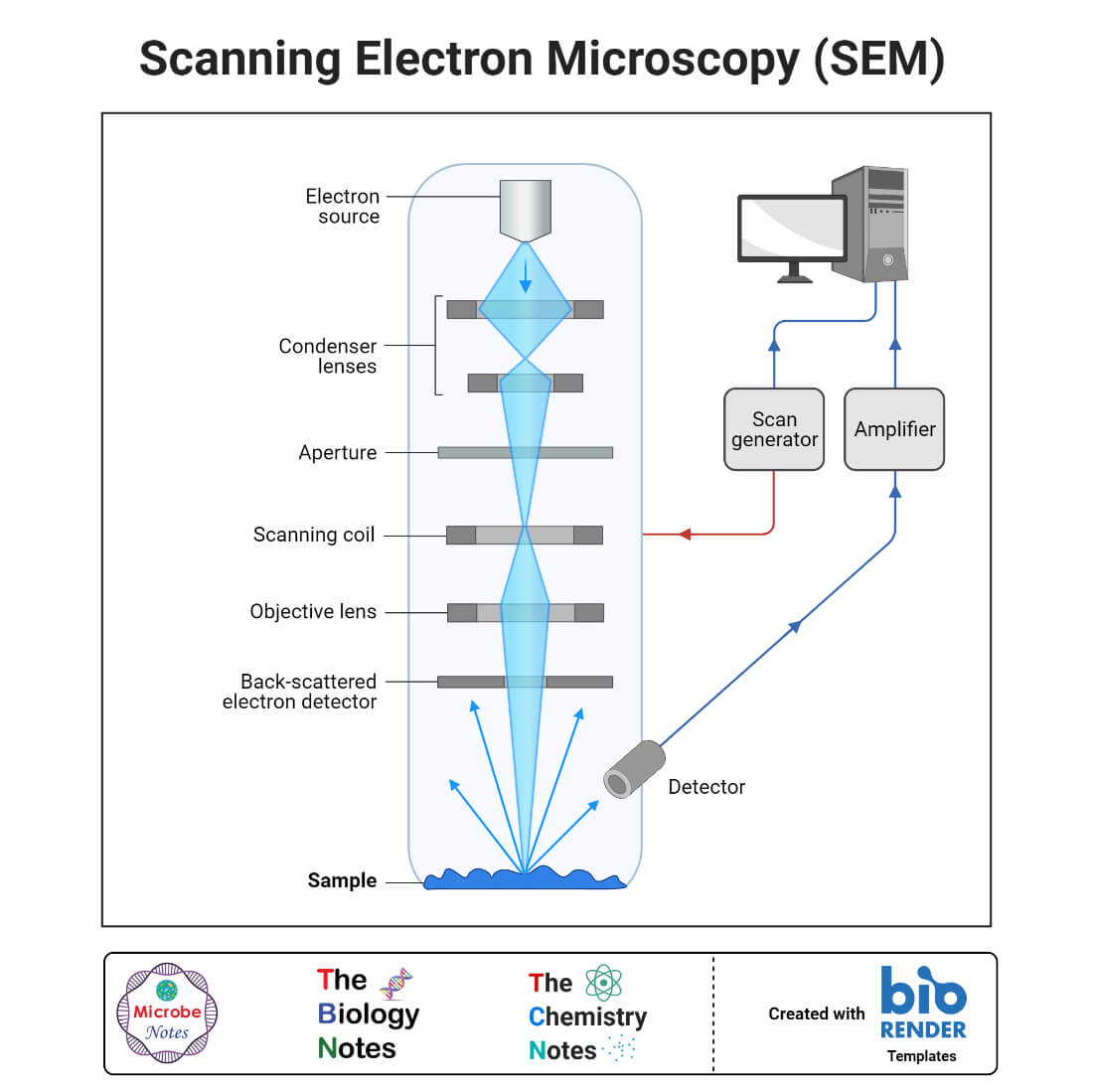
The SEM’s operation follows a clean sequence: generate electrons → accelerate and focus them into a tiny probe → raster that probe across the sample → collect the emitted signals → build the image. Here is each stage in detail.
- Electron gun emits electrons. At the top of the column, an electron gun generates the beam.
- Accelerating voltage boosts the electrons. A high voltage (typically 1–30 kV) accelerates them down the column. Higher voltage means shorter wavelength and more penetrating power, but also more risk of damaging delicate samples.
- Electromagnetic lenses focus the beam into a probe. A series of magnetic coils — not glass lenses — demagnify and focus the beam into a spot just a few nanometers wide at the sample surface.
- Scan coils raster the probe across the sample. Deflection coils sweep the focused spot in a grid pattern, line by line, exactly like an old cathode-ray television drawing a picture.
- The beam interacts with the sample. At each point the electrons penetrate a small teardrop-shaped region beneath the surface, generating multiple signals: secondary electrons, backscattered electrons, and characteristic X-rays.
- Detectors map signal to pixels. A detector collects the signal intensity at each grid point. That intensity value sets the brightness of the corresponding pixel on the monitor. Scan the whole grid, and you have a complete image.
The entire image is built point-by-point — there is no instant snapshot the way a camera captures a scene. Patience is part of the SEM workflow: a slow scan produces a clean, publication-quality image; a fast scan lets you navigate quickly but looks noisier.
The Electron Gun and Accelerating Voltage
Two gun types dominate modern SEMs. Thermionic guns heat a tungsten filament or a lanthanum hexaboride (LaB₆) crystal until electrons boil off — straightforward and affordable, but the beam is relatively broad. Field-emission guns (FEG) use a sharp tungsten tip under an intense electric field to pull electrons out without heating. The result is a much brighter, finer beam and substantially better resolution (~0.5–1 nm on high-end FEG-SEMs). If you see “FEG-SEM” or “FESEM” in a paper, that’s the instrument type — the higher-performance variant.
Accelerating voltage is a lever the operator adjusts per sample. Delicate biological tissue or polymer films often need 1–5 kV to avoid beam damage; metals and ceramics tolerate 10–30 kV and benefit from the deeper signal. Crank the voltage too high on a soft sample and you will watch it shrink, blister, or crack in real time — one of the first hard lessons SEM operators learn.
Electromagnetic Lenses and Scan Coils
Unlike light microscopes, an SEM has no glass optics. Its “lenses” are precisely wound copper coils carrying a controlled current; the magnetic field they generate bends the electron beam inward, focusing it just as a glass lens bends light. The condenser lens (or lenses) shapes the beam’s convergence; the objective lens makes the final, tightest focus just above the sample. Apertures at each stage block stray electrons at the edges, reducing aberrations. Getting the probe as small as possible — and keeping it stable — is what drives spatial resolution.

Immediately below the objective lens, the scan coils tilt the beam left-right and up-down in synchronized steps. The speed and step size define the image’s pixel count and field of view. This is the “scanning” in SEM, and it distinguishes the instrument fundamentally from a TEM, where no scanning occurs.
Building the Image Pixel by Pixel
When you look at an SEM image on the operator’s monitor, you are seeing a live grayscale feed — not an eyepiece view. Surfaces have a strikingly sculptural quality: a pollen grain looks like a spiky sea-mine, an insect compound eye resolves into a perfect field of hexagonal domes, a metal fracture surface reads like a miniature cliff face. The apparent “lighting” — the way shadows fall and ridges catch highlight — is not from any light source. It comes from the geometry of how electrons escape upward toward the detector. High ridges and edges facing the detector send more electrons that way and appear brighter; pits and shadowed faces send fewer and appear darker. The effect is convincingly three-dimensional even though no 3D rendering software is involved.
All SEM images are intrinsically grayscale. Brightness equals signal strength — nothing more. The famous colored SEM images of pollen, bacteria, and insects that you see in textbooks and on magazine covers are grayscale originals that someone colorized afterward in Photoshop or similar software. At the instrument itself, everything is gray.

Why Electrons Instead of Light
Resolution in any microscope is ultimately limited by the wavelength of whatever illuminates the sample — a principle captured by the Abbe diffraction limit. Visible light sits between roughly 400–700 nm in wavelength, which is why the best optical microscopes resolve features down to about 200 nm and achieve useful magnification around 1,000–1,500×. That’s a hard physical ceiling — you cannot resolve smaller features by building a better light microscope; the wavelength itself is the obstacle.
Electrons carry a de Broglie wavelength that depends on their momentum: λ = h/p. Accelerated through 10–30 kV, an electron’s wavelength drops into the picometer range — roughly 7–12 pm, or about 10,000 times shorter than visible light. That is why an SEM can, in principle, resolve features in the nanometer range, and why it delivers magnification up to ~500,000× (some instruments reach 1,000,000×+).
One important nuance: the electron wavelength is so short that it is no longer the limiting factor in SEM resolution. The real limits are the probe diameter (how tightly the lenses can focus the beam) and the interaction volume (the teardrop-shaped region in the sample where the beam spreads before generating a signal). A sub-nanometer wavelength does not translate to sub-nanometer SEM images for this reason. For a deeper look at how wavelength and other factors interact, see our article on how wavelength sets resolution, and for a side-by-side breakdown of electron microscopes vs light microscopes.
Why an SEM Needs a Vacuum
The entire column and sample chamber are evacuated to a high vacuum — typically around 10⁻⁵ to 10⁻⁶ mbar. There are three reasons this is non-negotiable:
- Beam integrity: air molecules would scatter and absorb the electron beam before it ever reached the sample, blurring the probe into uselessness.
- Filament longevity: a hot tungsten filament oxidizes and burns out almost instantly in air; vacuum protects it.
- Detector and column cleanliness: contamination from atmospheric moisture or hydrocarbons would degrade performance over time.
The practical consequence is that you cannot just swap samples quickly. Every time you open the chamber, air floods in; the pump must evacuate it again before imaging can start — typically a few minutes of waiting per sample change. It’s a deliberate, patient instrument.
One important exception: Environmental SEM (ESEM) and variable-pressure SEM allow the sample chamber to operate at much lower vacuum — just a few hundred pascals — by using differential pumping to isolate the column. This makes it possible to image wet, hydrated, and non-conductive samples without coating them, which has been transformative for biological and geological work.
Secondary vs. Backscattered Electrons: What Each Signal Reveals
The beam-sample interaction produces several signal types, but two dominate everyday SEM imaging. Understanding the difference is what separates a novice operator from a competent one.
| Signal | Energy | Origin | What it tells you |
|---|---|---|---|
| Secondary electrons (SE) | <50 eV (low) | Loosely bound electrons knocked from surface atoms; escape only from the top ~5 nm | Surface topography — crisp 3D-looking texture. High resolution. |
| Backscattered electrons (BSE) | High (close to beam energy) | Primary beam electrons elastically bounced back from deeper in the sample | Compositional contrast — yield scales with atomic number (Z). Heavier elements appear brighter. Lower spatial resolution than SE. |
A useful mental shortcut: SE = shape (surface topography), BSE = substance (composition). In practice, an experienced operator starts with SE to understand what the surface looks like, then switches to BSE the moment a question of “what is this feature made of?” arises — heavy inclusions in an alloy will pop bright against a dark matrix in the BSE image, instantly flagging their presence before EDX confirms the elements.
SE are collected by the Everhart-Thornley detector (a scintillator-plus-photomultiplier device that draws low-energy SEs toward it with a positive bias). BSE detectors are typically annular semiconductor devices mounted directly below the objective lens, positioned to catch the high-energy electrons bouncing straight back.
EDX — Reading a Sample’s Elements
The beam does more than knock out electrons. When it ejects an inner-shell electron from a sample atom, the atom relaxes by filling the vacancy from a higher shell — and emits an X-ray photon at an energy that is unique to that element. An energy-dispersive X-ray (EDX or EDS) detector reads these photons and produces a spectrum of peaks, each one identifying a specific element present in the interaction volume.
This turns the SEM into a chemical fingerprint tool, not just an imager. You can collect EDX spectra from a spot, a line, or an entire map — the map colors each pixel by elemental composition, overlaid on the SE image. Forensic applications exploit this heavily: gunshot residue analysis identifies lead, barium, and antimony particles under SEM-EDX with high specificity. In materials science, it tells you whether a bright BSE inclusion is titanium carbide or tungsten — information the SE image alone cannot give you.
Preparing a Sample for the SEM
Three requirements govern every sample: it must be dry (liquids boil in the vacuum), vacuum-stable (no outgassing materials that would contaminate the column), and electrically conductive (or made so). The conductivity rule trips up beginners most often.
If a non-conductive sample — a polymer, a mineral, a dried insect, biological tissue — is placed in the SEM uncoated, the beam charges the surface because electrons can’t drain away. The result is vivid moving bright streaks and washed-out white glare that completely obscures surface detail. The fix is sputter-coating: depositing a thin (3–10 nm) layer of gold, gold-palladium, or carbon onto the surface using a benchtop coater. Carbon coating is preferred when EDX analysis is planned (gold X-ray peaks can interfere); gold-palladium gives excellent SE contrast for morphology work.
Biological samples face a second challenge: removing all the water while preserving structure. Air-drying collapses cell membranes; the standard solution is critical-point drying, which transitions the sample from liquid to gas through the supercritical CO₂ state, avoiding surface-tension collapse entirely. Tissue is also fixed chemically (glutaraldehyde, osmium tetroxide) before drying to lock its structure in place. The Royal Microscopical Society publishes detailed guidance on SEM biological preparation protocols for those wanting to go deeper.
Beam damage is a real hazard. Dwell the beam too long on a polymer or biological specimen and you will see it shrink, crack, or develop a dark burn square — a contamination patch from carbon deposited by the beam polymerizing residual hydrocarbons. Keep voltage low, beam current modest, and don’t linger.
SEM vs. TEM: What’s the Difference
The SEM is frequently confused with the transmission electron microscope (TEM), but the two instruments differ fundamentally in geometry, sample requirements, and the information they provide.
| SEM | TEM | |
|---|---|---|
| Beam interaction | Scans across the surface; collects emitted/reflected electrons | Transmitted through an ultra-thin section |
| Image type | Surface topography, 3D-looking, grayscale | 2D internal structure / projection |
| Resolution | ~1–10 nm | ~0.05–0.2 nm (atomic columns visible) |
| Sample | Surface of bulk sample; coated if non-conductive | Ultra-thin sections (<~100 nm) |
| Magnification | ~10× to ~500,000× | Up to ~50,000,000× |
| Best for | Surface morphology, composition (BSE), elemental mapping (EDX) | Internal/atomic structure, crystallography |
The key conceptual split: an SEM images the outside of a sample with exceptional 3D fidelity; a TEM images the inside of an ultra-thin slice at atomic resolution. A materials scientist investigating a fracture surface reaches for the SEM; one trying to resolve the crystal lattice of a nanoparticle reaches for the TEM. To understand the broader landscape of instrument options, see our overview of the main types of microscopes and our breakdown of the advantages and disadvantages of electron microscopes.
What SEMs Are Used For
The combination of nanometer-scale resolution, large depth of field, and simultaneous elemental analysis (via EDX) makes the SEM versatile across many fields.
- Materials science and metallurgy: fracture surface analysis (fractography), grain structure, corrosion products, coatings, nanomaterial morphology. A fractographer can read a metal failure’s cause — fatigue, brittle fracture, ductile overload — from the texture of the fracture face.
- Semiconductor and electronics manufacturing: inspecting chip features, measuring critical dimensions on wafers (CD-SEM), defect analysis. Modern chip fabrication at single-digit nanometer nodes depends on SEM metrology at every production step.
- Biology and life science: surface ultrastructure of cells, viruses, bacteria, pollen, and insects. The iconic spiky-pollen and compound-eye images that appear in science books are almost always SEM images — colorized after the fact.
- Forensic science: gunshot residue (GSR) identification via SEM-EDX; fiber and paint analysis; counterfeit document examination; trace evidence in criminal investigations.
- Geology and earth science: mineral identification, microfossil characterization, sediment particle analysis, clay mineralogy.
- Quality control and failure analysis: pharmaceuticals (particle size and morphology), aerospace components, polymer research, nanotechnology development.
For visual examples of what all this looks like in practice, see real electron microscope images from across these fields.
Frequently Asked Questions
What magnification can an SEM achieve?
Most SEMs operate usefully from about 10× up to 500,000×; high-end field-emission instruments can push past 1,000,000× in favorable conditions. For context, the best optical microscopes top out around 1,000–1,500× before diffraction limits the image. For a full comparison of the highest-resolution microscopes, including how SEM stacks up against other instruments, see our dedicated article.
Are SEM images really gray, or do they show actual color?
They are truly and intrinsically grayscale. Brightness in an SEM image represents signal intensity — the number of electrons reaching the detector — not color. All “colored” SEM images, including the ones in textbooks and news articles, were colorized afterward using image-editing software. At the instrument, every image is gray, regardless of what material you’re looking at.
Do you always have to coat samples before putting them in an SEM?
Only if the sample is non-conductive. Metals and most semiconductors go in uncoated. Plastics, minerals, ceramics, and biological specimens need sputter-coating (gold, gold-palladium, or carbon — typically 3–10 nm thick) to prevent charge buildup. Alternatively, you can use low-voltage mode (<1 kV) or variable-pressure/ESEM mode, which allows uncoated non-conductive samples without coating at the cost of some resolution.
How much does an SEM cost?
Entry-level desktop SEMs start around $70,000–$100,000. Research-grade floor-standing instruments typically run $250,000–$700,000. High-end FEG-SEMs with EDX and multiple detectors can exceed $1,000,000. For a fuller breakdown, see our article on how much an electron microscope costs.
Why does my SEM image look blurry or stretched?
The most common culprit is astigmatism — a slight asymmetry in the magnetic lens field that focuses the beam more strongly in one direction than another, making circular features look elliptical and fine details look smeared. The fix is stigmation correction, using the instrument’s stigmator controls. Always focus and correct astigmatism at the highest planned magnification, then zoom out; doing it at low magnification masks the problem until you try to go high.
Can an SEM image living or wet samples?
Standard SEMs cannot — the high vacuum would instantly boil off water and collapse wet structures. Environmental SEM (ESEM) is the exception: it operates the sample chamber at reduced pressure (a few hundred pascals) using differential pumping, allowing hydrated, living, or insulating samples to be imaged with minimal preparation. Resolution is somewhat lower than high-vacuum SEM, but the ability to image uncoated, wet materials makes ESEM invaluable for certain biological and geological work.
What’s the difference between magnification and resolution in an SEM?
Magnification tells you how much larger the image appears compared to the object; resolution tells you the smallest feature that can be distinguished as separate. You can magnify any image digitally without gaining new detail — what matters is resolution. An SEM might display an image at 100,000× magnification but only resolve features down to ~5 nm; zooming further just enlarges blur. For a thorough explanation, see our article on the difference between magnification and resolution.
Conclusion
The scanning electron microscope achieves its remarkable imaging power through a chain of precisely engineered steps: a focused electron probe, swept point-by-point across a sample in vacuum, generates secondary and backscattered electrons that detectors translate into a high-resolution grayscale image. Secondary electrons reveal surface texture with stunning three-dimensional fidelity; backscattered electrons expose compositional differences; and EDX layers on elemental chemistry — all from a single instrument. Practical resolution of 1–10 nm, magnification into the hundreds of thousands, and the ability to analyze almost any dry solid sample explain why the SEM has become indispensable across materials science, semiconductor manufacturing, biology, forensics, and geology.
Have you used an SEM yourself, or seen SEM images that stopped you in your tracks? Tell us what you found — or what confused you — in the comments below. And if you’re curious how the SEM’s resolution compares to other instruments, check out our article on imaging individual atoms.