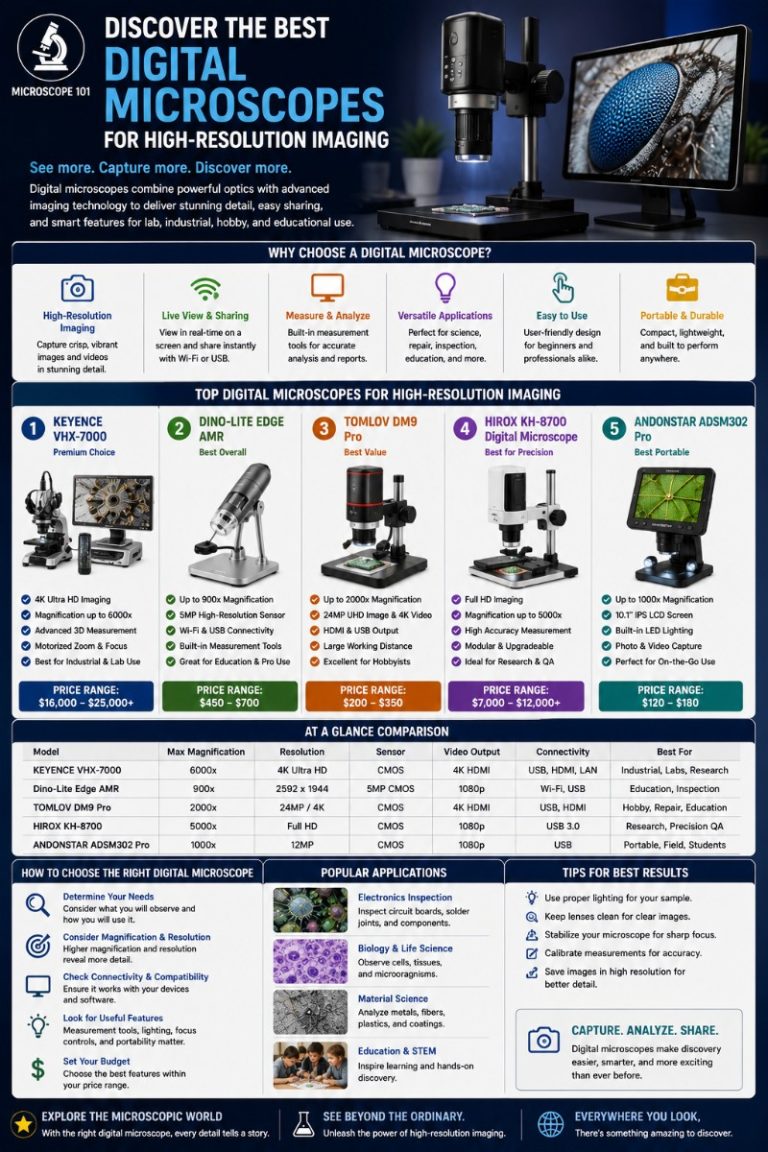
The best digital microscopes combine a high-resolution camera with either a built-in LCD screen or direct USB-to-PC connectivity, letting you examine circuit boards, error coins, biological slides, and natural specimens without squinting through a narrow eyepiece. Standalone LCD models work completely independently of a computer, while USB-connected designs leverage your existing monitor for a larger, brighter live view. Whether you are a hobbyist cataloguing coin varieties, a teacher setting up a classroom demonstration, or a technician doing SMD rework, the right digital microscope matches its screen size, magnification range, and connectivity options to your specific workflow.
What to Look for in a Digital Microscope
Screen size is the first spec to evaluate. Built-in displays run from 4 inches on pocket-portable handhelds up to 10.1 inches on professional desktop units. Larger screens reduce eye strain during long inspection sessions and make it easier to share a view with a second person seated beside you.
Magnification range matters more than the top number. Most hobbyist models cover 50X–1200X through a combination of optical and digital zoom. Electronics technicians doing fine-pitch soldering typically need at least 200X at comfortable working distance; coin collectors benefit from 50X–500X where depth of field remains manageable and detail is still sharp.
Sensor resolution determines still-image quality for documentation and archiving. Models in this roundup range from 2MP to 12MP. Video resolution is nearly universal at 1080P across the category, with UHD 2160P available on top-tier desktop units.
Connectivity shapes how you use the scope day-to-day. HDMI lets you output to any television or monitor without a PC. USB connects to Windows or macOS for software-based capture and precise measurement. Wi-Fi enables mobile-app control and wireless image transfer directly to a smartphone or tablet.
Power source determines portability. Battery-powered models support field observation and multi-room use; AC-only desktop units provide unlimited runtime on the bench. Look for MicroSD card support (8GB–32GB is standard) and confirm whether a card ships in the box.
Types of Digital Microscopes: LCD Standalone, USB-Only, and Battery-Powered Portable
LCD standalone microscopes have a built-in color screen and operate without any computer. Models like the Andonstar AD249S-M (10.1 inches), the TOMLOV DM9 (7 inches), and the Elikliv (4.3 inches) belong here. You power them on, place a specimen, and view immediately. They suit shared workspaces, repair shops, and classrooms where a PC is not always available at the workstation.

USB-connected scopes stream live video to your computer and use the PC’s display — which can be dramatically larger than any built-in screen. The Andonstar AD203 is the clearest example: it connects via USB to Windows (AmCap) or Mac (Photo Booth) and its 4-inch screen doubles as a standalone fallback when no PC is connected.
Battery-powered portable microscopes add an internal rechargeable cell so the scope works untethered anywhere. The TOMLOV DM301 Pro runs up to 3 hours on a charge, the PalliPartners LCD model up to 4–5 hours, and the Andonstar AD203 carries a 2000mAh battery that fits in a jacket pocket. These are the right pick for outdoor nature study, field coin hunting, or moving between stations in a lab without chasing power outlets.
Who Should Buy a Digital Microscope
Electronics technicians and PCB repair shops should prioritize a high-magnification desktop model with a large built-in screen and a stable boom arm stand. The Andonstar AD249S-M — with its 10.1-inch display, three interchangeable lenses, and HDMI output — is purpose-built for this environment.
Coin collectors and jewelry inspectors benefit most from strong, even LED illumination and the ability to weigh specimens without changing tools. The Elikliv is the only model in this roundup that integrates a 0.1g precision scale directly into its base, removing the need for a separate gram scale during grading sessions.
Educators and students need a scope that connects to TVs or projectors for group viewing. The TOMLOV DM301 Pro pairs a 7-inch IPS screen with Wi-Fi app support and USB/HD output, making it genuinely class-ready from the moment it is unboxed.
Hobbyists and families exploring coins, stamps, rocks, and insects in a home setting will find the TOMLOV DM9 a practical all-rounder: a rotating 7-inch screen, 1200X magnification, solid aluminum construction, and plug-and-play USB for Windows and Mac.
Children and first-time users do best with a lightweight, handheld, battery-powered kids’ microscope. The Andonstar AD203 weighs 220 grams, ships with a wrist strap and carrying bag, and requires zero software to start viewing — just press power and point at a leaf.
Comparison: Best Digital Microscopes at a Glance
| Model | Screen | Magnification | Sensor | Video | Connectivity | Power |
|---|---|---|---|---|---|---|
| Andonstar AD249S-M | 10.1″ | Up to 2000X | — | 2160P UHD | HDMI + USB/PC | AC |
| TOMLOV DM301 Pro | 7″ IPS | 1200X | 8MP | 1080P | Wi-Fi + USB/HD | Battery (3 hr) |
| PalliPartners LCD | 4.3″ LCD | 1000X | 10MP | 1080P | Wireless + USB | Battery (4–5 hr) |
| Andonstar AD203 | 4″ LCD | 80X | 2MP | 1080P FHD | USB (Win/Mac) | 2000mAh battery |
| Elikliv | 4.3″ IPS | — | 12MP | 1080P | USB (Win/Mac) | — |
| TOMLOV DM9 | 7″ rotatable | 1200X | 12MP | 1080P | USB (Win/Mac) | AC |
The Best Digital Microscopes: Full Reviews
1. Andonstar AD249S-M

The Andonstar AD249S-M is a digital microscope that delivers UHD 2160P video recording through a 10.1-inch built-in display and three interchangeable lenses optimized for electronics repair, coin examination, and biological slide work. It achieves up to 2000X magnification when outputting to a 28-inch HDMI monitor with the D lens at 3× digital zoom, and the A lens covers general-purpose observation of whole coins, plants, and stones from 18X to 720X on the same external display. A wireless remote control handles zoom and image-processing functions from a distance, making it practical for group demonstrations where the operator is not seated directly at the scope. The included measurement software connects to a Windows PC for length, area, and media capture. The upgraded pro boom arm stand adjusts front-to-rear, left-to-right, and angularly, supporting the heat and vibration demands of active soldering without flexing under tool pressure. Read our full Andonstar AD249S-M review for the complete breakdown.
✅ Pros
- 10.1-inch built-in screen — largest in this roundup
- UHD 2160P video — highest recording resolution here
- Three interchangeable lenses cover soldering, coins, and biology
- HDMI output to any external monitor up to 28 inches
- Wireless remote for hands-free zoom and color control
- Professional measurement software included for Windows
❌ Cons
- Requires AC power — no battery option
- Lens swapping requires a screwdriver (not tool-free)
- Sensor megapixel count not disclosed in specifications
2. TOMLOV DM301 Pro

The TOMLOV DM301 Pro is a digital microscope that pairs a 7-inch full-color IPS display with Wi-Fi connectivity and a companion app for iOS and Android, enabling real-time wireless control, live view, and media capture from a smartphone or tablet without a cable. It reaches 1200X magnification through three achromatic lenses and captures images at 8 megapixels and video at 1080P. A built-in rechargeable battery delivers up to 3 hours of untethered operation, making this the most versatile portable LCD microscope in the roundup — equally suited to a classroom bench or a field sample kit. Dual LED lighting, with separate top and bottom arrays and adjustable brightness, accommodates both reflected-light surface specimens and transmitted-light glass slide preparation. USB and HD output ports extend the display to a TV, laptop, or classroom projector when a larger shared view is needed. Read our full TOMLOV DM301 Pro review for the complete breakdown.
✅ Pros
- 7-inch IPS screen with adjustable viewing angle
- Wi-Fi with iOS and Android companion app
- 3-hour rechargeable battery for untethered use
- 8MP stills and 1080P video
- Dual top-and-bottom LED lighting system
- USB and HD output for TV or projector
❌ Cons
- Wireless requires a paired smartphone nearby for full app control
- 8MP sensor is lower than the 12MP found on the TOMLOV DM9
- No built-in weighing scale or measurement overlay
3. PalliPartners LCD Digital Microscope

The PalliPartners LCD Digital Microscope is a digital microscope that combines a 4.3-inch HD LCD screen with a 10-megapixel camera and a built-in rechargeable lithium battery rated for 4 to 5 hours of continuous use — the longest battery life of any model in this comparison. It magnifies from 50X to 1000X and records video at 1080P resolution, with both wireless and USB connectivity for output to a PC or larger display. Eight adjustable LED lights ring the lens housing, and brightness is controlled by a single sliding switch rather than software menus, making adjustments fast during active specimen work. A 32GB MicroSD card ships in the box, providing immediate on-device storage at no additional cost. The included metal bracket stabilizes the scope for bench use while the compact body and internal battery support outdoor observation of plants, insects, coins, and rocks. Read our full PalliPartners 4.3-Inch review for the complete breakdown.
✅ Pros
- 4–5 hour battery life — longest in this roundup
- 10MP camera with 1080P video recording
- 32GB MicroSD card included in the box
- 8 adjustable LED lights with slider brightness control
- 50X–1000X magnification range
- Compact portable form factor
❌ Cons
- 4.3-inch screen is among the smaller displays in this group
- No Wi-Fi — wireless relies on USB wireless mode only
- No stated compatibility with specific operating systems beyond generic PC
4. Andonstar AD203

The Andonstar AD203 is a digital microscope that packs a 4-inch built-in LCD screen and 1080P FHD imaging into a handheld body weighing only 220 grams, making it the lightest and most portable full-featured scope in this comparison. It runs on a 2000mAh rechargeable battery and ships with a wrist strap and carrying bag, giving children and adult hobbyists alike a genuinely pocketable field tool for observing plants, insects, and natural specimens outdoors. The 2-megapixel camera achieves 80X magnification under eight adjustable LED lights, which positions it as a general-purpose nature and hobby scope rather than a high-magnification inspection instrument. Images and video are stored to a MicroSD card, which is included in the package. USB connectivity extends to Windows PCs via AmCap and to Macs via Photo Booth, allowing the live feed to be displayed on a full computer monitor when bench use is preferred.
✅ Pros
- 220g body — lightest model in the roundup
- 4-inch built-in LCD screen (no PC needed to view)
- 2000mAh rechargeable battery
- Ships with wrist strap, carrying bag, and MicroSD card
- USB-compatible with both Windows and Mac
- Approachable for children and beginners
❌ Cons
- 80X maximum magnification — lowest in this roundup
- 2MP sensor produces the lowest still-image resolution here
- Not suited to electronics inspection, coin grading, or fine detail work
5. Elikliv

The Elikliv is a digital microscope that integrates a 0.1g-precision weighing scale into its base, making it the only model in this comparison able to simultaneously image and weigh coins, jewelry, and precious metals up to 300 grams — removing the need for a separate gram scale during coin grading or authentication sessions. It mounts a 12-megapixel camera above a 4.3-inch IPS screen with a 178° wide viewing angle and records at 1080P. Ten LED lights — eight surrounding the lens and two mounted on adjustable side arms — provide even, shadow-free illumination across reflective proof coin surfaces and faceted gemstones where glare would otherwise obscure surface detail. Real-time USB live view works plug-and-play with Windows and Mac computers, enabling display on a large monitor for coin club presentations or dealer counter setups. The scope can also detach from its base for handheld outdoor use on insects, leaves, and rocks. Read our full Elikliv EDM4 with Weighing Scale review for the complete breakdown.
✅ Pros
- Built-in 0.1g precision weighing scale (unique to this model)
- 12MP camera with 1080P video
- 10 LED lights (8 lens + 2 side) for shadow-free coverage
- 4.3-inch IPS screen with 178° wide viewing angle
- USB plug-and-play with Windows and Mac
- Converts to handheld portable for outdoor use
❌ Cons
- Magnification range not disclosed in product specifications
- No Wi-Fi or companion app
- Battery capacity not stated — portable use limits unclear
6. TOMLOV DM9

The TOMLOV DM9 is a digital microscope that mounts a 12-megapixel ultra-precise-focusing camera on a 7-inch FHD screen that rotates 90 degrees, reducing neck and eye strain during extended inspection or soldering sessions where the operator works from an angle. It covers 5X to 1200X magnification through eight built-in LED fill lights plus two adjustable gooseneck LED arms, providing configurable directional lighting on complex specimens with varied surface textures. The frame is constructed from aluminum alloy — base, stand, and holder — providing structural rigidity for micro-soldering and PCB repair work that requires the scope to hold position without vibration drift. It stores photos at resolutions up to 12MP (4032×3024) and video at 1080P (1920×1080) to a 16GB SD card included in the box. USB connectivity to Windows and macOS is plug-and-play — no additional software download is required, just connect and open the system’s built-in camera application. Read our full TOMLOV DM9 review for the complete breakdown.
✅ Pros
- 12MP sensor — sharpest stills at 4032×3024
- 7-inch screen rotates 90° to reduce neck strain
- 5X–1200X magnification range
- Aluminum alloy construction for long-term stability
- 16GB SD card included
- Plug-and-play USB for Windows and Mac (no software download)
❌ Cons
- No built-in battery — AC power only
- No Wi-Fi or companion app support
- Gooseneck arms require manual repositioning between specimen setups
Also Tested
A few more models from this category we’ve reviewed in full — they didn’t make the top picks above, but each has a specific strength or catch worth knowing before you buy.
- Andonstar AD210 — 10.1-inch screen is a standout, but the bundled soldering clips are the weak point. Full review →
- Andonstar AD246S-M — Three interchangeable lenses in one kit, but the “4K” spec is inflated. Full review →
- Aikokkl LP050 — Strong screen quality, held back by short battery life. Full review →
- Elikliv EDM4 — The 1000X label is inflated, but real-world image quality holds up. Full review →
- Elikliv EDM4B — Marketed for coin collecting, but reviewers use it far more broadly. Full review →
- Jiusion USB Microscope — Advertised magnification is overstated — usable range tops out near 200x, not 1000x. Full review →
- Bysameyee USB Microscope — The “1000X” figure is mostly digital zoom, not true optical magnification. Full review →
- Cainda X10 — A large buyer base flags the stand as the one recurring weak point. Full review →
- Cainda USB Microscope — Not compatible with iPhone at all — better suited to Android or PC users. Full review →
- Plugable USB Microscope — our hands-on test of the Plugable USB Microscope.
- Bysameyee USB Microscope — how the Bysameyee USB Microscope performed.
Frequently Asked Questions
What magnification do I need in a digital microscope?
It depends on what you are examining. Coin collectors and stamp inspectors generally need 50X–200X, where depth of field is comfortable and surface detail remains in focus. Electronics technicians doing SMD soldering or IC inspection typically need 200X–600X at a practical working distance. Biological slide work — viewing plant cells or microorganisms — is possible at 450X–1200X on models like the Andonstar AD249S-M and TOMLOV DM301 Pro. Anything above 1000X on a consumer digital microscope is usually achieved through digital zoom, which enlarges pixels rather than increasing optical resolution.
Can I use a digital microscope without a computer?
Yes, if you choose an LCD standalone model. Microscopes like the Andonstar AD249S-M, TOMLOV DM9, TOMLOV DM301 Pro, PalliPartners LCD, Elikliv, and Andonstar AD203 all have built-in screens and function independently of a PC. The Andonstar AD203 also doubles as a USB camera when you do connect it, but it does not require a computer to view specimens. USB-only microscopes that have no built-in screen require a PC for all viewing.
What is the difference between a USB digital microscope and an LCD digital microscope?
A USB digital microscope transmits its live image directly to a computer, using the PC’s screen — typically much larger than any built-in display — as its viewer. An LCD digital microscope has a built-in color screen and works entirely on its own. Many modern models are both: they have a built-in screen for standalone use and a USB port that lets you mirror the feed to a PC or Mac when you want a bigger display or need to capture measurements in software.
How do I store photos and videos from a digital microscope?
Almost all digital microscopes in this roundup use MicroSD cards for on-device storage. The TOMLOV DM9 and PalliPartners LCD include a card in the box (16GB and 32GB respectively); others require you to supply your own. When connected to a PC via USB, you can also save images directly to your computer’s hard drive using the native camera application or the manufacturer’s measurement software. Wi-Fi-equipped models like the TOMLOV DM301 Pro can transfer images wirelessly to a smartphone via the companion app.
Are digital microscopes suitable for children?
Yes — with the right model. The Andonstar AD203 is specifically designed for child-friendly use: it weighs 220 grams, has no sharp edges, requires no software to operate, and its wrist strap prevents accidental drops during outdoor exploration. The TOMLOV DM301 Pro is rated for ages 8 and up and includes a slides-and-accessories STEM kit that structures early experiments. For younger children, prioritize battery-powered portability, a durable build, and a built-in screen over raw magnification power.
What is the best digital microscope for electronics repair and soldering?
A desktop model with a large built-in screen, a stable arm stand, and high magnification is the right choice for electronics work. The Andonstar AD249S-M addresses this directly: its 10.1-inch screen reduces eye strain during long repair sessions, the pro boom arm stand is rated for high-temperature soldering environments, and the L lens (15–60X on-screen, up to 240X via HDMI) provides the working distance and magnification range most technicians need for through-hole and SMD work. The TOMLOV DM9’s aluminum alloy construction and 1200X capability also make it a solid bench tool for PCB inspection.
Do digital microscopes include a MicroSD card, or do I need to buy one?
It varies by model. The TOMLOV DM9 includes a 16GB SD card. The PalliPartners LCD includes a 32GB MicroSD card. The Andonstar AD203 ships with a MicroSD card. The Andonstar AD249S-M mentions a “Micro SD card provided” in its specifications. Always confirm the included accessories before purchasing if on-device storage is important to you, as card capacities and brand quality vary and some sellers may substitute cards between production runs.
Conclusion
The best digital microscope for you depends almost entirely on your primary use case and where you will use it. For electronics repair and serious inspection work, the Andonstar AD249S-M’s 10.1-inch screen, 2160P recording, and three-lens system make it the most capable professional desktop option in this group. Coin collectors who also weigh their finds will find the Elikliv’s integrated scale a genuine workflow advantage no other scope here offers. Educators and students who need battery-powered portability with classroom connectivity should look at the TOMLOV DM301 Pro, while hobbyists and families wanting a durable all-rounder for coins, stamps, and soldering will be well-served by the TOMLOV DM9’s rotating screen and aluminum build. For children and first-time users, the Andonstar AD203 is the right starting point — lightweight, intuitive, and genuinely pocketable. If battery life on outdoor trips is the priority, the PalliPartners model’s 4–5 hour runtime stands alone in this comparison.
Have you used one of these digital microscopes? Share your experience in the comments below — whether it is a tip for getting sharper focus on coins, a soldering workflow you have refined, or a question about which model suits a specific use case, the community benefits from your firsthand observations.
Originally posted 2020-07-02 10:00:58.