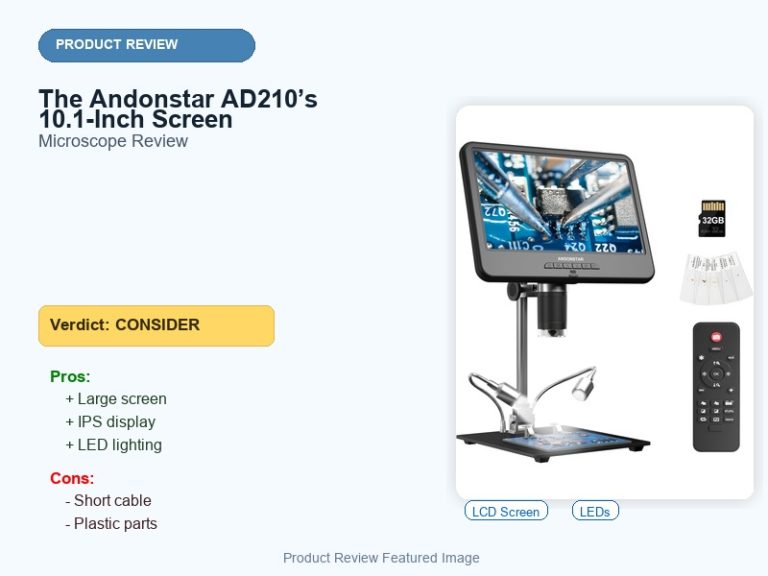
The Andonstar AD210 review verdict: buy this for the 10.1-inch IPS screen and genuine hobby versatility, not for its billing as a “soldering microscope.” The AD210 backs up a 4.5-star average across 731 reviews with real strengths — a huge, 178-degree viewing screen, a bundled 32GB card and remote, and enough working-distance range to handle coins, PCBs, and biological slides on one stand. But reviewers doing serious electronics repair consistently flag a fixed-position PCB clip mount that undercuts the soldering pitch, alongside thin plastic housing that reads as hobbyist-grade rather than professional. If you want one large-screen scope for casual coin collecting, light SMD work, and the occasional slide, it delivers well above its price; if precision PCB fixturing is the priority, plan to work around the clips.

✅ Pros
- Large 10.1-inch IPS screen with a 178-degree viewing angle — no huddling around a tiny eyepiece
- Genuinely versatile across coin collecting, light soldering, card grading, and watchmaking
- Strong value for the price, with a 32GB SD card, card reader, and remote control bundled in
- Easy setup — several verified buyers report being up and running within about 15 minutes
- Solid zoom and detail for coin inspection, including full-size Morgan silver dollars
❌ Cons
- PCB clips mount in only one fixed position, limiting real soldering and board-repair use
- Housing and remote are made of thin, flimsy-feeling plastic
- Included manual is thin and poorly translated, pushing buyers toward third-party tutorials
- Non-magnetic base won’t work with magnetic helping-hands tools
What to Look for in a Digital Microscope
Screen size and viewing angle matter more than the headline magnification number when you’re shopping for a large-format digital microscope like the AD210. A 178-degree viewing angle means multiple people can look at the same screen from the side without the image washing out — genuinely useful if you’re showing a coin find or a solder joint to someone else at the bench, rather than passing a small eyepiece around.
Working distance and stand adjustability are the next things to check, since they determine what you can actually fit under the lens. The AD210’s 1cm to 26cm adjustable range and 12.6-inch maximum stand height are built to handle everything from a coin held flat on the base to a full circuit board propped up for soldering. Illumination type is just as important — look for multiple independently adjustable LED sources rather than one fixed light, since coins, solder joints, and biological slides all need different lighting angles to show detail clearly. For a broader comparison of models in this category, see our guide to the best digital microscopes.
Who Should Buy a Digital Microscope?
Digital microscopes suit anyone who wants to inspect small objects on a large screen instead of squinting through an eyepiece — coin and error-coin collectors, electronics hobbyists doing light soldering or board inspection, watchmakers positioning tiny hands and gears, and trading-card collectors checking condition before submitting for grading. The big-screen format also lets more than one person view a specimen at once, which makes these tools a natural fit for family or classroom settings; our guide to microscopes for kids covers what to prioritize when a younger user is the primary audience.
Buyers who need precise, repeatable PCB fixturing for daily professional repair work, or lab-grade optics for serious biological study, are better served elsewhere. Digital scopes like the AD210 trade absolute mechanical precision and optical rigor for convenience, a big shared viewing screen, and easy photo and video capture — the right tradeoff for hobby and semi-professional use, not for shop-floor or laboratory-grade requirements.
Who This Is For
The Andonstar AD210 is built for coin collectors checking mint errors and full silver dollars, casual electronics hobbyists doing light SMD soldering, watchmakers, and card collectors doing a pre-grading visual check. It’s not the right tool for professional repair techs who need secure, repositionable PCB fixturing, or for anyone expecting the bundled biological slide kit to double as a serious compound-microscope substitute.
Full Specifications
| Spec | Value |
|---|---|
| Light Source Type | LED |
| Real Angle Of View | 178 Degrees |
| Magnification Maximum | 260 x |
| Voltage | 240 Volts |
| Objective Lens Description | Long working distance |
| Power Source | Corded Electric |
| Item Weight | 1.92 Kilograms |
| Enclosure Material | 10.1” IPS Microscope Monitor, 32GB SD Card, Card Reader, Bottom Light Stage, Prepared Slide Kit, Metal |
| Color | Black |
| Model Name | AD210 |
| Brand | Andonstar |
| UPC | 616361263512 |
| Manufacturer Part Number | AD210 |
| Unit Count | 1.0 Count |
Screen and Viewing Experience
The Andonstar AD210 delivers its core selling point through a 10.1-inch IPS display with a 178-degree viewing angle, paired with 1080P video and 12MP photo capture. One verified buyer summed up the effect directly: “A whopping 10.1 inches of IPS display glory, with a viewing angle so wide, you can share your microscopic discoveries with half the room without needing to pass the device around.” That combination of screen size and wide viewing angle is what separates the AD210 from smaller handheld digital scopes that force one person at a time to hunch over a tiny display.

The Andonstar AD210 extends its magnification range up to 260x through its long working-distance objective lens, adjustable across a 1cm to 26cm range depending on what’s being viewed. Reviewers using it for coins consistently praised the clarity at working magnification: “Very good quality image. Easy to set up and use… the magnification level works fine.” One buyer noted that at maximum zoom the lens frames slightly less than a full penny, which tracks with the product’s positioning as a detail-inspection tool rather than a low-power full-coverage scope. For general background on how manufacturers rate digital microscope optics, Andonstar’s own manufacturer site documents its product line and specifications in more depth.
Soldering and PCB Mounting
The Andonstar AD210 targets electronics repair through an upgraded metal stand rated for direct vertical movement and a maximum height of 12.6 inches, built to hold steady during solder work. That stability held up in review feedback, with reviewers citing reliable use for “smaller solder jobs” and general PCB inspection. The stand’s metal construction is a genuine strength here, giving the platform more rigidity than the plastic bases found on cheaper competitors.
The Andonstar AD210 falls short of its “soldering microscope” positioning through a PCB clip design that mounts in only one fixed location. One verified reviewer detailed the limitation bluntly: “The clips install in just one location, which means if you want to use them, you are limited to working only around the edges of a PCB… You’re basically going to want to throw the clips out and find other ways of securing PCBs to do soldering work.” The same reviewer flagged the non-magnetic base as a related shortfall for anyone using magnetic helping-hands tools alongside it — a real constraint for buyers planning to use the AD210 as their primary board-repair fixture rather than an occasional-use tool.
Illumination and Everyday Versatility
The Andonstar AD210 adapts to different subjects through three independently adjustable LED illumination types — top and side lights suited to coins and soldering, and a bottom light stage built for viewing biological slides. This matters because coins, solder joints, and slides all reflect and transmit light differently, and a single fixed light source tends to wash out or under-light at least one of those use cases. Reviewers across multiple hobbies confirmed the lighting held up in practice, from coin collectors to a watchmaker who called the large screen and lighting combination “a game changer” for placing tiny watch hands on a movement.
The Andonstar AD210 rounds out its kit with a bundled 32GB SD card, card reader, and remote control that lets users zoom, capture photos and video, and adjust image colors without touching the microscope and risking camera shake. Build quality on the accessories is the weak point reviewers repeatedly called out: one buyer described the display housing as “thin plastic” that “feels flimsy,” and noted the remote is made from the same lightweight material. A separate reviewer added that the printed manual is minimal, pushing new owners toward third-party tutorials to learn the remote and lighting modes fully — a documentation gap worth knowing about given the device’s several distinct lighting and zoom settings.
What Customers Say
The Andonstar AD210 holds a 4.5 out of 5 average across 731 ratings, with Amazon’s aspect-level sentiment breakdown showing quality (92% positive), functionality (90% positive), and value for money (91% positive) as the strongest categories, while zoom and image quality trail slightly at 82% and 85% positive respectively. One verified buyer summarized the overall impression: “Great value. Highly recommended. Way to go Andonstar.” A more critical, 3-star review captured the split sentiment precisely: “This microscope is good value for money, but has some frustrating design choices… Outside of this, the lights are great, the display is clear, and the magnification is good. It could so easily have been a five star product.”
Review integrity risk here reads LOW: all reviews in the sampled set carry the Verified Purchase badge, complaints are specific and varied — covering clip geometry, base material, and manual quality rather than vague dissatisfaction — and the review base spans multiple countries, which argues against a coordinated review campaign. For more on how platforms vet reviews like these, see Amazon’s own explanation of how it maintains a trusted review experience.
Final Verdict
CONSIDER: the Andonstar AD210 is a strong buy for coin collectors, casual solderers, and multi-hobby users who want one large, shareable screen at a budget price — but go in expecting to replace or work around the fixed PCB clips if serious electronics repair is your primary use case, and treat the “professional” label on the box as marketing rather than a real spec.
Frequently Asked Questions
What is the maximum magnification of the Andonstar AD210?
The AD210 reaches up to 260x magnification, with an adjustable working distance from 1cm to 26cm depending on the subject. It’s built for detail inspection of coins, solder joints, and slides rather than as a full-coverage low-power viewer.
Does the Andonstar AD210 come with an SD card?
Yes. It ships with a 32GB SD card and a card reader, letting you save photos and videos captured through the remote or on-device controls and transfer them to a computer afterward.
Can the AD210 be used for both coin collecting and soldering?
Yes, that dual-use case is one of its most common real-world applications according to reviewers. Just be aware that the bundled PCB clips only mount in one fixed position, so serious solder work may require an aftermarket fixture.
What does the AD210’s remote control do?
It lets you take photos, record video, digitally zoom, and adjust image colors without touching the microscope itself, which helps avoid camera shake during close-up shots. Reviewers note the remote’s build quality is lightweight and plasticky, matching the rest of the unit’s housing.
Is the included biological slide kit worth using?
It’s a nice-to-have rather than a core strength. One reviewer described the bundled prepared slides as “pretty lackluster” for anything beyond a casual first look, since they’re really suited to higher-magnification lab equipment.
What after-sales support does Andonstar offer for the AD210?
The listing includes 24-hour professional after-sales service, and at least one reviewer confirmed getting fast, effective support when they had trouble with the focus mechanism.
Is the Andonstar AD210 good enough for professional electronics repair?
Not as a primary tool. The fixed-position PCB clips and non-magnetic base make it awkward for repositioning boards during detailed repair work, so professional technicians doing this daily should look at dedicated repair-grade fixturing instead.
Conclusion
The Andonstar AD210 is best suited to coin collectors, casual solderers, watchmakers, and anyone who wants one large, shareable screen covering several hobbies at a budget price — not to buyers who need precise, repositionable PCB fixturing for daily professional repair work. Go in with realistic expectations about the clip mount and included slide kit, and it’s a versatile tool that earns its strong review base.
Have you used the AD210 for coins, soldering, or something else entirely? Share what worked — or didn’t — in the comments below. If the bundled biological slide kit has you curious about going further, our guide to preparing your own microscope slides is a good next step.
Originally posted 2026-07-15 08:00:00.