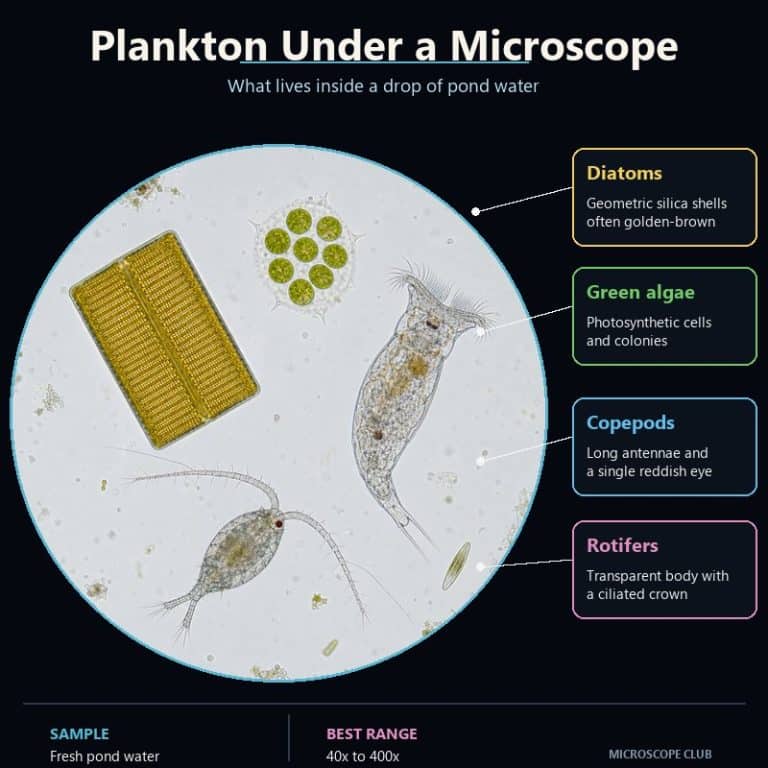
A single drop of pond or sea water holds an entire invisible ecosystem — and plankton under a microscope is one of the most rewarding things you can ever view on a slide. Plankton aren’t one organism; the word describes any aquatic life that drifts with currents rather than actively swimming against them, ranging from photosynthetic diatoms smaller than a human hair to shrimp-like copepods you can almost spot with the naked eye. In this guide you’ll learn how to collect a sample, what each major group looks like at the eyepiece, and which magnification unlocks which creatures.
How to Collect and Prepare a Water Sample
Before you can identify anything, you need a good sample. The quality of what you collect determines what you’ll actually see — a clear-looking jar of surface water is full of life that’s invisible until it’s on a slide.
Where and How to Collect
The richest freshwater plankton samples come from still or slow-moving water: pond edges, lake shallows, irrigation ditches, and the still margins of rivers. Avoid fast-running streams — currents flush plankton away. Collect water from just below the surface (the top few inches), where phytoplankton congregate for light. A clean glass jar or plastic bottle works fine; you don’t need specialized equipment for casual sampling.
For a denser sample, drag a fine-mesh nylon stocking or a commercial plankton net through the water in slow figure-eights for 30–60 seconds, then rinse the contents into a jar. This concentrates small phytoplankton that a plain jar scoop might miss. For marine samples, the same approach works from a pier or calm shoreline. You’ll also want to check out observing pond water under a microscope for a deep dive into freshwater sampling technique.
Refrigerate samples if you can’t view them within a few hours; most organisms survive 24–48 hours chilled. Label your jar with the collection site, date, and whether the water is fresh or marine — these details matter when you’re trying to identify what you find.
Making a Wet Mount
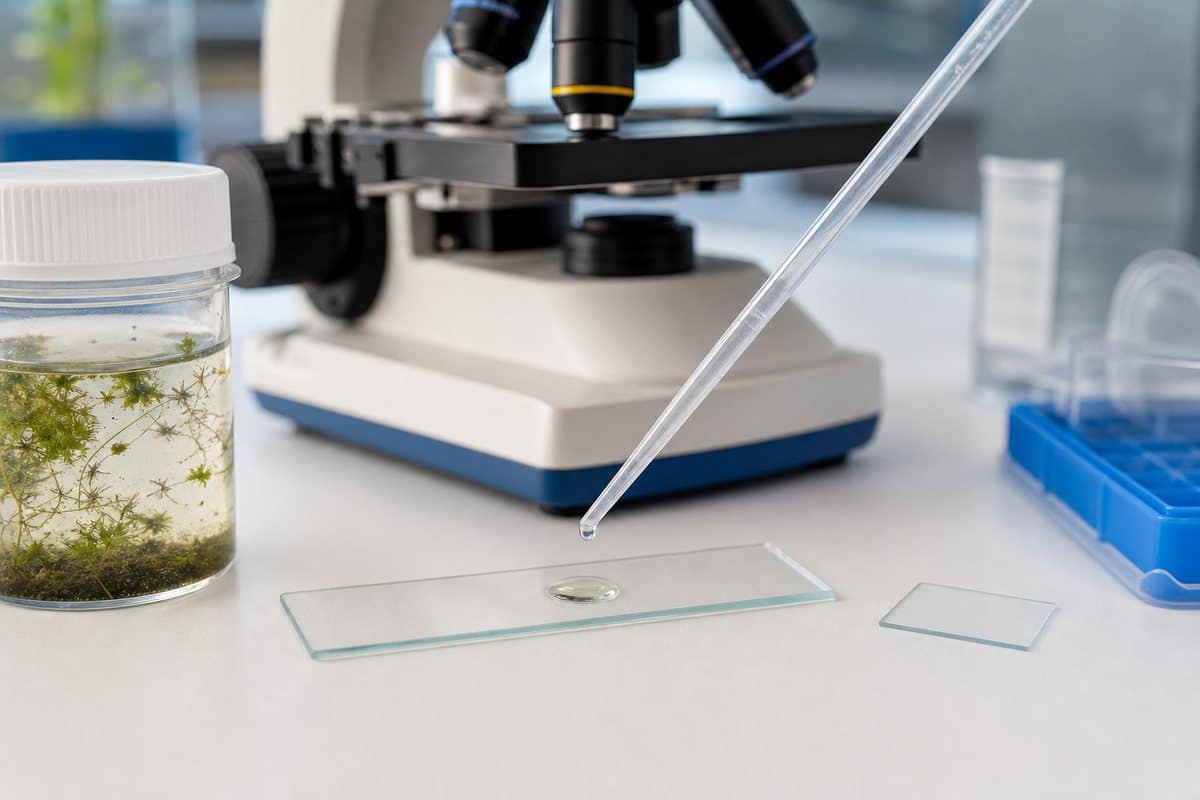
A wet mount slide is the standard prep for live plankton. Place one drop of your sample on a clean glass slide. Hold a coverslip at a 45° angle touching the drop’s edge, then lower it slowly — this pushes out air bubbles. Too much water and specimens wash around; too little and they dry out within minutes.
If your sample looks very dilute, let the jar sit undisturbed for 20 minutes first. Phytoplankton and some zooplankton sink slightly, so collecting from the bottom of a settled jar gives a more concentrated slide. For general slide prep tips, see preparing microscope slides.

Tips for Viewing Live, Moving Plankton
Live plankton move fast — especially copepods and rotifers — which makes them hard to observe. A drop of methyl cellulose added to the sample thickens the water and slows swimmers to a manageable pace without killing them. Alternatively, gently warm the slide by placing it on a light source for 30 seconds, which slightly reduces organism activity. Reduce your condenser iris slightly for better contrast — plankton are mostly transparent and can wash out under full illumination.
Phytoplankton vs. Zooplankton — The Two Groups You’ll See
Every plankton organism falls into one of two functional categories. Understanding the split helps you orient yourself when you’re scanning a slide full of unfamiliar shapes.
Phytoplankton — Plant-Like Drifters
Phytoplankton are the autotrophs — they photosynthesize. Despite being called “plant-like,” most are actually protists or bacteria, not members of kingdom Plantae. They contain chlorophyll and related pigments, which gives them characteristic colors: golden-brown in diatoms and dinoflagellates, bright grass-green in green algae. Phytoplankton are typically slow-moving or completely stationary on a slide. They tend to be smaller than zooplankton — most fall in the 2–200 micron range — and their shapes (geometric, symmetric, ornate) are their defining feature. Globally, phytoplankton produce about half of Earth’s atmospheric oxygen, making them ecologically critical far beyond any single pond.

Zooplankton — Animal-Like Grazers
Zooplankton are the heterotrophs — they eat phytoplankton or each other. They’re generally larger, visibly more active, and structurally more complex. On a slide you’ll see them swimming, jerking, filtering, and sometimes hunting. Key visual tells for zooplankton: antennae, beating cilia, visible internal organs (a beating heart in Daphnia is unmistakable), and directed movement. The category includes true animals (crustaceans, rotifers), single-celled protists (ciliates, heliozoans), and larval forms of larger organisms like crabs and barnacles.
The Major Plankton Groups Under the Microscope
Here’s what you’ll actually encounter at the eyepiece, group by group — with the diagnostic visual cue that makes each one identifiable on sight.
Diatoms — Geometric Glass Boxes
Diatoms are the most commonly encountered phytoplankton in freshwater samples and among the most visually striking. Their silica cell walls (called frustules) consist of two interlocking halves, like a petri dish with a lid. Under the microscope this gives them an almost manufactured look — crisp, geometric, and glassy. Two main body plans exist: pennate diatoms are elongated, boat- or needle-shaped (bilateral symmetry); centric diatoms are disc- or wheel-shaped (radial symmetry). Look for fine surface ornamentation — rows of pores, ribs, and striations — which becomes exquisitely detailed at 400×.
Size range: roughly 2–200 microns (most common 10–80 µm). Color: golden-brown from their fucoxanthin pigment. Best magnification: 100×–400×. If you’re viewing at 100× and you see something that looks like an etched glass medallion or a tiny transparent needle, you’ve found a diatom.
Dinoflagellates — Armored Spinners
Dinoflagellates are identified by two grooves where their two flagella sit: a transverse groove (cingulum) that rings the cell like a belt, and a longitudinal groove (sulcus) running perpendicular. These flagella give dinoflagellates a spinning, top-like motion. Many species are “armored” — thecate — with interlocking cellulose plates visible at higher magnification. Look for Ceratium (three-horned, like a tiny trident) or Peridinium (round to oval with visible plates). Size: 5–200 µm. Some cause harmful algal blooms (red tides) and are bioluminescent in marine waters. View at 100×–400×.
Green Algae and Colonies
Green algae (Chlorophyta) are easy to recognize by their vivid grass-green color — true chlorophyll dominates their pigment profile. Beyond individual cells, many form stunning colonial structures. Volvox looks like a slowly rotating hollow green sphere, its daughter colonies visible as smaller spheres inside. Pediastrum forms flat, star-shaped colonies of cells arranged like a puzzle piece. Scenedesmus forms neat rows of 4–8 cells. Motile species like Chlamydomonas have two flagella and move in smooth arcs. For a closer look at one of the most spectacular colony-formers, see Volvox under the microscope. Filamentous green algae like Spirogyra are also common in pond samples — learn more about Spirogyra under the microscope.
Copepods — Antennae and a Single Eye
Copepods are crustaceans and the most abundant multicellular animals on the planet. Under the microscope they’re unmistakable: a teardrop-shaped body, a pair of long branched antennae sweeping forward, a single reddish median (naupliar) eye at the front, and a forked tail (caudal rami). Females often carry paired egg sacs hanging from the rear. Their movement is a rapid, darting lunge — they use their antennae to sense and flee. Size: 0.5–2 mm, making them large enough to see as tiny moving dots without magnification. A stereo scope at 20×–40× shows their anatomy beautifully.
Cladocerans (Daphnia) — Transparent Water Fleas
Daphnia, commonly called water fleas, are a hobbyist favorite because they’re large, abundant, and their transparency makes their internal organs fully visible. You can watch the heart beating — typically 200+ beats per minute — and see food particles moving through the gut. The second antennae are huge relative to body size and power their characteristic jerky, hopping swimming motion. A transparent carapace covers most of the body; the brood chamber often holds eggs or juveniles. Size: 0.2–5 mm. Look for them at 20×–100× total magnification. Cladocerans are also a great indicator organism — their populations crash rapidly when water quality deteriorates.
Rotifers — The Spinning Wheel
Rotifers (“wheel animalcules”) get their name from the corona — a ring of beating cilia at the head that creates the illusion of two spinning wheels. This corona sweeps food particles into a muscular jaw apparatus (mastax) that grinds them. The spinning motion is one of the most mesmerizing things in a plankton sample. Most rotifers have a distinct foot at the tail end, sometimes with sticky “toes” for anchoring to surfaces. Size: 100–500 µm (0.1–0.5 mm). View at 40×–100×. They’re extremely common in freshwater samples and a reliable indicator of a healthy, living sample.
Many plankton samples also contain ciliates like Paramecium and Vorticella — technically protists but often counted as zooplankton. For context on what bacteria (including cyanobacteria) look like at the microscope, see what bacteria look like under a microscope.
Plankton Identification At a Glance
| Group | Type | Size | Key Visual Cue | Best Magnification |
|---|---|---|---|---|
| Diatoms | Phytoplankton | 10–80 µm | Geometric glass frustules, golden-brown | 100×–400× |
| Dinoflagellates | Phytoplankton | 20–200 µm | Spinning motion, two grooves, armored plates | 100×–400× |
| Green algae / colonies | Phytoplankton | 5–500 µm | Bright green; sphere/star colony shapes | 40×–200× |
| Cyanobacteria | Phytoplankton (bacteria) | 1–10 µm | Blue-green filaments or colonies | 400×+ |
| Copepods | Zooplankton | 0.5–2 mm | Teardrop body, long antennae, single red eye | 20×–100× |
| Cladocerans (Daphnia) | Zooplankton | 0.2–5 mm | Transparent, visible beating heart, jerky swim | 20×–100× |
| Rotifers | Zooplankton | 100–500 µm | Spinning ciliary crown, mastax jaw | 40×–100× |
What Magnification Do You Need?
Plankton spans four orders of magnitude in size, so no single lens setting reveals everything. Here’s how to work through a sample systematically.
Start with the lowest power — 4× or 10× objective (40×–100× total) on a compound scope, or a stereo microscope if you have one. This is your scanning view: you’ll spot large zooplankton (copepods, Daphnia) immediately, and you’ll get a sense of organism density. If you’re wondering whether a compound or stereo scope suits your needs better, see compound vs. stereo microscope.
Move to 100×–200× total to see rotifers, colonial algae, and the general shape of phytoplankton. This is where most pond-water observation happens — you can scan quickly and switch to higher power when something interesting appears.
Switch to 400× total (40× objective) for diatom frustule detail, dinoflagellate armor plates, and the structure of individual cells. This is also where flagella become visible on motile algae. If you want to understand how eyepiece and objective magnifications multiply together, see how to calculate total magnification.
Beyond 400×, you enter oil-immersion territory (1,000×). This reveals fine frustule ornamentation in diatoms and individual bacteria including cyanobacteria, but it requires immersion oil and is beyond the typical hobbyist session. Most plankton identification is fully achievable in the 40×–400× range.
Why Plankton Reveal Water Quality
What’s living in the water tells you a great deal about the water itself. Plankton are bioindicators — their assemblage reflects nutrient levels, pollution, temperature, and the overall health of an aquatic ecosystem.
Diatom diversity is one of the most established metrics in freshwater ecology. A sample with 10+ diatom species in roughly balanced numbers suggests clean, well-oxygenated water. A sample dominated by a single bloom species suggests stress — high nutrients, low oxygen, or chemical imbalance. The EPA uses algae (including diatoms) as official water quality indicators in national aquatic resource surveys.
Cyanobacteria are an especially important signal. These blue-green bacteria — often mislabeled “blue-green algae,” but they are bacteria, not algae — bloom explosively when nitrogen and phosphorus levels spike, typically from agricultural runoff or sewage. A sample that appears greenish-blue and has a paint-like surface sheen is likely experiencing a cyanobacteria bloom, which can be toxic. The bacteria Microcystis and Anabaena produce microcystin and other toxins harmful to humans, pets, and livestock. Research published on NCBI details cyanobacterial bloom dynamics and human health risks.
Daphnia populations crash rapidly in response to pesticides, heavy metals, and acidification — making them useful sentinel organisms for chemical contamination. Conversely, a thriving rotifer and copepod community generally signals a productive, balanced food web. If you’re interested in another compelling micro-animal hunt in aquatic environments, see how to find tardigrades under a microscope.
For educators, the water quality angle transforms a plankton lab from “look at cool stuff” into a genuine scientific investigation — students can compare samples from different sites and quantify what they find. The California Academy of Sciences offers free plankton identification resources for classrooms.
Frequently Asked Questions
Can you see plankton with the naked eye?
Some zooplankton are just barely visible without magnification. Adult copepods (0.5–2 mm) appear as tiny moving dots in a jar of water if you hold it up to light. Daphnia at their largest (up to 5 mm) are visible as jerking specks. Jellyfish are technically macroplankton and obviously visible. Most phytoplankton — diatoms, dinoflagellates — are invisible to the naked eye and require at least 40× magnification.
Is plankton a plant or an animal?
Neither — and both, depending on the group. “Plankton” is an ecological category, not a taxonomic one. It includes bacteria (cyanobacteria), protists (diatoms, dinoflagellates), true animals (copepods, rotifers), and larval forms of larger animals. Phytoplankton photosynthesize like plants, but most are protists, not members of the plant kingdom. Calling plankton a “plant” or “animal” is like calling all flying things “birds.”
Where is the best place to find plankton?
For freshwater plankton, the best spots are calm, sunlit pond edges and lake shallows — avoid fast currents. Sample from just below the surface where phytoplankton concentrate for light. Shallow water near aquatic plants often has excellent diversity. For marine plankton, calm shorelines, tidal pools, and pier edges are accessible options. In general, water that looks slightly green or has mild turbidity often contains a richer plankton community than crystal-clear water.
Do you need to stain plankton to see it?
No staining is needed for most plankton observation. Diatoms, copepods, Daphnia, and rotifers are all clearly visible unstained — their natural pigments (golden-brown diatoms, green algae) and structural contrast (transparent crustaceans against a bright background) make them identifiable. Reducing the condenser iris slightly improves contrast for transparent specimens. Staining is occasionally used for specific research purposes (e.g., iodine for starch detection, DAPI for DNA fluorescence), but it’s not required for standard identification work.
Why isn’t my plankton sample moving?
If your sample was collected more than a few hours ago without refrigeration, many organisms may have died. Zooplankton especially need live samples — try to view within 1–2 hours of collection, or keep samples chilled. If the sample was refrigerated, warm it to room temperature first (cold slows or stops movement). Another cause: too much pressure from the coverslip compresses organisms against the slide. Try a slightly thicker drop of water, or support the coverslip with a hair or thread spacer.
Can I use tap water to dilute my plankton sample?
Avoid tap water — the chlorine kills organisms within minutes. If you need to dilute a concentrated sample, use distilled water or, better, water from the same source you collected from. For marine samples, use pre-made marine salt solution; fresh tap water will kill saltwater organisms almost instantly through osmotic shock.
What’s the difference between plankton and algae?
Algae is a biological/taxonomic grouping (though informal); plankton is an ecological one based on behavior — drifting rather than swimming. Many phytoplankton are algae (green algae, diatoms), but not all algae are plankton. Attached algae growing on rocks or submerged surfaces are called periphyton or benthic algae — they don’t drift, so they’re not plankton. And not all plankton are algae: copepods, rotifers, and cyanobacteria are definitely not algae.
Conclusion
Plankton under a microscope is a reminder that the most complex ecosystems on Earth fit inside a jar of pond water. Glassy diatom frustules, spinning dinoflagellates, the beating heart of a water flea, the ciliary crown of a rotifer — all of it is available to anyone with a basic compound microscope and a sample from the nearest pond. The same diversity that makes plankton visually extraordinary also makes them functional: they produce much of the oxygen we breathe, drive aquatic food webs, and signal the health of every body of water on the planet.
Have you tried collecting your own plankton sample? Whether you found diatoms at a local pond or caught a rotifer spinning its crown at 100×, we’d love to hear what you discovered. Share your experience in the comments below — and if you photographed anything interesting, tell us what it was!
Originally posted 2026-06-17 14:16:55.