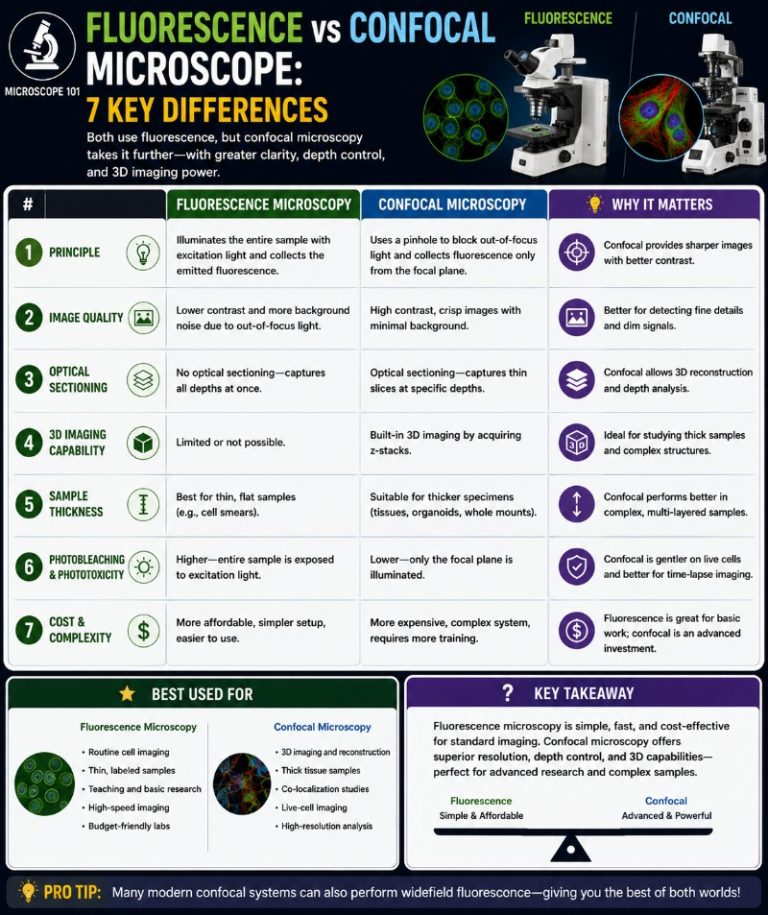
Fluorescence vs confocal microscope is one of the most common points of confusion in biological imaging — and the answer surprises most people: a confocal microscope is a fluorescence microscope. The difference is a single component, a tiny pinhole aperture, that blocks out-of-focus light and lets confocal produce sharp optical sections through thick samples. Widefield fluorescence illuminates the whole sample at once, capturing glowing signal from every depth simultaneously — fast and sensitive, but hazy in anything thicker than a cell monolayer.
The Quick Answer — Side-by-Side Comparison
Before diving into how each technique works, here’s the complete comparison at a glance. These are the attributes that actually determine which instrument you should use.
| Feature | Widefield Fluorescence | Laser-Scanning Confocal |
|---|---|---|
| Illumination mode | Full field, simultaneous | Point scan, sequential |
| Light source | Mercury lamp, metal-halide, or LED | Laser |
| Detector | CCD or sCMOS camera (full field) | PMT or GaAsP (point detector) |
| Pinhole | None | Yes — rejects out-of-focus light |
| Optical sectioning | No | Yes |
| Lateral (XY) resolution | ~200–250 nm | ~200–250 nm (minimal improvement) |
| Axial (Z) resolution | Blur — no effective sectioning | ~500–700 nm, true sections |
| Imaging speed | Fast (full frame at once) | Slower (point-by-point scan) |
| Best sample thickness | Thin (<10–20 µm) | Thick (>20 µm, 3D samples) |
| Relative cost | Low tens of thousands USD | $200,000–$1,000,000+ |
How a Widefield Fluorescence Microscope Works
Widefield fluorescence microscopy is built on a deceptively simple principle: flood the entire sample with excitation light, collect whatever fluorescent signal comes back, and photograph it all at once.
The underlying biology relies on fluorophores — molecules that absorb photons at one wavelength and re-emit them at a longer wavelength. The gap between absorption peak and emission peak is called the Stokes shift, and it’s what makes fluorescence imaging possible. By using a dichroic mirror (a beam splitter that reflects excitation wavelengths but transmits emission wavelengths) paired with excitation and emission bandpass filters, the microscope separates the dim fluorescent signal from the bright excitation light. Without this filter set, the returning excitation light would completely swamp the signal.
Common fluorophores you’ll label samples with include DAPI (excited at ~360 nm, marks nuclei blue), GFP (excited at ~488 nm, marks proteins green), and phalloidin conjugates for actin. Each requires a matched laser line or lamp filter block — using the wrong excitation wavelength means zero signal, which is the panicked first assumption many beginners make when their sample “didn’t work.”
The light source — historically a mercury or metal-halide arc lamp, increasingly an LED array — illuminates the full field simultaneously. A CCD or sCMOS camera captures the entire frame in one shot, which is why widefield is fast. You can image live cells at video rate.
The Out-of-Focus Blur Problem
Here’s what you actually see when you put a thick sample — say, a 50 µm tissue section — under a widefield fluorescence scope: the structures you want are glowing, but the whole image has a foggy, washed-out look. Bright signal bleeds everywhere because the lamp is exciting fluorophores at every depth in the sample, not just the focal plane. Out-of-focus planes above and below contribute their emission to every pixel in your image. The more depth the sample has, the worse it gets.

Scroll your focus knob up and down and you’ll notice the whole field stays partly lit — you never get a clean black background. That blur isn’t noise you can filter out; it’s real photons from real fluorophores, just at the wrong Z position. This is widefield’s fundamental limitation and why confocal was invented.
How a Confocal Microscope Works
A confocal microscope solves the out-of-focus blur problem with a single elegant addition to the optical path: a pinhole aperture placed at a conjugate focal plane. “Confocal” literally means “sharing a focus” — the pinhole is at the same optical conjugate position as the focal point in the sample.
Instead of flooding the whole field, confocal uses a focused laser beam as its excitation source. That laser spot is raster-scanned across the sample by fast galvanometer mirrors, illuminating one diffraction-limited point at a time. The emitted fluorescence from that point travels back through the optical path and hits the pinhole. Only light that originated from the focal plane passes through; light emitted from above or below — the out-of-focus haze — arrives at a slightly different angle and is physically blocked by the pinhole aperture before reaching the detector.
The detector in a confocal is not a camera. It’s a photomultiplier tube (PMT) or, in modern systems, a GaAsP detector — extremely sensitive point detectors that measure the signal from each scanned position one pixel at a time. The image is built up pixel-by-pixel as the laser sweeps the field, which is why confocal is inherently slower than widefield.
The result: collect a series of images at different Z positions (a Z-stack) and you have a genuine three-dimensional dataset you can reconstruct, rotate, and analyze — not the blurry, un-separable mess widefield gives you at depth.
What the Pinhole Actually Does
The pinhole’s diameter is measured in Airy units (AU) — a unit tied to the diffraction pattern of the objective. At 1 AU, the pinhole passes essentially all in-focus light while rejecting a large fraction of out-of-focus signal. Close the pinhole below 1 AU and you improve sectioning but sacrifice signal (thinner optical section, dimmer image). Open it above ~1.5–2 AU and the sectioning degrades toward widefield territory — you’re letting more out-of-focus photons through.
One of the most common beginner mistakes on a confocal is opening the pinhole too wide to compensate for a dim sample. The temptation makes sense — more signal is more signal — but you’re directly trading away the sectioning advantage that makes confocal worth the cost. The correct fix for a dim sample is to increase detector gain or use frame averaging, then touch laser power last, and leave the pinhole near 1 AU.
A second trap: cranking laser power to brighten a weak signal. On a laser-scanning confocal, the point intensity is extremely high even at low power settings. Raising power above what you need bleaches the fluorophore within seconds — you can watch the signal fade frame by frame in a live time series, and it doesn’t come back. Increase detector gain or averaging first; laser power is the last knob you should turn.
The 7 Real Differences That Matter
Here are the seven differences that actually determine which instrument you need — including the one that almost every comparison article gets wrong.
1. Optical Sectioning
Confocal can isolate individual planes through a thick sample. Widefield cannot. This is the single biggest functional difference and the reason confocal exists.
2. Contrast in Thick Samples
On a thick tissue section, widefield images look foggy because out-of-focus fluorophores contribute signal to every pixel. Confocal images of the same sample look crisp — dark background, cut-out edges on structures. The difference isn’t subtle; it’s the difference between a useful image and an unusable one at depth.
3. Lateral (XY) Resolution — The Misconception
This is where most articles mislead readers. Confocal’s theoretical lateral resolution is up to 1.4× better than widefield with a fully closed pinhole — but that gain is rarely realized in practice. Both techniques are diffraction-limited to approximately 200–250 nm with high-numerical aperture objectives under normal operating conditions. If you need to break the diffraction limit, you need super-resolution techniques (STED, SIM, PALM/STORM) — confocal is not super-resolution.
4. Axial (Z) Resolution
Confocal’s real resolution advantage is axial. Confocal achieves approximately 500–700 nm optical section thickness, depending on the objective’s numerical aperture and the pinhole setting. Widefield has no effective optical sectioning — its Z information is dominated by out-of-focus blur, not genuine depth discrimination. This is the axis where confocal definitively wins.
5. Speed
Widefield captures the entire frame in one camera exposure — fast enough for video-rate live imaging. Laser-scanning confocal builds an image point-by-point, which means typical frame rates of seconds per frame rather than milliseconds. Spinning-disk confocal (discussed below) narrows this gap significantly and is the go-to for fast live-cell imaging.
6. Phototoxicity and Photobleaching
Both techniques damage live cells and bleach fluorophores — this is a concern for both, not a confocal-only problem. But the mechanisms differ. Widefield exposes the entire sample depth continuously, bleaching fluorophores above and below the focal plane without imaging them. Laser-scanning confocal delivers extremely high instantaneous intensity to each point it dwells on, which can be damaging for live cells. For sensitive live-cell imaging, spinning-disk confocal or widefield with careful exposure control are generally gentler.
7. Cost
A widefield fluorescence microscope — a solid research-grade system with LED illumination and a sCMOS camera — runs in the low tens of thousands of dollars. A laser-scanning confocal costs $200,000 to over $1,000,000, a gap well documented by iBiology’s confocal microscopy series. Lasers, galvanometer scanning hardware, and sensitive point detectors drive that price. This is why university core facilities charge premium rates for confocal time and why the instrument choice matters for budget-limited labs.
When to Use Each — Decision Guide
The decision between widefield fluorescence and confocal comes down to your sample thickness, imaging speed requirements, and budget. Use this guide:
Use widefield fluorescence if:
- Your sample is thin — a cell monolayer, a tissue smear, a single-layer culture (<10–15 µm)
- You need fast frame rates — live-cell imaging at video rate, calcium imaging, tracking rapid events
- You’re screening many samples or fields — widefield throughput is far higher
- Your budget is limited — widefield delivers excellent results on thin samples at a fraction of the cost
- Signal is scarce — widefield collects from the whole depth, so it’s more photon-efficient on thin samples
Use confocal if:
- Your sample is thick — tissue sections (>20 µm), embryos, spheroids, organoids, 3D cell cultures
- You need 3D reconstruction — Z-stacks with genuine optical sectioning
- You need contrast in a thick, fluorescent sample — widefield images will be too blurry to interpret
- Co-localization analysis requires clean, background-free signal from a single plane
- Access is available — your institution’s core facility has one and you can justify the time cost
A practical tip that saves fluorophore and frustration: scout your sample on widefield first. Find your region of interest, focus on the right cell, confirm signal quality — then switch to confocal. Every second you spend scanning on confocal without a plan burns photons and bleaches your sample. Widefield eyepiece viewing costs nothing in terms of photobleaching; confocal laser scanning does not. For a broader overview of all light microscopy categories, see our guide to types of microscopes.
Beyond Confocal — Spinning-Disk and Super-Resolution
Spinning-disk confocal uses a Nipkow disk — a spinning disk with thousands of pinholes — to scan many points in parallel simultaneously. The result is true optical sectioning at much higher frame rates and lower per-point laser dwell time than laser-scanning confocal, making it the preferred choice for live-cell 3D imaging where phototoxicity and speed both matter. The trade-off: slightly reduced optical sectioning efficiency compared to laser-scanning.
If you need to go below the ~200–250 nm diffraction limit that bounds both widefield and confocal, the answer is super-resolution microscopy — STED, SIM, or PALM/STORM. These techniques use different physical tricks to extract spatial information beyond the diffraction barrier, as covered in this overview of super-resolution methods from the NIH. Confocal is not super-resolution; the two are separate categories. For more on how the diffraction limit constrains all light microscopy, see our explainer on magnification versus resolution and how microscope resolution works.
Laser-scanning confocal systems also use Class 3B or Class 4 lasers. In practice, these instruments are operated in enclosed, interlock-controlled scan heads by trained users in institutional core facilities — laser safety is managed at the facility level, not something users need to engineer themselves.
Frequently Asked Questions
Is confocal better than widefield fluorescence?
“Better” depends entirely on your sample. Confocal decisively wins on thick samples (>20 µm) that need optical sectioning and 3D reconstruction. On thin samples like cell monolayers, widefield is often faster, more photon-efficient, and just as informative — and far cheaper. There is no universally superior technique; there’s the right tool for the specific sample.
Why is confocal microscopy so expensive?
The cost comes from three hardware components that widefield doesn’t need: research-grade lasers (often multiple wavelengths, each stable to a fraction of a percent), high-speed galvanometer scanning mirrors, and sensitive point detectors (PMTs or GaAsP). The computing and control electronics that synchronize them add cost too. A complete laser-scanning confocal system with multiple laser lines typically runs $200,000–$1,000,000 depending on configuration — roughly 10–50× a comparable widefield setup.
Can a confocal microscope image live cells?
Yes, but with caveats. The focused laser delivers high instantaneous intensity to each point it dwells on, which can cause photobleaching and phototoxicity in living samples — particularly during long Z-stacks where early slices bleach before later ones are collected. For sensitive live-cell 3D imaging, spinning-disk confocal is usually the better choice: it scans many points in parallel, reducing per-point dwell time and laser dose. For 2D live-cell imaging at video rates, widefield is often the most practical option.
What is the resolution of confocal vs widefield fluorescence?
Lateral (XY) resolution is nearly identical — both are diffraction-limited to roughly 200–250 nm with a high-NA objective. Confocal’s theoretical 1.4× XY improvement (with a closed pinhole) is rarely realized in practice. The meaningful resolution difference is axial: confocal achieves ~500–700 nm true optical section thickness; widefield produces only a blurry, unsectioned Z blur. Check our deep dive on numerical aperture for how objective NA drives both limits.
Do you need special fluorescent dyes for confocal vs widefield?
No — the same fluorophores work in both instruments. DAPI, GFP, Alexa Fluors, phalloidin conjugates, and immunofluorescence antibody labels are compatible with both. The key requirement is matching the fluorophore’s excitation peak to the available laser line (confocal) or filter block (widefield). A fluorophore that requires UV excitation (DAPI, ~360 nm) needs a 405 nm laser on confocal; GFP needs the 488 nm line. The wrong laser line means no signal — not a failed sample.
What’s the difference between laser-scanning confocal and spinning-disk confocal?
Both produce optically sectioned images using a pinhole to reject out-of-focus light — the principle is identical. Laser-scanning confocal moves a single point across the field sequentially (slower, best optical sectioning, highest per-point intensity). Spinning-disk confocal passes light through thousands of pinholes on a rotating disk simultaneously, scanning many points in parallel — faster, gentler on live cells, but with slightly reduced sectioning efficiency. Spinning-disk is the standard choice for live-cell 3D imaging; laser-scanning confocal is preferred for fixed thick specimens where speed is less critical.
Why does my widefield image look foggy on a thick sample?
Because widefield illuminates all depths simultaneously. Fluorophores above and below your focal plane emit light that reaches the camera, adding a diffuse glow to every pixel. The thicker the sample, the worse the haze. This isn’t a problem you can fix by adjusting focus or exposure — it’s a fundamental consequence of full-field illumination with no out-of-focus rejection. Confocal (with its pinhole) or computational deconvolution software are the standard solutions. For thin samples, the problem is negligible and widefield works perfectly well.
Conclusion
Fluorescence and confocal microscopy share the same foundation — labeled samples, filter sets, and the Stokes shift — but diverge at one critical component: the pinhole. That pinhole enables optical sectioning, which is confocal’s genuine superpower. Lateral resolution is nearly the same between the two techniques; the real win is axial (Z) contrast in thick, three-dimensional samples. For thin specimens and fast live imaging, widefield fluorescence remains faster, cheaper, and often just as good. Understanding which tool fits your sample is the first decision you make before booking any scope time.
Have you imaged the same sample on both widefield and confocal and been surprised by the difference? Or are you trying to decide which technique makes sense for your work? Share what you’re working on in the comments — we’d love to hear what you found.
Originally posted 2026-06-17 14:10:08.