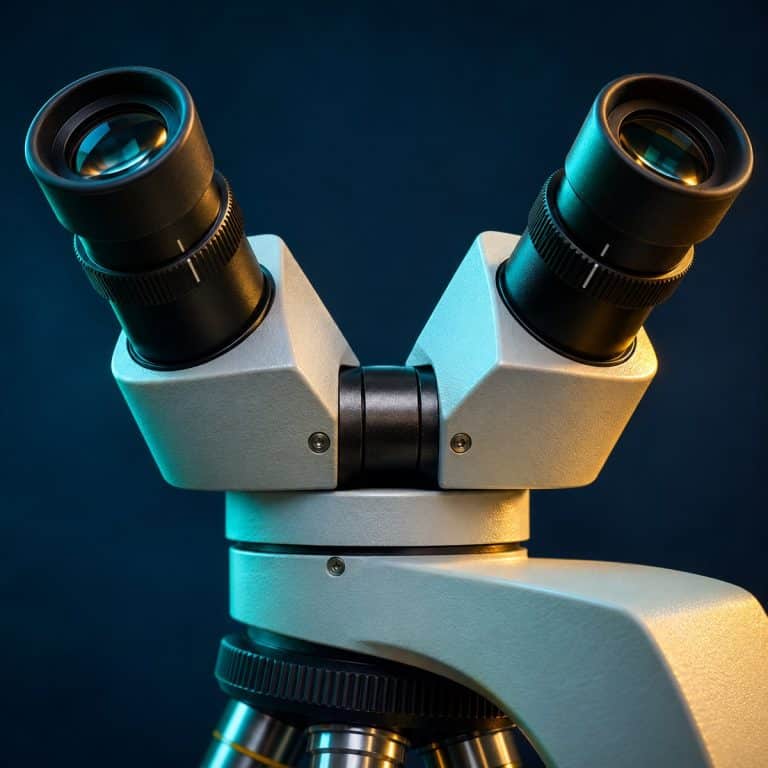
A Siedentopf binocular head is a microscope viewing head whose two eyepiece tubes swing on a central hinge, like a pair of binoculars. That lets you change the spacing between the eyepieces without changing the tube length, so the image stays in focus and you don’t have to refocus every time someone new sits down at the scope.
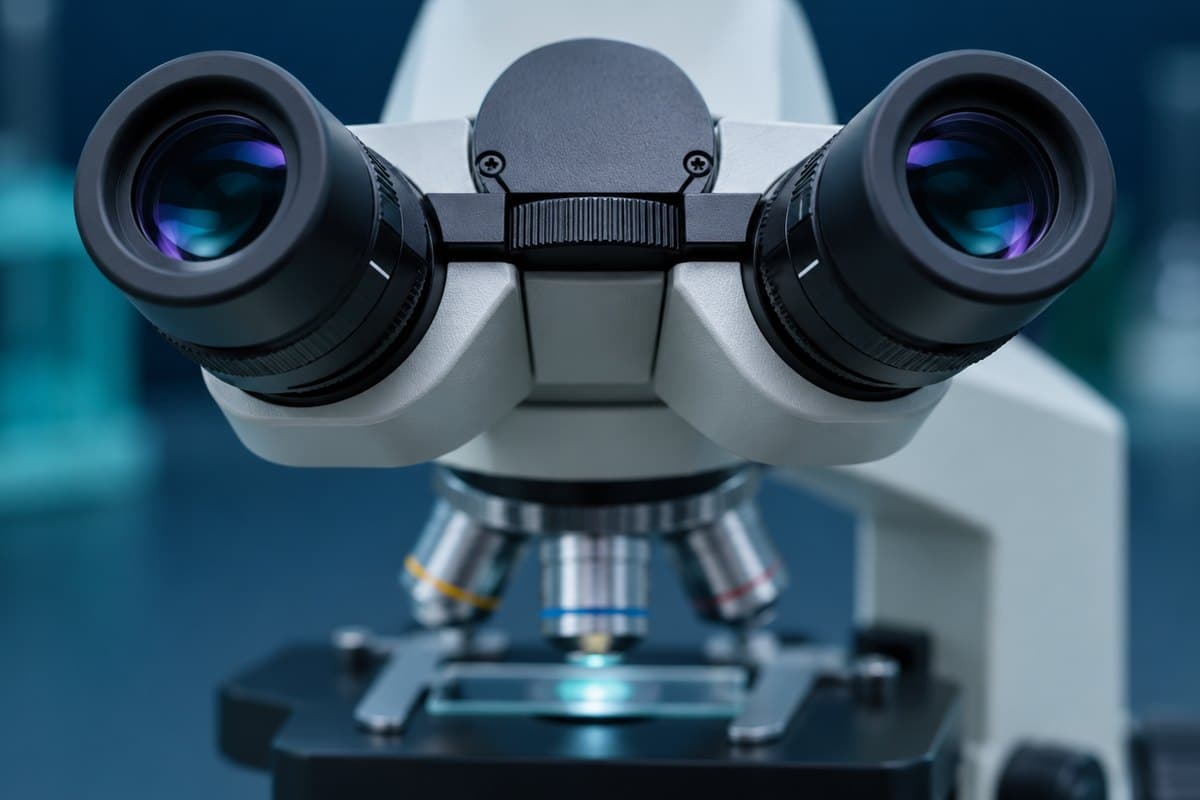
How a Siedentopf Head Works
A Siedentopf head adjusts interpupillary distance (IPD), the distance between your pupils, by rotating the eyepiece tubes around a central axis. Think of folding binoculars: you push the two barrels toward each other or pull them apart, and they pivot instead of sliding. On a microscope, you do the same thing with one hand on each eyepiece, pressing them down and together for narrow eyes or lifting them apart for wide ones. The movement is smooth with firm, even resistance. See Manchester Microscopical Society’s viewing-head FAQ for additional context.
The key point is what does not move. The mechanical tube length, the distance light travels from the objective to the eyepiece, stays constant no matter how you set the spacing. On a finite-optics microscope that distance is the classic 160 mm. Because the optics sit at the same distance from each other, the specimen you focused a minute ago is still sharp after you swing the tubes to fit your eyes. Retailers sometimes call this “compensation-free,” which is a fair description. The head is one of the main parts of the instrument, and you can see where it sits in the full parts of a compound microscope.
One side effect is worth knowing about. Because the tubes swing on an arc, the eyepieces rise or drop slightly as you change the spacing. It’s minor, but at a very narrow IPD it can make you hunch a little. Adjust your seat height rather than leaning into the eyepieces.
The Siedentopf head is named for a hinge style, not for glass quality or the number of tubes. Many student and lab scopes pair it with a 30-degree inclined, fully rotatable head, such as the Motic Siedentopf-type 30° inclined binocular head. The 360-degree rotation lets you turn the head toward a seated partner or put the stage controls on the other side. You will also see the name misspelled as “Seidentopf” on some listings; it is the same head.
Why Tube Length Keeps Your Objectives Parfocal
Finite-corrected objectives, the common “160 mm” type on hobby scopes, are designed to work at one specific mechanical tube length. When a head holds that length steady, your objectives keep behaving as designed. Switching from 4x to 10x to 40x needs only a touch of the fine focus, and the lens correction works as the manufacturer intended. If you want the bigger picture of how light travels through that tube, read how a compound light microscope forms its image, and for the objectives themselves see how 4x, 10x, 40x and 100x objectives differ.
A precise note on wording: “parfocal” strictly describes objectives that stay in focus when you rotate the nosepiece. The head itself isn’t parfocal. What it does is preserve the tube length that objective parfocality depends on. On infinity-corrected systems the tube-length dependency is weaker, but a sliding head can still shift the eyepiece focal plane.

Siedentopf vs Sliding (Jentzsch) Head
A sliding head, usually called a Jentzsch head (some retailers write “Jentsch”), moves the two eyetubes closer together or farther apart in a straight line, as this MicroscopeMaster explainer on Siedentopf and sliding heads describes. That straight-line motion changes the tube length, so the image goes soft as soon as you widen the eyepieces. Anyone who has used one knows the tell: your hand reaches for the focus knob every time the spacing changes. See Leica’s microscope ergonomics guide for additional context.
| Feature | Siedentopf head | Sliding (Jentzsch) head |
|---|---|---|
| How the eyepieces move | Rotate around a central axis, like binoculars | Slide apart or together in a straight line |
| Tube length while adjusting | Stays constant | Changes |
| Refocus needed? | No | Yes, unless you compensate |
| Compensation step | None | Set the eyetube scales to match the IPD reading |
| Eyepiece height change | Slight rise or drop on the arc | None on a plain sliding head; compensating tubes extend or retract |
| Typical scopes | Student, home, and lab microscopes | Cheaper and older microscopes |
| Best for | Shared scopes, classrooms, families | One user who sets it once |
The Jentzsch fix is a scale method. On the Zeiss-style dual-adjustment version, after you set your IPD you set both eyetube scales to that same number, and the tubes extend or retract to maintain a true 160 mm mechanical tube length. It works, but it adds a step that a Siedentopf head makes unnecessary. If you skip it, you’re back to chasing focus with the knob.
How to Adjust a Siedentopf Binocular Head (4 Steps)
Setting up a Siedentopf binocular head takes about a minute once you know the order, and the order matters. The sequence below follows the procedure on the McCrone binocular head adjustment guide. Do it on the 10x objective with an easy, high-contrast slide, then move up to higher power.
- Zero the diopter ring. Turn the diopter ring (the dial on the adjustable eyepiece that corrects focus differences between your two eyes) to 0. If the last user left it at +3, you will chase focus all session.
- Set the IPD. Look through both eyepieces with relaxed eyes and keep your head still. Swing the tubes closer or farther apart until you see a single clean circle without moving your head from side to side. Two overlapping circles, or a dark crescent at the edge of one eye’s view, means the spacing is still off. When it’s right, it feels like closing binoculars down to fit.
- Focus with the fixed eyepiece. Use only the eye over the fixed (non-diopter) eyepiece, and focus with the coarse knob, then the fine knob. For a full walkthrough, see the full routine for focusing a microscope.
- Set the diopter with the other eye. Block the fixed side, look with the other eye, and turn the diopter ring until the image is sharp. Do not touch the coarse or fine focus knobs during this step.
Two habits save time afterward. First, read your IPD number off the scale between the tubes (many heads have a millimeter scale) and remember it; next session you can set it in two seconds. Second, if an eyepiece holds a graticule (a built-in measuring scale or crosshair), focus the graticule first with your dominant eye.
The most common beginner mistake is using the focus knobs to fix the diopter eye. The knobs belong to the fixed-eyepiece eye; the diopter ring belongs to the other one. Another is setting IPD with one eye closed, which defeats the purpose. And when a shared scope changes hands, usually only the diopter ring needs a quarter turn for the next person, because the focus itself stays put.
The video above is a demo of binocular head adjustment in general, which follows the same IPD-then-diopter logic.
Is a Siedentopf Head Worth Paying For?
A Siedentopf head is worth paying for when more than one person uses the microscope. On a family scope, a classroom bench, or a lab where people take turns, it saves the constant refocusing between users, and that is its main payoff. For a single adult who sets the IPD once and never touches it again, the practical difference from a sliding head is small, so treat it as a nice-to-have rather than a deciding factor.
Be clear about what the head does not do. It is a mechanical hinge, not an optics upgrade. A cheap scope can have a Siedentopf head and mediocre objectives, so judge the objectives (achromat versus plan, meaning basic versus flat-field corrected) separately. When you compare models, our comparison of binocular compound microscopes shows how head type fits in next to the other specs.
Children are the exception to check carefully. Adult IPD averages about 63 mm, with most adults falling between roughly 54 and 74 mm according to the Wikipedia entry on pupillary distance. Children’s eyes sit closer together, often around 40 to 55 mm depending on age. Binocular head IPD ranges vary by model, so check the spec sheet rather than assuming one universal range. A young child with a narrow IPD may hit a head’s minimum spacing and still see double. In that case a monocular head avoids the problem entirely; see microscopes picked for kids.
One more correction: binocular does not mean 3D. On a compound microscope, both eyes see the same image through a single objective. Only a stereo microscope that gives true depth delivers a real three-dimensional view.
Siedentopf Heads on Trinocular Microscopes
Siedentopf describes the hinge, not the number of tubes, so trinocular heads are often Siedentopf-type too. A trinocular head adds a third port for a camera, with the same swing-to-fit eyepieces. The Swift SW380T, for example, is sold as a Siedentopf-head research-grade trinocular. The consistent tube length helps here as well. Once the camera adapter is set to match the eyepieces, changing the eyepiece spacing for a new user won’t throw the camera out of focus, which makes capturing images far less frustrating. For models and what to look for, see our trinocular microscope guide and our Kaisi TX trinocular review.
Frequently Asked Questions
Who was Siedentopf, and why is the head named after him?
Henry (Heinrich Friedrich Wilhelm) Siedentopf (1872 to 1940) was a German physicist at Carl Zeiss from 1899 to 1938 and head of its microscopy department from 1907. He co-developed the ultramicroscope with Richard Zsigmondy and the fluorescence microscope with August Köhler. The binocular tube carries his name.
Can kids use a Siedentopf binocular microscope?
Yes, if the head’s minimum IPD fits their eyes. Many heads bottom out around 48 to 55 mm, and a young child with narrower spacing may see double. Check the spec sheet before buying. Kids who press their faces into the eyepieces can also knock the spacing wider, so a teacher or parent should re-check between turns.
Is a Siedentopf head the same as a trinocular head?
No. Siedentopf is the style of hinge that adjusts eyepiece spacing. Trinocular means the head has a third tube for a camera. A trinocular head can be Siedentopf-type, and many are.
Can I use a Siedentopf head with my eyeglasses on?
You can, but many people with glasses take them off and rely on the diopter ring, which corrects focus differences between your two eyes. It does not correct astigmatism, so if you have astigmatism you may prefer to keep your glasses on. Eye relief on the eyepieces affects how comfortable that is.
Why do I get a headache after 10 to 15 minutes of looking?
Usually the IPD or diopter is slightly off, not the microscope. Rerun the four setup steps, with the diopter at zero first. If the discomfort continues, take a break and check that your seat height lets you sit upright rather than leaning in.
Conclusion
A Siedentopf binocular head swings its eyepiece tubes on a central hinge, which keeps the mechanical tube length constant so focus holds when you change the spacing. Compared with a sliding Jentzsch head, it removes the refocusing and the compensation scales, at the cost of a small change in eyepiece height. It is most valuable on shared scopes and least critical for a single user, and it says nothing about lens quality, so judge the objectives on their own.
Does your microscope have a Siedentopf or a sliding head, and did you notice the focus shift when you changed the spacing? Tell us what you found in the comments below.