
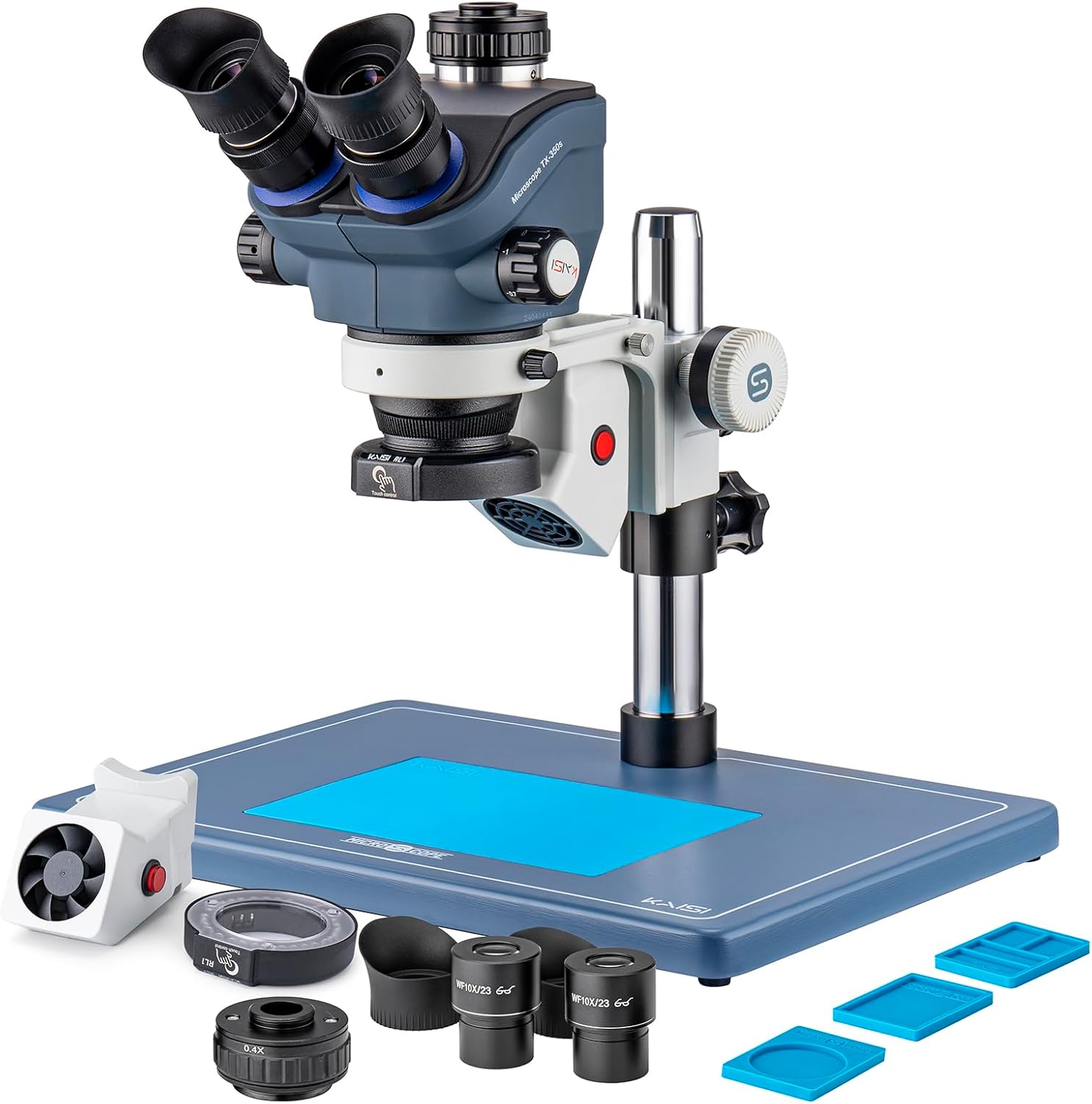
The Kaisi TX Trinocular Stereo Microscope earns its keep on a soldering bench: 7X-50X continuous zoom with genuinely sharp detail at max magnification, a heavy alloy-steel base that doesn’t wobble under a hot air gun, and a trinocular port that — unlike most cheap three-eye scopes — doesn’t blank out the left eyepiece the moment you plug in a camera. The catch is the stock rubber eyecups, which more than one buyer found hard enough to cause eye strain or outright prevent binocular focus. If you’re doing fine-pitch PCB rework and you’re willing to budget for an eyecup swap, this is a strong mid-tier pick; if soft eyecups are a dealbreaker out of the box, hold off until you’ve priced a replacement set.
✅ Pros
- Sharp, well-resolved detail at the top of the 7X-50X zoom range
- Solid, heavy alloy-steel base that stays put during soldering work
- Wide-field WF10x23 eyepieces with adjustable eye distance reduce eye and neck fatigue
- Trinocular port keeps the left eyepiece view live even with a camera attached
- Moddable platform — takes a Barlow lens and third-party PCB holders without a fight
❌ Cons
- Stock rubber eyecups are hard enough to cause discomfort during longer sessions
- At least one buyer found the eyecups prevented proper binocular focus and returned the unit
- Working distance is lens-position-dependent — setting up the 0.7x or 0.5x Barlow lens incorrectly will blur focus
- Only 9 total reviews back the rating, so real-world reliability data is still thin
What to Look for in a Soldering Stereo Microscope
Magnification range matters more than the peak number on the box. A 7X-50X continuous zoom like the Kaisi TX’s covers everything from spotting a lifted trace at low power to inspecting a 0201 solder joint at full zoom, without swapping objectives mid-job. Look for a stated zoom ratio (here, 0.7x-5x on the objective) rather than just a headline magnification figure, since the ratio tells you how much range you actually get between steps.
Illumination and working distance are the two factors that decide whether a scope is actually usable for soldering rather than just for looking at coins. A ring light mounted around the objective keeps shadows off the work surface, and a generous working distance leaves room for an iron, tweezers, and a hot air nozzle underneath the lens at the same time. If you’re still deciding between a stereo scope and a compound microscope for your bench, our stereo microscope beginner’s guide breaks down the tradeoffs in more depth.
Finally, check what the accessory kit actually solves. A soldering mat protects the work floor from a hot air gun’s extreme surface heat; a fume extraction fan pulls flux smoke away from the lens instead of letting it fog the view. These aren’t cosmetic extras — on a scope used daily for rework, they determine how long the optics and the surrounding desk stay usable.
Who Should Buy a Stereo Microscope?
Stereo microscopes are built for real-world, three-dimensional objects rather than thin, translucent slide samples — that’s what makes them the right tool for PCB rework, jewelry inspection, and coin or stamp examination. Electronics technicians and hobbyist repair enthusiasts are the core audience: anyone reflowing a BGA chip or reworking a 0402 resistor needs the depth of field and working distance a stereo scope provides, which a compound microscope simply can’t offer at that scale.
Educators and quality-control inspectors are the other common buyer profile, using stereo scopes to demonstrate assembly techniques or check manufactured parts for defects. If you’re unsure whether your use case calls for a stereo scope or a compound microscope, our compound vs. stereo comparison walks through which one matches which task.
Who This Is For
The Kaisi TX suits electronics hobbyists and professional micro-solderers doing fine-pitch PCB rework who want a trinocular setup for camera-assisted soldering, and who are comfortable treating this premium-tier unit as a base platform — adding a Barlow lens, a third-party camera, or swapped eyecups — rather than expecting a perfect out-of-box kit.

Full Specifications
| Spec | Value |
|---|---|
| Light Source Type | LED |
| Real Angle Of View | 45 Degrees |
| Magnification Maximum | 50 x |
| Voltage | 120 Volts |
| Compatible Devices | Personal Computer, Laptop, Smartphone, Tablet |
| Objective Lens Description | Multi-coated, 7X-50X |
| Power Source | Corded Electric |
| Enclosure Material | Alloy Steel |
| Color | Blue Black Stereo Microscope |
| Model Name | Kaisi TX Trinocular Stereo Microscope |
| Brand | Kaisi |
| Manufacturer Part Number | TX-350 |
| Warranty Description | Unconditional return within 30 days, parts damaged and replaced within half a year. |
| Built-In Media | Stereo Microscope, microscope stand, eyepiece, LED light, solder fan |
Optical Performance
The Kaisi TX delivers 7X-50X magnification through a 0.7x-5x continuous-zoom objective paired with WF10x23 wide-field eyepieces. That eyepiece spec is wider than the conventional WF10x20 found on many competing stereo scopes, which translates into a larger visible field at any given zoom step — useful when you’re tracking a trace across a crowded board rather than staring at a single pad.
The Kaisi TX resolves fine detail at maximum zoom clearly enough that one reviewer specifically called out “sharp detail” at the top of the range, describing it as an excellent tool for someone starting out in microsoldering. A second buyer separately confirmed “great field of view and focus,” which corroborates the optical claims rather than resting on a single data point.
The Kaisi TX maintains its full trinocular field through a redesigned camera port that no longer drops the left eyepiece view when a camera is mounted — a common failure point on cheaper trinocular scopes, where the beam-splitting optics for the camera path steal light from one eyepiece. For readers who want a deeper technical grounding in how stereo optics split and magnify a 3D image, Nikon’s introduction to stereomicroscopy is a solid primer.

Build Quality and Workstation Design
The Kaisi TX houses its optics and stand in an alloy-steel enclosure that one buyer described as a “solid heavy base,” a meaningful detail for a scope that gets nudged and leaned on during hours of rework. That mass keeps the head steady at full zoom, where even small vibrations get magnified along with the image.
The Kaisi TX protects its 14.9″ x 10″ work floor with a 7.4″ x 4.7″ silicone soldering mat rated for direct contact with hot air guns and soldering irons, plus three small silicone parts trays that keep screws and SMD components from rolling off the desk mid-job. The bundled fume-extraction fan and LED ring light round out the workstation, pulling flux smoke clear of the lens while keeping the board evenly lit.
The Kaisi TX also accommodates aftermarket additions without fighting the user — one buyer added a Barlow lens to raise the working height for soldering and 3D-printed an adapter to mount a Panavise PCB holder to the support pillar, which points to a stand and pillar that tolerate real modification rather than a sealed, non-adjustable unit.
Ease of Use and Accessories
The Kaisi TX ships with an adjustable eye-distance design on its WF10x23 eyepieces, letting users with different interpupillary distances find a comfortable binocular view without forcing their eyes to compensate. Setup instructions are described by one buyer as “clear easy to follow,” which matters given how lens-position-dependent the working distance is between the standard configuration and the optional 0.7x/0.5x Barlow lenses.
The Kaisi TX undercuts its own ergonomics with stock rubber eyecups that two independent buyers flagged as too hard — one as a minor annoyance worth upgrading, the other severely enough that they couldn’t achieve binocular focus and returned the unit. Budget for a third-party eyecup swap if extended sessions or glasses use are part of your routine; it’s a cheap fix for what is otherwise the single most consistently reported flaw on this scope.
What Customers Say
The Kaisi TX holds a 4.4 out of 5 rating from 9 total reviews on Amazon, with 5 of those reviews recoverable for detailed analysis — 4 were positive (5-star) and 1 was mixed (3-star), with no negative reviews in the sample. All 5 sampled reviews carry the Verified Purchase badge, and the complaints that do appear are specific and technically literate rather than generic, which are strong signals of authentic feedback. Given the review authenticity checklists used by bodies like the FTC’s guidance on evaluating online reviews, this sample reads as low-risk — but worth noting plainly: only 9 total reviews back a 4.4 average at this premium price tier, so treat the rating as directionally positive rather than statistically proven.
One reviewer wrote, “For professional use, I highly recommend it, especially if you’re starting out with microsoldering… it’s an excellent tool.” Another verified buyer added, “Great quality. Solid heavy base with clear easy to follow instructions. Great field of view and focus.” The lone critical voice in the sample was blunt about the eyecups: a verified buyer explained they were “very hard and hurt your eyes, and don’t let you focus with both eyes,” which is why they returned the unit.
Final Verdict
CONSIDER: the Kaisi TX is a genuinely capable soldering scope — sharp at maximum zoom, solidly built, and one of the few trinocular designs that doesn’t sacrifice the left eyepiece when a camera is attached — but the stock eyecups are hard enough to have caused at least one return, so budget for a replacement set before you commit to long sessions at the bench.
Frequently Asked Questions
What magnification range does the Kaisi TX Trinocular Microscope offer?
It provides 7X-50X total magnification through a 0.7x-5x continuous-zoom objective, paired with WF10x23 wide-field eyepieces. The zoom is continuous rather than stepped, so you can dial in any magnification within that range without swapping lenses.
Does attaching a camera to the trinocular port block the left eyepiece view?
No — this is the specific upgrade Kaisi built into the TX. Unlike older trinocular designs that lose the left eyepiece’s field of view once a camera is mounted, this model keeps both eyepieces live at the same time as the camera feed.
What accessories come included with the microscope?
The kit includes a soldering exhaust fan, an LED ring light, a 14.9″ x 10″ work floor with a 7.4″ x 4.7″ silicone soldering mat, and three small silicone parts trays for storing screws and components during disassembly.
How do I set up the working distance correctly with a Barlow lens?
The standard configuration mounts near the bottom of the optical path, the 0.7x lens sits in the middle-lower position, and the 0.5x lens sits in the middle-upper position. Getting this order wrong is the most common cause of blurry or unfocusable images reported by new users.
Is the Kaisi TX a good choice for someone new to microsoldering?
Yes, based on buyer feedback — one verified purchaser specifically recommended it “especially if you’re starting out with microsoldering,” citing sharp detail even at maximum zoom. New users should still budget time to correctly position the Barlow lens per the manufacturer’s instructions.
Are the stock eyecups comfortable for extended sessions?
This is the scope’s most consistently reported weak point. Two independent buyers described the stock rubber eyecups as too hard, with one finding them uncomfortable enough to warrant an upgrade and another unable to achieve binocular focus at all, leading to a return.
What warranty does the Kaisi TX come with?
Kaisi offers an unconditional return window of 30 days, plus replacement of damaged parts within six months of purchase.
Conclusion
The Kaisi TX earns its place on an electronics bench for anyone doing fine-pitch PCB rework who wants a trinocular setup that actually keeps both eyepieces active during camera use. It’s best suited to buyers who plan to treat it as a customizable platform — swapping eyecups, adding a Barlow lens, or mounting a third-party PCB holder — rather than expecting a flawless kit straight out of the box.
If you’ve used the Kaisi TX or a comparable trinocular soldering scope, share how the stock eyecups held up for you in the comments below. Readers weighing this against other brands may also want to check our guide to the best microscope brands before deciding.
Originally posted 2026-07-26 09:00:00.