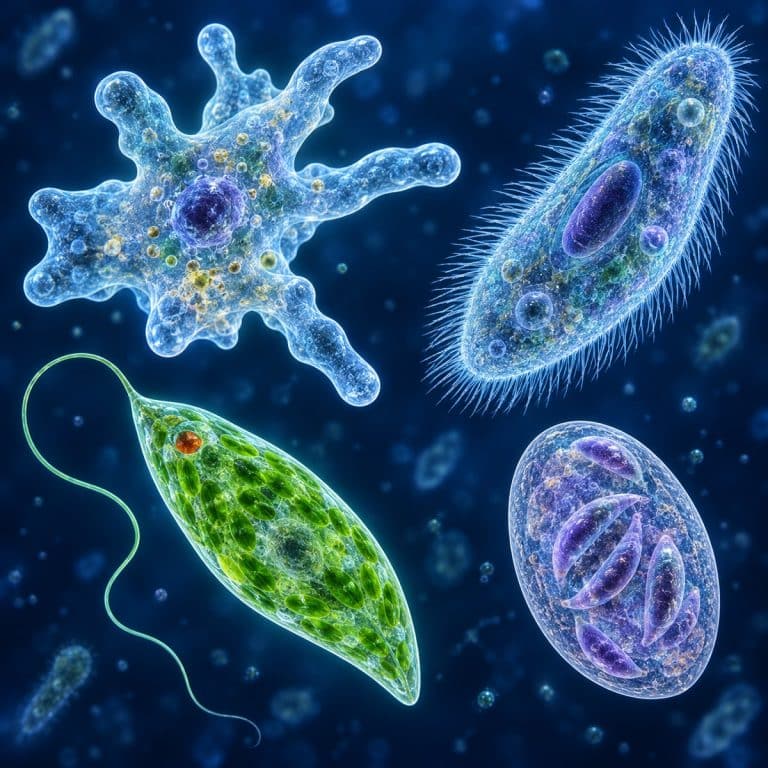
Protozoa are single-celled eukaryotic microorganisms — complete living things packed into one cell that carries a true nucleus, unlike bacteria. Modern science no longer treats “protozoa” as a single formal group. Instead, this guide sorts them the way a microscopist actually tells them apart — by how each one moves and feeds. By the end, you’ll recognize an amoeba, a Paramecium, and a Euglena on sight. You’ll also know why the “spinning wheel” rotifer that turns up in the same pond drop isn’t a protozoan at all.
How Protozoa Move: The 4 Main Types Explained
Protozoa are traditionally split into four groups based on their locomotion, and once you know the four movement styles, identifying a live sample under the microscope gets much easier. OpenStax illustrates how protists move with pseudopods, cilia and flagella.
Amoeboids — Movement by Pseudopods
Amoeboids move and feed by extending pseudopods (“false feet”), temporary bulges of cytoplasm that ooze the cell forward one blob at a time. They feed through phagocytosis, wrapping a pseudopod around a food particle and engulfing it into a food vacuole. The classic example is the amoeba and how it moves with its pseudopods.
Ciliates — Movement by Cilia
Ciliates are covered in cilia, short hair-like structures that beat in coordinated waves to propel the cell and sweep food into an oral groove. Ciliates are also unusual in carrying two nuclei — a macronucleus and a micronucleus. Paramecium and Vorticella are both ciliates, and you can meet the first one up close in our guide to the slipper-shaped Paramecium and its beating cilia.
Flagellates — Movement by Flagella
Flagellates move using one or more long, whip-like flagella. Euglena is the textbook flagellate — and a genuine oddball, since it carries chloroplasts and can photosynthesize while also swimming off to ingest food when light runs out. See it in motion in our page on Euglena, the flagellate that also photosynthesizes.
Sporozoans — Parasites Without Locomotion
Sporozoans have no locomotor organelle at all as adults and are exclusively parasitic, reproducing through spores inside a host. You won’t find one in a jar of pond water, but the group matters medically: Plasmodium, the parasite behind malaria in humans, is a sporozoan.
Common Protozoa Compared: Amoeba, Paramecium, Euglena, Vorticella & Rotifers
These five organisms are the ones you’ll actually encounter in a drop of pond water, and one of them — the rotifer — isn’t a protozoan at all. The table below compares how each moves, feeds, and stands out.

| Organism | Movement | Feeding | Group | Distinguishing feature |
|---|---|---|---|---|
| Amoeba | Pseudopods (creeping) | Phagocytosis | Amoeboid | No fixed shape; flows like slow-moving jelly |
| Paramecium | Cilia | Oral groove sweeps food in | Ciliate | Slipper shape; visible pulsing contractile vacuole |
| Euglena | Flagellum | Photosynthesis + ingestion (mixotroph) | Flagellate | Bright green; tiny red eyespot |
| Vorticella | Contractile stalk; cilia on the bell | Cilia sweep food to the mouth | Ciliate | Bell-shaped body on a spring-like coiling stalk |
| Rotifers | Corona (wheel) of cilia | Cilia draw food to the mouth | Not a protozoan — multicellular animal | Visible internal organs; “spinning wheel” head |
Vorticella is easy to spot once you know the trick. It looks like a tiny bell perched on a stalk, and when disturbed, the stalk suddenly coils back like a released spring. Rotifers and their spinning wheel of cilia are the odd one out on this list — they’re tiny multicellular animals with a gut and nervous tissue, not single-celled protozoa. Beginners scoop them up in the same pond sample anyway, so they’re worth knowing by sight.
Are Protozoa Animals, Plants, or Something Else?
Protozoa are neither animals nor plants — they’re eukaryotes that don’t fit cleanly into either kingdom. Older textbooks lumped them into “Kingdom Protista” alongside algae. Molecular classification has since scattered protozoa across several eukaryotic supergroups, such as Amoebozoa and the SAR group, based on genetic relationships rather than appearance. For a beginner, the useful takeaway is simpler than the taxonomy: protozoa are single-celled eukaryotes best sorted by behavior, not by a tidy kingdom name. Britannica’s overview of protozoan classification covers how that thinking has shifted. Euglena is the clearest example of why the old plant/animal split breaks down — it photosynthesizes like a plant but swims and eats like an animal, a genuine mixotroph. Its classification overview explains why protist groups do not form one simple kingdom.
Protozoa vs. Bacteria: What’s the Difference?
Protozoa are eukaryotes, while bacteria are prokaryotes — that single distinction explains almost every other difference between them. A protozoan’s DNA sits inside a membrane-bound nucleus and its cell contains organelles like mitochondria; a bacterial cell has no nucleus and a much simpler internal structure. Size gives it away too: protozoa typically run 10–200 micrometers, while bacteria are usually 0.5–5 micrometers, small enough that many need a much higher magnification to resolve clearly.

- Cell type: protozoa are eukaryotic; bacteria are prokaryotic
- Nucleus: protozoa have a true, membrane-bound nucleus; bacteria do not
- Size: protozoa are roughly 10–200 µm; bacteria are roughly 0.5–5 µm
Khan Academy’s rundown of prokaryotic versus eukaryotic cells is a good next stop if you want the full structural comparison, and our guide to how protozoa differ from bacteria under the microscope shows what that size gap actually looks like on a slide.
How Protozoa Feed, Move, and Survive
Protozoa feed in ways that match their movement style. Amoebas engulf prey through phagocytosis, ciliates sweep food into an oral groove, some flagellates absorb nutrients or photosynthesize, and sporozoans draw nutrients directly from a host. A structure called the contractile vacuole handles the housekeeping: it’s a small pump that collects and expels excess water so the cell doesn’t swell and burst. You can actually watch it pulse rhythmically inside a living Paramecium or Amoeba. Most protozoa reproduce asexually through binary fission, splitting one cell into two identical copies. Some ciliates also exchange genetic material through a process called conjugation, which functions more like recombination than reproduction.
Are Protozoa Harmful to Humans?
Most protozoa are harmless and ecologically important, quietly recycling nutrients and controlling bacterial populations in soil and water. A small number, however, are human pathogens: Plasmodium causes malaria, Giardia lamblia causes giardiasis, and Entamoeba histolytica can cause amoebic dysentery. This is educational background, not medical advice — if you suspect a parasitic infection, that’s a conversation for a healthcare provider, not a microscope slide.
How to See Protozoa Under a Microscope
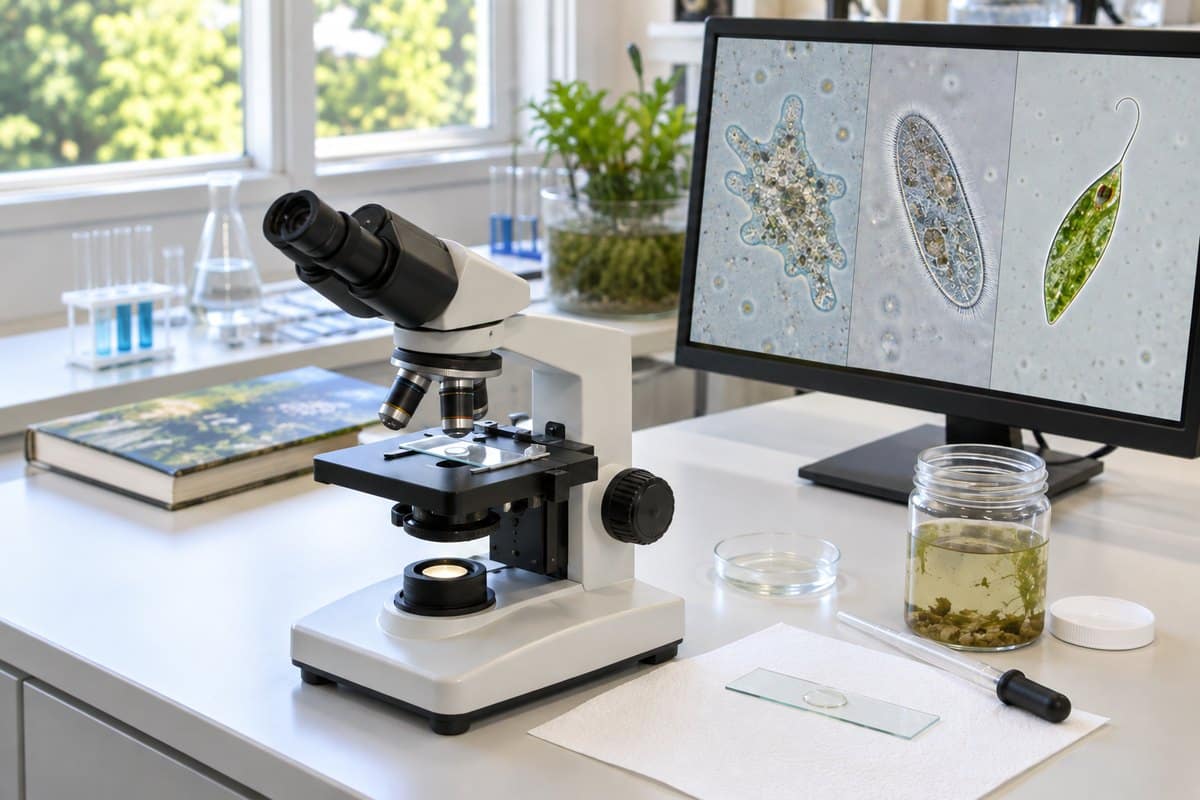
Pond water is the easiest place to find live protozoa, and a single drop under a coverslip can hold dozens of them. Scoop from the murky bottom or a clump of plant debris rather than clear surface water — that’s where protozoa concentrate. Prepare a wet mount slide following the standard steps for how to prepare microscope slides, then start scanning at 100×–400×; most protozoa fall in that range.
In that first minute at 100×, expect a busy, jittery field of near-transparent grey-green blobs and streaks — you’ll notice movement before you notice shape. An amoeba is easy to miss entirely; it barely moves and blends into debris, oozing a pseudopod forward like slow lava. Paramecium is the opposite: a fast, cigar-shaped cell that spirals as it swims and abruptly reverses when it bumps something, its cilia a faint shimmering blur along the edge. Two beginner mistakes cost most people their first good look. The first is cranking straight to the highest magnification — start at 40×–100× to find something moving, then zoom in. The second is flooding the field with light, which washes out these near-transparent cells; dial the diaphragm down for contrast instead. Fast swimmers also escape the field before you can focus; a fiber or a drop of methyl cellulose slows them down enough to actually study.
The same drop of pond water usually holds more than protozoa — keep an eye out for diatoms, the glass-shelled algae you’ll spot in the same sample, the plankton floating alongside them, and occasionally a larger hunter like Hydra. A moss squeeze, meanwhile, is your best bet for spotting tardigrades (water bears).
Frequently Asked Questions
Are protozoa unicellular or multicellular?
Protozoa are always unicellular — every protozoan is a single cell that carries out all life functions on its own. That’s exactly why rotifers, which are multicellular, don’t belong in the group despite looking similar under the microscope.
Is an amoeba a protozoan?
Yes. An amoeba is the classic example of an amoeboid protozoan, moving and feeding using pseudopods.
Where are protozoa found?
Protozoa live almost anywhere there’s moisture: freshwater ponds and puddles, marine water, damp soil, and even inside the bodies of host organisms as parasites.
How big are protozoa?
Most protozoa measure between 10 and 200 micrometers, with the majority falling in the 10–50 micrometer range. Paramecium, at up to 350 micrometers, can approach the edge of what’s visible as a moving speck to the naked eye.
Can you see protozoa without a microscope?
Not clearly. A few of the larger species might register as a barely visible speck of movement in bright light, but you need at least 100× magnification to make out any actual shape or structure.
Why is “protozoa” both singular and plural?
Strictly, “protozoan” is singular and “protozoa” is the plural — the same pattern as “bacterium” and “bacteria.” “Protozoans” is also accepted as a plural in everyday and scientific use.
Do protozoa reproduce sexually or asexually?
Most protozoa reproduce asexually by binary fission, splitting into two identical cells. Some ciliates also perform conjugation, a process where two cells exchange genetic material before separating again — it’s closer to recombination than to reproduction, since no new cells are produced.
Conclusion
Protozoa turn out to be far easier to sort than their name suggests once you stop looking for a tidy taxonomic box and start watching how they move: pseudopods, cilia, flagella, or nothing at all. That one habit — motion — is what separates an amoeba from a Paramecium from a Euglena at a glance, and it’s also what gives away the rotifer as an impostor in the group. The five organisms in this guide are exactly what you’ll meet in your first drop of pond water, so the next step is simple: get a slide under the scope and see which ones show up.
Have you spotted any of these in your own samples — or found one that didn’t match any of the four types? Tell us what you saw in the comments below.