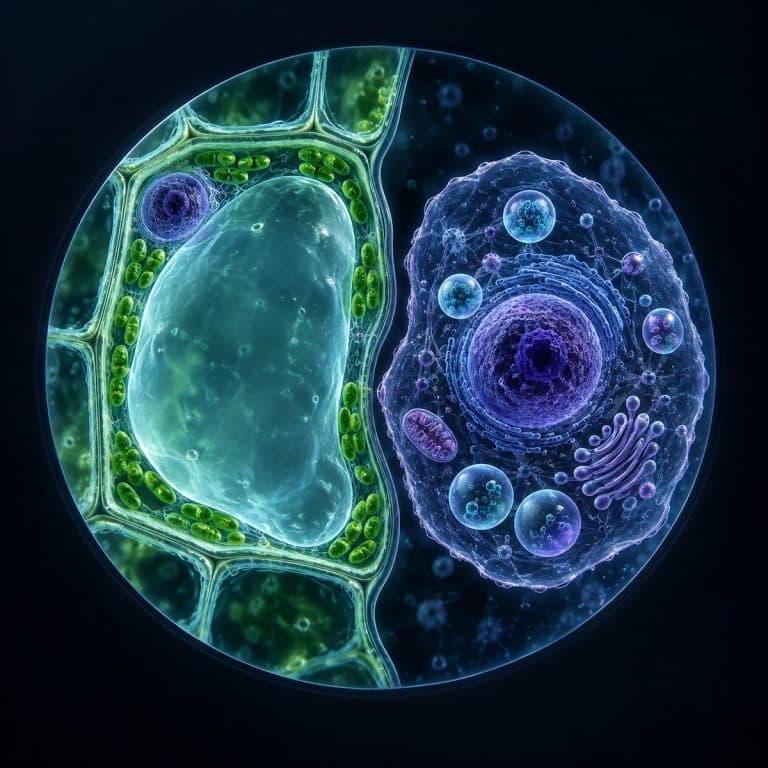
A vacuole is a fluid-filled sac wrapped in a single membrane, and in a mature plant cell one giant central vacuole can swell to fill 80 to 90 percent of the available space. Plants can get away with that because a rigid cell wall holds the resulting pressure in; an animal cell has no wall, so a permanent water balloon that size would simply burst it. The rest of this article breaks down what the vacuole is actually doing in there, why the plant-versus-animal split exists, and how to spot it yourself down a microscope.
What a Vacuole Actually Is
A vacuole is a membrane-bound organelle — essentially a bag inside the cell, sealed off from the surrounding cytoplasm. Vacuoles turn up across the eukaryotic world: plants, fungi, protists, and, in a much smaller and less permanent form, animals. In a mature plant cell, though, the vacuole isn’t a minor feature. It’s usually one enormous central sac that dominates the interior, squeezing the nucleus, chloroplasts, and cytoplasm into a thin layer pressed against the cell wall. That single-giant-sac arrangement is a feature of a mature cell, not a fixed rule for every plant cell at every stage of its life. OpenStax’s plant and animal cell comparison shows the central vacuole as a defining plant-cell structure.
Robert Hooke saw the outlines of this arrangement without knowing it in 1665, when he looked at a sliver of cork cells under the microscope and described neat rows of empty “boxes.” He was looking at dead plant cell walls with no living contents left inside — no vacuole, no cytoplasm, just the rigid cellulose scaffolding. That absence is actually a useful way to picture the vacuole: it’s the thing that, in a living cell, would have been filling most of that box.
The Tonoplast and Cell Sap
The membrane enclosing the central vacuole has its own name: the tonoplast, also called the vacuolar membrane. Like the outer cell membrane, it’s selectively permeable, and it’s studded with transport proteins — including a V-ATPase proton pump that actively keeps the inside of the vacuole more acidic than the surrounding cytoplasm. What the tonoplast holds in is cell sap: not just water, but a solution of dissolved ions (potassium, chloride), sugars, amino acids, pigments, enzymes, and metabolic waste products. Cell sap is not empty space and not the same thing as plant sap in the maple-syrup sense — it’s the vacuole’s working fluid, and the tonoplast decides what moves in and out of it.
What the Central Vacuole Does
The central vacuole isn’t just ballast. It runs several distinct jobs for the cell at once, and most of them come back to the same trick: moving water and solutes across the tonoplast. Its plant-body overview also explains how the large central vacuole supports plant structure.
Turgor Pressure: How It Holds the Plant Up
Water moves into the vacuole by osmosis, following the concentration gradient created by the solutes dissolved in the cell sap. As the vacuole takes up water, it swells and presses the rest of the cell’s contents — the protoplast — outward against the cell wall. That internal push is turgor pressure, and it’s the main reason non-woody plants stand upright without a skeleton. A cell with high turgor pressure is turgid: firm, plump, resistant to a light squeeze. Take water away — through drought, over-fertilizing, or just letting a cut flower sit too long — and turgor pressure drops, the cell goes flaccid, and the whole plant visibly wilts. Push the water loss further, into a strongly hypertonic solution, and the picture changes from “soft” to “detached”: the entire protoplast membrane pulls away from the cell wall. That’s plasmolysis, and it’s one of the easier vacuole behaviors to trigger and watch on purpose under a microscope.
Storage: Water, Nutrients, and Pigments
Beyond water, the vacuole is the cell’s long-term pantry. It stockpiles ions, sugars, and nutrients the cell isn’t using immediately, and it’s where many plants park their pigments. Anthocyanins — the pigments behind red and purple flowers, red cabbage, and red onion skin — sit dissolved in the cell sap, not floating loose in the cytoplasm. That’s a useful fact for a microscope slide: if you can see color pooling inside a plant cell, you’re very likely looking straight at the vacuole. The same storage role shows up structurally in tissue like a leaf cross-section under the microscope, where each mesophyll cell packs its chloroplasts around the rim of a vacuole that’s doing double duty as water reservoir and nutrient store.

Waste and Cleanup
Plants can’t excrete the way animals do — a rooted organism has nowhere to walk the trash to. Instead, the vacuole sequesters metabolic waste and toxic byproducts away from the cytoplasm. Its acidic interior also carries hydrolytic enzymes that break down worn-out organelles and unneeded macromolecules — the same degradation job animal cells hand off to a dedicated organelle, the lysosome. In a plant cell, the central vacuole does that work itself.
Why Plant Cells Have One Giant Vacuole and Animal Cells Don’t
The short answer is the cell wall. Turgor pressure only works as a support strategy if something on the outside can push back against it. A rigid cellulose cell wall can resist that outward pressure indefinitely, so a plant cell can safely fill most of its volume with a pressurized water balloon. An animal cell has no wall — just a flexible plasma membrane — so a large, permanent, water-filled vacuole would keep swelling until the membrane ruptured. That’s osmotic lysis, and it’s the reason animal cells never let a vacuole get that big or stick around that long; they regulate internal water and solute levels tightly instead.
The two lineages also solved “how do I stay upright” differently. Plants are sessile and lean on turgor pressure plus the cell wall for support at the cell level; animals move around, so they rely on a cytoskeleton and a body-level skeleton instead of a hydrostatic sac. Being sessile also explains the storage angle — a plant can’t walk over to find more water or nutrients, so banking a large reserve in one sac pays off. A mobile animal that can eat and excrete has far less use for one giant internal tank. There’s a growth-efficiency bonus too: a plant cell can get bigger mostly by pulling in water to expand the vacuole rather than manufacturing more cytoplasm, a cheap way to add surface area for light and gas exchange.

| Plant Central Vacuole | Animal Cell Vacuoles | |
|---|---|---|
| Number per cell | Usually one, in a mature cell | Many, small |
| Size | Up to 80–90% of cell volume | A small fraction of cell volume |
| Permanence | Long-term, stable structure | Often temporary (forms and empties as needed) |
| Main job | Turgor pressure, storage, waste isolation, degradation | Short-term transport, digestion of engulfed particles |
| Enclosing membrane | Tonoplast | Vesicle/vacuole membrane |
| Cell wall to contain pressure? | Yes | No |
Do Animal Cells Have Vacuoles?
Yes — the standard textbook diagram just makes it easy to miss. Animal cells do have vacuoles; they’re just small, numerous, and usually temporary rather than one dominant permanent sac. A white blood cell that engulfs a bacterium forms a food vacuole around it to digest the contents, then the vacuole disappears once the job is done. Cells constantly bud off and reabsorb smaller transport and secretory vesicles that function the same way in miniature. Compare that to a human cheek cell under the microscope, which has no large central vacuole at all — under a coverslip it just looks like a thin, roughly oval smear of cytoplasm around a nucleus, nothing like the obvious clear central zone you see in a plant cell. The accurate statement isn’t “animal cells have no vacuoles” — it’s that animal cells never build one large, permanent central vacuole the way plant cells do.
One More Kind of Big Vacuole: The Contractile Vacuole
There’s a third kind of vacuole worth knowing so it doesn’t get confused with either of the above. Freshwater protists like Paramecium and Amoeba live in water that’s more dilute than their own cytoplasm, so water constantly seeps in by osmosis. Left unchecked, that would burst them the same way it would burst an animal cell. Instead, they run a contractile vacuole: a structure that fills with excess water and then actively pumps it back out through the cell membrane on a regular cycle, a process called osmoregulation. It’s a functionally different organelle from the plant’s central vacuole — the plant vacuole stores and supports, the contractile vacuole bails water out — even though both are, at a glance, “the big sac in the cell.”
Seeing the Central Vacuole Yourself
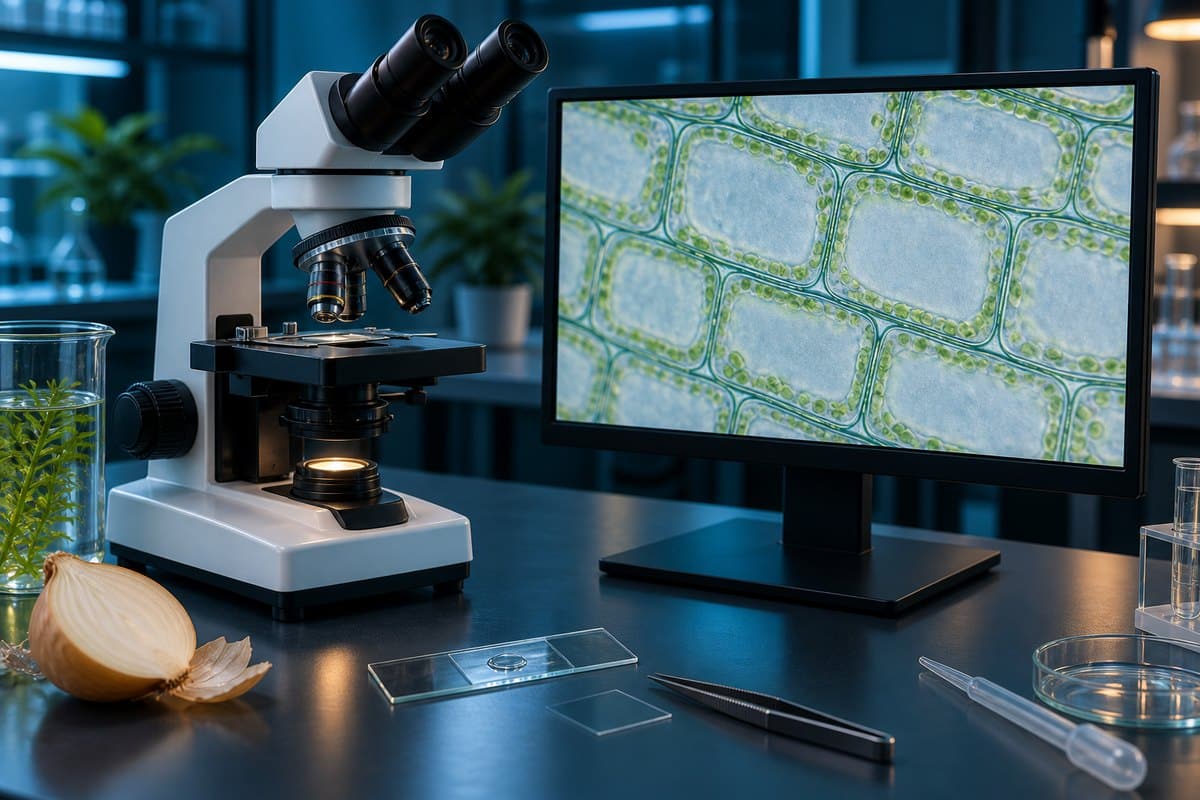
The central vacuole is one of the easiest plant-cell structures to see with a basic student microscope, and onion epidermal cells are the classic way in. Peel the thinnest possible layer of epidermis from the concave (inner) side of an onion scale — done right, it lifts off in one clean, transparent sheet — and lay it flat on a slide for a wet mount. At roughly 40–100x, the cells look like a brick wall or a tiled bathroom floor: long, interlocking rectangles. The big, clear, empty-looking zone filling most of each “brick” is the central vacuole; the cytoplasm is just a thin rim you’ll barely notice at first glance. Add a drop of iodine at the coverslip edge and wick it through with a scrap of paper towel, and the nucleus appears as a small stained dot pushed off to one side — sitting right against the wall, because the vacuole has shoved everything else out of the way.
Red onion makes the vacuole even more obvious, because the anthocyanin pigment tints the cell sap a visible purple-pink. Instead of an abstract clear space, you’re looking at a colored bag of liquid filling most of the cell — direct visual proof that the vacuole is a real, fluid-filled compartment and not just empty room. For an even more dramatic demonstration, add a drop of strong salt or sugar solution at one edge of the slide and watch live: the purple mass shrinks and pulls inward, away from the rigid cell wall, like a deflating water balloon retreating inside its box. That’s plasmolysis happening in real time, and it’s usually the moment a beginner really understands what the vacuole is. A leaf sample from Elodea (Anacharis) adds one more piece of the picture — its green chloroplasts stream in a thin, moving layer around the cell’s edge, circling the central vacuole rather than filling the cell, which is exactly why they hug the wall the way they do.
Two things ruin this slide more than anything else: over-staining (flood it with iodine and you drown the detail — one small drop, wicked through gently, is enough) and peeling a thick or folded piece of skin instead of a single clean layer, which gives an overlapping blur instead of the sharp brick-wall pattern. Work quickly, since a drying slide distorts the cells, and stop down the diaphragm — too much light washes out the vacuole’s already low contrast.
Frequently Asked Questions
What’s the difference between a vacuole and a vesicle?
They’re related, but not interchangeable. A vesicle is a small, short-lived transport sac used to shuttle materials around or into and out of a cell. A vacuole is generally larger and longer-lived — the plant central vacuole is the extreme example, a single permanent structure that can dominate the cell for its entire mature life.
Is the vacuole an organelle?
Yes. An organelle is simply a specialized, membrane-bound structure inside a cell that performs a specific job, and the vacuole fits that definition exactly: it’s bounded by the tonoplast and handles turgor pressure, storage, waste isolation, and degradation.
What happens to the vacuole when a plant wilts?
It loses water and shrinks. As water leaves the central vacuole, turgor pressure drops, the cell goes flaccid, and the whole plant droops. If water loss continues into a strongly hypertonic environment, the protoplast can pull away from the cell wall entirely — plasmolysis — which is a more severe, and not always reversible, version of ordinary wilting.
Do all plant cells have one big vacuole?
Only once they’re mature. Young, actively dividing plant cells (in the meristem, for example) start out with several small vacuoles scattered through the cytoplasm. As the cell matures and elongates, those small vacuoles gradually merge into the single large central vacuole that’s typical of a fully grown plant cell.
Can you see the vacuole under a microscope?
Yes, and it’s one of the easiest plant-cell structures to spot. In onion epidermal cells at 40–100x, the central vacuole is the large clear zone filling most of each rectangular cell, and in red onion the anthocyanin-tinted cell sap makes that same vacuole a visible purple-pink bag of fluid.
Conclusion
A vacuole is a straightforward idea once the cell wall enters the picture: plants can safely inflate one giant water-filled sac because their rigid wall contains the resulting pressure, and they put that pressure to work for support, storage, waste isolation, and cheap growth. Animal cells skip the giant version entirely — not because they lack vacuoles, but because a permanent one that size would burst a cell with no wall to hold it in.
Have you looked at onion or red onion cells under your own microscope and spotted the central vacuole, or tried the salt-water plasmolysis trick? Tell us what you saw in the comments below — and if the nucleus showed up as a stained dot pressed against the cell wall, you were looking at exactly the effect this article describes.