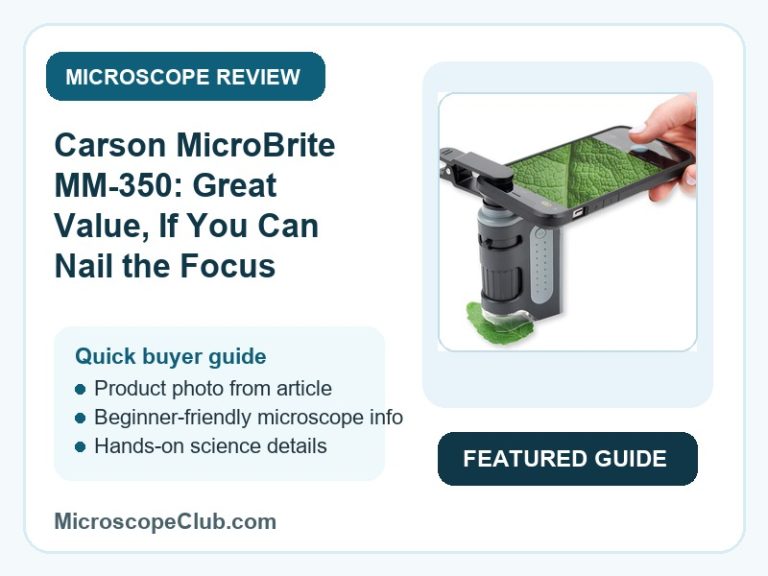
This Carson MicroBrite MM-350 review starts with the verdict: it’s a genuinely good buy for kids, homeschoolers, and casual hobbyists who want portable, LED-lit magnification — the #1 seller in Amazon’s School Science Supplies category — but one persistent frustration keeps it from being an easy recommendation for everyone. At 60x-120x optical zoom (up to 640x digital via the companion CarsonCam app), it’s built for curiosity-driven exploration — onion cell walls, mushroom pores, grass fibers — rather than lab-grade precision. If you’re buying for a kid who won’t mind a learning curve on focusing, or a hobbyist who wants a pocketable field tool, it delivers; if you wear glasses or need reliable smartphone photos, read the focus and adapter sections below before you buy.

✅ Pros
- Delivers genuinely clear close-up detail for the price — reviewers describe seeing onion cell walls and the nucleus without dyeing the sample
- LED illumination stays bright enough for on-the-go use, with several buyers noting it doubles as a flashlight in a pinch
- Pocket-sized and lightweight at 2.56 ounces — genuinely portable for field trips, hikes, and nature walks
- Kids find it engaging across a wide age range, holding attention well beyond a typical toy
- Backed by 1,395 reviews at a 4.1-star average and a #1 rank in School Science Supplies — a proven track record, not an unknown
❌ Cons
- Focus is the single biggest complaint cluster — nearly 6 in 10 mentions of “Focus” in customer feedback are negative, with some describing near-unusable sensitivity to movement
- A subset of buyers report a defective, drifting focus mechanism that keeps re-adjusting itself for a moment after the ring is released
- The smartphone digiscoping adapter doesn’t reliably fit newer or larger phones — iPhone 16 owners specifically flagged the fit
- Build feels cheap and plasticky to several buyers, including ones who otherwise rate it 5 stars
- Glasses wearers report real difficulty holding focus steady against the eyepiece
What to Look for in a Pocket Digital Microscope
Magnification range is the first spec buyers chase, but it’s the least useful number in isolation. The Carson MicroBrite MM-350’s 60x-120x optical range covers the sweet spot for surface-level detail — fabric weave, insect wings, leaf structure — without the razor-thin depth of field that makes true compound scopes frustrating for handheld use. The “640x” figure on the box is digital zoom through the CarsonCam app, which crops and upscales rather than resolving new detail, so it’s worth treating the optical number as the real spec and the digital number as marketing.
Illumination and focusing system matter more than magnification once you’re actually using the device. LED light sources solve the biggest practical problem with handheld scopes — inconsistent ambient light — but the focusing mechanism is where cheaper pocket microscopes tend to cut corners, and it’s the single attribute buyers complain about most across this entire product category. A dial or ring that’s too sensitive turns a five-second task into a five-minute one, especially for younger users. Build material also matters for longevity: plastic-bodied scopes like this one are light and drop-tolerant but feel less substantial than metal-barreled alternatives, a tradeoff worth understanding brand by brand — see our guide to the popular microscope brands for how manufacturers differ on build quality.
Smartphone compatibility is the feature that separates modern pocket microscopes from the loupes of a decade ago, but it’s also the most inconsistent spec on any listing. Adapter clips are sized for a range of phone thicknesses and camera-bump heights, and newer flagship phones with larger camera arrays are the most common fit failures. If digiscoping — capturing photos and video through your phone’s camera — is the main reason you’re buying, confirm your specific phone model against the adapter’s stated compatibility range before checkout, not after.
Who Should Buy a Pocket Digital Microscope?
Students, homeschoolers, and hobbyists who want a low-commitment entry point into magnified observation are the ideal audience for this category. A pocket digital microscope trades lab-grade optical precision for portability and immediacy — you can pull it out of a bag on a hike, in a backyard, or at a kitchen table, and start looking at something within seconds. That immediacy is exactly what makes these devices effective at building STEM curiosity in younger kids, where a full compound microscope’s setup, slide prep, and stationary use would be a barrier rather than a feature. For families weighing this category against a full classroom-style scope, our guide to the best microscopes for kids breaks down where pocket scopes fit against pricier alternatives.
Casual nature enthusiasts — hikers, gardeners, amateur mycologists — are the second core buyer for this category, and often the most satisfied. They’re not comparing the device to a pricier lab-grade compound microscope; they’re comparing it to using nothing at all, or squinting at a leaf with the naked eye. For that use case, a pocketable, battery-powered, LED-lit device that fits in a jacket pocket wins on convenience even when its optics fall short of laboratory standards.
Who This Is For
The Carson MicroBrite MM-350 is built for budget-conscious parents, homeschoolers, and teachers who want an entry-level STEM tool to spark curiosity, plus casual hobbyists — nature walkers, hikers, mycology and plant enthusiasts — who want a pocketable field magnifier rather than a precision instrument. The ideal buyer accepts a short learning curve on focusing and treats the phone-photo feature as a bonus rather than the main reason to buy.

Full Specifications
| Spec | Value |
|---|---|
| Light Source Type | LED |
| Magnification Maximum | 120x |
| Voltage | 5 Volts |
| Compatible Devices | Samsung, Smartphone, iPhone |
| Objective Lens Description | Achromatic |
| Power Source | Battery Powered |
| Item Dimensions L x W x H | 2.9″L x 1.1″W x 4.6″H |
| Item Weight | 2.56 ounces |
| Enclosure Material | Plastic |
| Color | Black, Grey |
| Model Name | MicroBrite Pro |
| Brand | Carson |
| UPC | 046876000201 |
| Global Trade Identification Number | 00046876000201 |
| Manufacturer Part Number | MM-350 |
| Unit Count | 1.0 Count |
| Item Type Name | Pocket Microscope |
| Warranty Description | One Year Limited Warranty from Manufacturers Defects |
| Built-In Media | Pocket Microscope, Smartphone Digiscoping Clip |
Optical Performance and Magnification
The Carson MicroBrite MM-350 delivers 60x-120x optical magnification through an achromatic objective lens designed to reduce the color fringing that cheaper single-element lenses introduce. That achromatic correction is the reason reviewers can consistently make out fine structure — one buyer, a self-described mycologist, used it to examine the pore structure of a Reishi mushroom and called the resulting detail sharper than expected for the price. Once focused correctly, the image is described repeatedly as “clear,” “bright,” and “crisp,” which suggests the optical path itself is doing its job.
The Carson MicroBrite MM-350 extends its effective range to 640x through the CarsonCam app’s digital zoom, though this is a crop-and-upscale function rather than additional optical resolution — a distinction the listing’s “Lab-Tested Precision” language doesn’t make clear. Buyers evaluating the digital zoom figure should expect it to help with framing and sharing photos, not to reveal detail the 120x optical lens can’t already resolve.
Focus System and Build Quality
The Carson MicroBrite MM-350 controls focus through a manual ring that, according to customer-aspect data, generates more negative feedback than any other attribute on the listing — 16 of 27 “Focus” mentions are negative, the only category on the entire listing that skews that direction. Reviewers describe outcomes ranging from a manageable learning curve (“This cheap little scope works great except it’s kinda hard to focus”) to reports that read as a hardware defect: one buyer detailed a focus ring that kept drifting for roughly a second after being released, calling the scope “almost unusable” as a result.
The Carson MicroBrite MM-350 houses its optics in an all-plastic enclosure weighing 2.56 ounces, a choice that keeps the unit pocketable and drop-tolerant but reads as “cheap and plasticky” to multiple reviewers — including buyers who otherwise rated the product 5 stars. Carson’s own product documentation covers the MM-350’s design and included accessories in more depth than the Amazon listing does; see the manufacturer’s MicroBrite product page for the full accessory breakdown.
Smartphone Digiscoping and Ease of Use
The Carson MicroBrite MM-350 pairs with the CarsonCam app to capture up to 48MP photos and 4K video once a phone is seated in the included clip-on adapter, and buyers who get the pairing right describe results ranging from “decent” to genuinely impressive — one reviewer’s photographed Reishi mushroom pores and rice-mold video samples drew unprompted praise for clarity. The adapter’s fit is the weak link: it’s confirmed to work with Samsung Galaxy models (S10 Plus specifically mentioned) and older iPhone bodies, but at least one buyer found it incompatible with an iPhone 16, and a Google Pixel 9 Pro XL owner reported the phone’s camera kept auto-switching lenses and losing the image.
The Carson MicroBrite MM-350 asks for a genuine adjustment period before it becomes intuitive, and this shows up most clearly with glasses wearers, who report needing to hold the eyepiece steady against their face while also managing focus — a combination several reviewers found workable only after repeated attempts, and one reviewer found workable almost not at all. For buyers without glasses, the learning curve reads more as “takes a little time to get used to” than as a genuine usability failure.
What Customers Say
The Carson MicroBrite MM-350 holds a 4.1-star average across 1,395 reviews, with Amazon’s aggregated aspect data showing roughly 72% positive sentiment overall — though that figure hides real variation by attribute. “Quality” and “Fun to use” mentions run 92-100% positive, while “Focus” is the one attribute that skews negative, and “Image quality” and “Usability” split closer to 60/40. One reviewer summed up the appeal plainly: “These microscopes are really good for the price because they allow you to see things up close and with very good quality.” Another, describing a homeschool science lesson, wrote: “You can see the cells in onions, the cell walls and the nucleus without having to dye the onion… This has exploded their curiosity and love for science.” A more critical verified buyer captured the flip side: “The focus keeps changing for like a whole second after you stop moving the focus ring… it makes the whole scope almost unusable.”
Every review examined in this analysis carried a Verified Purchase badge, complaints were specific rather than vague, and the sample spanned five languages with no repeated phrasing — the kind of internal consistency expected from a genuine long-tail review base rather than a manipulated one. Buyers who want to understand how review authenticity is typically assessed can reference the FTC’s rule on the use of consumer reviews and testimonials for the federal standard this kind of analysis is measured against.
Final Verdict
CONSIDER: the Carson MicroBrite MM-350 is a genuinely good buy for its target audience — kids, homeschoolers, and casual hobbyists who want a portable, LED-lit way to look closer at the world — but the focus ring is a real and recurring friction point that a meaningful minority of buyers describe as a dealbreaker, and glasses wearers in particular should manage expectations before purchasing.
Frequently Asked Questions
Does the Carson MicroBrite MM-350 come with glass slides or coverslips?
No. The MM-350 is designed as a handheld surface-viewing microscope rather than a slide-based compound scope, so it doesn’t include glass slides or coverslips. At least one buyer purchased slides and coverslips separately to make positioning specimens easier, but noted they aren’t necessary for how the device is meant to be used.
Will the phone adapter fit an iPhone 16 or a larger Android phone?
Not reliably. The adapter is confirmed to work with older iPhone bodies and Samsung Galaxy models like the S10 Plus, but at least one reviewer reported the clip did not fit an iPhone 16, and a Google Pixel 9 Pro XL owner had trouble getting the phone’s camera to register the image at all. Check your specific phone model’s dimensions against the adapter’s stated range before buying if digiscoping is your main use case.
Is the Carson MicroBrite MM-350 good for looking at solid objects, not just slides?
Yes — this is arguably its core strength. Reviewers use it on fabric, coins, plant leaves, grass, insects, and other opaque, everyday objects without any slide prep, which is exactly the kind of casual, no-setup observation this device is built for.
What warranty does the Carson MicroBrite MM-350 come with?
It ships with a one-year limited warranty covering manufacturer’s defects, consistent with Carson’s standard coverage on its entry-level optics.
Can adults use the Carson MicroBrite MM-350, or is it just a toy for kids?
Adults do use it, and several reviews describe it as genuinely useful for casual adult applications — one buyer’s husband uses it for lab-adjacent work examining trichomes, and a mycologist reviewer uses it regularly to inspect mushroom pore structure. It’s marketed toward kids first, but it isn’t exclusively a toy.
How does the Carson MicroBrite MM-350 compare to a traditional lab microscope?
It isn’t a substitute for one. Magnification tops out at 120x optical versus the 400x-1000x+ typical of compound lab microscopes, and there’s no slide-staging mechanism for thin-section or stained-slide work. Its advantage is portability and immediacy — no setup, no power outlet required, usable anywhere — which a lab-grade compound microscope can’t match.
Does the Carson MicroBrite MM-350 need batteries?
Yes. It runs on battery power at 5 volts to drive its built-in LED illumination, so it’s fully portable without needing to be near an outlet — one reviewer specifically noted using the LED as an improvised flashlight in the field.
Conclusion
The Carson MicroBrite MM-350 suits exactly the buyer it’s marketed to: a parent, homeschooler, or casual hobbyist who wants a portable, low-cost way to spark curiosity about the small-scale world, and who’s willing to spend a few minutes learning the focus ring in exchange for a device that fits in a pocket. It’s a harder recommendation for glasses wearers or anyone buying primarily for reliable smartphone photography, where the fit and focus complaints are concentrated.
If you’ve used the MM-350 to look at something unexpected — a leaf, a fabric, a backyard bug — we’d genuinely like to hear about it in the comments. And if you’re building out a broader field-observation habit, our guide on what grass looks like under a microscope is a good next stop for a first specimen to try.