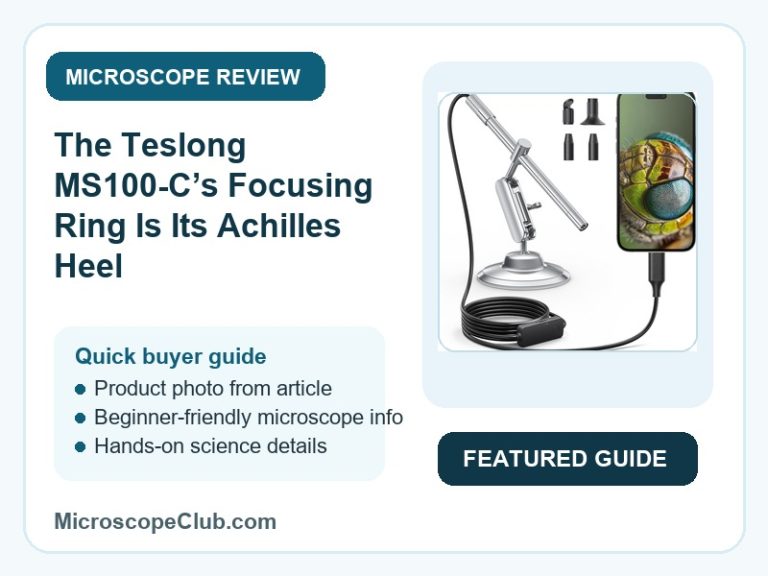
This Teslong MS100-C review lands on a clear verdict: it’s a genuinely capable budget USB-C handheld microscope for coin collectors, electronics hobbyists, and watchmakers, undercut by one recurring quality-control complaint — a focusing ring that some buyers describe as grinding and skipping instead of turning smoothly. At 4.0 stars across 186 ratings, the MS100-C isn’t a lab instrument and was never built to be one, but for phone-based inspection of small objects it delivers more than its price tag suggests, provided your expectations are calibrated to a hobbyist-grade tool rather than a precision optic.

✅ Pros
- Compact, pen-style body that’s genuinely portable — reviewers report carrying it for everyday inspection tasks, not just desk use
- Strong value for the price, especially for electronics repair work where a dedicated lab scope isn’t justified
- Good depth of field for a budget scope, making 3D objects easier to keep in focus than expected
- Well suited to niche precision hobbies like watchmaking, since the slim form factor doesn’t block tool access the way bulkier scopes do
- Plug-and-play setup with the companion app once connected, with adjustable focus and lighting controls
❌ Cons
- Inconsistent focusing ring — some units reportedly grind or skip between focus points instead of turning smoothly
- Camera/app has failed to function entirely on some Android devices, even after full setup
- No true optical zoom — the lens is fixed, so magnification changes by physically moving the scope closer or farther, not by zooming
- Computer and desktop support is inconsistent despite being listed as compatible
- Pink lens flare and a “ping” shading artifact can appear at the closest focus distances
What to Look for in a Handheld Digital Microscope
Magnification range is the number everyone quotes first, but it matters less than how usable that range actually is in hand. The MS100-C’s 10X-200X spread covers everything from reading fine print on a coin to inspecting solder joints on a circuit board, but like most handheld digital scopes in this price bracket, it achieves that range through a fixed lens and physical distance adjustment rather than true optical zoom — a distinction worth understanding before you buy, since it changes how you’ll actually use the device day to day.
Illumination and focusing mechanism decide whether a scope is pleasant to use or a source of daily frustration. Look for adjustable brightness (the MS100-C offers three levels across 8 LEDs) so you can kill glare on reflective surfaces like coins and PCB traces, and pay close attention to how the focus ring feels — smooth, dampened resistance is what you want, since a loose or gritty ring is one of the most common failure points across this entire product category. Connectivity matters just as much: USB-C is now the safe default for iPhone 15+ and modern Android, but always confirm computer support separately, since “compatible with Windows/Mac” claims on handheld scope listings are inconsistently honored in practice. For a deeper breakdown of what separates a genuinely good budget scope from a gimmick, see our guide to the best digital microscopes.
Build material and included accessories round out the decision. A metal barrel and stand, like the MS100-C’s, tend to survive daily handling better than plastic-bodied competitors, and bundled extras — ear specula, protective covers, side-view mirrors — signal a manufacturer targeting multiple use cases rather than a single narrow one.
Who Should Buy a Handheld Digital Microscope?
Hobbyists and collectors are the core audience for this category — coin and stamp collectors checking mint marks and wear, electronics hobbyists inspecting solder joints, and watchmakers who need clearance to work on a movement without a bulky stand in the way. For these buyers, a budget-friendly handheld scope replaces a loupe or magnifying glass with something that captures photos and video, which matters when you want to document a find or share it rather than just glance at it.
Students, educators, and curious first-time buyers are the other major segment, using a handheld scope to explore hair, skin, insects, and household objects rather than for professional inspection work. If that’s your household’s use case, our guide to microscopes for kids covers what to prioritize when the primary user is younger or newer to microscopy. What neither group should expect from this category is lab-grade optical precision — true cell and bacteria viewing requires a compound microscope, not a handheld digital scope at any price in this range.
Who This Is For
The Teslong MS100-C fits coin and stamp collectors, electronics repair hobbyists, and watchmakers who want an affordable, pocketable way to inspect small objects on an iPhone 15+ or USB-C Android device and view the results primarily on a phone or tablet screen. It’s a poor fit for anyone expecting reliable computer/desktop support, true optical zoom, or lab-level detail down to cells and bacteria.

Full Specifications
| Spec | Value |
|---|---|
| Light Source Type | LED |
| Real Angle Of View | 70 Degrees |
| Magnification Maximum | 200 x |
| Objective Lens Description | 10X to 200X Magnification |
| Power Source | USB Rechargeable |
| Enclosure Material | Metal |
| Color | Silver |
| Model Name | MS100-C |
| Brand | Teslong |
| Manufacturer Part Number | MS100-C |
| Unit Count | 1.0 Count |
| Warranty Description | 12 months warranty |
| Built-In Media | MS100-C, 2 Ear Specula, 1 Protective Cover, and 1 Side-viewing Mirror |
Optical Performance and Magnification
The Teslong MS100-C delivers 10X to 200X magnification through a fixed-focus lens rather than a true zoom mechanism, meaning you change effective magnification by physically moving the scope closer to or farther from the subject. One reviewer, a watchmaker, noted the tradeoff directly: “Note that it does not have a zoom lens, the lens is fixed and you have to get it closer or farther for better magnification” — a limitation he worked around by viewing the feed on a large monitor instead of pushing the scope in close.
The Teslong MS100-C achieves its stated depth of field through the same fixed-lens design, and multiple reviewers rated this a genuine strength rather than a weakness: one buyer with three comparable scopes called it “the deepest depth of field” of the group, adding that “focusing on 3D objects is much better” as a result — particularly when handheld rather than mounted on the included stand. Image quality drew mixed reports at the closest working distances, where the 8-LED ring light can produce pink lens flare or a washed “ping” shading effect, a known limitation of budget LED ring illumination at macro distances rather than a defect unique to this unit.
Build Quality and Focusing Mechanism
The Teslong MS100-C houses its optics in a metal enclosure with a rotating metal stand, giving it more resilience to daily handling than the plastic-bodied scopes common at this price. The build quality earns consistent praise in reviews — one buyer called it “well designed, well made, sturdy, easy to work with, small enough to fit anywhere” — and the compact pen-style body is precisely what makes it viable for tool-adjacent hobbies like watchmaking, where bulkier scopes physically get in the way.
The Teslong MS100-C splits opinion on exactly one component: the focusing ring. One buyer described a serious mechanical fault: “Sometimes the focusing ring is smooth and stays put. Other times it feels like a metal on metal pepper grinder and jumps from one focus point to another without warning. It likely has metal chips or burrs inside the microscope body and or on the treads.” That complaint isn’t isolated — of the review mentions specifically addressing focusing, the majority describe it as difficult or unreliable rather than smooth, making it the single weakest-rated aspect of the product and the main reason this review lands on a qualified recommendation rather than an unqualified one. Teslong’s build quality across its wider inspection camera and microscope lineup is generally well regarded, which makes an isolated mechanical fault like this one more likely a unit-level QC miss than a design flaw.
Connectivity, Compatibility & Ease of Use
The Teslong MS100-C connects through a USB-C interface built for iPhone 15 and newer models, Android devices with USB-C ports, Windows PCs, and MacBooks — on paper, broad coverage of the modern device landscape. In practice, setup is described as fast and reliable on the devices it’s designed for: one reviewer called it “pretty much plug and play with the i-see app,” with adjustable resolution, focus, and lighting controls once connected.
The Teslong MS100-C doesn’t hold up to its own compatibility claims universally, though, and this is the second most-repeated complaint after the focusing ring. One Android user reported a total functional failure after full setup: “I downloaded the app and adjusted all relevant settings on three different android devices and could only get the light to work, nothing else.” A separate reviewer flagged desktop support specifically: “needs an app for computers. OK for phone or tablet.” The pattern across reviews suggests the MS100-C performs best on the exact devices it’s marketed for — recent iPhones and USB-C Android — and is a gamble outside that lane.
What Customers Say
The Teslong MS100-C holds a 4.0-star average across 186 ratings, and Amazon’s AI-generated review highlights break sentiment down by topic: compatibility mentions run 23 positive to 7 negative, ease of use runs 7 positive to 4 negative, and focusing is the one category where negative mentions outnumber positive, at 6 negative to 3 positive out of 9 total mentions.
“It’s a little fiddly to set up but it works great. I use it for electronics work and you can’t beat the price,” one reviewer wrote. Another, more critical buyer summed up the focusing issue bluntly: “Fun little toy doesn’t focus well and I doubt it is a 200x magnifier.” A third, giving 4 stars overall, captured the product’s split personality well — “I’m really glad I bought this basic portable digital microscope! It has been allot of fun and very educational!!!” — despite detailing the same rough focusing ring as a “Super BAD issue” earlier in the same review. All sampled reviews carried the Verified Purchase badge, and the specific, differentiated detail across them — lens flare at close focus, ear-canal barrel sizing, watchmaking tool clearance — reads as authentic use rather than templated praise; for more on how to spot the opposite pattern, see this overview of fake and manipulated online reviews.
Final Verdict
CONSIDER: the Teslong MS100-C is a legitimately good value pick for coin collectors, electronics hobbyists, and watchmakers who need an affordable, portable way to inspect small objects on a recent iPhone or USB-C Android phone — but the documented focusing ring quality-control issue is real and recurring enough that buyers should go in with eyes open, test the focus action as soon as the unit arrives, and use Amazon’s return window if it grinds rather than turns smoothly.
Frequently Asked Questions
Does the Teslong MS100-C work with all iPhones?
No. It uses a USB-C interface, so it’s designed for iPhone 15 and newer models, which switched to USB-C. Older iPhones with a Lightning port aren’t natively supported by this scope.
Will it work with my Android phone?
It works with Android devices that have a USB-C port, and most reviewers report smooth setup on Android. A minority of buyers reported the camera failing to function on their specific Android device even after full setup, so this isn’t universally guaranteed.
Can I connect it to a Windows PC or Mac?
Teslong lists Windows PC and MacBook compatibility, and some buyers confirm it works well on a MacBook. At least one reviewer reported needing a separate, unlisted computer app to get it working, so desktop support is less consistent than phone support.
Does the MS100-C run on batteries, or does it need to be plugged in?
It’s USB rechargeable rather than battery-powered, and it draws power directly through the same USB-C cable used for the data connection. There’s no separate charging port or removable battery to manage.
What’s covered under the warranty?
The MS100-C comes with a 12-month manufacturer warranty. Given the documented focusing ring quality-control issue, it’s worth testing the unit thoroughly in the first few weeks rather than waiting until later in the warranty period.
Can I see cells or bacteria with this microscope?
No. This is a handheld inspection scope, not a compound lab microscope, and it doesn’t have the optical resolution needed to view cells or bacteria. It’s built for surface-level detail on coins, electronics, skin, hair, and small objects.
What accessories come in the box?
The MS100-C ships with the microscope body, a rotating metal stand, 2 ear specula, 1 protective cover, and 1 side-viewing mirror for examining hard-to-reach areas.
What file format do photos and videos save in?
Photos save as PNG files through the companion app, and one reviewer confirmed they can be converted to PDF, shared, or downloaded directly from the app — useful if you’re documenting a coin find or a repair job rather than just glancing at it live.
Conclusion
The Teslong MS100-C earns its place as a budget pick for collectors, electronics hobbyists, and watchmakers who want a portable, phone-based way to inspect small objects — as long as you accept its fixed-lens design and test the focusing ring the moment it arrives. It isn’t a lab microscope, it isn’t guaranteed to work flawlessly on every Android phone or computer, but for its core audience it delivers real value at its price point.
Have you used the MS100-C or a similar handheld USB microscope for coin collecting, electronics repair, or watchmaking? Share what worked — or didn’t — in the comments below. If you’re new to prepping subjects for a closer look, our guide to preparing microscope slides is a useful next stop.
Originally posted 2026-07-30 09:00:00.