Observing Sperm Cells Under Microscope

Photo of Observing Sperm Cells Under Microscope

Observing sperm cells under a microscope is another interesting experiment to conduct. Analyzing sperm can give information about the reproductive function of a male patient. Observing sperm cells is also part of a routine semen analysis and is done to identify issues with the male reproductive cells. An observer can come up with normal sperm …

Read more

Observing Blood Cells Under the Microscope

Photo of Observing Blood Cells Under the Microscope

Observing blood cells under the microscope is often part of the medical analysis to find any abnormalities in the structure of the blood. The process is called blood smear or hematology analysis. Often, doctors would request for complete blood count to check the disparity of the red blood cell, white blood cells and get the …

Read more

What Does Grass Look Like Under a Microscope?

Photo of What Does Grass Look Like Under a Microscope?

Grass under the microscope reveals a world of geometric precision that most people walk over every day without suspecting. Mount a fresh blade of lawn grass, bring it into focus at 40×, and the first thing that snaps into view is a neat row of oval vascular bundles running the length of the leaf — …

Read more

What Does a Worm Look Like Under a Microscope?

Photo of What Does a Worm Look Like Under a Microscope?

Worms under a microscope reveal a world far stranger and more detailed than a garden shovel ever shows: transparent organs pulsing with fluid, hair-like setae gripping a glass slide, and embryos assembling cell by cell inside a living body. Three completely unrelated groups — segmented annelids, flat platyhelminthes, and cylindrical nematodes — all carry the …

Read more

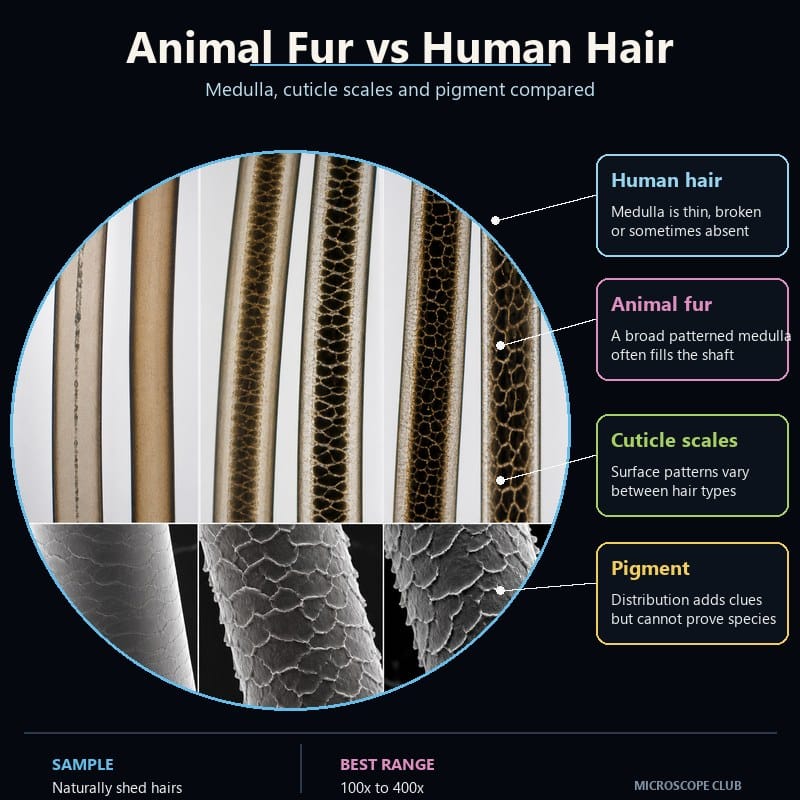
Animal Fur vs Human Hair Under a Microscope: Species ID

Human hair and animal fur compared under a microscope by medulla and cuticle scale patterns

Animal fur vs human hair under a microscope comes down to three structures: the medulla, the cuticle scale pattern, and the way pigment sits inside the shaft. Animal fur usually shows a wide, patterned medulla and crown- or petal-shaped scales, while human hair shows a thin or absent medulla under flat, tile-like scales. Below is …

Read more

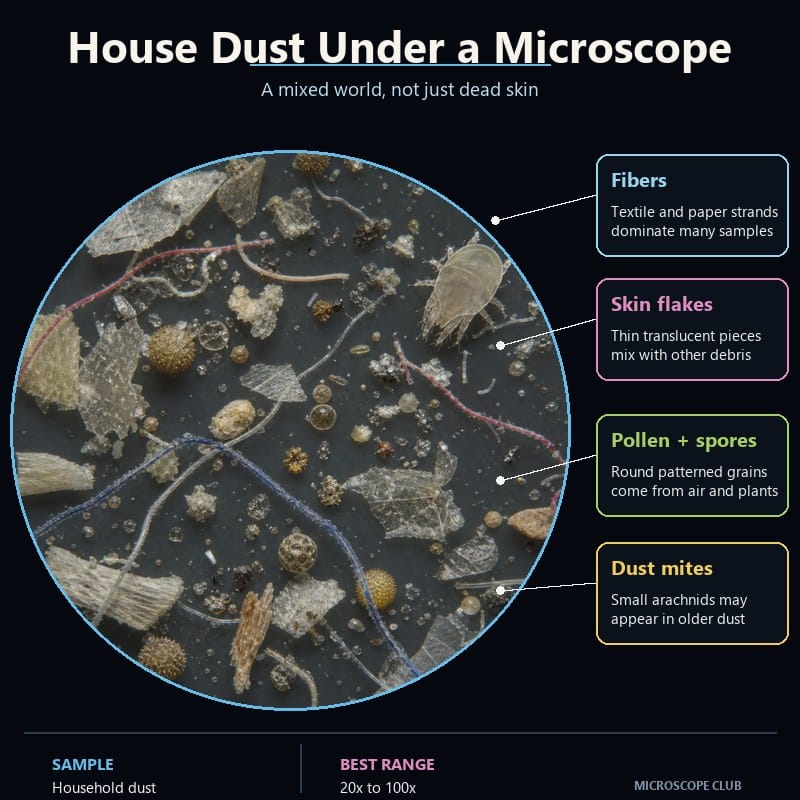
House Dust Under a Microscope: Not Just Dead Skin

House dust under a microscope showing fibers, skin flakes, pollen, mineral particles and a dust mite

House dust under a microscope turns out to be a mixture of shed skin flakes, textile and paper fibers, pollen grains, mold spores, dust mites and their droppings, and tracked-in mineral particles. It isn’t the featureless gray fluff it looks like to the naked eye. Despite the popular myth, most of it doesn’t even come …

Read more

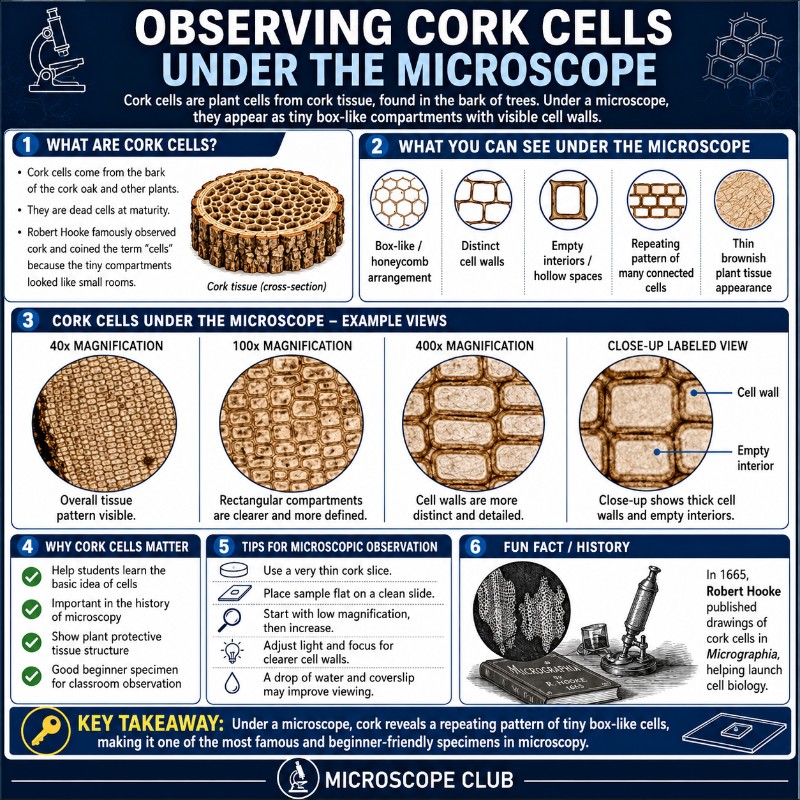
Observing Cork Cells Under The Microscope

Photo of Observing Cork Cells Under The Microscope

Cork cells are the reason the word “cell” exists in biology at all. When Robert Hooke pressed a sliver of cork against his primitive microscope lens in 1665, he saw rows of empty, walled compartments so uniform they reminded him of the tiny rooms — cellae — in a monastery. He drew them, named them, …

Read more

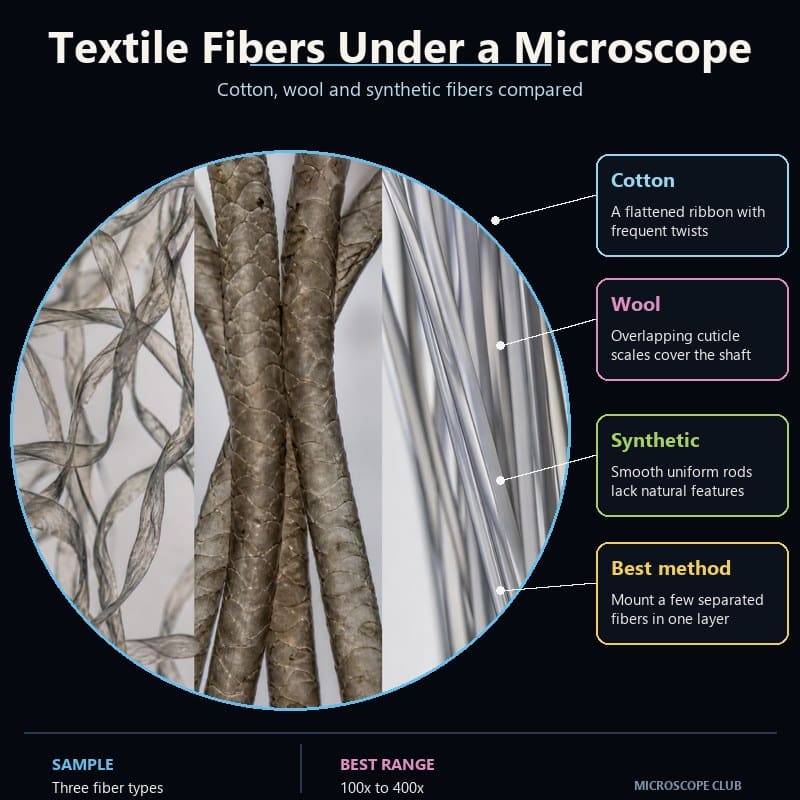
Textile Fibers Under a Microscope: Cotton, Wool & Synthetic

Cotton, wool and synthetic textile fibers compared under a microscope

Textile fibers under a microscope give up their identity in seconds, long before a chemical test is needed. Cotton shows up as a flat, twisted ribbon; wool as a cylinder wrapped in overlapping scales; and synthetic fibers like nylon and polyester as a smooth, featureless rod. Once you know these three shapes, you can pull …

Read more

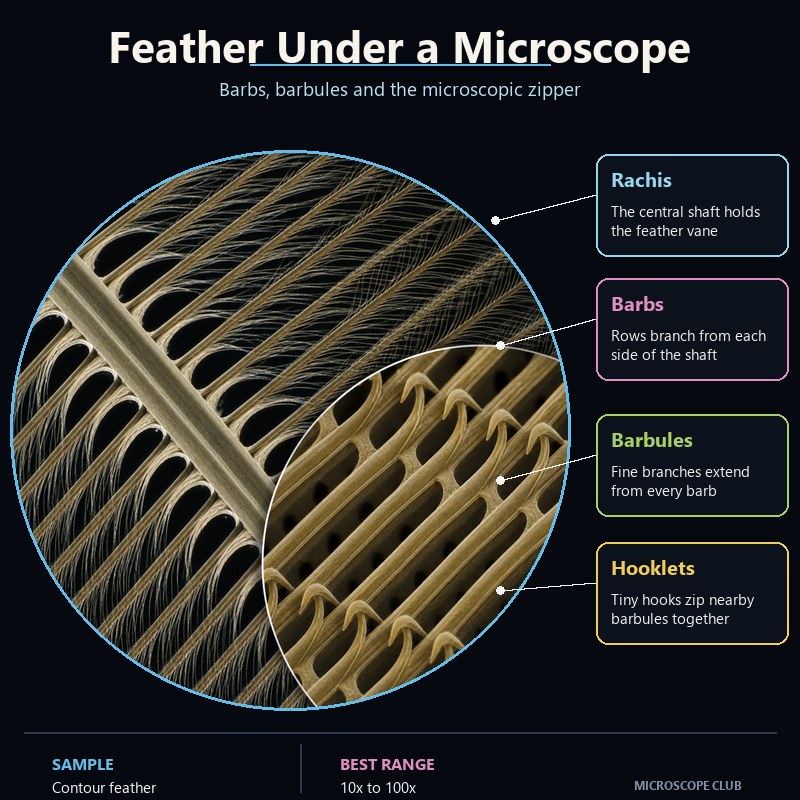
Feather Under a Microscope: Barbs, Barbules & the Zipper

Feather structure under magnification showing the rachis, barbs, barbules and interlocking hooklets

A feather under a microscope breaks apart into a branching hierarchy. A central shaft called the rachis carries rows of slender barbs angled off to each side. Each barb is fringed with barbules so fine they’re invisible to the naked eye. Zoom in far enough and those barbules resolve into microscopic hooks that latch onto …

Read more

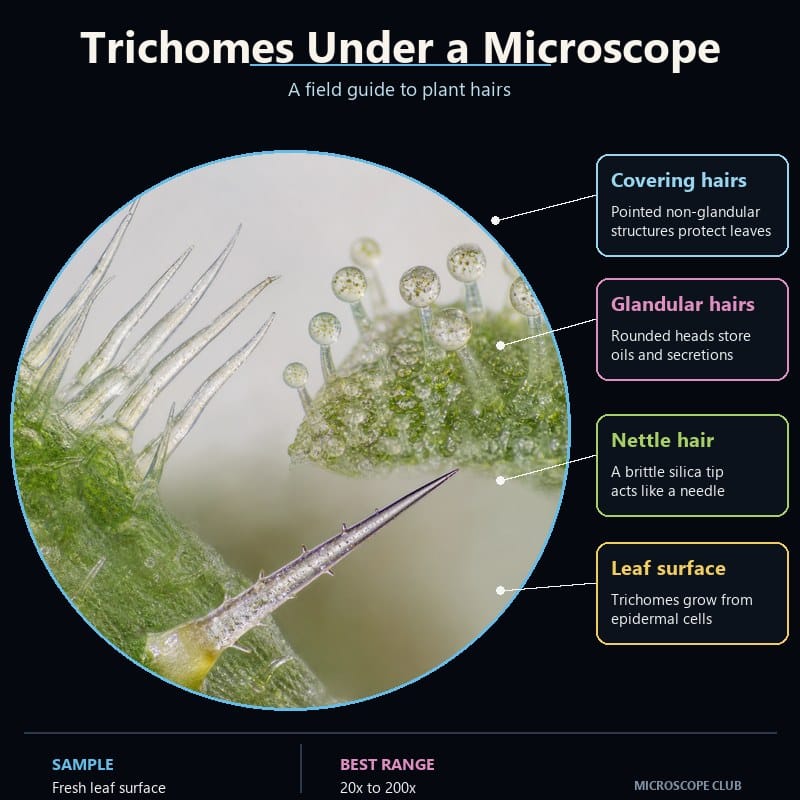
Trichomes Under a Microscope: A Plant Hair Field Guide

Non-glandular, glandular and stinging plant trichomes compared under a microscope

Trichomes under a microscope reveal a plant’s leaves and stems as far stranger surfaces than the naked eye suggests. Expect forests of glassy spikes, translucent balloon-headed glands, and even a tiny hypodermic needle. A trichome is simply a fine outgrowth of the plant epidermis — a plant hair — and it falls into one of …

Read more