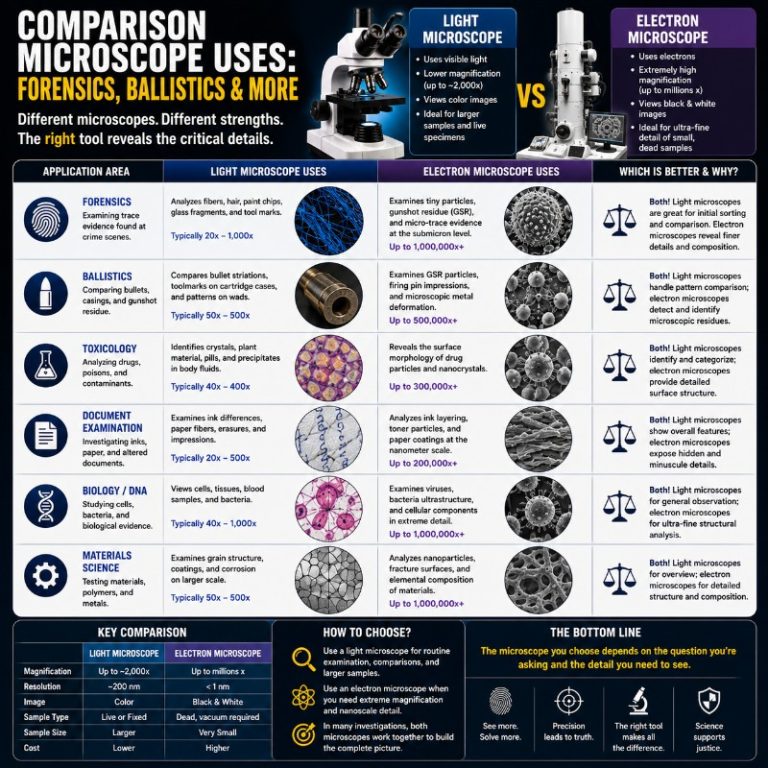
A comparison microscope is used to view two specimens simultaneously in a single split field of view — most famously in forensic science, where examiners place a bullet from a crime scene on one stage and a test bullet fired from a suspect weapon on the other, then judge whether the microscopic scratch patterns match. Unlike looking at two separate photographs, the side-by-side view under a comparison microscope lets a trained examiner align features directly across a dividing line in real time, making it the cornerstone tool of forensic ballistics, hair and fiber analysis, questioned-document examination, art authentication, and several other fields that depend on answering the question: do these two samples share the same origin?
How a Comparison Microscope Works: The Optical Bridge
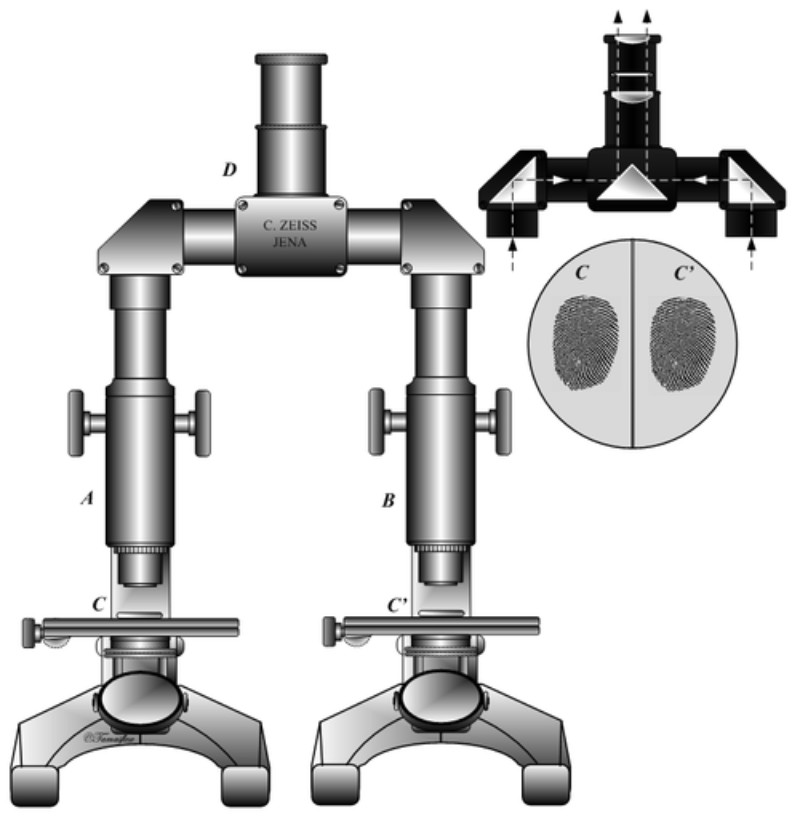
A comparison microscope is not one exotic instrument — it is two ordinary compound light microscopes mounted side by side on a single stand, connected by an optical bridge. That bridge contains a precise arrangement of mirrors and prisms that take the image from the left microscope’s objective, the image from the right objective, and merge them into a single eyepiece (or camera port). The result is a circular field of view divided by a thin vertical hairline — like two half-moons pressed together at their flat edges.
Each stage operates independently. The examiner can adjust the magnification, focus, and illumination on each side separately, then fine-tune until both halves of the field are crisp and equally lit. That independent control is the whole point: you can’t fairly compare two specimens if one side is brighter, blurrier, or magnified more than the other.
Illumination is usually reflected (incident) light for opaque samples like metal bullet surfaces and cartridge cases — light bounces off the surface at an angle, throwing striations and textures into sharp relief. For thin or translucent samples like textile fibers or biological hairs, transmitted light passes through both specimens simultaneously. Some comparison systems allow the examiner to switch modes independently on each side.
Magnification in forensic comparison work typically runs in the 10×–200× range, with ballistics examiners often working at lower power — around 10×–60×. Cranking magnification too high is one of the most common beginner mistakes: you zoom past the gross striation pattern you’re trying to match and end up staring at metal surface noise. Matching lives at lower magnification, where the full groove pattern is visible across both halves of the field at once. This is also why magnification vs. resolution matters — raw magnification without the right working distance for the sample type tells you nothing useful.
What a Comparison Microscope Is Used For
The comparison microscope earns its place in professional labs because the simultaneous, same-magnification, same-lighting view is qualitatively different from photographing two samples separately and looking at the photos. Subtle differences in lighting angle or magnification between photos can make matching features appear different, or make different features appear to match. The following fields rely on the real-time, single-field view for exactly that reason.

| Field | What’s being compared | Why side-by-side matters |
|---|---|---|
| Forensic ballistics | Bullet striations; cartridge-case marks | Striation alignment must be judged at identical magnification and lighting in real time |
| Toolmark analysis | Scene marks vs. suspect tool | Fine surface detail is lost in sequential photography |
| Hair & fiber | Unknown sample vs. known reference | Color banding, diameter, scale pattern compared simultaneously |
| Questioned documents | Ink, paper, type/print features | Alterations and ink differences visible side by side |
| Paint & trace evidence | Layer structure, color | Layer sequence must match precisely |
| Art authentication | Brushstrokes, pigments, canvas fibers | Micro-texture matching requires identical optical conditions |
| Gemology | Inclusions, cut facets | Identifying the same stone or detecting substitution |
| Industrial QC / metallurgy | Surface finish vs. reference standard | Rapid pass/fail against a certified reference part |
Forensic Ballistics and Firearms Identification
This is the comparison microscope’s signature application. When a firearm fires a bullet, the barrel’s interior leaves unique microscopic striations — fine scratches and grooves — on the bullet’s surface. These marks arise from the rifling (the spiral grooves cut into the barrel) and from microscopic tool marks left during manufacturing, which are unique to each individual barrel. The firing pin and breech face similarly imprint unique marks onto the cartridge case.
A forensic firearms examiner places the crime-scene bullet on one stage and a test bullet fired from the suspect weapon on the other, then slowly rotates the crime-scene bullet until the striation lines appear to flow continuously across the dividing hairline — the grooves on one side continuing seamlessly into the grooves on the other. When that continuity holds across the full circumference of the bullet, it is the basis for an identification. It’s a compelling visual: when the match is real, the lines don’t jump at the dividing line — they flow through it as if the hairline weren’t there.
Important caveat: the comparison microscope presents the evidence; the examiner decides. Firearms and toolmark identification has faced significant scientific scrutiny. The 2009 National Research Council report Strengthening Forensic Science in the United States and the 2016 PCAST report to the President both flagged firearms-toolmark identification as a discipline lacking fully established scientific validity for error-rate estimation. The instrument is a precision tool; the conclusions drawn from it are an expert judgment, not an automated or infallible result.
Toolmark Analysis
The same logic that governs bullet comparisons applies to marks left by any tool: a pry bar used to force a door, bolt cutters used on a padlock, or a screwdriver used to strip a serial number. A comparison microscope lets an examiner place the marked surface (a door jamb, a lock shackle) on one stage and the suspect tool on the other, then compare the microscopic surface texture of the tool’s cutting or pressing edge against the marks it left. Understanding the parts of a compound microscope helps explain why the stage controls — independent X/Y movement, rotation — are critical for this kind of alignment work.
Hair and Fiber Comparison
Hair and fiber trace evidence is a routine part of crime lab work. A comparison microscope lets an examiner view what human hair looks like under a microscope on one side and an unknown questioned hair on the other simultaneously. Under transmitted light, both hairs appear as translucent shafts with a darker central core (the medulla) and a surface scale pattern. The examiner compares diameter, medullary index, color banding, and scale structure side by side. Textile fibers show dye color, cross-sectional shape, and surface texture. Unlike DNA analysis, hair comparison under a microscope is a morphological — not a genetic — method, which limits its evidential weight when used alone.
Questioned-Document and Ink Examination
Document examiners use comparison microscopes to detect alterations: an added zero on a check, a substituted page in a contract, a forged signature. Comparing the ink lines of the suspected alteration against the known original ink under the same lighting conditions can reveal differences in ink depth, spread pattern, pen pressure, and fiber lifting that are invisible to the naked eye.
Paint, Glass, and Trace Evidence
Paint chip analysis — common in hit-and-run investigations — involves comparing the layer structure and color of a chip from the scene vehicle against paint from a suspect vehicle. A cross-section of the chip is mounted so both samples show the same layer sequence, then compared at the same magnification. Glass fragments can be compared for refractive index and surface texture. For any layered sample, the value of the comparison microscope is that the layer sequence, color, and thickness can be judged simultaneously at identical optical conditions rather than sequentially across photographs.
Beyond Forensics: Art Authentication, Gemology, and Industry
Art conservators and authentication specialists use comparison microscopes to examine brushstroke texture, pigment particle size, and canvas fiber weave — comparing a questioned painting against an authenticated reference work or a known section of the same canvas. A single forged brushstroke under a comparison scope alongside a genuine one by the same artist can reveal characteristic differences in pressure and direction.
In gemology, a comparison scope lets a gemologist place two stones side by side to detect substitution (a synthetic beside a natural gem) or to re-identify a stone from a collection. A metallurgical microscope serves an analogous role in industrial quality control, but the comparison configuration speeds up pass/fail inspection by eliminating the memory-comparison problem: both the reference and the test part are live in the same field.
What You Actually See Through a Comparison Microscope
The field of view is a single circle cut precisely down the middle by a thin, crisp vertical line. Left stage on the left half, right stage on the right — two half-moons pushed together. It takes a moment to adjust to the division; first-time users often try to move their eyes as if they’re looking at two separate images, but it’s one eyepiece, one image, split.
For a bullet comparison: the curved metal surface fills each half, lit from the side so that the striations — fine parallel scratches like the grain in a piece of wood, or the grooves on a vinyl record — appear as raised and lowered lines catching the light. When you slowly rotate the crime-scene bullet, there’s a moment where the lines begin to align across the hairline — and when a match is real, they snap into continuity, the groove pattern flowing from one side of the dividing line to the other without a jump or offset. Experienced examiners describe it as unmistakable when genuine.
For hair samples under transmitted light, both shafts glow against a bright background. You watch the medulla (the central channel) and the surface scale pattern on both sides simultaneously, making it straightforward to spot differences in diameter or color that would be easy to second-guess when comparing photographs. For fibers, dye color and surface texture are the key features, and side-by-side direct comparison eliminates the color-memory problem entirely.
The most common practical problem: uneven illumination between the two stages. If one half is brighter, surface detail on the dimmer side retreats into shadow, and genuine matching features can appear different. Experienced examiners set both stages to the same lighting before making any comparison — establishing a neutral optical baseline is the first step, not the last.
Comparison Microscope vs. Compound Microscope
| Feature | Comparison Microscope | Standard Compound Microscope |
|---|---|---|
| Number of stages | Two (independent) | One |
| Field of view | Single split circle (two specimens) | Single full circle (one specimen) |
| Primary purpose | Side-by-side specimen comparison | Single-specimen examination |
| Typical magnification | 10×–200× (forensic: often 10×–60×) | 40×–1000× (biological work) |
| Illumination | Reflected and/or transmitted, independent per side | Transmitted (typically) or reflected |
| Core mechanism | Two objectives + optical bridge | Single objective + single eyepiece |
| Typical setting | Forensic lab, authentication, QC | Biology class, research, clinical lab |
The key conceptual difference is purpose. A standard compound light microscope is built for examining a single specimen in detail. A comparison microscope is built for a specific question: are these two things the same? The optical bridge makes the comparison simultaneous and exact, which is something a photograph — or even two microscopes examined in sequence — cannot fully replicate. For a broader sense of where the comparison scope fits among the different tools available, see our guide to different types of microscopes and how their designs reflect their purposes.
A Brief History: From Gravelle and Goddard to Modern Crime Labs
The comparison microscope was developed in the early 1920s by Philip O. Gravelle, who conceived the optical bridge design, working with Calvin Goddard, Charles Waite, and John Fisher. The group’s goal was to put firearms identification on a scientific footing — to replace the expert’s “opinion” with a demonstrable, reproducible visual comparison that could be documented and reviewed.
The instrument’s most famous early application came in 1929. After the St. Valentine’s Day Massacre in Chicago — in which seven men were killed — Calvin Goddard used a comparison microscope to match cartridge cases recovered at the scene to two Thompson submachine guns found at a suspect’s home. That analysis helped establish the weapons’ connection to the crime and is widely cited as a landmark moment in the history of the microscope applied to criminal justice. The case is documented in the Britannica account of the St. Valentine’s Day Massacre and remains a standard example in forensic science education.
Modern forensic comparison microscopes are optically refined versions of Goddard and Gravelle’s original concept, now typically coupled to digital cameras and imaging software that let examiners document their comparisons in archivable photographs. The instrument itself hasn’t changed in principle; the documentation and review standards around it have.
Frequently Asked Questions
Who invented the comparison microscope?
Philip O. Gravelle conceived the optical bridge design in the early 1920s. He developed it alongside Calvin Goddard, Charles Waite, and John Fisher, who together established its use in forensic firearms identification. Goddard is most often credited publicly because of his high-profile casework — including the 1929 St. Valentine’s Day Massacre investigation — but Gravelle’s optical engineering was the foundation.
Is a comparison microscope definitively used to prove a match in forensics?
No. The comparison microscope is a tool for presenting evidence; the conclusion is a trained examiner’s judgment. Firearms and toolmark identification has faced peer-reviewed scientific scrutiny — both the 2009 National Research Council report and the 2016 PCAST report noted limitations in the established scientific validity of this method’s error-rate estimates. Comparison microscope findings are one type of forensic evidence, not a guaranteed proof of origin.
How much does a comparison microscope cost?
Entry-level comparison microscopes designed for educational use start around $800–$1,500. Professional forensic-grade systems from manufacturers like Leica, Nikon, or AmScope’s forensic line run $3,000–$10,000+, and fully configured crime-lab systems with digital imaging cameras and documentation software can exceed $20,000. The optical bridge itself is the costly component; it must maintain precise optical alignment across both microscope columns.
Can a comparison microscope be used for ballistics?
Yes — ballistics identification is the comparison microscope’s most prominent application. Forensic examiners use it to compare the striation marks on recovered bullets and the impression marks on cartridge cases against test-fired rounds from a suspect firearm. The simultaneous split-field view is what makes this practical: the examiner can rotate and align the specimens until striation lines either do or do not flow continuously across the dividing line.
Why can’t forensic examiners just photograph both samples and compare photos?
Photographs introduce variables that the optical bridge eliminates: exact magnification must match, lighting angle must match, and focus depth must match. Even small differences between two separately taken photos make it difficult to judge whether features genuinely align. The comparison microscope controls all three variables simultaneously on both specimens, which is why it remains the standard tool rather than a photographic workaround.
What’s the difference between a comparison microscope and a stereo microscope?
A stereo microscope (dissecting microscope) gives you a three-dimensional view of a single specimen at low magnification — it uses two separate optical paths that converge on one object. A comparison microscope uses two separate microscopes connected by a bridge to view two different specimens in a single split field. They solve different problems. For the full breakdown, see our compound vs. stereo microscope guide.
Can I buy a comparison microscope for home use or teaching?
Yes. Several manufacturers sell student and hobbyist comparison microscopes. They’re popular in forensic science classrooms for demonstrating evidence-comparison concepts. Look for models that include independent illumination controls on both stages — fixed-illumination setups make it impossible to demonstrate the lighting-mismatch problem that real examiners work around. AmScope and Swift both offer entry-level units suitable for educational demonstrations.
Conclusion
The comparison microscope is a deceptively simple idea — two microscopes, one bridge, one split field — that solves a specific and important problem: how do you compare two specimens with absolutely consistent magnification, focus, and lighting? That solution has made it indispensable in forensic science, art authentication, gemology, and industrial quality control for over a century. Its power is in the simultaneity of the view, not in any exotic optics.
Have you ever looked through a comparison microscope, in a lab class, a museum exhibit, or a crime-scene science program? Or are you thinking about adding one to a classroom or home lab? Tell us what you found — or what you’re hoping to compare — in the comments below.