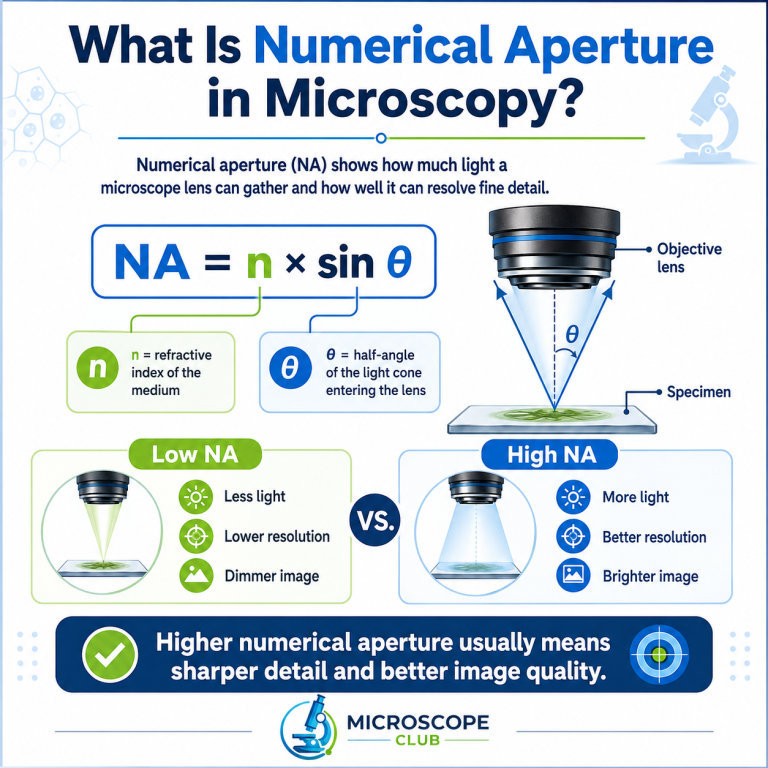
Numerical aperture in microscopy — abbreviated NA — is the single number stamped on every objective lens that determines how much detail you can actually resolve and how much light your lens can gather. Defined by the formula NA = n · sin(θ), it tells you the range of angles over which an objective can collect light from a specimen. Unlike magnification, which only makes an image bigger, NA is what decides whether two closely spaced structures can be distinguished at all. Understanding it is the difference between choosing an objective wisely and picking one by the magnification number alone.
What Is Numerical Aperture in Microscopy?
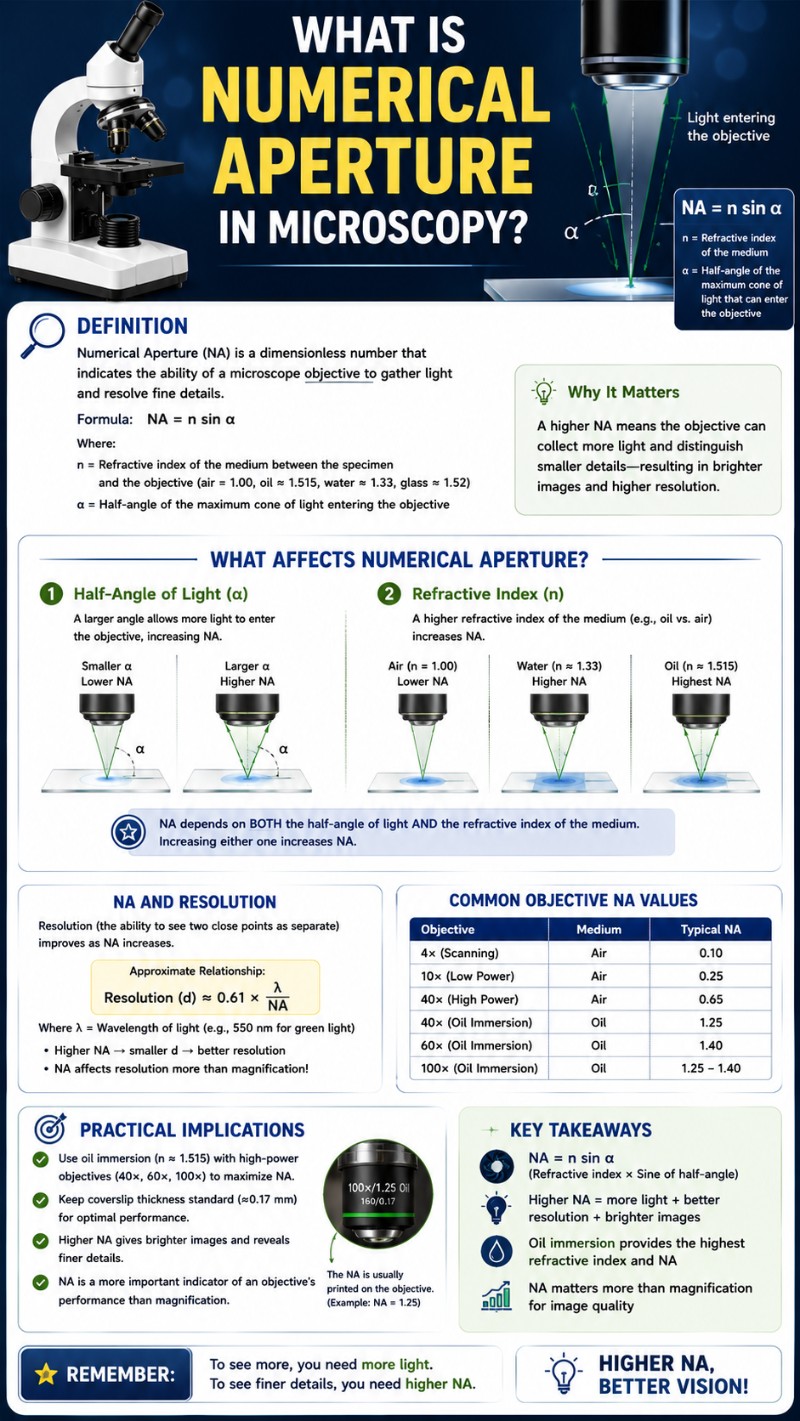
Numerical aperture is a dimensionless number that characterizes an objective’s (or condenser’s) ability to gather light and resolve fine specimen detail. The higher the NA, the more light the lens captures and the finer the detail it can resolve. It is independent of magnification — a 40× lens can have a higher NA than a 100× lens from a cheaper microscope.
Every objective barrel is labeled with both values: for example, 40× / 0.65 or 100× / 1.40 Oil. The second number is NA. Learning to read it tells you far more about an objective’s performance than the magnification ever will.
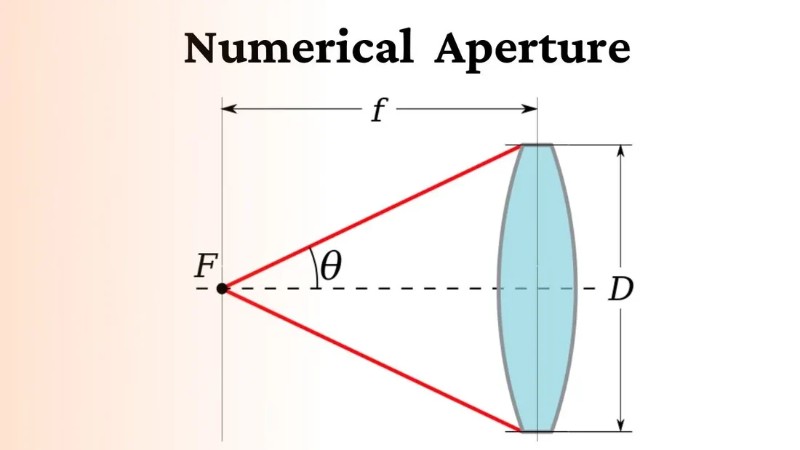
Numerical Aperture in Plain Terms
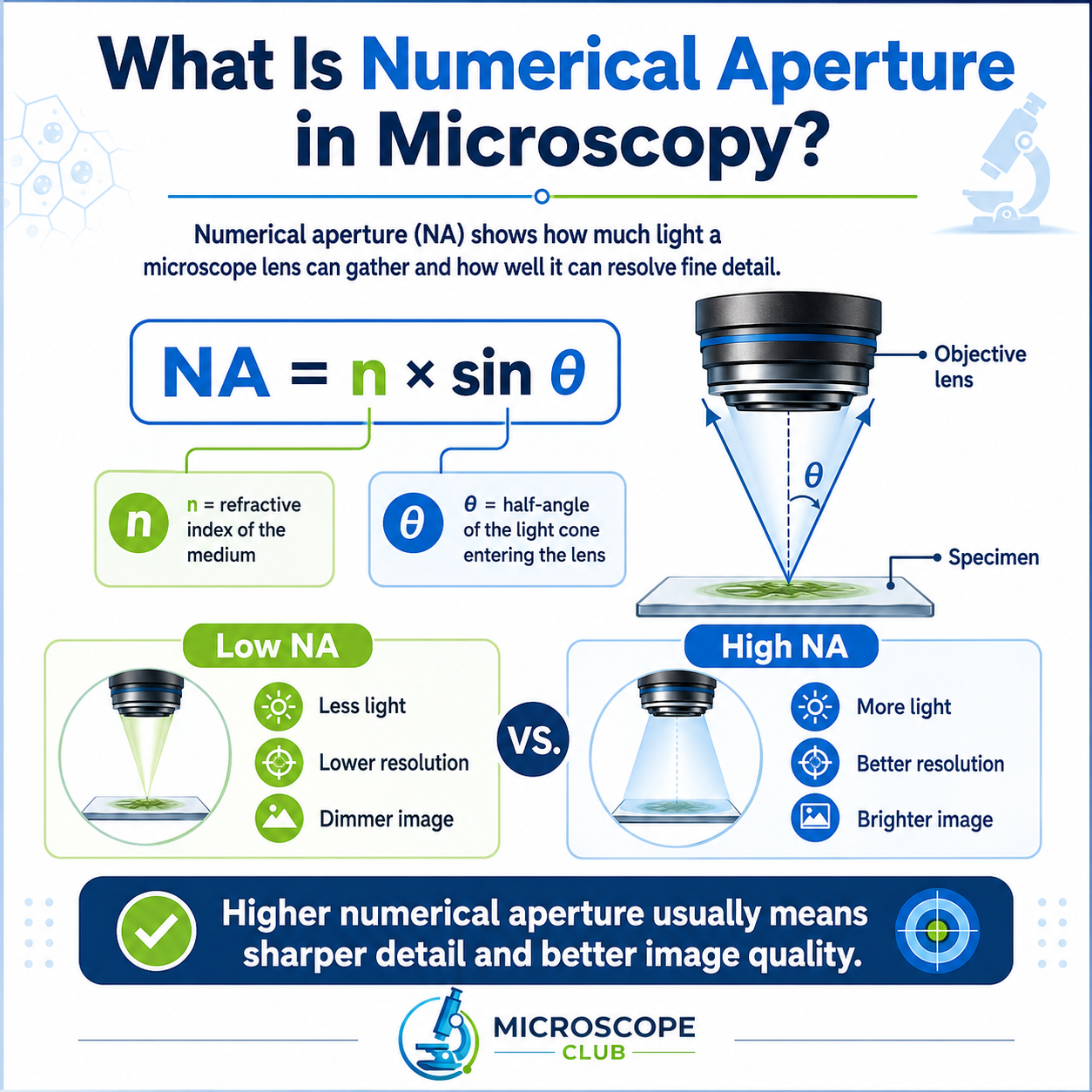
Picture a cone of light rising from your specimen toward the objective. The wider that cone — the more extreme the angles it captures — the more information about fine details reaches your eye or camera. NA is a measure of how wide that cone is, scaled by the optical properties of whatever medium sits between the front lens and the specimen. A wider cone means better resolution and a brighter image. A narrow cone means you’re throwing away detail before it ever reaches the lens.
The Numerical Aperture Formula Explained
The governing equation is:
NA = n · sin(θ)Two terms, but each carries a lot of meaning.
What the Refractive Index (n) Contributes
The variable n is the refractive index of the medium that fills the space between the objective’s front lens and the coverslip — or, for a condenser, between condenser and slide. Common values:

- Air: n ≈ 1.00
- Water: n ≈ 1.33
- Glycerol: n ≈ 1.47
- Immersion oil (matched to glass): n ≈ 1.515
Because NA is the product of n and sin(θ), the medium sets the hard ceiling for what NA is achievable. No matter how perfect the glass or how wide the angle, a dry (air) objective can never exceed NA = 1.0 in principle. In practice it tops out around NA 0.95, because sin(θ) cannot reach 1 — that would require a 90° half-angle, a physical impossibility. Switch to immersion oil and that ceiling rises to roughly NA 1.40–1.45.
What the Half-Angle (θ) Contributes
θ (theta) is the half-angle of the maximum cone of light the lens can accept — measured from the optical axis to the outermost ray the objective can gather. A wider objective front element and shorter working distance generally allow a larger θ. The sine function means gains diminish at extreme angles: going from 30° to 60° roughly doubles sin(θ), but going from 60° to 80° adds far less. This is why raising n via immersion media is ultimately more effective at boosting NA than engineering ever-wider angles alone.
Why Numerical Aperture Matters for Resolution
Resolution — the ability to distinguish two closely spaced points as separate — is governed by the relationship between how numerical aperture and wavelength determine microscope resolution. The Abbe diffraction limit gives the smallest resolvable distance:
d = λ / (2 · NA)Where λ is the wavelength of the illuminating light. A shorter wavelength or a higher NA shrinks d — meaning finer detail is resolved. The more complete form that accounts for the condenser is:
d = λ / (NA_objective + NA_condenser)Worked Example — Resolving Power at Different NA Values
Using green light at λ = 550 nm (a common reference wavelength), and the simplified Abbe formula d = λ / 2NA:
| Objective | Typical NA | Medium | Resolution @550 nm | Typical Working Distance |
|---|---|---|---|---|
| 4× | 0.10 | Air | ~2.75 µm | ~20 mm |
| 10× | 0.25 | Air | ~1.10 µm | ~5–10 mm |
| 40× | 0.65 | Air | ~0.42 µm | ~0.5–0.7 mm |
| 60× | 0.95 | Air | ~0.29 µm | ~0.15 mm |
| 100× | 1.25–1.40 | Oil | ~0.20–0.22 µm | ~0.13 mm |
| 60×/100× (TIRF) | 1.49 | Oil | ~0.18 µm | Very short |
The critical takeaway: a quality light microscope with a high-NA oil objective achieves around 200 nm (0.2 µm) resolution. That is the canonical resolution floor for conventional light microscopy — a hard limit set by physics, not engineering. Techniques like STED and STORM break this barrier by other means, but a standard compound light microscope cannot.
Values are representative; actual specs vary by manufacturer and correction class.
Rayleigh vs. Abbe — Why You’ll See Two Formulas
You may encounter a second formula in textbooks: the Rayleigh criterion, d = 0.61λ / NA. This gives slightly larger (more conservative) resolution values because it defines resolution as the point where the central maximum of one Airy disk falls on the first minimum of the adjacent one. The Abbe formula (λ/2NA) is the more commonly cited headline figure and represents the theoretical diffraction limit for self-luminous or coherently illuminated points. Both are correct; they apply different criteria for when two points are “just resolved.” Either way, NA is the key variable.
NA vs. Magnification — and the Empty Magnification Trap
This is one of the most common misconceptions in microscopy: magnification does not equal resolution. You can magnify an image to any size you want; that doesn’t reveal detail that was never captured in the first place. Once you exceed roughly 500–1000× the NA value, you enter the zone of empty magnification — the image is bigger but no sharper, and fine structures remain blurred or unresolved.
A 40× / 0.65 objective can resolve ~0.42 µm features. Projecting that image to fill a screen via a high-power eyepiece or digital zoom does not improve on 0.42 µm — you just see the same blur, larger. Meanwhile, a 40× / 0.95 objective resolves ~0.29 µm at the same magnification. NA is doing the real work. If you want more detail, raise NA. If you want a more comfortable viewing size, raise magnification. Don’t confuse the two jobs.
For more context, see the highest-resolution microscopes and why resolution depends on physics rather than magnification power.
Dry vs. Immersion Objectives (and Why Oil Raises NA)
When light travels from glass (the coverslip, n ≈ 1.515) into air (n = 1.00), it refracts at the interface. High-angle rays — the ones carrying the finest detail — undergo total internal reflection and never reach the objective at all. Immersion media eliminate this problem by filling the gap between coverslip and objective front lens with a substance whose refractive index closely matches the glass.
- Air (dry) objectives — n = 1.00, practical NA ceiling ~0.95. Convenient, no preparation required. Good for low-to-medium magnification work, live cells in thick vessels, or any situation where a long working distance is needed.
- Water immersion — n ≈ 1.33, NA up to ~1.2. Preferred for live-cell imaging in aqueous media; avoids the refractive index mismatch between oil and living tissue.
- Glycerol immersion — n ≈ 1.47, intermediate NA. Used with certain fixed specimens and confocal systems.
- Oil immersion — n ≈ 1.515, NA up to 1.40–1.45 (1.49 for TIRF objectives). The gold standard for maximum resolution in fixed, coverslipped samples. The oil’s refractive index matches glass, so high-angle rays travel from specimen through coverslip into objective without bending or being lost.
To be clear: immersion media are not primarily about brightness (though brightness does improve). Their purpose is to preserve the high-angle rays that carry fine structural information, raising n in the NA formula and pushing the resolution limit lower. Olympus’s microscopy primer on immersion techniques goes deeper on the physics of refractive index matching if you want the full picture. Learn more about coverslip thickness and slide preparation — using the wrong coverslip thickness (the standard is No. 1.5, i.e., 0.17 mm) with a high-NA objective will introduce spherical aberration and degrade the image even with perfect immersion technique.
The Trade-offs of High Numerical Aperture
Higher NA is not universally better. Every gain in resolution and light-gathering comes with real costs:
Working Distance
As NA increases, the objective must sit physically closer to the specimen. A 4× / 0.10 lens enjoys ~20 mm of working distance — plenty of room for thick specimens, well plates, or culture dishes. A 100× / 1.40 oil objective may have only 0.13 mm of clearance. This limits it to thin, coverslipped preparations. For depth of field vs. working distance trade-offs, the physics of high NA leave no free lunch.
Depth of Field
High NA produces a razor-thin in-focus slice — the depth of field decreases as NA rises, approximately proportional to 1/NA². A 4× / 0.10 objective keeps a thick section in focus simultaneously. A 100× / 1.40 oil objective has a depth of field measured in hundreds of nanometers. This is excellent for optical sectioning (confocal, structured illumination) but frustrating when you need to view a whole organism or a rough surface.
Coverslip Sensitivity
High-NA dry objectives (NA 0.85–0.95) are extraordinarily sensitive to coverslip thickness. Using a No. 1 (0.15 mm) instead of No. 1.5 (0.17 mm) coverslip can noticeably degrade image quality at NA 0.95. Many premium dry objectives include a correction collar to compensate for this variation. Oil immersion objectives are somewhat more forgiving because the oil fills any gap, but the standard No. 1.5 coverslip is still the correct choice.
Cost
NA correlates strongly with objective price. A plan apochromat oil objective at NA 1.40 from a major manufacturer can cost several hundred to several thousand dollars. The glass elements must be figured to near-perfection, and aberration corrections (chromatic, spherical) become harder to achieve at extreme angles. Budget entry-level objectives at NA 0.25 are inexpensive precisely because the optics are far simpler.
The Condenser’s Numerical Aperture
The objective is only half the optical system. The condenser and its own numerical aperture set the other half of the equation. In the full Abbe formula — d = λ / (NA_objective + NA_condenser) — a high-NA condenser enables better resolution than using the objective NA alone.
To achieve an objective’s full theoretical resolution, the condenser NA should equal or exceed the objective NA. A dry condenser (n = 1.00) caps effective condenser NA at roughly 0.95 even if you’re using a 1.40 oil objective. For maximum resolution with an oil objective, the condenser should also be oiled to the underside of the slide.
The iris/aperture diaphragm controls effective condenser NA: closing the diaphragm reduces NA, which lowers resolution but increases contrast and depth of field — a useful trade-off for phase contrast or when imaging low-contrast specimens. Always set the aperture diaphragm to roughly 70–80% of the objective NA for a balanced image; don’t close it all the way as a substitute for proper specimen preparation. The Nikon MicroscopyU condenser NA tutorial is an excellent interactive resource for visualizing how condenser aperture affects system resolution.
How to Choose the Right NA for Your Work
The right NA depends on what you’re trying to see and the physical constraints of your sample:
- Low NA (0.10–0.30): Overview work, thick specimens, live organisms in culture dishes, anything requiring long working distance. Sacrifice resolution for reach and depth of field.
- Mid NA (0.40–0.75): General biology, histology sections, most routine work. The 40× / 0.65 sits here and handles the majority of educational and laboratory tasks.
- High dry NA (0.85–0.95): Fine structural work without the hassle of oil. Use when the 40× doesn’t resolve enough but you want to avoid immersion. Requires correct coverslips and possibly a correction collar.
- Oil immersion NA (1.25–1.40): Maximum resolution in bright-field microscopy, fluorescence, and any application where the ~200 nm floor matters. Required for resolving fine cytological detail, bacteria at high magnification, or sub-cellular structures.
- Water immersion NA (0.8–1.2): Live-cell fluorescence imaging where oil would create refractive index mismatch with aqueous tissue. Standard in confocal and multiphoton systems for biological samples.
If you’re imaging live specimens under a coverslip in aqueous medium, water immersion outperforms oil immersion for penetration depth even at similar NA values. If you need the absolute highest resolution on fixed, stained sections, oil immersion at NA 1.40 is the standard. For scanning large areas quickly, a low-NA 4× or 10× is your workhorse — and that’s exactly what it’s designed for.
It’s also worth understanding why electron microscopes break the light-resolution limit: they use electrons with wavelengths thousands of times shorter than visible light, achieving sub-nanometer resolution that no NA value in optical microscopy can match.
Frequently Asked Questions
What does numerical aperture mean in simple terms?
Numerical aperture (NA) is a number that describes how wide a cone of light an objective can capture from a specimen. A higher NA means the lens gathers light from more extreme angles, giving you better resolution and a brighter image. It’s the most important spec on a microscope objective — more important than magnification for determining image quality.
What is the formula for numerical aperture?
NA = n · sin(θ), where n is the refractive index of the medium between the objective and the specimen (1.00 for air, 1.515 for immersion oil), and θ is the half-angle of the maximum cone of light the lens can collect. The formula shows why immersion media — which raise n above 1.0 — are the key to achieving NA values above 1.0.
How does numerical aperture affect resolution?
Resolution is calculated using the Abbe diffraction limit: d = λ / (2 · NA), where λ is the wavelength of light. A higher NA reduces d, meaning two points that are closer together can still be resolved as separate. At NA 1.40 with green light (550 nm), the theoretical resolution limit is approximately 200 nm — the practical floor for conventional light microscopy.
What is the difference between numerical aperture and magnification?
Magnification makes an image larger. Numerical aperture determines how much detail is actually captured. You can magnify an image far beyond what NA can resolve — at that point you’re just getting a bigger blur, which is called empty magnification. Both specs appear on every objective (e.g., 40× / 0.65), and both matter, but NA is what limits the finest detail you can ever see.
Why is the numerical aperture of oil immersion objectives higher than dry objectives?
Because NA = n · sin(θ), and immersion oil (n ≈ 1.515) has a much higher refractive index than air (n = 1.00). This allows the objective to capture high-angle rays that would otherwise undergo total internal reflection at the glass–air interface and be lost. Oil also matches the refractive index of the coverslip, eliminating refraction and maintaining those high-angle rays all the way to the objective. The result is NA values of 1.40 or higher — impossible with air alone.
Can numerical aperture be greater than 1?
Yes, but only with an immersion medium whose refractive index exceeds 1.0. Since NA = n · sin(θ) and sin(θ) is always less than 1, NA can exceed 1.0 only when n > 1.0. Dry (air) objectives are physically limited to NA < 1.0. Standard oil immersion objectives reach NA 1.40–1.45; specialized TIRF objectives reach NA 1.49.
How does numerical aperture relate to depth of field and working distance?
Both decrease as NA increases. Higher NA objectives sit very close to the specimen (working distances as short as 0.13 mm at NA 1.40), and they produce an extremely thin in-focus plane — depth of field scales roughly with 1/NA². This is useful for optical sectioning but means high-NA objectives are impractical for thick or tall specimens. Low-NA objectives offer millimeters of working distance and a much deeper in-focus zone, at the cost of resolution.
What is a good numerical aperture for a microscope objective?
It depends on the task. For general educational and routine lab work, a 40× / 0.65 dry objective is a solid all-around choice. For maximum resolution on fixed, stained specimens, a 100× / 1.40 oil immersion objective is the standard. For live-cell fluorescence imaging, a water immersion objective at NA 1.0–1.2 often gives better results than oil despite slightly lower NA, because it avoids refractive index mismatch with biological tissue.
Conclusion
Numerical aperture is the single specification that most determines what a microscope objective can actually do. It governs resolution through the Abbe diffraction limit, controls how much light the lens gathers, shapes depth of field, and dictates working distance. The formula NA = n · sin(θ) shows that the medium between lens and specimen is as important as the glass itself — which is exactly why oil immersion has been standard practice in high-resolution microscopy for over a century. Magnification is visible on the image; NA is what determines whether the detail was ever there to see.
Have you run into the empty magnification trap — cranking up magnification only to get a bigger blur? Or tried switching from a dry to an oil objective and seen the jump in sharpness firsthand? Share what you observed in the comments below — it’s one of those moments where the theory clicks through direct experience.