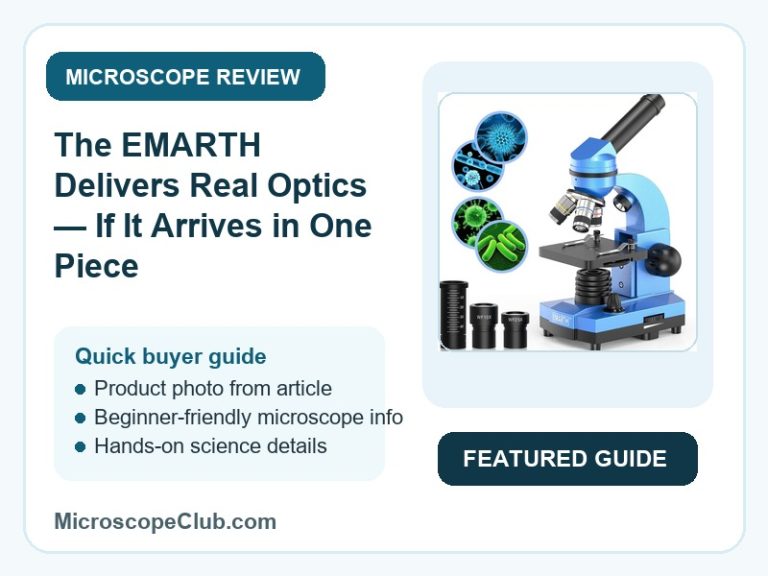
The EMARTH 40X-1000X microscope review comes down to one tension: this is a genuine compound scope, not a toy, and most buyers get exactly what they wanted for a modest STEM gift. But a real minority of units show up with a dead LED, a snapped stage, or a missing eyepiece lens straight out of the box, which means the buying decision hinges as much on inspecting the package on arrival as it does on the optics themselves. At 4.5 stars across 1,097 ratings, the EMARTH earns its reputation as a solid first “real” microscope for kids 8-12 — provided yours isn’t the one that arrived broken.

✅ Pros
- Genuine compound optics with achromatic objectives across a 40X-1000X range — not a toy scope
- Fair price-to-value for a metal-frame body with dual top/bottom LED illumination
- High fun and engagement factor — kids stay interested rather than losing interest fast
- Clear imaging that’s easy enough for a third-grader to focus without adult help
- 52-piece accessory kit (slides, tools) means no extra purchases needed to get started
❌ Cons
- A minority of units arrive with a dead LED light that won’t turn on with fresh batteries
- Some buyers report the head or eyepiece breaking off after only light handling
- Shipping/transit damage shows up repeatedly — stages have arrived already snapped
- At least one report of a missing eyepiece lens, rendering that unit unusable out of the box
What to Look for in a Compound Microscope for Kids
Magnification range is the first spec parents check, but it’s the least useful one on its own — a scope that claims 1000x with cheap glass will show less detail than a well-built 400x scope. What matters more is objective quality (achromatic objectives, like the EMARTH uses, correct for color fringing that plastic lenses can’t) and whether the eyepiece and stage stay rigid under a child’s hands. If you want the full breakdown of how compound, stereo, and digital scopes differ before you commit to this category, our guide to microscope types covers the tradeoffs in more depth.
Illumination setup is the second major decision point. Bottom-only lighting works for translucent prepared slides but leaves opaque specimens — coins, insect wings, fabric — looking flat and dark. Dual top-and-bottom LED illumination, which the EMARTH includes, solves that by letting a child switch between transmitted and reflected light depending on what’s on the stage. Finally, check what the kit actually includes: a scope with no slides, tools, or specimens sitting in a box is a scope nobody uses in the first week.
Who Should Buy a Compound Microscope for Kids?
This category is built for three buyer types: parents introducing a child aged roughly 8-12 to real biology rather than a toy-store scope, homeschool families who need a hands-on science tool without lab-grade cost, and gift-buyers looking for a STEM present that outlasts the holiday season. None of these buyers need — or should pay for — a research-grade instrument; they need something durable enough to survive curious hands and clear enough to reward the first look through the eyepiece.
If brand reputation and build consistency matter more to you than price, it’s worth comparing how different manufacturers approach this same beginner tier — our guide to the popular microscope brands lays out how EMARTH stacks up against AmScope, Swift, and other names you’ll see in this price range.
Who This Is For
The EMARTH 40X-1000X suits a parent or homeschooler buying a first genuine compound microscope for a child around 8-12, or a gift-buyer wanting a STEM present that supports casual biology exploration — pond water, hair, pollen, fabric fibers — rather than rigorous lab-grade work. It’s a poor fit for anyone who needs guaranteed reliability straight out of the box with zero tolerance for a return or exchange.
Full Specifications
| Spec | Value |
|---|---|
| Light Source Type | LED |
| Real Angle Of View | 38 Degrees |
| Magnification Maximum | 1000 x |
| Compatible Devices | Personal Computer, Laptop |
| Objective Lens Description | Achromatic |
| Power Source | Battery Powered |
| Enclosure Material | Metal, Plastic |
| Color | Blue |
| Model Name | 1405 |
| Brand | Emarth |
| UPC | 612409850850 |
| Manufacturer Part Number | 1405 |
| Unit Count | 1 Count |
Optical Performance
The EMARTH 40X-1000X delivers its magnification range through achromatic objectives paired with swappable eyepieces, which is a meaningfully different setup than the toy-store scopes it competes against. One buyer who directly compared it against two competitor kids’ scopes noted it “come[s] with two eye pieces, one 10X and the other 25X. Very quick to swap them for a different view,” and concluded it produced the clearest image of the three at the top of its magnification range.

The EMARTH achieves this clarity in part because its objective lens housings are metal rather than the plastic housings found on cheaper rivals — a detail the same comparison review flagged as a real differentiator, not a marketing point. Achromatic objectives correct for the color fringing that uncorrected lenses introduce at higher magnifications; Nikon’s introduction to microscope objectives explains why that correction matters more as magnification climbs toward the 1000x ceiling this scope reaches.
Illumination System
The EMARTH 40X-1000X separates itself from single-light beginner scopes through independent top and bottom LED illumination, letting a child switch between transmitted light for translucent prepared slides and reflected light for opaque specimens like coins or fabric. Reviewers consistently single out this dual-light setup as one of the scope’s clearer advantages over similarly priced competitors.
The EMARTH runs this lighting off 3 AA batteries that are not included in the box, and that single detail is the scope’s most common first-use friction point. Multiple reviewers report the light failing to power on even after swapping in a second set of batteries — a fault that reads as a dead unit rather than a battery problem, and the reason we’d recommend testing the light immediately on arrival rather than waiting for the first lesson.
Build Quality & Reliability
The EMARTH 40X-1000X builds its main body around a metal frame while relying on plastic for the eyepiece housing and stage components, a hybrid approach that keeps the price down but concentrates almost all of the reported failures in exactly those plastic parts. One buyer put it plainly: “the microscope body frame is pretty sturdy, except for the eyepiece that is plastic and a few other small components.”
The EMARTH shows this weakness most clearly in the shipping-damage and breakage complaints that recur across the review set — a stage snapped off before first use in one case, a microscope head that “broke off” after only a few hours of normal play in another. None of these are optical failures; they’re mechanical failures at the plastic-metal joints, which is why inspecting the unit for cracks or looseness the moment it arrives is worth the two minutes it takes.
What Customers Say
The EMARTH holds a 4.5-star average across 1,097 ratings, with sentiment analysis showing roughly 83% positive mentions overall. The positive concentration is heaviest on suitability for beginners and fun factor, both essentially unanimous in tone. One reviewer summed up the appeal directly: “This is a real microscope; not a toy. It’s a good microscope for beginners and the price is very reasonable for what you get.” Another verified buyer compared it against two competing kids’ scopes and called it “the best of the three,” even at its highest magnification level.
The negative signal clusters almost entirely around functionality and durability — dead lights, broken stages, missing lenses — which sit at roughly 40% negative within those two specific themes even though overall sentiment stays strongly positive. We rate the review integrity risk here as LOW: the sampled reviews span a genuine four-year date range, include non-5-star ratings, and read as specific rather than generic, none of which is typical of manipulated review sets. For more on how to read review authenticity signals generally, the FTC’s guidance on consumer reviews and endorsements is a useful reference point.
Final Verdict
CONSIDER: the EMARTH 40X-1000X is a genuinely good beginner compound microscope with real achromatic optics, dual illumination, and a metal-frame body that outperforms plastic toy-store alternatives at a similar price — but buy it with the expectation that you’ll inspect it immediately on arrival, since a real minority of units show up with a dead light, a broken stage, or a missing lens. If yours arrives intact, it’s a strong first “real” scope for a curious 8-to-12-year-old; if it doesn’t, use Amazon’s return window rather than waiting on seller support, which at least one buyer found unresponsive.
Frequently Asked Questions
Does the EMARTH 40X-1000X microscope come with batteries?
No. It runs on 3 AA batteries that are sold separately. Several buyers have reported the LED light failing to power on, so it’s worth testing with fresh batteries the moment the microscope arrives rather than waiting to find out during the first lesson.
What age range is this microscope suitable for?
It’s designed primarily for kids roughly 8-12 years old, though reviewers also report adult beginners, homeschoolers, and even teenagers using it. One buyer noted their teenager kept picking it up after buying it for a 9-year-old.
What’s included in the 52-piece accessory kit?
The kit includes prepared slides, blank slides, and basic tools for hands-on experiments, so a new owner can start viewing specimens the same day without buying anything extra.
Is this a genuine compound microscope, or is it a toy?
It’s a real compound microscope with achromatic objectives and a 40X-1000X magnification range, not a toy-store scope. Multiple reviewers explicitly contrast it with toy microscopes and note it performs closer to a lab-style instrument, with the caveat that build materials are a mix of metal and plastic rather than metal throughout.
Does it come with more than one eyepiece?
Yes — one buyer’s side-by-side comparison against two competing scopes noted the EMARTH ships with two eyepieces, a 10X and a 25X, that swap quickly for different magnification needs.
What should I do if mine arrives with a broken part or a light that won’t turn on?
Inspect the microscope immediately on arrival rather than waiting. Shipping damage and DOA electrical faults are a recurring complaint in the review data, and at least one buyer reported no response after emailing the seller about a broken component — so lean on Amazon’s own return window rather than relying on seller support.
Can it view both opaque objects and translucent slides?
Yes. The dual top-and-bottom LED illumination lets you switch between transmitted light for translucent prepared slides and reflected light for opaque specimens like coins, fabric, or insect wings.
Conclusion
The EMARTH 40X-1000X is a solid, honest entry point into real microscopy for a child, backed by genuine achromatic optics and a metal-frame body rather than toy-grade plastic. The catch isn’t the optics — it’s the shipping and quality-control gap that leaves a minority of buyers with a broken or dead-on-arrival unit, so treat the unboxing inspection as part of the purchase, not an afterthought.
If you pick one up, we’d love to hear what your young scientist finds first under the lens — drop a comment below with what worked (or didn’t) for you. And once you’re ready to load the stage, our step-by-step guide to preparing microscope slides will get a first-time user past the trickiest part of the whole process.