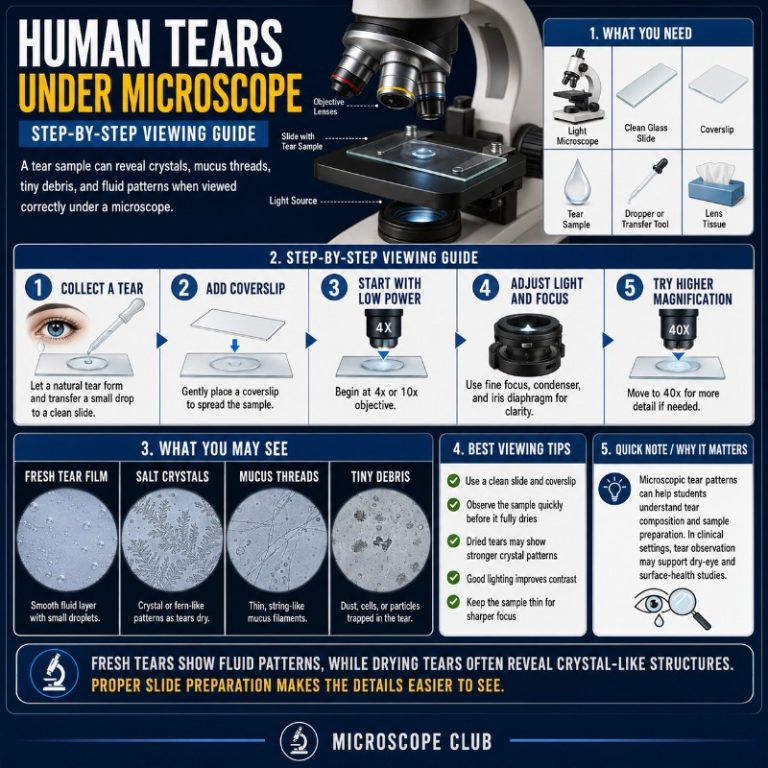
Dried human tears under a microscope look nothing like what you’d expect from a salty drop of liquid — they form branching, frost-like crystal landscapes that change shape from one tear to the next. Each drop leaves behind a map of salt, proteins, and lipids as the water evaporates, and no two ever look identical. This guide walks you through what you’ll actually see, why the patterns form, and how to view your own tears at home with a basic microscope.
What Human Tears Are Made Of
Human tears are roughly 98–99% water. The remaining 1–2% is what makes them interesting under a microscope: sodium chloride (salt), proteins including lysozyme and lactoferrin, lipids secreted by the meibomian glands, mucins from goblet cells, and trace enzymes and antibodies. The wet tear film is almost entirely water; the dried image on the slide is dominated by crystallized salt, which is why what you see looks almost geological in structure.
Tears fall into three functional types. Basal tears are produced continuously by the lacrimal gland to lubricate and protect the cornea — you’re making them right now. Reflex tears are triggered by irritants: onion vapor, smoke, dust, or a corneal scratch. Emotional (psychic) tears are the ones that flow during grief, joy, or pain. The underlying biochemistry differs slightly — researcher William Frey’s 1980s work found that emotional tears appeared to contain more protein, more prolactin, ACTH, and the natural painkiller leucine-enkephalin compared to irritant-induced tears. That finding is widely cited, though it hasn’t been independently replicated at scale, so treat it as a plausible hypothesis rather than settled science.
One claim you’ll see repeated elsewhere — that tears contain neurotransmitters like dopamine and oxytocin — is misleading. Those chemicals are active in the brain during crying, regulating when and how much you cry; they aren’t documented components of tear fluid itself. The brain chemistry that triggers emotional crying involves the oxytocin and opioid systems, but that’s different from the tears “containing” them.

Why Dried Tears Look Like Landscapes
The branching, feathery, almost aerial-photograph quality of a dried tear comes down to one process: evaporation-driven crystallization. As the water evaporates from the edge of the drop inward, dissolved salts are left behind and nucleate into crystals. The exact shape — whether you get long dendritic branches, tight interlocking plates, or a shattered-glass pattern — depends on evaporation rate, the humidity and temperature of the air, the concentrations of protein and lipid in that particular tear, and how fast the slide cooled.
This is why two tears from the same person, cried in the same moment, can look completely different. It’s also the insight at the center of photographer Rose-Lynn Fisher’s project Topography of Tears, in which she photographed approximately 100 tears at 100× magnification over roughly a decade (the project began around 2008; her book was published in 2017). Fisher shot her own tears, tears from friends, tears of joy, grief, laughter, and irritation — and what she found was that the structures track drying conditions at least as strongly as they track the emotion that caused the crying — as Fisher documents on her project page. The images resemble satellite photography of river deltas, salt flats, cracked desert floors.
The Smithsonian reported on her work and described the view exactly right: each image is a tiny landscape shaped more by physics than by psychology.


How to View Your Own Tears Under a Microscope
This is genuinely home-doable with any basic compound or stereo microscope. The technique is simpler than most microscopy work because no staining is required — unlike fixed biological samples under the microscope, the crystallized salt provides all the contrast you need.
What You Need
- A clean glass microscope slide (clean matters — oil from fingers destroys the pattern)
- A coverslip (if using a compound scope — protects the objective lens from dried crystals)
- A compound microscope with 20×–40× capability, or a USB/stereo scope at similar magnification (see our guide to preparing a microscope slide if you’re new to the basics)
Step-by-Step Method
- Induce a tear. Reflex tears are easiest — cut an onion and hold the slide near your eye, or let a yawn produce a natural reflex tear. Emotional tears work just as well. You only need one drop.
- Catch the drop on the slide. Hold a clean slide just below your eye and let the tear fall directly onto it. Alternatively, transfer the drop with a clean glass pipette. Aim for a drop roughly the size of a small pea — not a smear, not a puddle.
- Air-dry completely. This step is where most beginners fail: the slide must look completely dry and slightly crusted before you put it under the lens. Wet or even damp tears show nothing interesting — salt only crystallizes once the water is fully gone. Leave the slide flat on a clean surface for at least 20–30 minutes; in humid conditions, an hour is safer. Do not blow on it, heat it, or tilt it while drying — any disturbance changes the crystal pattern.
- Add a coverslip (compound scope users only). Lay it gently over the dried drop. Without one, the dried salt crystals are abrasive enough to scratch a high-power objective.
- Start at 20×–40× and scan the edge of the drop. The outer rim of the dried tear shows the best branching crystal structures — the interior tends to be denser and more chaotic. Move the slide slowly and find a region that interests you before zooming in.
- Step up to 100× for detail. This is the magnification Fisher used for the Topography of Tears images. At this level you can resolve individual crystal edges and the layering between salt and dried protein deposits. Going higher (400×) tends to lose the composition — you’re looking at crystal micro-texture rather than the landscape pattern.
- Dry a second tear and compare. Even from the same eye, two consecutive tears will form noticeably different patterns because drying conditions — the ambient humidity and temperature — shift moment to moment.
Common Problems and Fixes
- Thick white crust, no visible pattern: Too much fluid on the slide. Use a smaller drop next time, or wait longer for the outer edge to fully crystallize.
- Blurry image at high power: Drop back down to 40× — the field of view at 400× is very shallow and the crystal surface is uneven. Most of the interesting structure reads better at low power anyway.
- No structure at all, just dust-like specks: The slide dried too fast (low humidity, warm room) or was contaminated. Clean the slide with ethanol and retry.
- Image looks great at 40× but disappears at 100×: Normal. Scan for a well-formed crystal branch at low power first, center it, then zoom. Lighting matters more at high power — adjust the condenser aperture.

Do Basal, Reflex, and Emotional Tears Look Different?
Honestly, not reliably — and most sites won’t tell you that. In theory, the biochemical differences between tear types should influence crystal shape: emotional tears have higher protein content (per Frey’s work), and proteins compete with salt during crystallization, potentially producing more complex branching. In practice, the variation caused by how the tear dries — humidity, speed of evaporation, drop size — is large enough to swamp the chemical signal. You cannot look at two dried tears and confidently identify which one was cried in grief and which one was caused by an onion.

Fisher’s images look different from each other not primarily because of the emotion involved, but because of variations in drying conditions across different times and environments — a point The Marginalian’s coverage of the project makes plain. The emotional significance is real; the visual signature is not forensically identifiable. That’s worth knowing before you spend an evening trying to classify your tear types by shape.
What Microscope to Use
You do not need a lab instrument for this — if you’re still deciding on equipment, our guide to choosing the right microscope covers the main categories. The famous Fisher images were shot at 100× on a standard light microscope with a mounted digital camera — equipment available at the hobbyist level. For dried-tear work specifically, a USB digital microscope or a basic stereo scope at 20×–40× actually gives a more satisfying “landscape” view than a high-power compound, because the low magnification frames the full crystal structure rather than zooming into a single facet. If you want to step up to 100× for detail, any compound scope with a 10× eyepiece and a 10× objective will do it.
The Zeiss Axio Observer and Nikon Eclipse Ti2 sometimes recommended for tear viewing are research-grade instruments costing $20,000–$60,000 — they are not hobbyist options. Phase contrast microscopy is likewise unnecessary for dried tears; it becomes valuable only when viewing live or wet-mounted biological samples. The products below are appropriate for home and classroom use.
No products found.
The Topography of Tears Project
Rose-Lynn Fisher began the Topography of Tears project in 2008, initially photographing her own tears during a period of personal grief. Over roughly a decade she expanded the collection to approximately 100 tears from men, women, and children — tears of laughter, grief, physical pain, and reflex irritation. She worked with a standard light microscope at 100× magnification and a mounted digital camera.
What makes the project lasting is its documentary honesty: Fisher didn’t try to find systematic emotional differences between tear types. She found instead that each dried tear was a small unrepeatable event, shaped at least as much by the physics of evaporation as by the feeling behind it. The images became widely shared because they reframe something invisible — the physical trace of a moment of feeling — as something visibly extraordinary.
FAQ
Can you see tears under a basic home microscope?
Yes. Any compound microscope with a 40× setting, or a USB digital scope at 20×–40×, will show the salt-crystal landscape of a dried tear. You don’t need staining, special preparation, or research-grade equipment.
Do tears taste salty because of sodium chloride?
Yes — the salinity of tears is similar to blood plasma, roughly 0.9% NaCl. That’s the same salt that crystallizes into the visible structures when the tear dries on a slide.
Can I use a phone microscope attachment to see tear crystals?
A clip-on phone lens that reaches 20×–40× will show the gross crystal pattern but won’t resolve the fine branching detail. Dedicated USB scopes or optical microscopes give sharper results at the magnifications where tears look best.
Does adding a coverslip change the crystal pattern?
Only if you add it before the tear is fully dry. A coverslip placed over a wet drop flattens and disrupts the crystallization. Always wait until the slide is completely dry, then lay the coverslip on top.
Conclusion
Dried human tears form crystallized salt landscapes under the microscope — branching, frost-like structures driven more by evaporation physics than by emotion, yet no less remarkable for that. The tear is ~99% water while liquid; once dry, crystallized NaCl dominates the image. You can recreate Rose-Lynn Fisher’s approach at home: catch a single drop on a clean slide, let it air-dry completely (30–60 minutes), and start at 40× magnification — the outer rim of the drop shows the best branching patterns. Scale up to 100× for detail, compare two tears from the same eye to see how much drying conditions matter, and resist the urge to read emotion directly into the crystal shape. The science doesn’t support that leap — but the view is striking enough without it.
RELATED POST:
Originally posted 2025-09-21 14:06:47.
Last update on 2026-09-23 / Affiliate links / Images from Amazon Product Advertising API