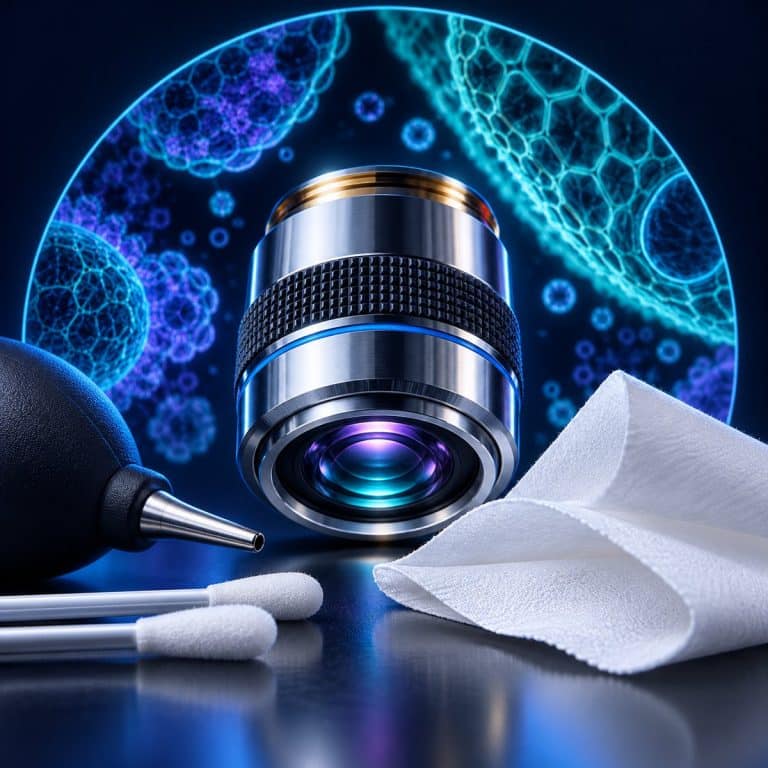
How to clean a microscope comes down to one order of operations: blow the dust off first, then brush what’s left. Wipe the optics last, with a single-use sheet of lens paper lightly dampened with isopropanol, always in a spiral from the center outward. Skip the facial tissue, the shirt hem, and any urge to take an objective apart. Also get immersion oil off the 100x objective the same day you use it. Modern oil doesn’t harden, it stays tacky and collects airborne dust — and it’s the next wipe across that grit that scratches the coating.
Find the Dirt Before You Clean Anything
A speck in the field of view does not tell you where the dirt actually is, and guessing wrong means touching an objective you never needed to touch. Run this three-part test first: See Nikon’s clean-optics guidance for additional context.
- Rotate the eyepiece in its tube. If the speck spins with it, the dirt is on the eyepiece — almost always the top (eye) lens, left there by eyelashes and skin oil.
- Move the slide with the stage controls. If the mark moves with the specimen, it’s on the slide or coverslip, not the microscope at all.
- Swap objectives. If the mark only shows up on one objective, that objective’s front lens is the culprit.
- Still there through all three, and it shifts when you rack the condenser up and down? That’s the condenser front lens or the field lens in the base.
Most “my microscope is dirty” complaints turn out to be the eyepiece top lens or the slide — the two safest, easiest things to clean. Diagnose first and you’ll often find you never needed to touch an objective. It’s also worth ruling out the illumination itself — a hazy, low-contrast image is just as often a misadjusted condenser or a Köhler setup that’s drifted as it is a dirty lens.
What You Need (and What Will Ruin Your Optics)
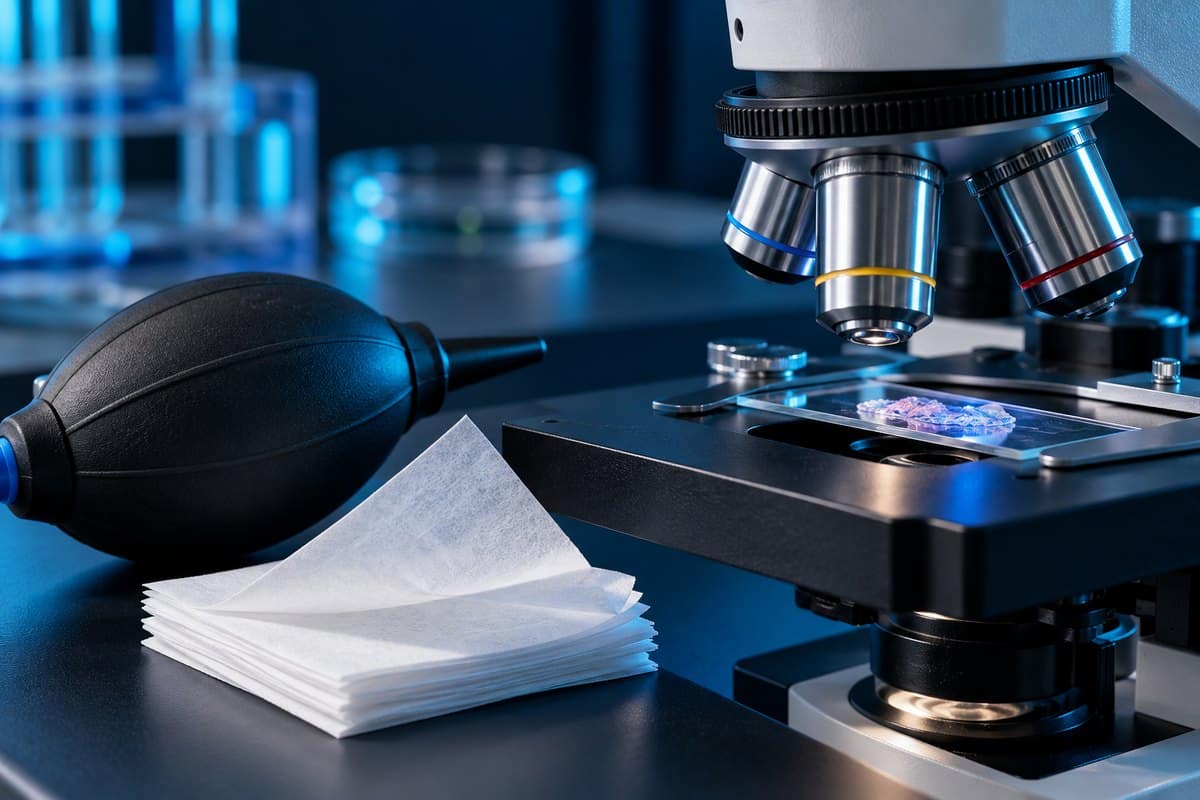
Everything you need to clean a microscope safely costs less than a single replacement objective. The list below is ranked gentlest to most aggressive — the order you’ll use it in. See Leica’s microscope-optics cleaning guide for additional context.
| Safe | Never Use |
|---|---|
| Rubber hand-bulb blower | Canned/compressed air (propellant residue) |
| Soft camel-hair or goat-hair lens brush, kept in a capped tube | Facial tissue, paper towel, or a shirt tail (wood fibers scratch coatings) |
| Optical lens paper (single-use, fold and discard) | Cosmetic cotton pads or swabs (often lotion-impregnated) |
| Isopropanol (70–99%) or a dedicated lens fluid, applied to the paper | Acetone (attacks lens cement and plastic housings) |
| Distilled water for water-soluble grime | Household glass cleaner, detergent, or soap directly on glass |
| Cotton swab, rolled not scrubbed, for tight recesses | A microfiber cloth (made for eyeglass coatings, not objective coatings, and it picks up pocket grit) |
| Mild soapy water on a soft cloth, for the body only | Dismantling an objective or condenser |
The one rule that covers all of it
Anything that touches glass has to be single-use and softer than the coating it’s touching. Lens paper qualifies; everything from your laundry basket doesn’t. Isopropanol and any lab solvent are flammable, so keep them away from open flame, and skip xylene or ether. Pro labs use them, but they attack older lens cement and need ventilation a home bench doesn’t have. Zeiss and Nikon both publish cleaning guidance, and they converge on the same rules: least aggressive method first, single-use lens paper, fluid on the paper — never on the lens. Isopropanol itself is safe — it’s what the manufacturers specify. What ruins an objective is flooding it: alcohol pooled at the edge of the front lens wicks past the seal, softens the cement holding the elements, and shows up weeks later as an internal haze that no wipe will ever reach.
How to Clean a Microscope: The 7-Step Routine
This is the master sequence, in order, for a routine clean of the whole instrument. Work through it top to bottom rather than jumping straight to the part that looks dirtiest.
- Power off the illuminator and let the lamp cool before you touch anything near it.
- Blow the dust off every optical surface with a rubber bulb blower — no canned air.
- Brush away whatever the blower missed with a soft lens brush.
- Clean the eyepieces with a damp lens paper spiral wipe.
- Clean the objectives, starting with a reflected-light inspection before you touch the glass.
- Clean the condenser front lens and the illuminator window in the base.
- Wipe the stage and body with mild soapy water on a soft cloth, keeping liquid away from the focus mechanism.
Cleaning the eyepieces
The eyepiece top lens is the dirtiest surface on the scope, since it’s the one you press your face against every session. A dirty eyepiece shows up as a fuzzy gray blob or a chain of little donuts floating over the image. They look like they’re inside the specimen until you rotate the eyepiece and the whole constellation swings around with it. Fold a sheet of lens paper into quarters, handling only the edges, dampen it with a single drop of isopropanol, and wipe once in a spiral from the center outward. Don’t unscrew the eye lens to “get inside” — the dirt is almost always on the outer surface.

Cleaning the objectives
Inspect the front lens under a desk lamp at an angle before you wipe anything. Dirt on an objective doesn’t look like discrete specks — it’s a soft haze that kills contrast everywhere at once, so the image looks washed out through fog rather than spotty. If you see genuine grime, use fresh lens paper for every single pass, spiral from center outward, and apply no pressure — let the solvent do the work. A second pass with the same paper just re-deposits what you collected on the first one. Never disassemble an objective to clean it — it’s shimmed and centered at the factory, and opening it ends its optical life.
Cleaning the condenser and the light in the base
Rack the condenser up to reach its front lens and treat it like an objective: blower first, then damp lens paper if needed. The illuminator window in the base is also a glass surface that picks up fingerprints — let the LED cool, then blow and wipe it the same way. Condenser cleanliness matters even more for dark field microscopy, where a smear on the condenser shows up directly as glare.
Cleaning the stage, body and focus knobs
Use a damp cloth with mild soap for the painted body, base, and stage — never solvent, since acetone in particular will craze plastic. The focus knobs collect the most skin oil of any part of the scope, so wipe them for hygiene even when the optics look fine. Keep the cloth damp, never dripping; liquid that runs into the focus block washes the grease out of the mechanism and the fine focus goes gritty permanently. For everyday handling between cleans, follow the routine in our compound microscope how-to.

How to Remove Immersion Oil from a 100x Objective
Oil exists because it matches the objective’s numerical aperture to the refractive index of glass, gathering more light at 100x than air ever could. Fresh immersion oil handles like thin honey and strings when you pull the bottle away. A day-old smear on a nosepiece turns tacky — like the residue left behind by a price sticker — and by then it has already picked up visible dust flecks. Older oil hardened into varnish; modern synthetic oils mostly stay tacky instead, collecting airborne dust into a paste of abrasive grit sitting directly on a coated front lens. The damage happens on the next wipe, not from the oil itself, which is why same-day cleaning matters more than how the oil is removed.
- Blot the front lens with dry lens paper laid flat on the glass, then drag it off in one direction.
- Dampen a fresh sheet of lens paper with isopropanol and spiral-wipe from center outward.
- Repeat with fresh paper until a reflected-light inspection under a desk lamp shows no colored sheen. Residual oil looks like a faint rainbow, similar to a drop of gasoline on wet asphalt, where clean glass gives a flat, colorless glint.
- Finish with one light, barely damp pass to remove any solvent residue, and store the objective front-down so oil creep can’t run back across the lens.
Oil belongs only on the 100x objective. If you rotate the nosepiece and a dry objective swings through the oil drop on the slide, clean that objective immediately too. Dry objectives aren’t sealed against solvent wicking and are damaged most often by oil left in place. Aqueous cleaners won’t help; immersion oil isn’t water-soluble. See Evident’s guidance on cleaning immersion oil off objectives for the manufacturer view on the same sequence. Check the guide to viewing bacteria under a microscope at 1000x or reading a blood smear for the two situations you’ll use oil immersion most.
Dried-On Mess: Mountant, Stain and Fingerprints
Dried methylene blue on a stage forms a matte purple-black ring in a coffee-ring shape, not a smear — a clue that water alone might not lift it. Start with distilled water on a cloth or swab for water-soluble grime — dried mountant, salt from wet mounts, fingerprint salts — since it carries zero risk to coatings. If that doesn’t clear it, move to isopropanol on the same swab, rolling rather than scrubbing into tight recesses like the rim around an objective front lens. Stop there; anything that survives both isn’t a cleaning problem anymore. Sloppy technique during preparing microscope slides and making a wet mount slide is the biggest source of stage grime, along with dried stain from the Gram staining technique. Don’t forget the mechanical stage rails — grit trapped there makes the slide movement feel gritty even after the glass is spotless.
How Often to Clean a Microscope
| When | Do |
|---|---|
| After every session | Cap or cover the scope; remove oil from the 100x immediately if used; blow dust off the eyepieces |
| Weekly (or every few sessions) | Damp-clean the eyepiece top lenses, check the condenser front lens, wipe the stage |
| Monthly | Body, base, illuminator window, and mechanical stage rails; inspect all objectives by reflected light |
| Before long storage | Full clean, dust cover on, silica gel in the case, stored somewhere dry and out of direct sun |
Storing a Microscope So It Stays Clean
Every minute spent on storage is a wipe you don’t have to risk later. Put the dust cover on before you leave the room, not “later” — later never happens, and an uncovered scope collects the dust that becomes next week’s abrasive grit. Switch the illuminator off first, since a warm LED housing under a dust cover can sweat and leave condensation on the optics. In humid climates, storage without silica gel sachets is how mold gets started — fungal filaments inside an objective show up as fine branching threads in the field. That’s not something you can clean out yourself. Store spare objectives vertically in their capsules, front lens down, never with oil left on, and carry the scope in its case by the arm and base.
When to Stop and Send It for Service
Some problems aren’t cleaning problems. There’s a short list of red flags: internal haze after external cleaning, fungal filaments inside an objective, and a focus mechanism gone gritty. A permanent pale flare that follows one objective from slide to slide (a sign of an existing scratch) is another. Any of these means the instrument needs a technician, not another pass with lens paper. Opening a sealed objective or condenser yourself ends its optical life. The Duke Light Microscopy Core’s guide to cleaning an objective and the Quekett Microscopical Club’s lens-cleaning guide agree on where that line sits. Both separate what a user should attempt from what belongs to a service bench.
Frequently Asked Questions
Can I use eyeglass cleaner, Windex, or a microfiber cloth on a microscope?
No. Household glass cleaner leaves interference films that can creep between lens elements, and a microfiber cloth is made for harder eyeglass coatings, plus it picks up pocket grit. Stick to single-use lens paper.
Can you clean a microscope objective by taking it apart?
No. Objectives are shimmed and centered at the factory, and opening one ends its optical life. If cleaning the outer surfaces doesn’t fix the problem, the objective needs a technician, not disassembly.
Does leaving immersion oil on overnight actually damage the objective?
Yes, indirectly. Oil left overnight attracts atmospheric dust, and that dust becomes a micro-abrasive sitting on the front lens. The damage happens the next time someone wipes it, not from the oil sitting there — which is why same-day cleaning is the rule.
Can you clean a microscope with distilled water?
Yes, and it should be your first try for water-soluble grime — dried mountant, salt from wet mounts, fingerprint salts. It carries zero risk to coatings. Move up to isopropanol only if distilled water doesn’t clear it.
Is it safe to clean a plastic kids’ microscope the same way?
Mostly, with one change: clean a plastic body with mild soapy water, never solvent, since acetone will craze plastic. Plastic lenses on microscopes built for kids should get a blower and dry lens paper only — skip the alcohol, which can cloud some plastic optics.
Conclusion
Cleaning a microscope well isn’t about scrubbing harder — it’s about diagnosing where the dirt actually is, then using the least aggressive method that clears it: blow, brush, dry paper, damp paper with water, damp paper with isopropanol, then stop. Get immersion oil off the same day you use it, keep a dust cover on between sessions, and most of the cleaning you’ll ever need stays limited to an eyepiece and a slide, never an objective.
Have you found a stain or a mark that this routine didn’t clear? Tell us what it was and where it turned up in the comments below — it might be a case worth adding to this guide.