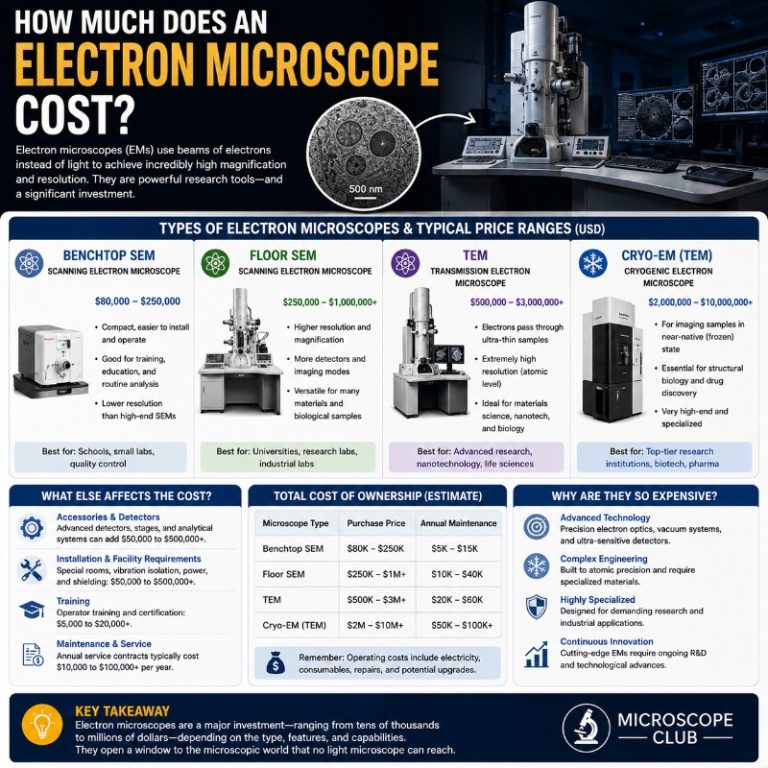
Electron microscope prices range from around $50,000 for a compact benchtop unit to well over $20 million for an aberration-corrected transmission electron microscope — and the instrument cost is only the beginning. Whether you are evaluating an in-house purchase for a materials lab, a university core facility, or a biomedical research group, understanding the full price landscape by segment, the ongoing cost of ownership, and the realistic access alternatives will save you from a costly mismatch between budget and capability.
Electron microscope price by type: 2025–2026 market ranges
Electron microscopes split into two families — scanning electron microscopes (SEMs), which map surface topology, and transmission electron microscopes (TEMs), which penetrate the sample interior at atomic resolution — but within each family there are several distinct price tiers driven by beam technology, vacuum specification, and detector packages. The table below reflects 2025–2026 street pricing from major manufacturers including JEOL, Thermo Fisher Scientific (formerly FEI), Hitachi High-Tech, and Zeiss.
| Segment | 2025–2026 price range | Example models |
|---|---|---|
| Benchtop / desktop SEM | $50,000–$150,000 | Thermo Fisher Phenom ProX (~$90K–$110K), Thermo Fisher Axia |
| Floor-standing thermionic SEM | $80,000–$250,000 | JEOL JSM series, Hitachi SU series |
| Field-emission SEM (FEG-SEM) | $150,000–$500,000+ | JEOL JSM-7610F, Zeiss GeminiSEM |
| FIB-SEM dual-beam | $1,000,000–$2,000,000+ | Thermo Fisher Helios, Thermo Fisher Scios, Zeiss CrossBeam |
| Analytical TEM | $500,000–$3,000,000 | JEOL JEM series, Thermo Fisher Talos |
| Cryo-TEM | $1,000,000 (100 kV Tundra) – $6,000,000+ (300 kV Titan Krios) | Thermo Fisher Glacios (200 kV), Titan Krios (300 kV) |
| Aberration-corrected TEM | $10,000,000–$20,000,000+ | Top-tier JEOL and Thermo Fisher platforms with Cs correctors |
| Used / refurbished (any class) | 30–70% below new | Via SEMTech Solutions, IET Integrated Engineering, Copia Scientific, LabX, eBay Scientific |
Prices vary significantly by region, configuration, detector package, and negotiation. Always obtain a current vendor quote before budgeting. Figures here reflect 2025–2026 market ranges.

SEM vs. TEM: which is cheaper, and why?
Scanning electron microscopes are substantially cheaper than transmission electron microscopes because they operate at lower accelerating voltages and impose less extreme engineering demands on the column, vacuum system, and sample stage. A scanning electron microscope runs its electron beam at typically 0.5–30 kV (500–30,000 eV) — the exact value is dialed in by the operator depending on the sample and contrast mechanism needed; see how accelerating voltage affects SEM imaging for a detailed explainer. Low-voltage SEM can go as low as ~100 eV to reduce charging on non-conductive materials, while higher voltages (15–30 kV) improve X-ray signal for EDS elemental mapping.
A transmission electron microscope demands far more: accelerating voltages of 80–300 kV, ultra-thin (<100 nm) sample preparation, a much higher vacuum, and a precision high-voltage power supply that alone costs tens of thousands of dollars. Cryo-TEM platforms like the Thermo Fisher Titan Krios operate at a fixed 300 kV and add a cryogenic stage, autoloader, and direct electron detector — all of which stack onto the base TEM cost and push total system price above $6 million.
The practical rule: if you need surface morphology or elemental composition, an SEM is almost always sufficient and far less expensive. If you need atomic-resolution internal structure — protein complexes, crystal defects at sub-angstrom scale — a TEM is the only option and the price reflects it. See our comparison of scanning electron microscope vs. transmission electron microscope for a full capability breakdown.

What drives the price within each category
Within any segment, electron microscope pricing is shaped by five main variables:
- Electron source (gun) type. Thermionic guns (tungsten or LaB₆ filaments) are cheaper but produce a broader, less bright beam. Field-emission guns (FEGs) — cold-FEG or Schottky FEG — deliver a finer probe, higher brightness, and better resolution at low voltage, and they add $50,000–$200,000 to the base SEM price. FEG is standard on all TEMs.
- Resolution specification. Resolution is ultimately constrained by the precision of every lens element. An SEM rated to 1 nm resolution requires tighter column machining and better electronics than one rated to 3 nm. Each order-of-magnitude resolution improvement multiplies the engineering cost.
- Detector and analysis package. A backscattered electron (BSE) detector, energy-dispersive X-ray spectrometer (EDS), electron backscatter diffraction (EBSD) system, or wavelength-dispersive X-ray (WDX) detector can each add $30,000–$150,000 on top of the base instrument. A fully-loaded analytical SEM with EDS, EBSD, and a cathodoluminescence detector can reach $600,000–$700,000 even on a mid-range platform.
- Vacuum system. TEMs and FIB-SEMs require ultrahigh vacuum (UHV) in parts of the column, which demands ion pumps and longer pump-down times — adding equipment and installation cost versus the medium-vacuum systems found in conventional SEMs.
- Automation and software. Modern instruments with automated data collection, AI-assisted navigation, and cloud-connected analysis suites carry a software premium. Cryo-TEM autoloaders that handle vitrified grids under cryogenic conditions add significant mechanical and software complexity.
Benchtop and desktop SEMs: the overlooked entry point
The most affordable route into in-house electron microscopy is the benchtop or desktop SEM, a category the original version of this article omitted entirely. Benchtop SEMs — led by the Thermo Fisher Phenom series — cost roughly $50,000–$150,000, fit on a standard lab bench, require no dedicated room, and reach usable resolutions of 5–10 nm — current pricing across benchtop models is detailed at NanoImages desktop SEM pricing.
What you give up: accelerating voltage is typically capped at 15–20 kV, limiting X-ray penetration depth for EDS. Automated stage movement and field of view are more constrained than on a floor-standing unit. But for quality control in manufacturing, failure analysis, and routine materials characterization, a Phenom ProX at $90,000–$110,000 is often a better institutional investment than a $250,000 floor-standing SEM that sits idle half the week because it requires a dedicated trained operator for every session.
Scanning electron microscope — capabilities and cost context
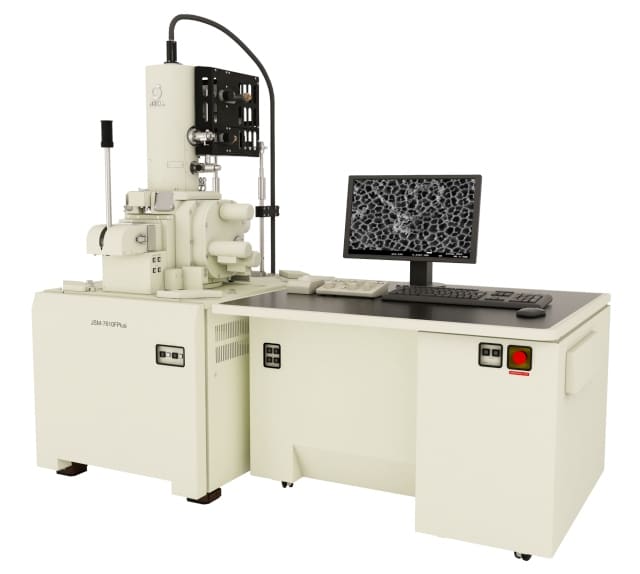
A scanning electron microscope rasters a finely focused electron beam across the specimen surface and collects secondary and backscattered electrons to build a topographic image. Resolution on a modern FEG-SEM reaches 1 nm or better. The practical advantages over a TEM are significant: samples require minimal preparation (conductive coating is often all that is needed), sample size is less constrained, and the imaging chamber is accessible without the risk of destroying an ultrathin TEM foil. SEM also generates three-dimensional surface images that carry immediate intuitive value for materials scientists and failure analysts. The tradeoff is that SEM sees the surface only — it cannot reveal internal crystal structure or image single protein molecules.
Transmission electron microscope — capabilities and cost context

A transmission electron microscope fires a broad, high-energy electron beam through an ultra-thin sample — typically 50–100 nm thick — and captures the transmitted electrons to form a two-dimensional image at atomic resolution. TEMs achieve magnifications exceeding 50,000,000×, the highest of any instrument class. This capability comes with steep constraints: sample preparation (ion milling, focused-ion-beam sectioning, or ultramicrotomy) is time-intensive and destructive, and every session requires a trained specialist. For cell biology, structural biology, and semiconductor defect analysis, these tradeoffs are unavoidable — the TEM is the only tool that resolves angstrom-scale features.
Cryo-TEM deserves separate mention. Cryo-electron microscopy — the technique recognized by the 2017 Nobel Prize in Chemistry — vitrifies biological samples in near-native hydrated state and images them at cryogenic temperatures, revealing protein and virus structures at near-atomic resolution. Cryo-TEM platforms from Thermo Fisher (Glacios at 200 kV, Titan Krios at 300 kV) cost $1M–$6M+ and require additional cryogenic handling infrastructure — figures detailed in C&EN’s cryo-EM cost analysis.
True cost of ownership: beyond the purchase price
The purchase price is the most visible cost, but experienced procurement managers budget the 5-year total cost of ownership (TCO) at roughly 150–200% of the purchase price. Here is how that breaks down for a representative floor-standing SEM:
Worked TCO example — $300,000 floor-standing SEM over 5 years
- Purchase price: $300,000
- Annual service contract (~10% of purchase price × 5 years): $150,000 — manufacturer service contracts for electron microscopes typically run 8–15% of purchase price per year; they cover preventive maintenance, parts replacement, and emergency callouts. Skipping the contract saves money short-term but risks a $20,000–$80,000 uncontracted repair.
- Consumables, power, and miscellaneous (~$10,000/year × 5 years): $50,000 — this covers vacuum pump oil, filament replacements (thermionic guns burn through tungsten filaments regularly), EDS calibration standards, and the continuous power draw of the instrument and its chilled water system.
- Liquid nitrogen (cryo-TEM or cryo-stage only): add $5,000–$15,000/year for cryo-EM platforms that maintain cryogenic temperatures continuously.
- Trained operator (partial salary allocation): varies by institution — a dedicated electron microscopist with a PhD or equivalent typically earns $60,000–$120,000/year in the United States.
5-year subtotal (instrument + service + consumables, excluding staff): ~$500,000 — approximately 1.67× the purchase price. Add a full-time operator over five years and the number climbs to $800,000–$1,100,000 for a $300,000 SEM.
The formula to keep in mind: 5-year TCO ≈ purchase price × 1.5 to 2.0, not counting staffing.
Facility requirements — what the instrument needs from the room

An electron microscope does not sit on a standard lab bench and plug into a wall outlet (except for benchtop SEMs, which are specifically designed to do exactly that). A floor-standing SEM or TEM imposes specific facility demands:
- Vibration isolation. Even low-frequency floor vibration from HVAC systems, nearby road traffic, or building footfall degrades image resolution. Facilities use passive vibration isolation tables, pneumatic isolation pads, or — for the most demanding instruments — purpose-built concrete inertia blocks on vibration-damped mounts. Being underground is one way to achieve this, but a properly engineered above-ground room works equally well.
- Magnetic field canceling. Stray AC magnetic fields from building wiring, transformers, or nearby equipment deflect the electron beam. Active or passive magnetic shielding is standard practice; high-performance FEG-SEMs and TEMs specify maximum ambient AC field levels (often <1 mG at 50/60 Hz) that the facility must meet.
- Temperature stability. Thermal drift in the column and stage degrades resolution over a long acquisition. Most manufacturers specify room temperature stable within ±1°C over 24 hours — typically requiring a dedicated HVAC zone separate from the rest of the building.
- Acoustic noise. Acoustic pressure waves couple mechanically into the stage. Low acoustic noise (ideally <45 dB NC) is part of the site specification for high-resolution instruments.
- Power supply. High-voltage TEMs require clean, stabilized three-phase power. Budget for dedicated electrical panel work and possibly a power conditioner.
Facility preparation for a floor-standing SEM typically adds $20,000–$100,000 to the project cost depending on the existing room condition. A cryo-TEM installation in a purpose-built suite can cost $200,000–$500,000 in facility upgrades alone.
New vs. used and refurbished electron microscopes
A used or refurbished electron microscope can cost 30–70% less than new, and for mature platform generations this is often an excellent institutional decision. Instruments from established platforms (JEOL 7000-series SEM, Thermo Fisher Tecnai TEM) have decades of documented performance data and a large pool of qualified service engineers.
Where to buy: specialized used-instrument dealers including SEMTech Solutions, IET Integrated Engineering Technology, Copia Scientific (formerly BioSurplus), and LabX list refurbished electron microscopes with service histories. University surplus sales via eBay are another route, though these typically come with no warranty and require independent condition assessment.
Before purchasing any used electron microscope, budget for:
- A pre-purchase inspection by an independent qualified engineer ($500–$2,000)
- Decommissioning, crating, and shipping ($5,000–$30,000 depending on weight and distance)
- Reinstallation and recommissioning by a certified service engineer ($5,000–$20,000)
- Replacement of consumables (filament, apertures, detector upgrade if needed)
Recommissioning a used SEM in good condition typically costs $15,000–$50,000 on top of purchase price — still far below the cost of a new instrument.
Leasing and shared-access alternatives
Not every lab needs to own an electron microscope. Two lower-capital paths exist:
Manufacturer leasing programs. JEOL and Hitachi High-Tech offer instrument leasing arrangements, typically structured as operating leases over 36–60 months. Monthly payments for a floor-standing SEM run roughly $3,000–$8,000/month depending on the system and term. Leasing preserves capital, keeps the instrument on the manufacturer’s balance sheet (easing service obligations), and allows upgrade at lease end; Excedr’s TEM cost guide covers leasing options in detail.
Core facilities and shared-access programs. Most research universities operate electron microscopy core facilities where external users can book instrument time. Rates at US academic core facilities typically run $50–$200 per hour for SEM and $100–$400 per hour for TEM, with reduced rates for affiliated academic users. This is the most cost-effective path for labs with infrequent imaging needs — a team needing 20 hours of SEM time per year at $100/hr spends $2,000, versus owning an instrument with $50,000/year in service and consumables costs alone.
How institutions fund electron microscope purchases
The most common mechanism for US institutions to acquire major electron microscope systems is competitive federal grant funding:
- NSF Major Research Instrumentation (MRI) program — funds single instruments or integrated instrument systems in the range of $100,000–$4,000,000. Requires institutional cost-sharing (typically 30% for non-PhD-granting institutions, less for R1 universities). See the NSF MRI solicitation for eligibility and deadlines.
- NIH S10 Shared Instrumentation Grant — funds instruments from $50,000–$2,000,000, primarily for biomedical institutions. Requires demonstrated shared use across at least three NIH-funded research groups.
- DOE Office of Science and EU structural funds — fund national or regional user facilities; not typically accessible for single-lab purchases.
For commercial facilities and industry labs, capital expenditure approval processes and equipment financing through manufacturers’ finance arms are the primary routes.
What type of electron microscope do you actually need?
The right instrument is the one that matches your specimens, required resolution, throughput, and budget — not the most impressive one in the catalog. A practical use-case map:
- Materials science surface characterization, failure analysis, QC/QA: Floor-standing thermionic SEM or FEG-SEM ($80K–$500K). A benchtop SEM suffices if throughput demands are modest.
- Elemental mapping alongside morphology: SEM with EDS — add $30,000–$80,000 for the detector package.
- 3D volume reconstruction, cross-sectional site prep: FIB-SEM dual-beam ($1M–$2M+). The focused ion beam mills precise cross-sections while the SEM images serially.
- Crystal structure, thin-film defect analysis, semiconductor: Analytical TEM ($500K–$3M). Requires dedicated sample preparation capability (FIB or ion miller).
- Structural biology, protein complex structure: Cryo-TEM ($1M–$6M+). A Glacios at 200 kV handles screening and medium-resolution structures; a Titan Krios at 300 kV for near-atomic resolution. Most institutions access cryo-TEM via national facilities (EMSL, cryo-EM centers) rather than purchasing.
See our types of microscopes overview, our guide to advantages of electron microscopes, and the comparison of light microscope vs. electron microscope for further context on choosing the right imaging platform.
Frequently asked questions about electron microscope cost
Why are electron microscopes so expensive?
Electron microscopes require ultra-precise electromagnetic lenses (rather than glass), high-voltage power supplies stable to parts per million, ultra-high vacuum systems, vibration-isolated stages, and sophisticated digital detection systems — all manufactured to tolerances far beyond standard laboratory instruments. The engineering and quality-assurance cost per unit is enormous, and production volumes are small (the global installed base of SEMs is in the tens of thousands, not millions). Field-emission guns, aberration correctors, and direct electron detectors each represent breakthrough precision components that are expensive to build and certify.
What is the cheapest electron microscope you can buy?
A used benchtop SEM is the lowest-cost entry point — expect to pay $20,000–$50,000 for a functional older-generation tabletop unit purchased through a reseller. New benchtop SEMs (Thermo Fisher Phenom series) start around $50,000–$70,000 for the most basic configurations. There are also “mini-SEM” or educational desktop electron microscopes in the $5,000–$15,000 range (e.g., the Hitachi TM series), though at that price point resolution and capability are significantly limited compared to research-grade instruments.
Can you buy a used electron microscope?
Yes — used and refurbished electron microscopes are a well-established market. Reputable dealers (SEMTech, IET, Copia Scientific) sell reconditioned instruments with inspection reports and limited warranties. Expect to pay 30–70% of new price. Budget an additional $15,000–$50,000 for shipping, reinstallation, and recommissioning. The main risk is hidden column or detector degradation not apparent in a brief demo — an independent pre-purchase inspection is strongly recommended.
What is the most expensive electron microscope?
Aberration-corrected transmission electron microscopes with cold field-emission guns and direct electron detectors sit at the top of the market, priced at $10,000,000–$20,000,000+. These instruments resolve individual atomic columns and chemical bonds. At the national-facility level, entire cryo-EM suites (multiple Titan Krios instruments plus supporting sample-prep infrastructure) represent investments of $30M–$50M or more.
How much does it cost to run an electron microscope per year?
Annual operating costs for a floor-standing SEM typically run $30,000–$80,000/year (excluding staff), made up of: service contract (8–15% of purchase price), consumables and vacuum supplies (~$5,000–$15,000), and power/cooling. A cryo-TEM adds liquid nitrogen costs and higher service contract fees. Staff — a trained electron microscopist — is typically the largest single operating cost.
Do universities let you use an electron microscope?
Yes. Most research universities operate shared-access core facilities where external and internal users book instrument time at hourly rates. Academic rates typically run $50–$200/hour for SEM and $100–$400/hour for TEM. Some national facilities (like US DOE user facilities or NIH-supported cryo-EM centers) provide beam time through competitive proposals at subsidized or no direct cost. This is often the most practical path for labs with infrequent or specialized imaging needs.
Conclusion
Electron microscope cost spans five orders of magnitude — from a $50,000 benchtop SEM to a $20 million aberration-corrected TEM — and the purchase price is only the start. The 5-year total cost of ownership typically runs 1.5 to 2 times what you pay on day one, once service contracts, consumables, and facility requirements are factored in. Before committing to an in-house instrument, map your actual imaging requirements against the price-by-segment table above, calculate TCO honestly, and investigate whether shared-access core facilities or a leasing arrangement could meet your needs at a fraction of the capital outlay. If ownership is the right call, request quotes from at least two manufacturers (JEOL, Thermo Fisher, Hitachi High-Tech, Zeiss), explore used instrument dealers, and — for instruments above $100,000 — investigate NSF MRI or NIH S10 grant mechanisms that can significantly offset the purchase cost.