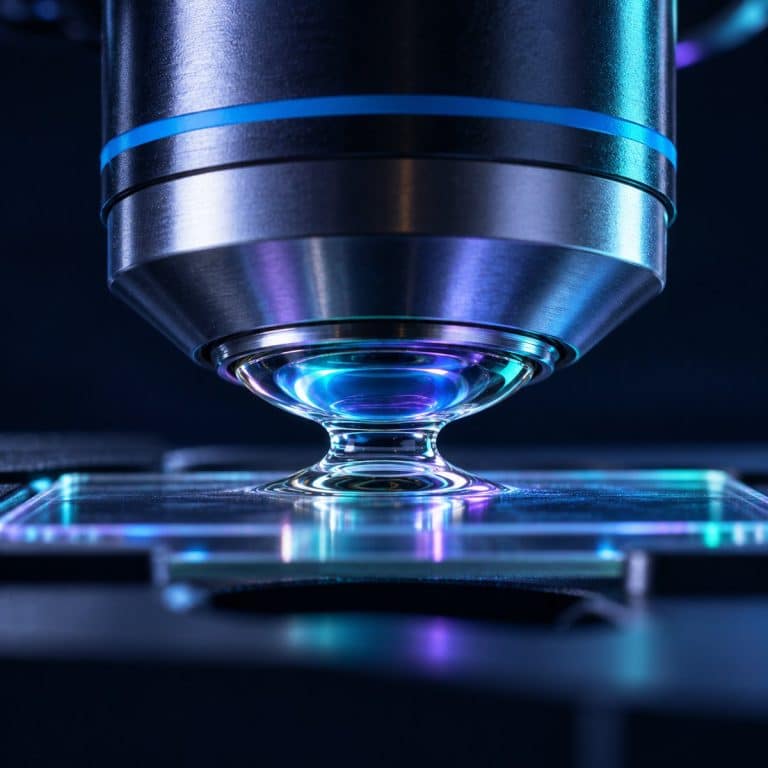
Microscope immersion oil is a purpose-made optical fluid with a refractive index of about 1.515, matched to the glass in your coverslip and objective lens — and yes, which specific bottle you buy actually matters. It works by closing the air gap between the coverslip and the objective’s front lens, so the steep light rays that would otherwise scatter and reflect away actually reach the lens. That gap is the difference between a 0.95 numerical aperture (NA) dry objective and a 1.40 NA oil objective, and it is worth understanding before you squeeze a drop onto a slide.

How an Air Gap Steals Your Resolution — and Why Oil Fixes It
Refractive index describes how much a medium bends and slows light. A specimen sits under a glass coverslip — the same standard 0.17 mm coverslip you use whenever you prepare microscope slides — and light leaving it must cross whatever fills the gap to the objective’s front lens. Fill that gap with air (refractive index 1.0003) and steep-angle rays bend sharply away from the axis; the steepest undergo total internal reflection and never leave the coverslip. Only the near-axial rays get through, producing the washed-out, low-contrast image every new 100x user recognizes — pale and milky no matter how the fine focus is turned. See Nikon’s immersion-oil tutorial for additional context.
Oil fixes this by matching the glass instead of fighting it. At roughly the same refractive index as the coverslip and the objective’s front lens, oil turns glass-oil-glass into one optically continuous path with no interface left to refract at, so the steep rays that air would have lost now reach the objective. This is why the technique is formally called homogeneous immersion — the medium is optically uniform with the glass around it.
| Medium | Refractive index |
|---|---|
| Air | 1.0003 |
| Water | 1.333 |
| Glycerin | 1.4695 |
| Standard immersion oil / crown glass | 1.515 |
| Bromonaphthalene | 1.6585 |
| Methylene iodide | 1.740 |
What Numerical Aperture Has to Do With It
Numerical aperture is calculated as NA = n · sin µ, where n is the refractive index between specimen and objective and µ is half the objective’s angular aperture. Because sine can never exceed 1, n is a hard ceiling on NA regardless of lens design — capping a dry objective at around 0.95 NA. Swap air for oil at 1.515 and the same design reaches up to 1.40 NA (specialist TIRF — total internal reflection fluorescence — objectives push to 1.45–1.49). That’s why a 100x objective is essentially always an oil objective and why oil sets the practical ceiling on microscope magnification: air’s low NA ceiling starves a 100x dry lens of the light it needs.
How Much Sharper Does It Actually Get?
Numerical aperture translates directly into resolving power through the Rayleigh criterion, d = 0.61 λ / NA, where d is the smallest separation the lens can resolve. Using green light at 550 nm: a best-case dry objective at 0.95 NA resolves to about 353 nm; a typical 100x oil objective at 1.25 NA resolves to about 268 nm; a high-end oil objective at 1.40 NA gets to d = 0.61 × 550 ÷ 1.40 ≈ 240 nm. That’s close to a 32% gain in fine detail over the best dry objective, from a bottle of oil that costs less than a single objective lens — this is how numerical aperture sets the resolution limit in practice.
| Setup | NA | Calculation (λ = 550 nm) | Resolution (d) |
|---|---|---|---|
| Best dry objective | 0.95 | 0.61 × 550 ÷ 0.95 | ≈ 353 nm |
| Typical 100x oil objective | 1.25 | 0.61 × 550 ÷ 1.25 | ≈ 268 nm |
| High-end oil objective | 1.40 | 0.61 × 550 ÷ 1.40 | ≈ 240 nm |
Reading the Label: Refractive Index, Abbe Number, and Viscosity
Immersion oil sold for microscopy is a specified product, not an improvised clear liquid: the spec is ISO 8036 — refractive index nₑ 1.5180 ± 0.0005, Abbe number vₑ 44 ± 3, measured at 23 ± 0.1°C. Buyers often see two different numbers on spec sheets, 1.515 and 1.518, and assume they’re different products. They aren’t: 1.515 is the n_D value at the sodium D-line (589.3 nm), while 1.518 is the nₑ value at the e-line (546.07 nm) — the same oil measured at two wavelengths, and a bottle stating either is correctly spec-grade. See Nikon’s refractive-index explanation for additional context.
Matching refractive index alone isn’t the whole story. The Abbe number describes dispersion — how much refractive index varies across the visible spectrum — and the oil must match the glass’s dispersion as well as its index, or different colors focus at slightly different depths, producing chromatic artifacts at high NA. That’s the technical reason “it has roughly the right refractive index” is never a valid argument for a substitute liquid.

Type A vs Type B: It’s Viscosity, Not Quality
Viscosity, not performance, separates the common immersion oil types, and treating a higher letter as “better” is the most common buying mistake here. Type A is thin (150 cSt), pours easily, and resists trapping bubbles — the easiest choice for a beginner on a single slide, and worth checking against the major microscope brands’ own recommendations before ordering. Type B is thick (1250 cSt) and holds its domed shape without running off, suiting larger gaps, tilted or inverted stages, and batch slide work — the full range of grades, including low-fluorescence and inverted-scope formulations, is cataloged on Cargille’s immersion oil reference. Neither is the premium product; the right choice depends on the setup.
| Type | Refractive index (n_D) | Viscosity | Best for |
|---|---|---|---|
| Type A | 1.515 | 150 cSt | General use, easy spreading, fewer bubbles |
| Type B | 1.515 | 1250 cSt | Larger gaps, inverted scopes, batch slide work |
| Type 37 | 1.515 at 37°C | 1250 cSt | Live-cell and incubated work |
| Low-fluorescence (LDF/HF) | 1.515 | 500–700 cSt | Fluorescence microscopy only |
| Cedarwood oil | ~1.515 when fresh, drifts as it ages | Varies, thickens over time | Antique optics restoration only |
Every ISO-compliant grade hits the same 1.515 refractive index — the letter on the bottle selects viscosity, not optical quality — which is precisely why a non-spec substitute fails no matter how thick or thin it is.
Held against white paper, the oil is water-clear with a faint yellow tinge. Type A pours like thin syrup; Type B behaves more like honey, a drop hanging off the dropper tip for a beat before letting go. On the slide it domes up rather than spreading flat, 3–4 mm across, holding that shape until a lens pushes into it. It has almost no smell — a useful test, since an old unlabeled bottle smelling sharp and woody, like pencil shavings, is cedarwood, not synthetic. A trapped air bubble shows up as a dark-rimmed circle or shimmering crescent that drifts when the stage is nudged and won’t focus away; too much oil instead looks like a hazy veil, drifting as the excess creeps.

Why There’s a Separate Oil for 37°C
Immersion oil’s refractive index falls as it warms, at roughly -dn/dt = 0.00033 per °C. A 10°C rise shifts it by about 0.0033 — over six times the ISO tolerance of ±0.0005 — visibly softening the image at NA 1.4. That’s why Type 37 exists: formulated to sit at spec at 37°C rather than the standard 23°C, for live-cell and incubated imaging. For a hobbyist, the same physics shows up smaller: a hot illuminator, a heated stage, or a bottle left on a sunny windowsill all push ordinary oil off its rated index.
Synthetic vs. Cedarwood Oil
Cedarwood oil was the original immersion medium, used since the Abbe era, but it has real failure modes that make it a poor default today. Its acid value is distinctly higher than synthetic oil’s, and that acidity can penetrate and degrade the cement bonding an objective’s front lens over repeated exposure. It also dries and hardens on contact with air into a varnish-like film — it must be wiped off immediately, while non-drying synthetic oil can sit for a while — and it yellows with age, absorbing UV and blue light in ways that interfere with fluorescence work. Synthetic oil, introduced in the 1940s and reformulated to remove PCB-based compounds by 1971, is color-stable, non-drying, and available in dedicated low-fluorescence grades. Unless you’re restoring antique optics, synthetic is the right default.
| Property | Cedarwood oil | Modern synthetic |
|---|---|---|
| Drying behavior | Dries and hardens into a film | Non-drying, stays liquid |
| Cleanup window | Must be removed immediately | Can be delayed safely |
| Lens cement | Higher acid value, can degrade cement | Lower acid value, relatively inert |
| Color stability | Yellows with age | Stays neutral |
The mechanism behind the cedarwood-to-cement damage is covered in more technical depth by Bitesize Bio’s explanation of oil immersion chemistry, which is worth a read if you have inherited an old scope with an unlabeled bottle sitting next to it.
What Happens If You Use the Wrong Oil
Household substitutes fail for the same reason every time: their refractive index and dispersion don’t match glass, so the air-gap problem the oil was meant to solve reappears in a different form. Vegetable and cooking oils sit well off the 1.515 target and aren’t dispersion-matched at all, and they eventually gum up and oxidize into a sticky residue that’s hard to remove. Mineral oil is closer but still off-spec and untested for lens cement compatibility. Glycerin, at 1.4695, is tempting but still measurably short. Water sits at 1.333 — a genuine step up from air, which is why water-immersion objectives exist as their own corrected class — but it still falls well short of the coverslip’s 1.515, so the refracting interface moves rather than disappears. An oil objective is corrected for oil, not water, and feeding it the wrong medium defeats the correction. None of these are simply “slightly worse” — they’re the wrong tool that happens to look similar in the bottle, risking slow chemical damage to an expensive objective with no clean fix. Get the oil right and the payoff is immediate: crisp detail on bacteria under the microscope or a blood smear under the microscope at 1000x, instead of a gray smudge.
Which Objectives Take Oil (and Which One You’ll Ruin)
Objective markings tell you exactly which liquid, if any, that lens is designed for, and reading them before reaching for the dropper prevents the most common and most permanent mistake in this topic. An objective etched “Oil,” “Oel,” or “HI” (homogeneous immersion) is built for oil; “W” or “WI” means water-immersion, “Glyc” means glycerin, and unmarked means dry. Cross-contamination is the real hazard: oil on a 40x dry objective — usually from rotating the nosepiece to the oil objective the wrong way through a wet slide — seeps past the front element with no reliable way back out. Knowing which way your nosepiece turns to reach the oil position among the objective lenses on a compound microscope, and always turning the other way when moving off it, avoids the problem entirely.
Objectives aren’t the only optic that needs oil. A condenser rated above NA 1.0 must be oiled directly to the underside of the slide to actually deliver that rating — run it dry and the air gap underneath throttles the illumination cone, capping the system at air’s refractive index regardless of the condenser’s quality. Buyers who upgrade their condenser but skip oiling the microscope condenser for NA above 1.0 never receive the resolution they paid for.
Storing Immersion Oil So It Stays in Spec
Immersion oil doesn’t spoil like food, but it drifts out of spec over time, and storage determines how fast. Keep the bottle capped between uses — an open dropper loses volatile components and collects dust and lint, and grit is what scratches a front lens element, not the oil itself. Store it upright, away from heat and direct sunlight, as manufacturer guidance for products like Zeiss Immersol specifically calls out — the temperature coefficient above explains why: a bottle baking on a windowsill is measurably off spec long before it looks any different. As for “does it expire,” there’s no single honest universal figure to quote, since it varies by brand. The oil degrades through volatile loss, contamination, and heat or UV exposure rather than spoiling on a fixed clock, and the date on your specific bottle is the number to trust over any generic rule of thumb.
Getting It Off the Lens Afterward
Cleanup deserves a short, careful note here rather than a full walkthrough. Wipe the objective with lens tissue first, and reach for a solvent only if the objective manufacturer specifies one, since modern cements and coatings react differently to different solvents and an aggressive one can do real damage. Never let any solvent run down into the barrel — it can dissolve the cement holding the lens elements from the inside out. The full step-by-step application and cleanup routine, including how to avoid trapping bubbles in the first place, is covered in a dedicated procedure guide on this site.
Frequently Asked Questions
Is immersion oil toxic or dangerous?
Modern immersion oils aren’t acutely toxic, but manufacturer safety data sheets classify them as skin irritants — Zeiss Immersol 518 F’s safety data sheet, for example, labels it this way. Avoid prolonged skin contact, wash off with soap rather than water alone, and keep it from eyes. The real historical hazard is pre-1971 oil, some of which contained PCB-based compounds; a vintage bottle of unknown origin should be disposed of, not used.
Can you mix two different brands of immersion oil?
It’s best avoided. Different manufacturers formulate to the same ISO 8036 targets but with different base chemistries, and mixing brands risks a cloudy or separated result and an unpredictable combined refractive index. Finish one bottle before opening another rather than topping one up with the other.
What is immersion oil actually made of chemically?
Modern synthetic immersion oil is a non-drying synthetic ester or hydrocarbon blend engineered to hit the ISO 8036 refractive index and dispersion targets, replacing the halogenated (PCB-based) compounds used in some oils before 1971. Cedarwood oil, the historical alternative, is a natural resin-based oil derived from cedar trees.
How much does a bottle of immersion oil cost, and how long does it last?
A bottle of spec-grade synthetic oil is inexpensive, costing less than a single replacement objective. Because only one small drop is needed per slide, a bottle lasts a hobbyist or student a very long time — this isn’t a consumable you’ll reorder often, which makes buying the correct spec-grade bottle an easy call.
Conclusion
Microscope immersion oil is not a lubricant or an accessory you can improvise — it’s an optical component with a specification, ISO 8036, that exists because refractive index and dispersion both have to match glass. Type A versus Type B is a viscosity decision, synthetic beats cedarwood for nearly every modern user, and the wrong substitute doesn’t just blur the image, it can damage the objective. Get those three things right, plus keeping the bottle capped and out of the heat, and a bottle of oil delivers a real, measurable resolution gain no dry objective can match.
Have you had the “washed-out gray blur” moment the first time you tried a 100x objective without oil, or run into oil creeping somewhere it shouldn’t? Tell us what happened in the comments below.