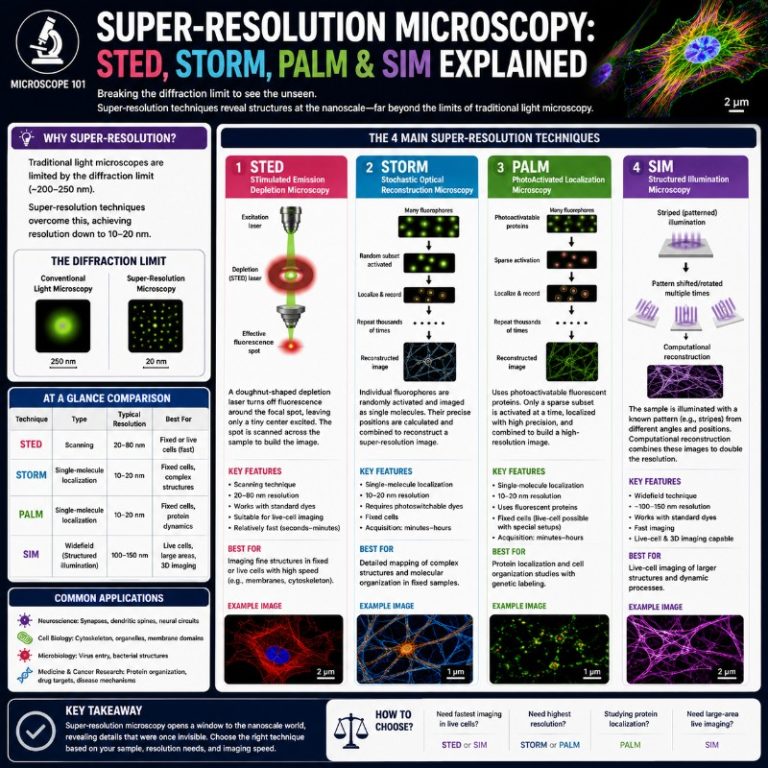
Super-resolution microscopy is the family of optical techniques that breaks the ~200 nm diffraction limit of conventional light microscopy, resolving biological structures down to 10–50 nm — while still using light and, in many cases, still imaging living cells. It earned the 2014 Nobel Prize in Chemistry and has since revealed biological architecture that was simply invisible before: the periodic skeleton of nerve cell axons, the eightfold geometry of nuclear pores, and the nanoscale clustering of proteins in cell membranes. If you’ve ever looked at a confocal image and wondered why two nearby proteins just look like one fuzzy blob, super-resolution microscopy is exactly what was needed.
How Super-Resolution Microscopy Actually Works
All four major super-resolution techniques share one core insight: you don’t need to sharpen the light beam itself — you need to control which fluorescent molecules are emitting at any given moment. Once you can make only a tiny, well-defined subset of molecules glow at a time, you can localize each one with far more precision than the diffraction limit would normally allow.
That single idea splits into two distinct engineering strategies:
- Patterned illumination — use cleverly shaped or structured light to define a sub-diffraction-sized emission zone. STED and SIM belong here.
- Single-molecule localization — make fluorophores blink on and off randomly so only one fires at a time in any given region, then fit a mathematical curve to each isolated spot to find its center with nanometer precision. PALM and STORM belong here.
These two families look completely different at the instrument level, but they are solving the same problem: conventional light microscopy lets too many molecules emit simultaneously, and their overlapping glow blurs into one unresolvable smear. Super-resolution separates the signals in space (patterned illumination) or in time (single-molecule blinking).
The Diffraction Limit: Why Light Microscopes Hit a Wall
In 1873, Ernst Abbe worked out mathematically that the finest detail any light microscope can resolve is roughly d = λ / (2·NA), where λ is the wavelength of light and NA is the numerical aperture (NA) of the objective lens. For green light (~500 nm) and a high-quality oil-immersion objective (NA ≈ 1.4), that works out to about 200–250 nm laterally and 500–700 nm axially. Call it roughly a quarter of a micrometer — a firm wall built into the physics of wave optics. Nikon’s MicroscopyU resource offers an accessible breakdown of optical resolution and the point-spread function if you want to go deeper on the math.
The reason the wall exists is that light bends around obstacles and spreads as it focuses. A perfect point source doesn’t image as a sharp dot; it images as a blurred halo called an Airy disk (or more precisely, a point-spread function, PSF). When two points are closer together than the width of that halo, their halos overlap and your eye — or camera — can no longer tell them apart. You can read more about the resolution of a light microscope and how NA and wavelength set the limit in our dedicated explainer.
Resolution vs. Magnification (and Why This Matters Here)
One of the most common misconceptions about a conventional compound light microscope is that cranking up magnification will eventually reveal finer detail. It won’t. Magnification and resolution are different things — magnification just enlarges an image, while resolution determines how much genuine detail that image contains. The difference between magnification and resolution is fundamental: more pixels on a blur is still a blur. Super-resolution microscopy increases actual resolution, not just zoom level.

The Four Main Super-Resolution Techniques
Four techniques dominate the field. They share the goal but take radically different routes to get there.
SIM — Structured Illumination Microscopy
SIM projects a fine striped grid pattern onto the sample. The grid interferes with the specimen’s fine structure the way two overlapping fence patterns create a large-scale Moiré pattern — encoding high-frequency structural information into lower-frequency interference fringes that the camera can actually detect. Computational reconstruction then pulls out the hidden detail, typically achieving ~100–130 nm lateral resolution — roughly a 2× improvement over conventional widefield.
SIM is the gentlest of the four techniques. It requires no special fluorescent dyes, uses relatively low laser power, and acquires images fast enough for live-cell work. The trade-off is that 2× improvement, which is real super-resolution but modest compared to what STED or STORM can do. Watch for honeycomb-pattern reconstruction artifacts in SIM images — they appear when the signal-to-noise is poor or the reconstruction parameters are off.
STED — Stimulated Emission Depletion
STED uses two synchronized laser beams: a conventional excitation spot, and a second doughnut-shaped “depletion” beam that forces molecules to stop fluorescing everywhere except the very center of the doughnut — a region that can be squeezed far below the diffraction limit. The microscope then scans this tiny emission zone across the sample like a conventional scanning confocal, producing a super-resolved image directly with no post-processing reconstruction required.
Typical STED lateral resolution is 30–80 nm, and because it’s a scanning method you get an image in real time — a major practical advantage. The downside is the depletion laser is intense. Phototoxicity and photobleaching are real concerns; the high photon dose that makes STED work can also damage live cells and burn out dyes before you finish imaging.
PALM & STORM — Single-Molecule Localization Microscopy
PALM (Photoactivated Localization Microscopy) and STORM (Stochastic Optical Reconstruction Microscopy) work on the same principle: use photoswitchable or blinking fluorophores so that at any given moment only a sparse, random subset of molecules is glowing. Each isolated flash is then fitted with a mathematical function (usually a Gaussian) to find its center with precision of 10–30 nm — far better than the size of its glow. Repeat for thousands of frames, accumulate the localizations, and you have a super-resolution reconstruction.
The raw data looks like a starfield — individual molecules blinking on and off frame after frame across a dark background — before software stacks tens of thousands of frames into a single crisp image. PALM uses genetically encoded photoactivatable fluorescent proteins (like PA-GFP), making it well-suited for imaging proteins inside living cells. STORM classically uses synthetic dye pairs (Cy3–Cy5) or single activatable dyes (dSTORM) and often produces the finest resolution of any optical technique. The practical cost: a single STORM image can take minutes to acquire, making fast live dynamics nearly impossible.
At-a-Glance Comparison
| Technique | Resolution (lateral) | Principle | Live Cell? | Cost / Complexity |
|---|---|---|---|---|
| SIM | ~100–130 nm | Patterned illumination (Moiré) | Yes — fast, low dose | Moderate; no special dyes |
| STED | ~30–80 nm | Patterned illumination (depletion donut) | Yes, with care | High; photostable dyes needed |
| PALM | ~10–30 nm | Single-molecule localization | Limited | High; photoactivatable proteins |
| STORM | ~10–30 nm | Single-molecule localization | Limited | High; photoswitchable dyes, long acquisition |
What Super-Resolution Revealed That Light Microscopy Couldn’t
The payoff of super-resolution microscopy isn’t just sharper images — it’s discoveries that were categorically impossible before. A few landmark examples:
Axonal actin rings. In 2013, Xiaowei Zhuang’s lab at Harvard used STORM to discover that the axons of neurons are wrapped in a periodic scaffold of actin and spectrin rings spaced ~190 nm apart — a discovery published in Science (Xu et al., 2013) — a structure that had been completely invisible under the main types of microscopes available before. Because the spacing (190 nm) is below the 200 nm diffraction limit, conventional microscopy saw only a blur; STORM revealed a beautiful, repeating lattice that turns out to play a key role in maintaining axon shape and electrical properties.
Nuclear pore architecture. The nuclear pore complex — the gatekeeper that controls what enters and exits the cell nucleus — has an eightfold rotational symmetry with subunits spaced ~20 nm apart. That geometry is far too fine for light microscopy to resolve but sits comfortably within STORM/STED range, enabling researchers to map protein positions within the pore without the electron microscope’s requirement for fixed, dehydrated samples.
Membrane protein clustering. Key receptors and signaling proteins in cell membranes that appeared uniformly distributed under confocal microscopy turned out to be organized into discrete nanoscale clusters — a finding with significant implications for how cells process signals and, in some cancers, how those signals go wrong.
In each case, the critical detail was not just below the resolution of conventional optics — it was below the diffraction limit by design, inaccessible to any amount of magnification or optical improvement short of breaking that limit.
Limitations and Trade-offs
Super-resolution microscopy is not a universal upgrade to conventional fluorescence. Every technique comes with costs that shape which one a lab actually chooses:
- Cost. A commercial STED system runs $500,000–$1,000,000+. STORM setups are somewhat cheaper to build but require sophisticated analysis software and careful sample prep. SIM systems are the most accessible, and several manufacturers now offer turnkey options, but “accessible” is relative — most researchers access these through the highest-resolution microscopes available at institutional core facilities.
- Sample preparation. PALM and STORM require fluorophores that can switch between on and off states — either genetically encoded photoactivatable proteins or specific synthetic dye pairs. Standard GFP or FITC won’t work for single-molecule localization. Preparing a sample correctly for STORM (buffer composition, oxygen scavenging, the right dye concentration) is its own specialized skill.
- Photobleaching and phototoxicity. STED and STORM both demand high laser intensities that bleach dyes and damage cells. A STORM image needs thousands of frames; if your dye burns out after 500, you don’t get enough localizations for a useful image. Labs use bright, photostable dyes and minimize exposure per frame, but it remains a fundamental tension.
- Acquisition time and drift. A single STORM reconstruction can take 30 minutes of frame collection. Over that time the sample drifts. Even nanometer-scale drift smears the final image — labs compensate with fiducial markers (bright fluorescent beads that don’t blink) and drift-correction algorithms. STED images faster because it doesn’t require frame stacking, but still demands careful anti-vibration setups.
- Reconstruction artifacts. Both SIM and SMLM methods are computationally intensive. Overly aggressive reconstruction in SIM produces a characteristic honeycomb artifact. Under-labeling in STORM leaves gaps in structure that can look like real biology. Getting the algorithm settings right matters as much as the optics.
Super-Resolution on Live Cells
Live-cell super-resolution is possible but demands compromise. SIM is the go-to for living samples — its low laser dose and fast acquisition (as little as 100 ms per frame) let researchers capture organelle dynamics with ~130 nm resolution. STED can image live cells if the depletion beam power is carefully controlled and photostable, cell-compatible dyes are used; frame rates are practical for some dynamics. PALM suits live cells conceptually (photoactivatable proteins are genetically encoded and don’t need to be loaded externally), but the thousands-of-frames requirement still limits temporal resolution. STORM on live cells remains very challenging — the required dye chemistry is hard to deliver inside a living cell at the right concentration, and long acquisition times don’t suit fast biological events. The field is actively developing faster acquisition schemes, including MINFLUX (see Emerging Directions below), that aim to square this circle.
Emerging Directions
Super-resolution microscopy is still evolving rapidly. Several directions stand out:
MINFLUX (Minimal photon Fluxes), developed by Stefan Hell’s group and described in a landmark 2017 paper in Science, uses a doughnut-shaped illumination like STED but localizes individual molecules by tracking where the minimum of the beam is, rather than where the maximum lands. The result is sub-10 nm resolution with far fewer photons than STORM — potentially combining single-molecule precision with live-cell viability. Commercial MINFLUX systems are just beginning to reach core facilities.
Expansion Microscopy (ExM) takes an opposite approach: physically embed the sample in a swellable hydrogel and expand it ~4× before imaging with a conventional fluorescence microscope. The expansion brings nanoscale structures into the range of standard diffraction-limited optics, achieving effective resolution of ~70 nm without a specialized instrument. It’s cheap and accessible but requires sample destruction — no live cells.
Correlative Light and Electron Microscopy (CLEM) and cryo-SR combine super-resolution light images with electron microscopy on the same sample — getting the molecular specificity of fluorescence labels and the structural detail of EM in one dataset. Cryo-SR-CLEM, where both modalities are performed on vitrified (frozen) samples, is an active frontier that promises near-native structural context at nanometer scale.
Super-Resolution vs. Electron Microscopy
It’s worth being explicit: super-resolution microscopy is not the same as electron microscopy, and the two are not competing for the same niche. How light and electron microscopes compare is a subject in its own right, but in brief: electron microscopy achieves sub-nanometer (even sub-ångström) resolution — far beyond any light-based technique. However, EM requires samples to be fixed, dehydrated, and placed in a vacuum. No live cells, no fluorescent labeling of specific proteins, no dynamic processes.
Super-resolution microscopy operates in the 10–130 nm range — not as fine as EM, but with light, in aqueous solution, often on living samples, and with the molecular specificity that fluorescent labels provide. The two techniques are more complementary than competitive; CLEM workflows deliberately combine them. For an overview of electron microscopy variants like TEM and SEM, see our separate guide.
Frequently Asked Questions
What resolution can super-resolution microscopy actually achieve?
It depends on the technique. SIM reaches ~100–130 nm (roughly 2× better than conventional light microscopy). STED achieves ~30–80 nm. PALM and STORM push down to 10–30 nm under ideal conditions. The emerging MINFLUX method can resolve features below 10 nm. All of these compare to the ~200–250 nm hard floor of standard diffraction-limited optics.
Who invented super-resolution microscopy, and why did it win the Nobel Prize?
The 2014 Nobel Prize in Chemistry was awarded to Eric Betzig, Stefan W. Hell, and William E. Moerner “for the development of super-resolved fluorescence microscopy”. Hell developed STED; Betzig demonstrated PALM; Moerner performed the first single-molecule fluorescence detection that made localization microscopy possible. The Nobel committee recognized that breaking Abbe’s century-old diffraction limit opened an entirely new window on living biology at the nanoscale.
What is dSTORM, and how does it differ from STORM?
dSTORM (direct STORM) is a variant that uses a single photoswitchable dye — typically Alexa Fluor 647 or similar — rather than the activator-reporter dye pairs used in classic STORM. In classic STORM, an activator dye (e.g., Cy3) triggers the fluorescence of a nearby reporter dye (Cy5) through energy transfer; this requires precise dye pairing and labeling density. dSTORM simplifies this by exploiting the fact that many standard fluorescent dyes will spontaneously blink on and off in the presence of reducing agents and oxygen-scavenging buffers. This makes dSTORM more compatible with antibody labeling protocols that labs already use, though careful buffer control (the “switching buffer”) remains essential.
How much does a super-resolution microscope cost?
Commercial STED systems typically run $500,000–$1,000,000 or more. Complete STORM setups — if built from components — can cost $150,000–$400,000 plus software and sample-prep reagents. SIM systems are generally the most affordable entry point, though still well into six figures. Most researchers access super-resolution through institutional core facilities rather than owning a system outright.
Do I need special fluorescent dyes for super-resolution microscopy?
For SIM: no — standard fluorescent labels work fine. For STED: you need photostable dyes that can withstand the high-power depletion laser without bleaching immediately; specific dyes like ATTO 647N are commonly used. For PALM: you need genetically encoded photoactivatable or photoconvertible fluorescent proteins (e.g., PA-GFP, mEos2). For STORM: you need photoswitchable synthetic dyes or single-molecule blinking chemistry; standard GFP will not work.
Why do some super-resolution images look speckled or have grid artifacts?
Speckled images are usually STORM or PALM images with too few localizations — the reconstruction hasn’t collected enough single-molecule events to fill in the structure, leaving visible gaps that may look like real features but aren’t. Grid or honeycomb artifacts are a signature of poor SIM reconstruction — typically caused by low signal-to-noise, incorrect reconstruction parameters, or sample movement during acquisition. In both cases the artifact looks like biology but is entirely instrumental. Collecting more frames (STORM/PALM) or optimizing sample labeling and reconstruction settings (SIM) corrects it.
Is super-resolution microscopy the same as confocal microscopy?
No — confocal microscopy improves image contrast and enables optical sectioning through a pinhole that rejects out-of-focus light, but it does not break the diffraction limit. A confocal microscope still has ~200–250 nm lateral resolution. Super-resolution techniques specifically overcome that limit. Confocal is a valuable and widely used method, but it is not super-resolution by definition.
Conclusion
Super-resolution microscopy reframed what “seeing” means in biology. By controlling which fluorophores emit — either through patterned light or single-molecule blinking — STED, SIM, PALM, and STORM collectively pushed optical resolution from ~200 nm down to 10–30 nm without abandoning the advantages of light: fluorescent labels, hydrated samples, living cells. The trade-offs are real — cost, sample preparation, phototoxicity, acquisition time — but emerging methods like MINFLUX and expansion microscopy are steadily lowering those barriers. What was once a Nobel-worthy instrument in a handful of elite labs is becoming standard equipment at university core facilities worldwide.
Have you had a chance to look at super-resolution images in your own work or study, or visited a facility that runs STED or STORM? We’d love to hear what you found most surprising — share your experience or questions in the comments below.
Originally posted 2026-06-20 06:49:29.