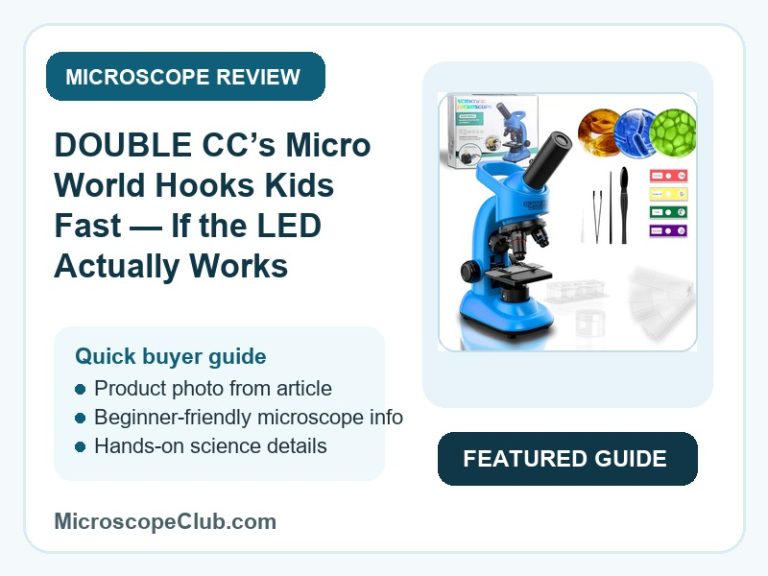
The DOUBLE CC Micro World kids microscope earns its 4.2-star average by nailing the basics — real WF10X eyepiece optics paired with 4x/10x/40x objectives, a stacked 26-piece accessory kit, and a price point low enough to hand to a first-time young scientist without a second thought. But it ships with a genuine coin-flip risk: a meaningful slice of buyers receive a unit with a dead or barely functional LED light, and at least one reported that the warranty replacement arrived broken too. If you’re comfortable troubleshooting a light source or returning a dud unit, the optics and accessory kit justify the buy. If flawless out-of-box function matters more than anything else, this one carries real odds against you.

✅ Pros
- WF10X eyepiece with 4x/10x/40x objective lenses delivers genuinely usable clarity on leaves, fabric, and prepared slides
- 26-piece accessory kit — prepared slides, blank slides, tweezers, droppers — removes the need for separate purchases
- Sturdy, kid-sized build that most reviewers found durable enough for small hands
- Dual top/bottom LED illumination with a 7-color aperture disk for both opaque and translucent specimens, when it’s working
- Budget-friendly price with a bundled phone adapter, making it a strong gift-value pick for a first microscope
❌ Cons
- LED lighting draws a high rate of negative mentions, including reports of a replacement unit arriving with the same fault
- Optical focus is inconsistent unit-to-unit — most see a crisp image, but some report lenses that never sharpen
- The focusing/adjustment mechanism can frustrate younger children who expect an instant clear view
- Build quality varies enough that “sturdy” and “flimsy” both show up as verified-purchase descriptions for the same product
What to Look for in a Kids Microscope
Before comparing spec sheets, it helps to know which numbers actually matter for a child’s first microscope. Magnification range is the headline figure sellers lead with, but the objective lens count — here, 4x/10x/40x paired with a WF10X eyepiece — determines whether a kid can actually find and hold focus on a specimen, not just what the maximum multiplier theoretically allows. A dual illumination system (light from above for opaque objects like coins or fabric, light from below for translucent slides) matters more for a beginner kit than raw magnification power, since most disappointing “microscope” experiences trace back to a subject that’s too dark to see rather than too small to resolve.
Build material and accessory completeness are the other two factors worth checking before buying. A metal-and-plastic body with a focusing wheel and brightness knob, like this kit uses, tends to survive a child’s handling better than an all-plastic frame, though as this review shows, unit-to-unit QC can still vary within the same product line. If you’re still narrowing down what matters most for your child’s age and attention span, our guide to the different types of microscopes breaks down where a compound kit like this one fits versus stereo or digital options.
Who Should Buy a Kids Microscope?
A kids microscope in this category is built for curiosity-first exploration, not classroom-grade precision. It suits children roughly 6-12 who want to poke around at leaves, fabric fibers, salt crystals, and prepared slides under adult or older-sibling supervision, where the goal is sparking interest rather than producing lab-accurate results. Parents buying a first microscope as a gift or a STEM starter kit are the core audience — the appeal is the complete, ready-to-use bundle rather than any single optical spec.
It’s a weaker fit for teens or older kids who already know how to use a microscope and want more consistent optical performance, and for any parent who can’t tolerate the possibility of troubleshooting a dead light or returning a unit. If your child fits the older end of that range, our roundup of the best microscopes for kids covers a few step-up options worth comparing before you commit.
Who This Is For
This is the right pick for a parent or gift-giver who wants a budget-friendly, complete-kit introduction to science for a 6-12 year old and is comfortable with the small chance of receiving a unit that needs a light-related exchange. It’s not the right pick for anyone expecting consistent, lab-grade focus and reliable illumination out of the box, or for older children who’ll outgrow a beginner-level adjustment mechanism quickly.
Full Specifications
| Spec | Value |
|---|---|
| Light Source Type | LED |
| Real Angle Of View | 45 Radians |
| Magnification Maximum | 400 x |
| Compatible Devices | Smartphone |
| Objective Lens Description | Multiple Objective Lenses With Magnification Levels |
| Power Source | Battery Powered |
| Item Dimensions L x W x H | 5.12″L x 3.35″W x 8.66″H |
| Item Weight | 0.6 Pounds |
| Enclosure Material | Metal, Plastic |
| Color | Yellow |
| Model Name | Micro World |
| Brand | DOUBLE CC |
| UPC | 721527655589 |
| Warranty Description | 2 years |
| Built-In Media | 1x WF10X eyepiece, 4X objective lenses, 10x operating accessories, 15x microscope slides set, prepared microscope slides with specimen sets |
Optical Performance
The DOUBLE CC Micro World delivers its magnification through a WF10X eyepiece combined with 4x, 10x, and 40x achromatic objective lenses, giving six usable magnification steps rather than a single fixed zoom. The listing’s marketing claims stretch as high as 1600x, but that figure is the product of multiplying eyepiece and objective values together — Amazon’s own spec sheet lists a 400x maximum, which is the more realistic ceiling for resolvable, in-focus detail on this kit. Reviewers consistently describe the lower-to-mid range of that scale — enough to make out slide details, leaf structure, and fabric fibers clearly.

The DOUBLE CC Micro World also includes a 7-color aperture disk beneath the stage, which increases contrast on translucent specimens and can filter out ambient light interference. One verified buyer noted “the magnification range is impressive, the LED light works great, and the prepared slides make it easy to start exploring right away,” while a dissenting reviewer reported the opposite: “the lenses are blurry and don’t focus well at all, so my kids couldn’t see anything clearly, no matter how much we adjusted it.” That split lines up with a genuine QC variance rather than a universal defect — most units focus cleanly, but not all. For a deeper technical grounding in how eyepiece and objective magnification combine, Nikon’s microscopy education resource, MicroscopyU, is a solid reference.
Illumination System & Reliability
The DOUBLE CC Micro World runs a dual illumination system — a top incident light for opaque objects like coins or jewelers’ loupes, and a bottom transmitted light for translucent slide specimens — with touch-sensitive brightness adjustment on the bottom source. On paper this is a more capable setup than most kits at this price, since it covers both specimen types without needing an add-on lamp.
The DOUBLE CC Micro World also carries this review’s single biggest purchase risk: lighting draws 30 total review mentions, and 12 of them (40%) are negative. One buyer wrote plainly, “the LED light is very weak and barely helps,” and a separate complaint noted “the light doesn’t work in the original or the replacement they sent,” with no way to open the housing to check or replace the batteries. Against that, other verified buyers describe the same light as “bright and adjustable” and central to a “clear view of samples.” Read together, this points to inconsistent unit-level quality control on the lighting component specifically, not a uniform design flaw — worth budgeting for the possibility of an exchange.
Build Quality, Accessories & Ease of Use
The DOUBLE CC Micro World ships in shockproof, drop-proof packaging and uses a metal-and-plastic enclosure at 0.6 pounds, sized to be manageable for smaller hands at 5.12″ x 3.35″ x 8.66″. Most reviewers back this up directly: “the design is thoughtful and sturdy, perfect for small hands,” and “it’s sturdy enough for younger kids to handle, and the focus knobs are smooth and easy to use.” A minority disagree sharply — one one-star review called the build “extremely cheap and flimsy, more like a toy than an actual science kit” — which again points to per-unit variance rather than a consistent build defect.
The DOUBLE CC Micro World bundles a 26-piece accessory kit — prepared specimen slides, blank slides, tweezers, droppers, and a smartphone adapter — that removes the setup friction of sourcing slides separately, a common early hurdle for beginner kits. Ease of use skews positive overall, with one buyer noting assembly “takes under 20 mins,” though at least one reviewer found the focus adjustment “very hard to adjust” for a young child, enough that “kiddo is never looking at this anymore.” Expect a learning curve of a few sessions before a 6-8 year old can focus independently.
What Customers Say
The DOUBLE CC Micro World holds a 4.2 out of 5 average across 353 ratings. In an 8-review sample, sentiment ran roughly 75% positive, 12.5% mixed, and 12.5% negative, with 100% of sampled reviews verified as actual purchases — a solid authenticity signal. One reviewer summed up the upside plainly: “the design is thoughtful and sturdy, perfect for small hands,” while another called it “a great educational toy that makes learning fun.” On the other end, a verified buyer described a unit where “the lenses are blurry and don’t focus well at all,” and a separate one-star review flagged that “the light doesn’t work in the original or the replacement they sent.”
Review integrity here sits at LOW-MEDIUM risk. Every sampled review carries a Verified Purchase badge and the negative reviews are specific and mechanically detailed rather than vague, which argues against a coordinated fake-review campaign. The one flag worth noting: a five-star review was submitted before the product had even been used (“even though we haven’t used it yet, I can already tell it’s going to be a Christmas favorite”), which is a minor aspirational-review pattern that can inflate the star average without reflecting real-world performance. For more on how to spot that kind of pattern in any product’s reviews, see this overview of fake and manipulated reviews.
Final Verdict
CONSIDER: the DOUBLE CC Micro World backs up its price with real optics, a genuinely complete accessory kit, and a majority of happy, verified buyers — but the LED lighting system’s 40% negative mention rate is a real, quantifiable risk rather than a minor gripe, and at least one buyer received a defective replacement unit. Buy it if you’re prepared to test the light immediately on arrival and exchange it without hesitation if it fails; skip it if you need a guaranteed-functional unit out of the box for a fixed occasion like a birthday.
Frequently Asked Questions
What age range is the DOUBLE CC Micro World microscope best suited for?
The listing and reviews consistently point to ages 6-12, with several buyers specifically praising it as a first microscope for kids as young as 6-7. Reviewers note the focusing mechanism can frustrate the youngest end of that range without adult help, and teens who already have microscope experience will likely find it too basic.
Does the kit include prepared slides, or do I need to buy them separately?
Yes — the 26-piece accessory kit includes prepared specimen slides as well as blank slides for making your own, along with tweezers and droppers. Multiple reviewers called this out as a key reason the kit avoided the usual “buy more accessories separately” hassle of beginner microscopes.
Can this microscope be used with a smartphone to take photos?
Yes, a phone adapter is included in the accessory bundle, and the listing lists smartphones as a compatible device. One reviewer specifically called out being able to “capture what they discover” using the included adapter.
What is the actual maximum magnification — 400x, 1000x, or 1600x?
The marketing bullets advertise up to 1600x across six levels (40x, 100x, 250x, 400x, and 1000x), but Amazon’s own technical specification table lists a 400x maximum. Treat the higher figures as the mathematical product of eyepiece and objective magnification rather than a guarantee of resolvable detail — real-world use centers on the lower-to-mid range of that scale.
Is the DOUBLE CC Micro World powered by batteries or does it plug in?
It’s battery powered, which drives both the top and bottom LED illumination. There’s no listed way to access the battery compartment for replacement in some units, which one reviewer flagged as a specific complaint when the light stopped working.
What should I do if the LED light doesn’t work when it arrives?
Test the light immediately after unboxing rather than waiting. Given that 12 of 30 review mentions of lighting are negative, and at least one buyer received a non-functional replacement, request an exchange or refund right away through Amazon rather than assuming a fix is possible at home.
Is this microscope durable enough for younger children (ages 6-8)?
Most verified reviewers describe the build as sturdy and well-suited to small hands, with smooth focus knobs and a shockproof, drop-proof design. A minority report a build that feels cheap or flimsy, so durability appears to vary somewhat by individual unit rather than being a consistent problem.
Conclusion
The DOUBLE CC Micro World suits a parent or gift-giver who wants a complete, low-cost science kit for a curious 6-12 year old and is willing to test the light on arrival and exchange it if needed — the optics, accessory kit, and overall sentiment support the buy for that buyer. It’s a weaker choice for anyone who needs guaranteed, flawless function out of the box or is shopping for a teen who wants more precision than a beginner kit offers.
If you’ve used this kit or a similar beginner microscope with your kids, share what worked (or didn’t) in the comments below — and if you’re setting one up for the first time, our guide to preparing your own microscope slides is a good next stop once the basics are covered.