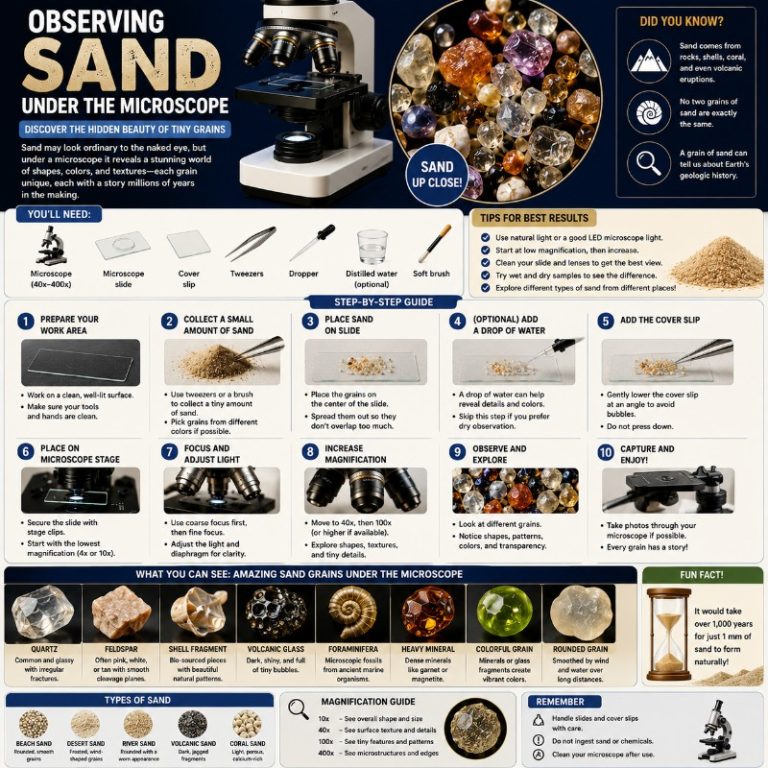
Sand grains under a microscope reveal more than most people expect — not just shape and color, but the entire travel history of a grain: whether it was hurled by desert winds, tumbled down a river, or built grain-by-grain from the skeletons of sea creatures. A $40 stereo scope and a pinch from your local beach is all it takes to start reading that story.
What is sand? Size, composition, and classification
Sand is a granular sediment made of fine mineral and rock particles. The standard used in geology is the Udden–Wentworth scale, which defines sand as grains between 0.0625 mm (1/16 mm) and 2 mm in diameter — anything finer is silt or clay, anything coarser is gravel. Within that range, geologists distinguish five sub-grades: very fine (0.0625–0.125 mm), fine (0.125–0.25 mm), medium (0.25–0.5 mm), coarse (0.5–1.0 mm), and very coarse (1.0–2.0 mm). Engineering and construction references use the ASTM sieve standard instead (0.075–4.75 mm, bracketed by a #200 sieve at the fine end and a #4 sieve at the coarse end), which is why you will see different numbers in different contexts.
The most common sand mineral worldwide is quartz (silicon dioxide) — chemically inert and mechanically tough, it survives weathering long after softer minerals have broken down. Other minerals commonly found alongside it include feldspar, mica, olivine, magnetite, and hornblende. At tropical reef beaches, the grains are often entirely biogenic — the broken skeletons of mollusks, coral, and microscopic foraminifera that precipitated calcium carbonate from seawater rather than eroding from rock.

How to view sand under a microscope — step-by-step setup
A stereo microscope at 10–40x is the best tool for sand. It gives a 3D, top-lit view of opaque grains — exactly what you need when grain shape and color are the primary data. A compound microscope with a 4x objective works in a pinch, but the view is flat and the working distance is tight.
The single most common beginner mistake is dumping too many grains onto the slide. When grains pile on top of each other, they roll, cast confusing shadows, and you can’t isolate a single grain to study. Here is the procedure that avoids that:
- Spread a single sparse layer. Tap just a few grains onto a glass slide or a piece of card stock — you want grains sitting apart, not touching. Fewer grains, better view.
- Set the magnification to 10x to start. At this power you can see the full range of grain sizes, shapes, and colors across your sample.
- Light from the side. Aim a bright flashlight at a low angle across the surface of the slide. Side-lighting throws shadows that define texture and relief on each grain. Do not use the compound microscope’s transmitted (base) illuminator — sand is opaque; transmitted light just silhouettes the grains as dark blobs.
- Test both backgrounds. Slip a sheet of white paper under the slide, then switch to black. You will immediately see that some grains “disappear” against one background and pop against the other. Dark grains like magnetite vanish on black; light quartz grains often show better detail on black.
- Step up to 40x once you’ve identified a grain of interest. At this magnification you can start to see surface texture — whether a grain is glassy and polished, or dull and pitted.
- Compare two sands side by side. This is where it gets genuinely interesting. Even a brief comparison between a handful from a beach and a pinch from a potted-plant bag of construction sand reveals radical differences in roundness, color, and grain uniformity.
For preparing microscope slides of loose, dry material like sand, a simple dry mount (no coverslip needed for the stereo scope) is all that is required. Keep the grains dry — moisture causes them to clump together and obscure surface detail.

What sand looks like under a microscope — the visual mineral key
At 10x through a stereo scope, a mixed beach sand sample looks like a scattered handful of tiny gemstones — glistening whites, translucent grays, salmon pinks, an occasional black fragment. The variety is the first thing that stops people. At 40x, the character of individual grains becomes clear: the glassy smoothness of a quartz crystal face, the flat mirror-flash of a mica flake, the dense opaque black of a magnetite grain.

Use the table below as a field guide. When you find a grain that matches the left column, you have a confident identification of the mineral or material on the right:
| Appears as | Likely identity |
|---|---|
| Glassy, clear or milky white, more rounded | Quartz |
| Creamy white, gray, or salmon/pink, more angular | Feldspar (pink = potassium feldspar) |
| Shiny black, dense, responds to a magnet | Magnetite |
| Olive to pale green, glassy | Olivine |
| Flat, thin, catches light like a tiny mirror | Mica |
| Black, elongated, prismatic | Hornblende |
| White or pink with visible spirals, chambers, or ridges | Biogenic — shell, coral, or foraminifera |
| Rounded + dull/matte surface | Wind-transported (desert dune) grain |
| Rounded + glossy/polished surface | Water-transported (beach or river) grain |
Quartz is the most weathering-resistant common mineral on Earth, which is why it tends to be the most abundant and most rounded grain in any sample. Feldspar is softer and breaks down faster, so feldspar grains are generally more angular and fresher-looking. The difference is visible even at 10x once you know what to look for.

Reading grain shape — how sand records its own history
Grain roundness is one of the most informative things a microscope reveals, because grains record their transport history physically. The more a grain has been bounced, abraded, and smoothed against other grains, the more rounded it becomes.
- Angular, sharp-edged grains — short transport from the source rock. You often see this in construction sand from quarries, or in freshly eroded material near a cliff face.
- Rounded, polished (glossy) grains — long transport in water. Rivers and waves tumble grains for kilometers, polishing them smooth. Most beach sand and river sand falls here.
- Rounded + frosted (dull, matte) grains — desert dune sand. The frosting is micro-pitting caused by high-velocity grain-on-grain collisions during wind transport. Under 40x magnification, the surface looks almost sandblasted — dull and rough compared to the glassy shine of water-transported quartz.
This directly answers one of the most common questions about sand: beach sand and desert sand are not the same. At 40x, beach sand is generally more polished and often retains more color variety (because waves bring in grains from varied sources). Desert dune sand is typically more uniform in size (wind sorts grains efficiently), rounder in shape, and heavily frosted — a recognizable fingerprint of aeolian (wind) transport.
Types of sand and what they look like up close
Volcanic sea sand — black and green
On beaches near active volcanic islands, the sand is basalt. Waiʻānapanapa Beach in Maui, Hawaii, is a classic example — the black sand is ground basalt lava, produced by the combined action of waves and high coastal winds. Under the scope, basalt sand looks dark gray to black, with an irregular, almost glassy fracture surface rather than a crystal face.
Green sand is rarer still and one of the more striking sights in microscopy. Olivine is a dense, heavy mineral that forms in basaltic magma; when lava cones erode, waves wash away the lighter minerals and concentrate the green olivine crystals. The result is a beach with noticeably green sand. Papakōlea Beach on the Big Island of Hawaii (near South Point, Puʻu Mahana cinder cone) is the most famous example — one of only about four green-sand beaches on Earth, the others including Talofofo Beach on Guam, Punta Cormorant in the Galápagos, and a site in Norway. Under magnification, olivine grains are glassy and olive-to-lime green, typically more angular than well-traveled quartz.
Magnetic sea sand — black and dense
Some beaches concentrate magnetite — an iron oxide mineral — because it is dense enough to resist wave action that washes away lighter quartz. The result is a dark or black band of sand along the waterline. Malaga Cove in Palos Verdes, Southern California, is a documented example where magnetite and ilmenite dominate the heavy-mineral fraction. You can demonstrate this yourself: drag a magnet in a plastic bag through the dry sand and the magnetite grains will cluster on it — a simple, dramatic test.
Under the microscope, magnetite grains are opaque, shiny black, and noticeably denser-looking than the surrounding minerals. They sit lower on the slide under their own weight.

Shell sea sand — white, pink, and structured
In many beach and seafloor environments, the grains are not mineral at all — they are the broken remains of shells, coral, and foraminifera. This biogenic carbonate sand dominates tropical reef beaches, where the calcium carbonate skeletons of marine organisms are continuously broken down by wave action. The sand on most picture-perfect white beaches in the Caribbean, the Maldives, and the Pacific Islands is almost entirely biological in origin.
Under the microscope, biogenic grains are distinctive: you can sometimes make out the remnant structure of the original organism — tiny spiraling foraminifera tests, curved shell fragments with visible ridges, or coral pieces with a spongy internal texture. The color is white to cream, often with a pink or brown tint from iron staining or organic residue.
Wave energy shapes the grains. On the North Shore of Oahu, Hawaii, intense wave action produces rounder, more pebble-like shell fragments. On calmer beaches like Cabo in Baja Mexico, grains remain coarse, irregular, and barely abraded.
Coral sea sand
Where living coral reefs are abundant, parrotfish and wave action combine to produce fine, powdery coral sand. At 10x, coral sand looks almost like rock salt — the grains are roughly cubic, white, and coarse-looking — but it is actually powdery soft to the touch. The Huahine beach in Tahiti, French Polynesia, is a well-known example of this type.

Lake and river sand
Rivers deliver sand by eroding rocks upstream and depositing them as water slows in shallower reaches. Lake Powell in Utah is a good example: the beach sand there is relatively fine and shows a mix of shiny white quartz and salmon-orange feldspar — minerals eroded from the sandstone formations upstream. River sand tends to be moderately to well-rounded (water is an efficient polisher), but less so than ocean beach sand, because river transport distances are shorter.
Because rivers sort grains by size as flow velocity drops, river-mouth and lake-edge sand is often more uniform in grain size than beach sand, which receives inputs from many directions.
Construction sand
Construction sand is mined from mountain sides, inland dunes, river beds, and quarries. What you buy at a lumber yard is typically fine, grayish-white quartz sand — angular to sub-angular, because it has not traveled far. Under the scope it looks noticeably rougher and more angular than beach sand of the same grain size. It is used in concrete because those angular faces lock together mechanically; rounded beach sand makes weaker concrete.
Light microscope vs. SEM — what each reveals
A stereo or compound light microscope shows color, 3D relief, and translucency — the difference between a glassy quartz grain and an opaque magnetite grain is immediately obvious. But it cannot resolve fine surface texture at the scale of individual micro-pits.
A scanning electron microscope (SEM) strips away color but reveals surface architecture in extraordinary detail: the conchoidal fracture faces on quartz, the micro-pits from aeolian transport, the chemical etch patterns from weathering. If you see SEM sand images online — silvery gray, almost lunar-looking — the frosted, cratered surfaces on dune grains and the smooth glassy faces on water-polished grains are immediately visible. High-magnification digital microscopes (like those used in materials science labs) can bridge some of this gap at 200x and above.
For a hobby observer with a stereo microscope, the practical ceiling is about 40x for surface texture. That is enough to distinguish frosted dune grains from polished beach grains, and to identify major minerals by color and crystal habit. Electron microscope images of mineral surfaces show what lies beyond that threshold if you want to see the full picture.
FAQ
Is beach sand the same as desert sand?
No — they are visibly different under magnification. Desert dune sand grains are typically well-rounded and heavily frosted (dull, matte surface) from high-velocity grain-on-grain collisions in wind. Beach sand grains tend to be moderately rounded and polished (glossy) from water abrasion. Desert sand is also more size-uniform because wind sorts grains efficiently. At 40x these differences are clear.
Can I use a compound microscope for sand?
Yes, at low power (4x objective). However, a stereo/dissecting microscope at 10–40x is far better for sand because it gives a 3D, top-lit view of opaque grains. On a compound scope with transmitted light, sand grains appear as dark, featureless silhouettes because they are opaque — you lose all the color and surface texture information.
What magnification do you need to see sand under a microscope?
10–20x through a stereo scope is enough to see grain shape, color, and basic mineral identity. Step up to 40x to begin seeing surface texture — frosting, pitting, and polish. Higher magnifications (100x+) require an SEM or high-end digital microscope to be useful for surface detail.
How do you tell quartz from feldspar under a microscope?
Quartz grains are glassy and clear to milky white, with a tendency toward rounded shapes (quartz is hard and resists abrasion). Feldspar grains are creamy white, gray, or salmon/pink (potassium feldspar in particular is distinctively pink), and are more angular because feldspar is softer and breaks down faster. At 10x the color difference alone is usually sufficient for a confident separation.
What is sand made of?
Most commonly quartz, followed by feldspar. Depending on the location, sand can also contain significant mica, olivine, magnetite, hornblende, and biogenic carbonate (shell, coral, foraminifera). Tropical reef beaches are often predominantly biogenic carbonate with very little quartz.
Why is some sand black, green, pink, or white?
Color tracks mineral identity. Magnetite and basalt produce black sand; olivine produces green sand; broken shells and coral produce pink-to-white biogenic sand; quartz-dominated sand is white to tan. Mixed-mineral beach sand shows all of these colors simultaneously under a microscope.
Conclusion
Sand under a microscope is one of the most accessible entry points into geology and mineralogy — no special preparation, no expensive reagents, just a pinch of material and a low-power lens. Each grain carries information about its mineral composition, its travel history, and the environment that produced it. The key practical steps are a sparse single layer of grains, side-lighting to reveal 3D texture, and a comparison between two different sand samples — that contrast is where the real learning happens. If you want to go further, try placing salt crystals under the microscope alongside your sand sample — the angular crystal geometry is a sharp contrast to rounded sediment grains. Or compare with a sample of how soil looks under a microscope — the jump in complexity is striking, and it puts sand’s relative simplicity in useful perspective.
Originally posted 2020-05-12 14:18:20.