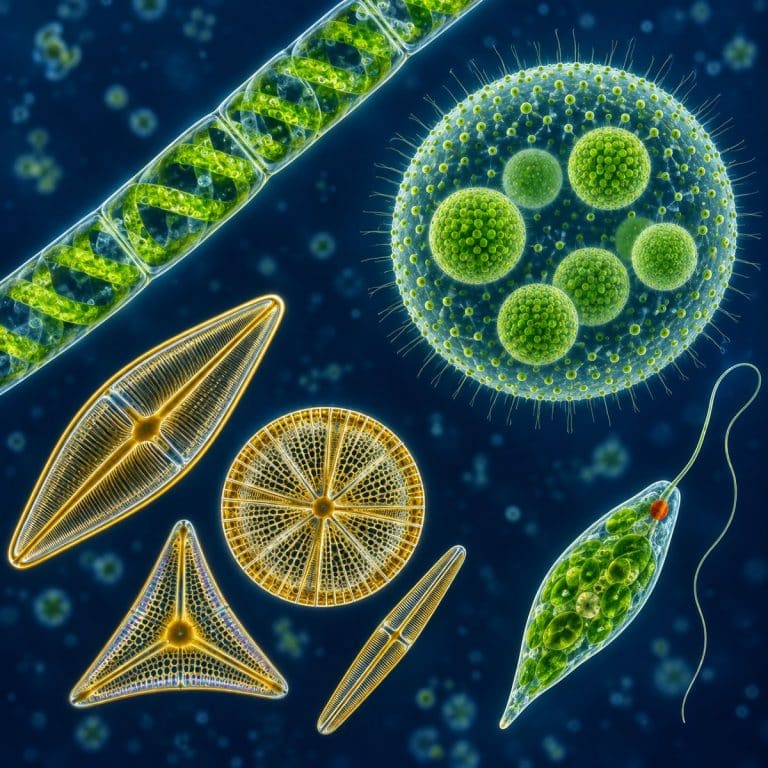
What are algae? Algae are a huge, mixed group of mostly photosynthetic, mostly aquatic organisms that range from single microscopic cells to giant kelp. Despite the “plant-like” reputation, though, none of them have true roots, stems, or leaves. Scoop up a jar of green pond water or scrape the film off aquarium glass, and a home microscope will show you most of what this group has to offer: bright green ribbons, rolling green spheres, and tiny golden-brown glass boxes drifting past. This guide clears up the classification mix-ups beginners always hit and walks you through finding and viewing algae yourself.
What Algae Are (and What They’re Not)
Algae is not a single kingdom or a tidy scientific category — it is a catch-all term for photosynthetic organisms that make their own food using chlorophyll but are not land plants. Most algae are eukaryotes, meaning each cell has a true nucleus and chloroplasts, and most live in fresh or salt water. The size range is enormous: a single Chlamydomonas cell is invisible to the naked eye, while brown algae (kelp) can grow to meters long. Despite their small size, algae and other phytoplankton do outsized work for the planet — NOAA estimates ocean phytoplankton produce roughly half of the oxygen on Earth. For a home microscope, though, only the microscopic and filamentous algae matter — kelp and seaweed are macroalgae you can already see without any magnification. OpenStax provides useful context on photosynthesis in algae, plants and cyanobacteria.
Not a plant, not a protozoan — the simple rule
Land plants evolved from green algae, which makes green algae the closest living relatives of plants — but that ancestry does not make algae plants themselves. Algae lack the vascular tissue, roots, stems, and leaves that define a true plant. A strand of pond algae is therefore built completely differently from a blade of grass, even though both are green. Algae also overlap with the same chloroplasts that green a plant leaf, which is exactly why the two get confused. Algae are also easy to mix up with protozoa, since many single-celled algae are protists — the same broad grouping protozoa belong to. The dividing line is nutrition: algae are autotrophs that photosynthesize, while classic protozoa are heterotrophs that eat other organisms. Euglena blurs this line on purpose — it photosynthesizes in sunlight and can feed when light runs out, a mixotroph that makes it one of the best teaching organisms in pond water.
The “blue-green algae” trap: cyanobacteria are bacteria
The single biggest classification mistake beginners make is treating “blue-green algae” as a type of algae. It isn’t. Blue-green algae are cyanobacteria — prokaryotes with no nucleus and no chloroplast, doing their photosynthesis instead on internal membranes called thylakoids. That makes cyanobacteria bacteria, not true algae, no matter what the common name suggests. The distinction matters beyond biology class: some cyanobacteria blooms produce cyanotoxins, and the EPA’s guidance on harmful algal blooms is worth a read before you go collecting from anything that looks like a thick paint-like scum.
The Main Types of Algae (Comparison Table)
Six groups cover almost everything a beginner will encounter, in a sample or in a search result. Cyanobacteria are included as a comparison row, not as a true algae group, since ruling it out is half the point. Its protist guide also surveys green algae, diatoms and other photosynthetic groups.
| Group | Common name | Single/Multi-cell | Key pigment / color | Beginner example | Where you find it |
|---|---|---|---|---|---|
| Chlorophyta | Green algae | Both — single cells, colonies, filaments | Chlorophyll a + b — grass green | Spirogyra, Chlamydomonas, Volvox | Freshwater ponds, aquarium glass |
| Bacillariophyta | Diatoms | Single-celled, sometimes chain-forming | Golden-brown | Pillbox, boat, and star-shaped diatoms | Fresh and salt water, damp soil |
| Phaeophyta | Kelp / brown seaweed | Multicellular (macroscopic) | Brown (fucoxanthin) | Kelp | Marine coastlines — not microscope-scale |
| Rhodophyta | Red seaweed | Mostly multicellular | Red (phycoerythrin) | Marine red seaweeds | Mostly marine, some freshwater |
| Euglenoids | Euglena | Single-celled | Green, with a red eyespot | Euglena | Freshwater ponds and ditches |
| Cyanobacteria | “Blue-green algae” (not a true alga) | Single-celled or colonial | Blue-green (phycocyanin) | Forms thick surface blooms | Freshwater blooms, ponds |
How to Collect and View Algae Under a Microscope
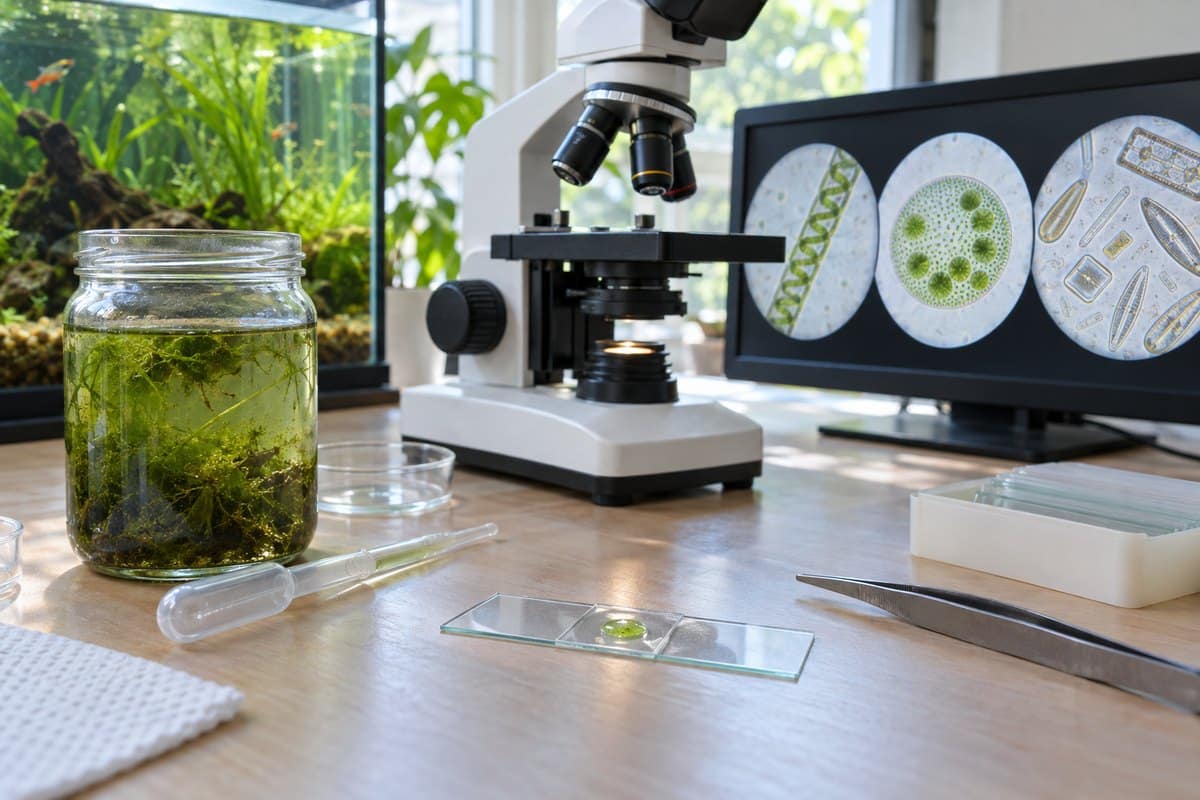
You do not need lab equipment to find algae — most of it is sitting in the nearest pond, ditch, or fish tank.
- Find a source. Green pond water, the slimy film on rocks or aquarium glass, and roadside ditches are all reliable. Scraping the green film off a rock or aquarium wall often gives cleaner filamentous algae (like Spirogyra) than scooping open water.
- Sample it. Collect a small jar of water, or scrape a pinch of the green film directly into a drop of water. You need very little material — a visible green tint is plenty.
- Make a wet mount. Place one drop of your sample on a slide and lower a coverslip at an angle rather than dropping it flat, so you don’t trap air bubbles. If you’ve never made one, make a wet mount slide the same way you would for any pond sample.
- Scan at low power first. Start at 40–100x. Filaments like Spirogyra and colonies like Volvox are visible at this range, and scanning low is how you actually find material before you commit to a smaller field of view.
- Step up to 400x for detail. The diagnostic features — the spiral chloroplast in Spirogyra, the pyrenoid, the eyespot on Chlamydomonas and Euglena, and the fine etched pattern on a diatom’s shell — need 400x. You will not need 1000x or oil immersion for any of the organisms in this guide.
- Optional: stain with iodine. A drop of iodine stains the starch stored around the pyrenoid, making it pop into view — but it kills motile cells. View live swimmers like Chlamydomonas and Euglena first, then stain afterward if you want the structural detail.
Safety note: don’t handle or let pets drink water from a thick blue-green or paint-like scum — some cyanobacteria blooms produce toxins that are harmful to people and animals. This is general safety guidance, not medical advice; if you suspect exposure, contact a medical professional.

What Algae Looks Like Under a Microscope
Once you know what to look for, the same handful of algae keep showing up in almost every freshwater sample.
Spirogyra — green ribbons with a spiral chloroplast
Spirogyra shows up as bright grass-green threads that look like tiny bracelets strung end to end — unbranched filaments made of cells stacked like train cars. The feature that gives it away instantly is the chloroplast: it winds around the inside of each cell wall like a green spiral staircase, or a stretched-out spring. It’s the single most recognizable algae structure a beginner will see, and it’s visible at 100x, with the spiral itself sharpening up nicely at 400x.
For a closer look beyond this overview, a closer look at Spirogyra, a common filamentous green alga, walks through its structure in more depth.
Chlamydomonas & Volvox — single green cells and rolling colonies
Chlamydomonas cells look like tiny green teardrops that dart and stop, propelled by two hair-thin flagella you’ll only resolve at 400x. A cup-shaped chloroplast fills most of the cell, and a red-orange eyespot sits near the front — the organism’s simple light sensor. Volvox is the colonial version of the same idea: a hollow sphere of hundreds of similar cells that rolls slowly across the field of view like a green marble, sometimes with smaller daughter spheres visible tumbling inside the parent colony.
Diatoms — golden glass boxes
Diatoms are unmistakable once you’ve seen one: little golden-brown boxes — pillbox-shaped, boat-shaped, or star-shaped. Each is encased in a silica cell wall called a frustule, etched with impossibly fine lines that glint like frosted glass under the light. For the full range of shapes and symmetry you’ll encounter, diatoms, the golden-brown algae with glass shells, covers the group in detail, and the UC Museum of Paleontology’s diatom overview is a solid academic reference if you want to go deeper on their biology.
Euglena — the swimmer that photosynthesizes
Euglena is a green spindle-shaped cell that glides and flexes its body in a wriggling motion called euglenoid metaboly, driven by a single whip-like flagellum at the front. Like Chlamydomonas, it carries a red eyespot, and its mixotroph lifestyle — photosynthesizing in the light, feeding when it can’t — is what makes it worth a dedicated look. Euglena, the flagellate that photosynthesizes and swims, covers its behavior and structure in full.
Beginner Mistakes to Avoid
A few habits separate a clear view of algae from a frustrating one. Loading a thick green clump onto the slide is the most common: it just produces an opaque green blob with nothing resolvable. Tease out a few filaments, or use one drop of the water itself rather than the mat. Cranking the light all the way up is the second: pale green chloroplast detail washes out to white under too much illumination, so stop down the diaphragm until the contrast returns. The third is expecting everything to move — most algae, including Spirogyra, have no flagella and never swim, so a still filament isn’t a dead one. Motility is a trait of specific genera like Chlamydomonas and Euglena, not a test for whether something is algae at all. Work quickly, too: a sample can dry out under the lamp’s heat within minutes, so add a fresh drop of water if the field starts to look grainy or cracked.
Frequently Asked Questions
What magnification do you need to see algae?
Filaments and colonies like Spirogyra and Volvox are visible at 40–100x. The finer detail — chloroplast shape, the pyrenoid, and single motile cells — needs 400x. You don’t need 1000x or oil immersion for any beginner algae.
Is algae a single cell or multicellular?
Both. Algae range from single-celled organisms like Chlamydomonas and diatoms, to colonies like Volvox and filaments like Spirogyra, up to fully multicellular kelp that grows meters long.
Are algae and seaweed the same thing?
Seaweed is algae, specifically the large multicellular marine kinds — mostly brown algae (kelp) and red algae. The microscopic algae covered in this guide are a different, much smaller-scale slice of the same broad group.
Is pond scum the same as algae?
Mostly, yes — the visible green mat on a pond is usually filamentous green algae like Spirogyra. But a thick, paint-like blue-green scum is more likely cyanobacteria, which is worth treating with caution rather than handling casually.
Do you need to stain algae to see it under a microscope?
No. Most algae are visible live and unstained, since their pigments already provide plenty of contrast. Iodine is optional and mainly used to highlight starch around the pyrenoid — but it kills motile cells, so view live swimmers first.
How long does a live algae sample last before it dies?
A wet mount itself only lasts minutes before it dries out under the light. The source sample, kept in its original water in a cool spot out of direct sun, can stay viable for observation over several days.
Conclusion
Algae turn out to be far less mysterious once the classification confusion is cleared up. They are not plants, not protozoa, and not the bacteria hiding under the “blue-green algae” nickname, but their own sprawling group of mostly photosynthetic organisms that range from a single drifting cell to a strand of kelp. With nothing more than a jar of pond water, a wet mount, and a scope stepped up to 400x, the same short list of organisms — Spirogyra’s spiral chloroplast, Volvox’s rolling colonies, a diatom’s glass shell, Euglena’s gliding swim — is within reach of almost anyone.
Have you found any of these in your own samples yet? Tell us what turned up in your pond water or aquarium scrapings in the comments below — and if you spotted something that didn’t match anything here, that’s often the start of the more interesting search.