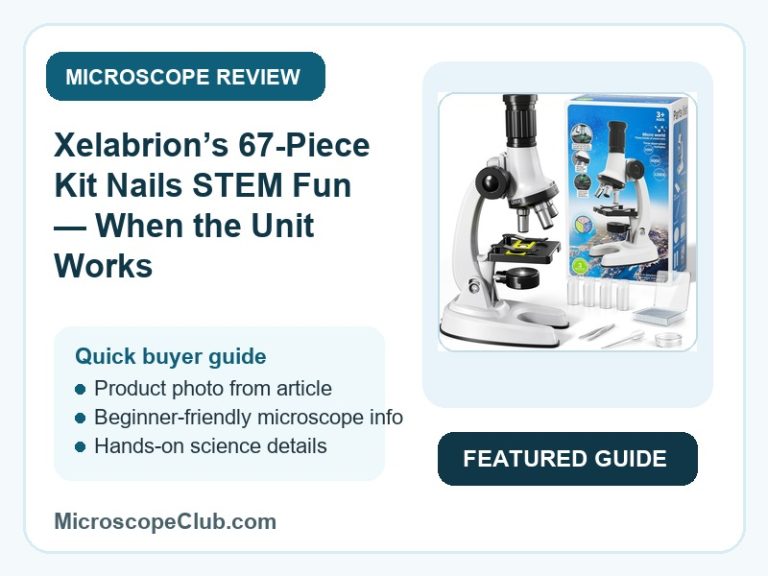
This Xelabrion kids microscope review lands on a mixed verdict: it’s a 67-piece STEM kit that nails the fun parts — 100x-1200x magnification, a 7-color LED base light, and enough slides and tools to keep young scientists busy — but a real slice of buyers get a unit that won’t turn on or breaks within days. Parents who land a working kit report genuine engagement and an easy learning curve for kids as young as five. Buyers hoping for a dependable instrument, rather than a hit-or-miss toy, should treat this as a gamble rather than a safe bet.

✅ Pros
- 67-piece bundle covers 12 prepared slides, 45 blank slides, cover slides, tweezers, dropper, collection bottles, and a storage box
- Works well as a group activity or gift — reviewers used it for birthday parties and grandkids with no prior setup help needed
- 7-color LED base light lets kids switch lighting to bring out different tissue types without staining specimens
- Quick learning curve — several parents report kids using it confidently within half an hour, even without instructions
- When units work correctly, buyers describe the build as solid enough to last with normal care
❌ Cons
- Functionality is the single biggest complaint category — multiple buyers report units that turn on intermittently or stop working entirely
- Enclosure plastic is described as cheaply made and prone to breaking under normal child handling
- Focus and image clarity are inconsistent — some buyers call the view sharp, others say it stays blurry regardless of adjustment
- Quality control issues include units and slides arriving already broken or missing from the box
What to Look for in a Kids Microscope
Magnification range is the first spec parents check, but it isn’t the whole story. A kit that advertises 100x-1200x, like this one, needs a focusing system and light source that can actually deliver a usable image at the top of that range — otherwise the number on the box is a marketing claim rather than a real capability. If you want a deeper breakdown of what those magnification jumps actually mean for image quality, our guide to microscope objective lenses walks through how 4x, 10x, and 40x objectives change what a child can actually see.
Illumination matters just as much as magnification for kids’ microscopes specifically, since young users are usually observing semi-transparent specimens — onion skin, insect wings, fabric fibers — without staining them first. A color-adjustable LED base light, like the 7-color system here, helps compensate for that by letting kids increase contrast on the fly instead of needing lab-grade staining techniques.
Build quality and accessory count round out the decision. A microscope kit for a child needs to survive drops, clumsy slide swaps, and repeated focus-knob adjustments — an area where toy-grade ABS plastic construction is a known trade-off for hitting a low price point. For a broader sense of how this category is engineered across brands and price tiers, see our stereo microscope beginner’s guide.
Who Should Buy a Kids Microscope?
Kids’ microscopes in this price bracket are built for exposure, not precision — they’re the right tool for a child who has never used a microscope and needs a low-stakes way to get curious about the microscopic world. Parents introducing a first grader to slide prep, teachers running a classroom science station, or anyone buying a one-off gift for a curious kid are the core audience this category is designed to serve.
Buyers who need reliability more than novelty — a homeschool family building a full biology curriculum around one instrument, for example — are usually better served stepping up to a compound microscope from an established optical brand. Our guide to the best microscope brands covers where that step-up money is best spent if durability is the priority.
Who This Is For
This kit fits parents or teachers buying a low-cost, disposable-budget STEM toy for a birthday, classroom activity, or group setting — where the goal is sparking curiosity rather than achieving lab-grade optical performance. It suits kids roughly 7-12 with some adult supervision during setup; it’s a poorer fit for the 3-5 age range given the reported fragility of the plastic housing.

Full Specifications
| Spec | Value |
|---|---|
| Light Source Type | LED |
| Real Angle Of View | 12 |
| Magnification Maximum | 1200 |
| Objective Lens Description | 100x-1200x magnification range |
| Enclosure Material | Plastic |
| Color | Black |
| Brand | Xelabrion |
| Unit Count | 67.0 Count |
| Built-In Media | Manual |
Optical Performance
The Xelabrion kids microscope delivers its 100x-1200x magnification range through interchangeable viewing settings paired with a 12-degree real angle of view, which keeps the image reasonably wide for a toy-grade optical path. One reviewer confirmed the top end holds up in practice: “The scope also has 3 magnification levels, and even at the highest setting, the image stays clear enough to make out fine microstructures.”
The Xelabrion kids microscope also drives its illumination through a 7-color LED base light with touch-sensitive adjustment, letting kids swap colors to bring out contrast in semi-transparent specimens without staining. The same reviewer called out this feature specifically: “One standout feature is the 3-color light source. Being able to switch between different colored lights really helps when looking at different tissue types.”
The Xelabrion kids microscope does not hold that clarity consistently across every unit sold, however — other buyers report the opposite experience, with focus that never sharpens regardless of adjustment, pointing to unit-to-unit variance rather than a single design flaw. For a primer on how objective lenses and focus mechanisms are supposed to work together, the Olympus Microscope Resource Center is a solid, brand-neutral reference.
Build Quality
The Xelabrion kids microscope houses its optics and electronics in an ABS plastic enclosure with rounded, burr-free edges designed for child safety rather than lab-grade rigidity. That safety-first design intent shows up positively in some feedback — one buyer noted, “Not a bad scope for my grandchildren. Very well made and should last a while if taken care of.”
The Xelabrion kids microscope also shows its weakest results here through reported battery and light-circuit failures, with multiple buyers describing units that stop functioning shortly after unboxing. One buyer summarized it bluntly: “Even after installing the required batteries, the unit did not function reliably – it would turn on intermittently and then stop working altogether.” Another reported the housing itself failing: “The unit is plastic very cheaply made.”
The Xelabrion kids microscope also arrived pre-damaged for at least one buyer, whose box had already broken open with a slide missing before the kit was ever used — a sign of a packaging or quality-control gap rather than pure product design.
Ease of Use & Accessories
The Xelabrion kids microscope ships its 67 pieces through a single storage box that organizes 12 prepared slides, 45 blank slides, 5 cover slides, a plastic tweezer, a dropper, 4 collection bottles, and a culture dish — enough volume that kids can prepare their own specimens rather than only viewing pre-made ones. That range of included tools is exactly what drove one parent’s positive experience at a group event: “The kids loved exploring the slides and using the tools, and the adjustable magnification made it easy for different ages.”
The Xelabrion kids microscope also keeps its onboarding curve short through a printed manual and touch-based light controls, which several reviewers said took beginners under thirty minutes to pick up unassisted. That combination of volume and simplicity is why this kit performs best as a group or classroom activity rather than a single child’s only science tool.
What Customers Say
The listing sits at 3.6 out of 5 stars across 171 ratings, and the sentiment underneath that average is genuinely split rather than mildly positive. Amazon’s review-summary data shows Functionality mentioned 15 times with 11 negative, and Durability mentioned 13 times with 8 negative — while Educational value (8 mentions, all positive) and Gift suitability (5 mentions, all positive) skew entirely the other way. Quality itself is dead even at 9 positive to 9 negative mentions.
One verified buyer summed up the upside: “Great beginner microscope kit with plenty of accessories. Easy to use, sturdy, and educational. Magnification works well for kids.” On the downside, another verified buyer wrote: “I was disappointed with this kids microscope. The construction feels very flimsy… it would turn on intermittently and then stop working altogether.” A third, after receiving a broken unit, said simply: “It broke on my grandson. It never worked.”
Review integrity risk here is rated MEDIUM in our analysis — all sampled reviews were Verified Purchase and the negative reviews are specific and varied (a pattern consistent with real complaints), but several top positive reviews echo the listing’s own marketing phrasing closely enough to warrant some skepticism about how organic that positive cluster is. If you want a primer on how to weigh review authenticity on any Amazon listing, Common Sense Media publishes independent, ad-free reviews of kids’ products as a useful cross-check.
Final Verdict
CONSIDER this kit if you’re buying for group use, a gift, or a first taste of microscopy where a non-working unit is a minor disappointment rather than a wasted budget — the accessory count and LED lighting genuinely deliver when the unit functions. AVOID it if you need a dependable instrument for a specific deadline, like a school project, given how frequently reviewers report units that stop working or never turn on at all.
Frequently Asked Questions
What age range is this kids microscope actually suited for?
The listing markets it broadly for ages 3-12, but reported plastic fragility makes it a better fit for the 7-12 range with adult supervision during setup. Younger kids in the 3-5 bracket are more likely to break the housing during normal handling, according to buyer feedback.
Does the 7-color LED light actually help with viewing specimens?
Yes, according to buyer feedback — one reviewer specifically called out being able to switch colors to bring out detail in different tissue types without staining. It’s most useful for semi-transparent specimens like onion skin or insect wings.
What’s included in the 67-piece kit?
The kit includes the microscope body, 12 prepared slides, 45 blank slides, 5 cover slides, a plastic tweezer, a dropper, 4 collection bottles, a culture dish, and a storage box for keeping everything organized.
Is this a good choice if I need it working for a specific school project deadline?
Not ideally. Multiple buyers reported units that stopped working shortly after unboxing or arrived already broken, and at least one buyer discovered the defect after their return window had closed. If a deadline is firm, budget time to test the unit immediately on arrival.
How does the magnification range compare to what’s advertised?
Reviewer experience is mixed. Some buyers confirm the image stays clear even at the highest magnification setting, while others report focus that stays blurry regardless of adjustment — suggesting inconsistency between individual units rather than a universal optical flaw.
Is this microscope durable enough for repeated classroom use?
Durability feedback is close to a 50/50 split among reviewers, with a meaningful share reporting fragile plastic construction. For repeated multi-student classroom use over a full term, a more rugged compound microscope may be a safer investment.
Does it come with batteries, and are functionality issues battery-related?
The unit requires batteries to power the LED light system. Several buyers reported the light and unit failing to function reliably even after installing batteries as instructed, which points to a hardware or wiring issue rather than a simple battery problem in at least some cases.
Conclusion
The Xelabrion 67-piece kids microscope kit delivers real STEM value when the unit works as intended — the accessory count, color LED lighting, and short learning curve make it a genuinely good fit for group activities, gifts, and first-time exposure to microscopy. The trade-off is a meaningful chance of getting a unit with functional or build-quality problems, so it suits buyers who can tolerate that risk more than buyers who need guaranteed reliability.
If you’ve used this kit or a similar beginner microscope with your own kids, share what specimens worked best in the comments below — and if you’re looking for an easy first project once the slides arrive, our guide to observing cork cells under the microscope is a good starting point for a first at-home slide.