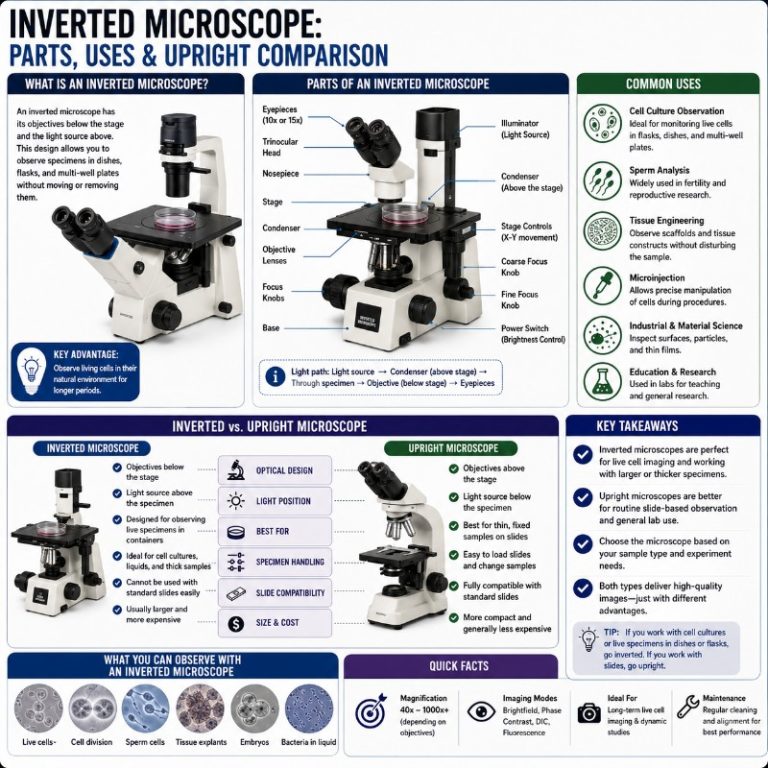
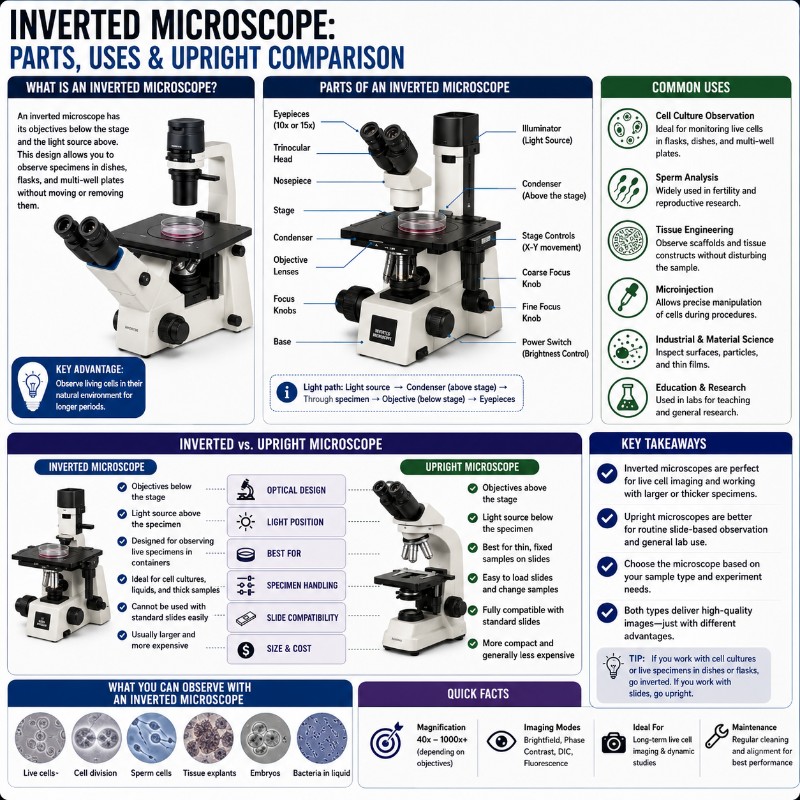
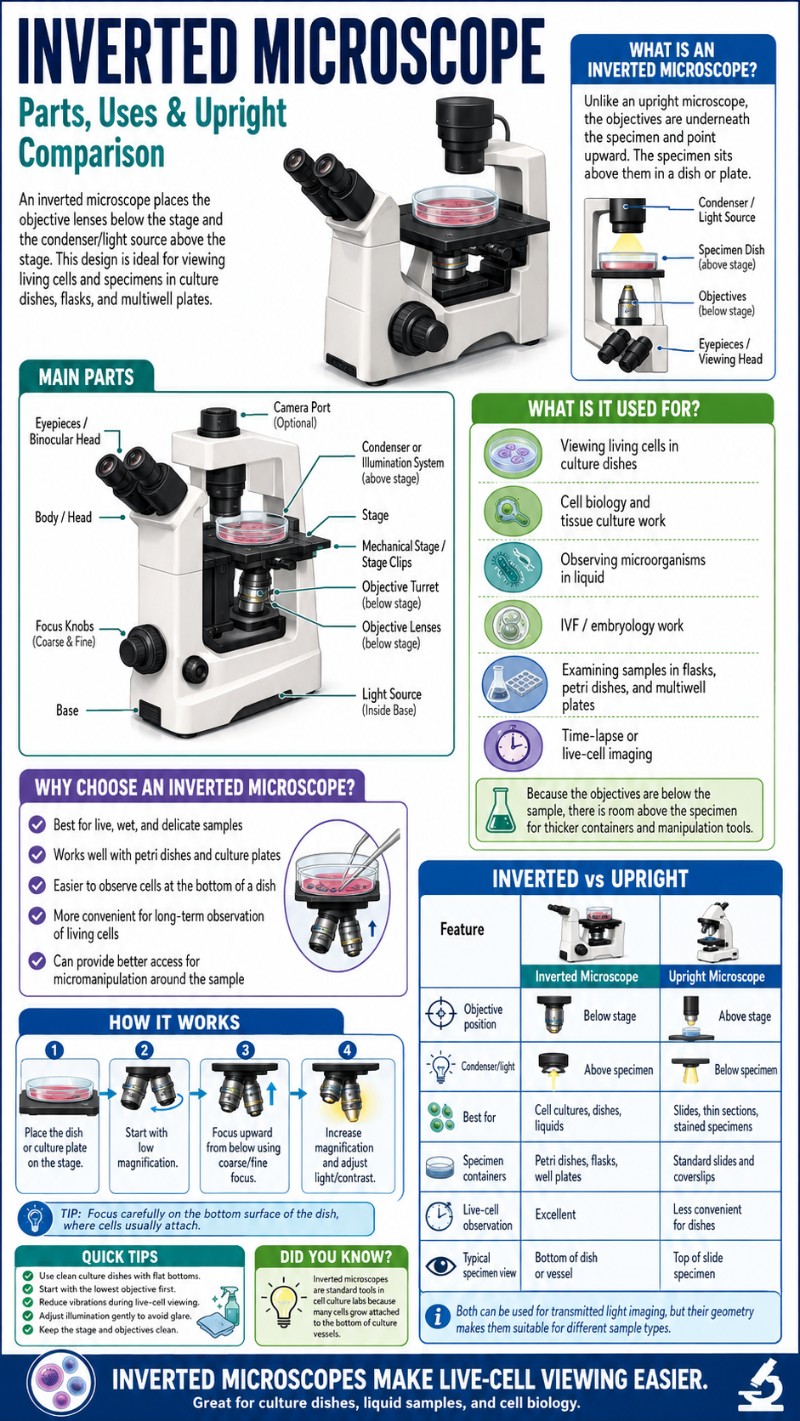
An inverted microscope is a compound light microscope with its objective lenses and nosepiece mounted below the stage and its light source and condenser mounted above it — the mirror image of a conventional upright scope. That flipped geometry is not an accident: it lets you look up through the thin, flat bottom of a culture flask or Petri dish to image living cells resting on that surface, without disturbing the liquid medium sitting above them. The same inverted design also powers a completely different instrument — the metallurgical inverted scope — used by materials scientists to examine polished metal cross-sections under reflected light.
The Parts of an Inverted Microscope (and What Each Does)
If you’ve used a standard upright scope before, an inverted model looks disorienting at first — the lens cluster is underneath the stage instead of above it. The layout becomes intuitive once you understand what’s been flipped and what stayed put. For reference, our overview of the parts of a microscope and their functions covers how these same components are arranged on a conventional compound scope.
What’s Mounted Below the Stage
- Nosepiece (turret): The rotating mount that holds the objectives — sits below the stage and points upward. For a deep dive on this component, see our guide to the nosepiece (turret).
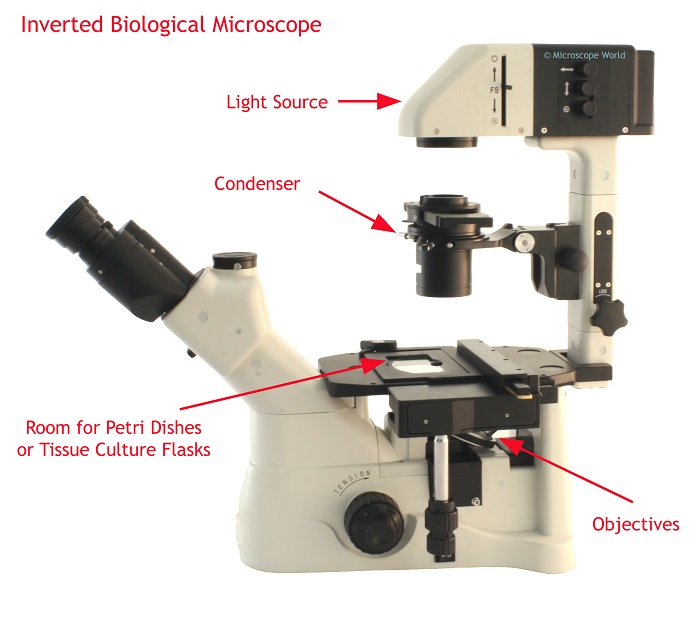
- Objective lenses: On biological inverted scopes, these are long-working-distance, phase-annulus-equipped lenses — commonly 4x, 10x, 20x, and 40x — pointing up toward the specimen through the vessel’s transparent base. Our guide to objective lenses (4x, 10x, 40x, 100x) explains how each magnification is used.
- Coarse and fine focus knobs: Raise and lower the objective assembly to bring the sample into focus. Some designs move the stage instead; the optical result is the same.
What’s Mounted Above the Stage
- Illuminator / light source: Sits at the top of the instrument and directs light downward onto the specimen. LED or halogen for transmitted-light biological models; a separate reflected (episcopic) illuminator is added on metallurgical models.
- Condenser: Mounted on a tall arm above the stage, the condenser focuses transmitted light onto the specimen from above. Inverted-scope condensers are designed with extra working distance so tall culture flasks fit underneath.
- Phase contrast annulus: Built into the condenser on phase-contrast-equipped models. It must be matched to the corresponding phase ring in the objective — mismatch the two and you lose contrast entirely, getting a flat, washed-out image.
The Stage and Vessel Holders
- Stage: Usually large and flat with a mechanical XY drive, designed to hold culture flasks, multiwell plates, and Petri dishes. Vessel-specific inserts keep containers from sliding.
- Eyepieces (oculars): Typically 10x, mounted on an angled ergonomic head so you look into them while the objectives point down below you. Most research inverted scopes include a trinocular port for attaching a camera.
- Frame and base: Heavier and taller than comparably priced upright scopes because of the tall condenser arm. The mass dampens vibration — critical when imaging live cells at 40x, where even footsteps on the floor can knock cells out of focus.
Why the Optics Are Inverted
The first time you load a culture flask onto an inverted scope, the logic clicks immediately. Adherent cells — HeLa cells, fibroblasts, primary neurons — sink and attach to the flat plastic bottom of the flask. Gravity does the work of positioning them for you. If you tried to image them with an upright scope, you’d have to focus down through centimeters of liquid growth medium before reaching the cells. Standard high-power objectives have working distances measured in fractions of a millimeter, not centimeters, so they simply can’t reach the cells without dipping into (and contaminating) the medium.
An inverted microscope eliminates this problem by placing the objective directly below the thin, optically flat base of the vessel. The objective only needs to focus through the vessel bottom — typically 0.17 mm of glass or thin plastic, equivalent to a standard coverslip. The depth of medium above is irrelevant. You can add more liquid, change the medium, or use a sealed flask, and nothing about the imaging geometry changes.
The inversion principle applies equally in a completely different context: metallurgical microscopes use a reflected-light inverted design. A polished metal or alloy cross-section is placed face-down on the stage. Light from the illuminator passes down through the objective, reflects off the polished metal surface, and travels back into the detector. Through the eyepiece, a well-etched steel sample looks like an aerial map — bright mirror-like grains separated by dark etched boundaries at grain boundaries. Materials scientists use this view to measure grain size, identify phases, and locate inclusions or defects.
What an Inverted Microscope Is Used For
The inverted design solves a specific imaging problem — specimens beneath a deep liquid layer or opaque surfaces — so its real-world applications cluster in fields where that problem is most common.

Cell Culture and Tissue Culture
This is where inverted microscopes spend the majority of their working hours. A lab technician checks adherent cell cultures daily: are the cells confluent? Do they look healthy? Is there any sign of contamination? Through phase contrast, a healthy confluent culture looks like crazy-paving — flattened, spread, spindle- or star-shaped cells packed together in a cobblestone pattern that fills the field of view. Unhealthy or dying cells behave very differently: they go round, bright, and highly refractile (the classic “balling up” appearance), and float free from the surface. You can read the health of a culture in about 30 seconds once you’ve seen both states.
Work quickly once a flask is out of the incubator. Cells off-gas CO₂ as they warm, which causes the phenol-red indicator in the medium to shift from pink toward yellow or purple, and cells don’t thrive with extended time at room temperature. Keep the lid on — you’re imaging from below, so the flask stays sealed the entire time, which also protects sterility.
IVF and Embryology
Inverted microscopes equipped with phase contrast or Hoffmann modulation contrast are standard instruments in in vitro fertilization (IVF) laboratories, used to observe oocytes, assess sperm motility, monitor fertilization, and track early embryo development. The gentle contrast methods allow observation without staining, keeping specimens in a closed dish under controlled temperature and gas conditions. Clinical embryology labs pair their inverted scopes with heated stages and gas-controlled incubator chambers to minimize time specimens spend outside physiological conditions. These applications are carried out by qualified embryologists and clinical staff under established medical protocols; this article describes the optical instrument only.
Microbiology and Suspension Cultures
Non-adherent cells — yeast in liquid culture, bacterial suspensions, free-floating immune cells — also benefit from inverted imaging. The cells settle to the vessel bottom by gravity and the scope images them exactly where they land, without requiring any manipulation or concentration step.
Metallurgy and Materials Science
As described above, inverted reflected-light metallurgical scopes examine polished cross-sections of metals, alloys, ceramics, and semiconductors. The specimens are solid, opaque, and prepared by grinding and polishing rather than growing in a flask. The inverted design here serves a mechanical purpose as much as an optical one: large, heavy metal coupons rest stably on the stage face-down without needing a mount or holder.
Inverted vs. Upright Microscope
Both are compound light microscopes — they use multiple lenses to produce highly magnified images. The key difference is geometry and the sample types each design handles best. Note that an inverted microscope is categorically different from a stereo (dissecting) microscope; see our compound vs stereo microscope guide if you’re comparing those two.
| Feature | Inverted Microscope | Upright Microscope |
|---|---|---|
| Objective position | Below the stage, pointing up | Above the stage, pointing down |
| Light source position | Above the stage, pointing down | Below the stage, pointing up |
| Best sample types | Live cells in culture vessels, large liquid containers | Prepared slides, thin fixed sections, mounted specimens |
| Working distance | Long — must clear vessel walls and medium depth | Short — optimized for standard glass slides |
| 100x oil immersion | Impractical through standard plastic vessel bottoms | Standard — works easily with coverslipped slides |
| Phase contrast use | Near-essential for living unstained cells | Optional — most use brightfield on stained tissue |
| Bench footprint | Large — tall condenser arm, wide stage | Compact |
An inverted scope is unbeatable for live-cell imaging in vessels; an upright is faster and more ergonomic for routine stained-slide work. High-NA oil-immersion imaging at 100x is effectively off the table with standard plastic culture vessels on an inverted scope — you’d need glass-bottom dishes or coverglass-insert plates, which adds cost. For a complete overview of how the two compare across more use cases, see our guide to the different types of microscopes.
Contrast and Imaging Modes on Inverted Platforms
Living, unstained cells are nearly transparent — their refractive index is so close to that of the surrounding water-based medium that standard brightfield microscopy shows almost nothing. This is why phase contrast is the most important feature on a biological inverted scope, and why most research and clinical models include it as standard.
Phase contrast works by converting differences in refractive index across cell structures into visible brightness variations. Through a phase-contrast inverted scope, living cells appear as pale gray outlines with characteristic bright halos against a gray background. The nucleus shows as a lighter or darker disc; mitochondria and large vesicles appear as bright spots. A dividing cell stands out immediately — you can watch the process unfold in real time without touching or staining the sample. The Florida State University Molecular Expressions microscopy resource offers an excellent technical explanation of the phase-annulus optics if you want to understand the mechanism in depth.
A common beginner mistake: mismatching the phase settings — using a Ph1 objective with a Ph2 condenser annulus, for example. The result is an image that looks like dim, flat brightfield with no cell detail. Always confirm the phase number matches on both the objective and condenser turret, then verify Köhler illumination (the standard alignment procedure that produces uniform, glare-free illumination across the field) is set before concluding something is wrong with your cells.
Differential interference contrast (DIC) produces a pseudo-3D, shadow-relief image with no halos — useful for seeing membrane boundaries clearly and imaging thicker samples where phase halos become distracting. DIC requires a polarizer, analyzer, and Nomarski prisms, adding cost. It is not compatible with plastic culture vessels (plastic depolarizes light), so it requires glass-bottom dishes.
Fluorescence modules on research-grade inverted scopes deliver epifluorescence up through the objective from below, exciting fluorescent dyes (GFP, DAPI, Texas Red, and others) tagged to specific proteins or structures. The inverted geometry is advantageous here because the high-numerical-aperture (NA) objective sits close to the labeled structures on the dish floor, maximizing light collection efficiency — a higher NA means more light gathered and better resolution, as our guide to numerical aperture in microscopy explains. This imaging mode is how the majority of quantitative cell biology research is performed today. For a look at another specialized contrast technique, see our overview of dark field microscopy.
Frequently Asked Questions
Who invented the inverted microscope?
The inverted microscope is credited to J. Lawrence Smith, working at the Medical College of Louisiana (now Tulane University), around 1850–1852. He designed the inverted configuration to observe living organisms in liquid — the same fundamental purpose the instrument still serves today. Britannica’s history of the optical microscope provides broader context on 19th-century instrument development.
Is an inverted microscope a compound microscope?
Yes. An inverted microscope is a type of compound light microscope — it uses two or more lens groups (objective plus eyepiece) to achieve high magnification, exactly like a conventional upright compound scope. The term “inverted” refers only to the physical arrangement of those optics relative to the stage, not to any fundamental optical difference. It is not a stereo microscope, a simple magnifier, or a separate optical class.
Do I need an inverted microscope for cell culture, or will an upright work?
For routine adherent cell culture in standard flasks and multiwell plates, an inverted scope is effectively necessary — an upright scope cannot image through centimeters of medium with a short-working-distance objective. If your cell work is limited to fixed, stained cells mounted on glass slides (no live imaging in vessels), a standard upright works fine and costs less. The NIH cell biology reference outlines standard microscopy requirements for mammalian cell culture.
How much does an inverted microscope cost?
Entry-level inverted scopes for student or basic tissue-culture use start around $500–$1,500. Mid-range research models with phase contrast, mechanical stage, and a camera port run $3,000–$10,000. Full research platforms with DIC, fluorescence modules, motorized stage, and live-cell environmental chambers from Leica, Nikon, Zeiss, or Olympus can exceed $30,000–$100,000+. The biggest price driver is the contrast and imaging package, not the basic scope body.
What magnification does an inverted microscope provide?
Most biological inverted scopes come with 4x, 10x, 20x, and 40x objectives. Paired with standard 10x eyepieces, that gives total magnifications of 40x, 100x, 200x, and 400x — more than sufficient for all routine cell culture monitoring. A 100x oil-immersion objective is rarely practical in routine inverted use because standard plastic vessel bottoms are too thick and uneven for high-numerical-aperture imaging. Glass-bottom dishes or coverglass-insert plates are required for sharp imaging at 60x or 100x.
Conclusion
The inverted microscope solves a specific optical problem with elegant geometry: put the objective below the stage, move the illuminator above it, and you can image living cells through the bottom of any culture vessel without disturbing them. That one design decision made modern cell biology, IVF embryology, and routine tissue-culture monitoring practical. Understanding the parts — nosepiece and objectives below, condenser and light source above, long-working-distance optics throughout — gives you the mental model to troubleshoot image problems, match the right contrast mode to your sample, and decide whether an inverted or upright scope is the right tool for your work.
Have you used an inverted microscope in a cell culture lab, an IVF clinic, or for materials work — or are you trying to figure out whether you need one? Drop your questions or observations in the comments below. We’d love to hear what you’re imaging and what you’ve found.