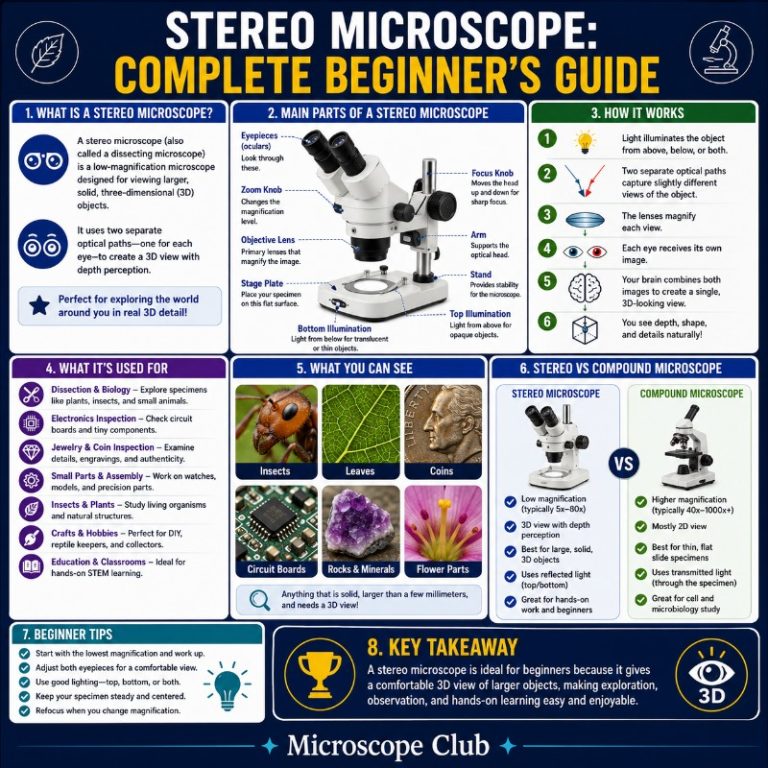
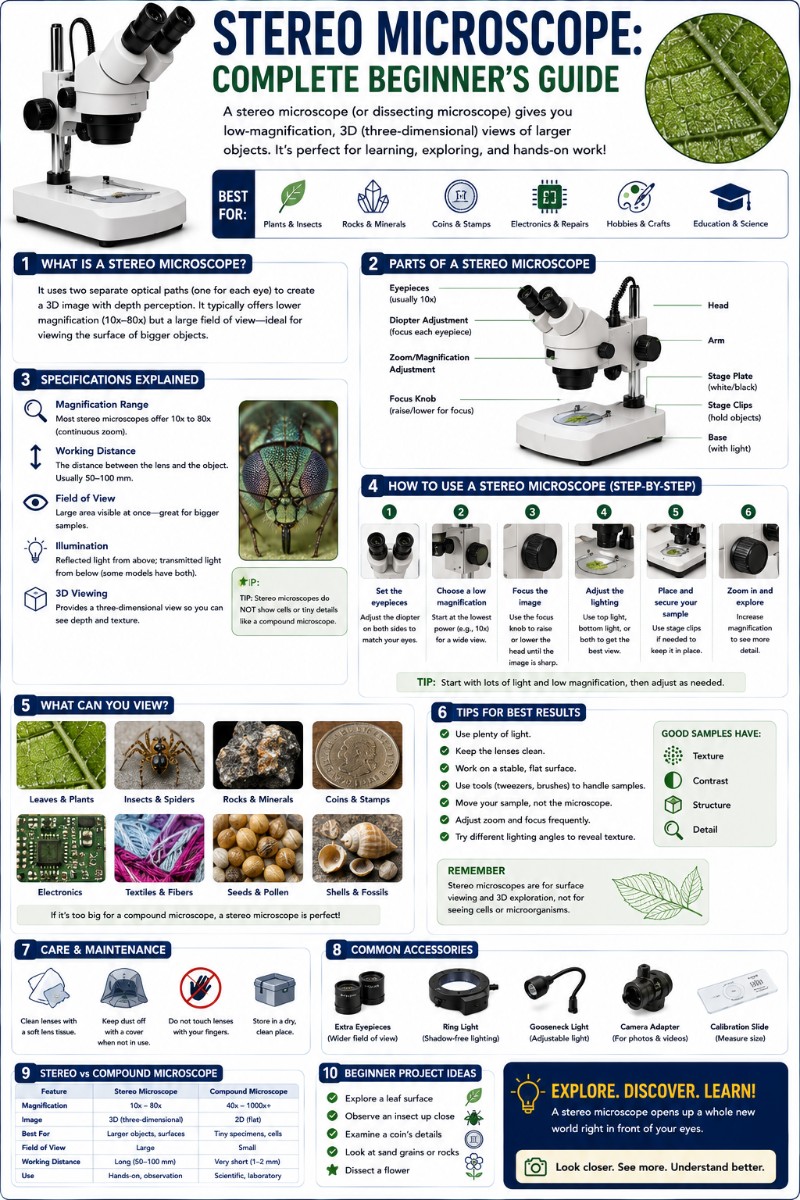
A stereo microscope is a low-power optical instrument with two completely separate light paths — one for each eye — that combine in your brain to produce a true, three-dimensional view of whole objects at magnifications typically ranging from 10x to 50x. Unlike a compound microscope that forces you to squint at a flat, slide-mounted sliver of something, a stereo scope lets you look at a circuit board, a coin, an insect, or a gemstone exactly as it sits on the table — just magnified, in full depth, with room to hold tools and actually work on the thing. If you’ve ever wondered what all those knobs do or why the image looks blurry for one eye, this guide covers everything: how it works, how to set it up, what it’s best for, and the mistakes that trip up almost every beginner.
How a Stereo Microscope Works: The Two-Eye 3D Principle
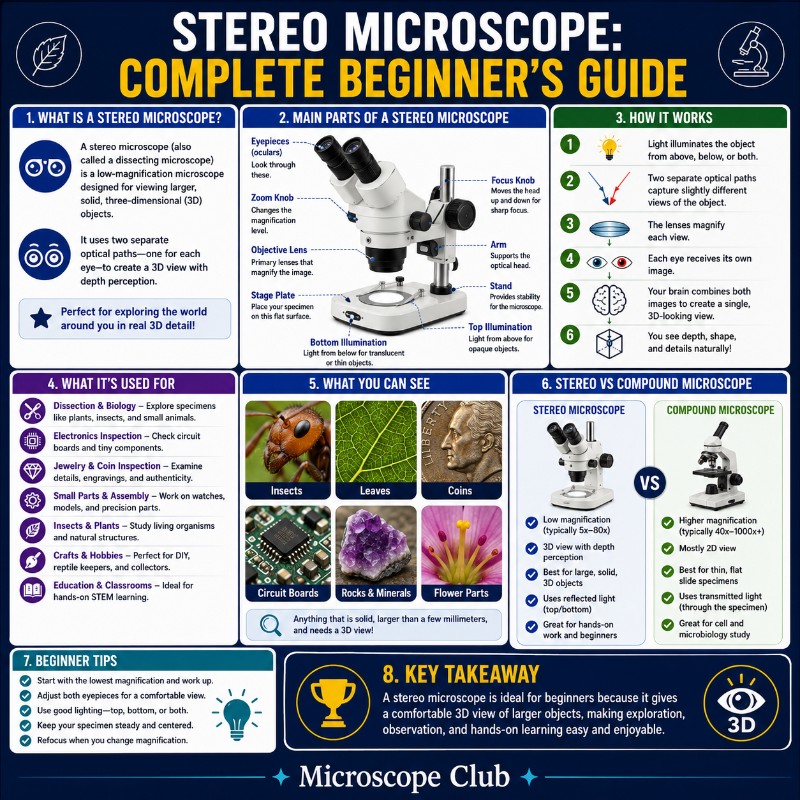
The key to understanding a stereo microscope is that it is two microscopes built into one body. Each eye looks through its own complete optical train — its own eyepiece and its own objective path — and those two paths are aimed at the specimen from slightly different angles, typically about 10 to 15 degrees apart. That angular offset is called the convergence angle, and it’s the same principle your own eyes use to judge depth in the real world. Each eye receives a slightly different view, and your brain fuses them into a single image with genuine depth perception. Move your finger under the scope and you can feel its relationship to the specimen in three dimensions, which is exactly why this instrument became the standard tool for dissection, soldering, and fine assembly work.
This is the fundamental difference from a compound light microscope. Even a binocular compound scope — one with two eyepieces — still uses a single optical path split to both eyes, so both eyes see an identical, flat, two-dimensional image. “Binocular” simply means two eyepieces; it does not mean stereoscopic. Only the separate, angled dual paths of a stereo scope produce a real 3D image. For a deeper breakdown, see our full compound vs stereo microscope guide.
Greenough vs. CMO Designs
All stereo microscopes fall into one of two optical architectures. The Greenough design uses two physically separate, tilted optical columns — one per eye — converging on the specimen. It’s the older design and still common in affordable beginner units; image quality is excellent but there’s a slight keystone distortion toward the edges. The Common Main Objective (CMO) design, used in most research and higher-end consumer scopes, has a single large shared objective lens at the bottom with two parallel optical paths running through it. CMO scopes accept modular accessories (ring lights, camera ports, auxiliary lenses) more easily and tend to have a flatter field. For hobbyist use, a quality Greenough scope is perfectly capable; CMO matters most when you’re adding a camera or doing professional work. Olympus Life Science’s stereo microscopy primer covers the optical differences between these designs in more detail.
Magnification Range and What the Numbers Mean
Total magnification on a stereo scope is calculated the same way as on any microscope: eyepiece magnification × objective magnification. Most stereo scopes ship with 10x eyepieces. A typical fixed objective at 2x gives you 20x total; click to 4x and you have 40x. On a zoom model with an objective range of 0.7x–4.5x and 10x eyepieces, you can dial continuously from 7x up to 45x. Add 15x or 20x eyepieces and you push higher, but image quality softens. Practical working range for most tasks is 10x to 50x; specialized entomology or geology work sometimes uses up to ~80x. To understand how these numbers translate to actual detail, see our guide on magnification vs resolution, how to calculate total magnification, and what objective lens numbers mean.
Stereo vs. Compound Microscope — Which One You Actually Need
The short answer: if you want to look at whole objects — insects, coins, circuit boards, rocks, small plants — you want a stereo scope. If you need to see individual cells, blood, or microorganisms, you need a compound scope at 400x or higher. The table below captures the main differences at a glance.

| Feature | Stereo Microscope | Compound Microscope |
|---|---|---|
| Magnification range | 7x – ~90x | 40x – 1000x+ |
| Image | 3D, upright, correctly oriented | 2D, inverted and reversed |
| Working distance | 100mm+ (room to use tools) | A few millimeters |
| Depth of field | Large — most of a 3D object in focus | Very thin — razor-shallow |
| Sample type | Whole, solid, opaque objects | Thin, transparent, slide-mounted |
| Slides required? | No | Yes (for most specimens) |
If you’re still weighing the decision, our dedicated compound vs stereo guide walks through specific scenarios. And if you want a broader overview before committing, the types of microscopes article covers the full landscape.
The Parts and Controls — and What Each One Does
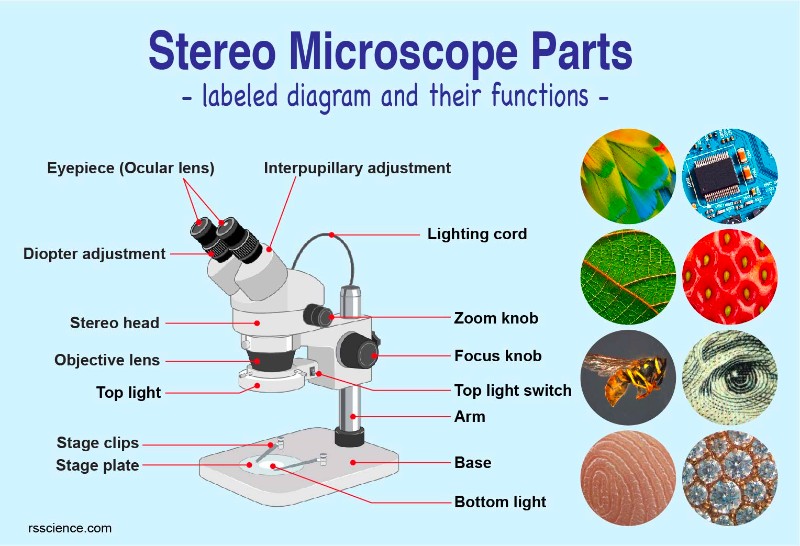
Sit down at a stereo scope for the first time and it’s easy to feel overwhelmed by the knobs. Our full parts of a microscope guide covers microscope anatomy broadly; here’s every control specific to the stereo scope, in plain language.
- Eyepieces (oculars): The lenses you look through. Most are 10x. One eyepiece — usually the left — has a rotating diopter ring around it (see below).
- Interpupillary distance adjustment: A hinge or sliding mechanism between the eyepieces that lets you push them closer together or farther apart to match the distance between your eyes. This is the most important adjustment beginners skip.
- Diopter ring: A graduated rotating collar on one eyepiece that lets you fine-tune focus for that eye independently. Used to compensate for differences in vision between your two eyes.
- Zoom knob (or objective turret): On zoom models, a smooth-turning knob changes magnification continuously. On fixed-turret models, you click between two or three set objectives.
- Focus knob: A single large knob (sometimes with a coarse/fine pair on higher-end scopes) that moves the optical head up and down relative to the specimen. Stereo scopes typically have one focus control; the long working distance gives you a generous travel range.
- Stage / baseplate: The flat surface your specimen rests on. Many stages have a reversible insert — black on one side, white on the other — for contrast. Frosted glass inserts allow transmitted (bottom) light through.
- Stage clips: Small metal clips to hold thin specimens flat. Optional for most stereo work since most objects sit stably on their own.
- Top illuminator (incident/reflected light): The light source shining down onto the specimen from above. Used for opaque, solid objects — the normal mode.
- Bottom illuminator (transmitted/diascopic light): A light shining up through the stage for thin, translucent specimens. Not present on all models.
How to Use a Stereo Microscope: Step by Step
- Place your specimen on the stage. Set it in the center, lit by top (reflected) light if it’s a solid object. Turn the ring-light or top lamp on to a comfortable brightness — not maximum.
- Set magnification to the lowest setting. Dial the zoom all the way down, or click to the lowest objective. Never start zoomed in; you will lose the specimen and have to search blind.
- Set your interpupillary distance. Look through both eyepieces and gently push the eyepiece tubes together or apart while your eyes are relaxed. You’ll see two overlapping circular fields. Keep adjusting until they snap into a single, clean, round field. The instant they merge, the depth perception kicks in — this is the “aha” moment that defines the stereo scope experience.
- Focus with the main focus knob. Cover or close your left eye (the diopter eye) and bring the specimen into sharp focus using only the main focus knob.
- Set the diopter. Now close your right eye and open your left. Without touching the main focus knob, rotate the diopter ring on the left eyepiece until your left eye sees a sharp image. From this point on, both eyes focus together whenever you turn the main knob.
- Adjust the lighting. Angle the light to bring out surface texture. Coin collectors and electronics techs know that light from a low, raking angle reveals surface relief; flat overhead light flattens everything.
- Zoom in gradually. Once the specimen is centered and in focus at low power, increase magnification slowly. Refocus slightly at each step; higher magnification also reduces depth of field.
Setting interpupillary distance and diopter takes about 90 seconds and needs to be done only once per viewing session for your eyes. Skip it and you’ll get eye strain in minutes and never get a proper 3D image.
Lighting Your Specimen: Top vs. Bottom Light
Lighting makes or breaks the image in stereo microscopy — arguably more than the optics themselves. Understanding which type to use for your specimen is non-negotiable.
Incident (top/reflected) light shines down from above onto the surface of the specimen. This is what you use for almost everything: circuit boards, coins, insects, rocks, flowers, model parts. The light bounces off the surface and back up through the objective. Angle matters enormously here — a coin’s luster and tooling marks completely disappear under flat overhead light but burst into relief when the light hits from a low angle. This is why a ring light (which illuminates from all sides simultaneously) is a popular upgrade for electronics work: it gives even, shadow-free lighting that eliminates glare hot spots on shiny objects like solder joints.
Transmitted (bottom/diascopic) light shines upward through a glass or frosted stage insert and through the specimen. It’s useful only for thin or semi-transparent subjects — thin leaves, some mineral sections, translucent aquatic organisms in a petri dish. Beginners sometimes accidentally leave the bottom light on for opaque objects and get a dark, silhouetted, completely flat image. If your specimen looks like a shadow puppet, switch to top light.
A dual-gooseneck illuminator — two flexible-arm LED lights you can position independently — gives you full control over lighting angle and is the hands-on user’s favorite setup for varied specimens. LED is preferred over halogen: cooler running, longer lifespan, and better for live specimens that wilt under heat. Nikon’s MicroscopyU resource on stereomicroscopy covers stereo illumination techniques in more depth if you want the optical physics behind it.
What a Stereo Microscope Is Used For
The defining features — long working distance, large depth of field, correctly oriented 3D image, no slides required — make the stereo scope the tool of choice for any task where you need to see closely AND do something with your hands at the same time.
- Electronics and PCB work (10x–40x): Inspecting solder joints, placing SMD components, reworking fine-pitch ICs, reading tiny component markings. At 20x, a solder joint becomes a shiny silver mountain; a cold joint shows its dull, cracked surface immediately. This is one of the most popular hobbyist use cases today.
- Entomology and nature (20x–50x): Pinned insects, mounted butterflies, collected beetles. You’ll see hairs standing off the body, the facets of a compound eye as a curved dome, and legs casting real shadows — dimensional and tactile in a way a photo never captures. See what this looks like in our article on insect eyes under the microscope, or explore viewing a butterfly under a microscope.
- Coins, stamps, and jewelry (10x–30x): Grading, authentication, detecting repairs. The 3D view of coin relief and die wear is something a loupe or flat photo simply can’t provide. Jewelers use stereo scopes for setting stones and inspecting prong integrity.
- Lapidary and minerals (10x–40x): Identifying crystal structure, checking facets on cut stones, examining inclusions. The depth of field keeps a faceted gem — with its curved, complex surface — largely in focus at once.
- Biology dissection (10x–40x): Dissecting mushrooms, flower parts, small animals — the classic school lab application that gave the scope its alternate name, the dissecting microscope.
- Education and kids (10x–20x): A stereo scope is one of the most engaging first microscopes for children because you just put things on it — no slide preparation, no staining, no waiting.
- Model making and watchmaking: Painting miniature figures, hand-brushing detail on scale models, fitting hairspring escapements in watches. The correctly oriented (non-reversed) image is critical here — your hand moves left and the image moves left. A compound scope’s inverted image would make hand work nearly impossible.
Common Beginner Mistakes — and How to Fix Them
Most early frustration with a stereo scope traces back to three setup errors. All are easy to fix once you know what to look for.
1. Skipping interpupillary adjustment is by far the most common. You look through and see two overlapping circles — like a Venn diagram — with a dark crescent on one side, and the image never feels right. Your eyes are working against each other to fuse two misaligned fields, which produces rapid eye strain and headache. The fix: while looking in with relaxed eyes, slowly slide or hinge the eyepiece tubes apart or together. The Venn diagram circles will slide toward each other and snap into one clean round field. When they do, depth perception engages instantly — the object suddenly looks three-dimensional in a way it didn’t a moment before.
2. Ignoring the diopter adjustment means one eye is always slightly out of focus, and your brain compensates by tensing the eye muscles — a headache waiting to happen. The fix, described in the step-by-step section above, takes under a minute and stays set for your eyes through the whole session.
3. Wrong lighting for the specimen — usually transmitted (bottom) light left on for an opaque object, or flat top-light that kills surface texture. If your coin, circuit board, or insect looks like a dark shadow with no surface detail, check that top/reflected light is on and that the light is angled rather than coming straight down.
Beyond setup errors, a few practical pitfalls catch beginners mid-session: zooming in too fast before centering the subject at low power (you’ll lose it entirely and have to start over), bench vibration at higher magnifications (at 40x, leaning on the table shakes the whole field — isolate the scope on a stable surface), and tall specimens running out of focus travel (raise the head higher or remove the stage insert for more headroom between objective and specimen).
Choosing Your First Stereo Microscope
The buying decision comes down to three practical choices.
- Zoom vs. fixed turret: A zoom is significantly nicer to use in practice — you dial smoothly between magnifications without re-focusing or clicking between objectives. Fixed-turret scopes are sharper per dollar but feel clunky once you’ve used a zoom. If budget allows, get a zoom.
- Single light vs. dual (top + bottom): If your work is electronics, coins, insects, or rocks — all opaque — you only ever need top light. Save the money. If you might view thin leaves, aquatic specimens, or translucent minerals, dual lighting is worth it. Most upgradeable scopes can add a transmitted light base later.
- Magnification range: For electronics and most hobbyist uses, 7x–45x (a 0.7x–4.5x zoom with 10x eyepieces) is the practical sweet spot. More than 45x becomes difficult to manage without vibration isolation. Less than 10x at the low end and you lose the detail that makes the scope useful.
If you want a digital rather than optical experience, USB microscopes offer a flat-screen alternative — no eyepieces, no interpupillary setup — though you sacrifice the true 3D depth perception that defines the stereo scope experience. For a more detailed introduction to how these instruments fit into the broader world of optical tools, Britannica’s microscope overview is a solid reference, and Carolina Biological’s educator resource on microscopes covers classroom selection well.
Frequently Asked Questions
Can you see cells or bacteria with a stereo microscope?
No. Cells typically require 400x magnification and bacteria require 1000x with oil immersion — far beyond the 10x–50x range of a stereo scope. A stereo microscope shows you surface detail and three-dimensional structure of whole objects; seeing individual cells or microorganisms requires a compound microscope. If you’re curious what bacteria actually look like, our article on bacteria under the microscope explains what’s needed.
Is a stereo microscope the same as a dissecting microscope?
Yes — completely the same instrument. “Stereo microscope,” “stereoscopic microscope,” “dissecting microscope,” and “low-power microscope” are all names for the same tool. The “dissecting” name comes from its traditional biology lab use; “stereo” refers to the optical principle. You’ll see both names used interchangeably in catalogs and lab manuals.
Do you need slides to use a stereo microscope?
No — and that’s one of its biggest advantages. You place specimens directly on the stage and view them as-is. Whole insects, coins, PCBs, gemstones, plant parts, small shells: all viewed without any preparation. This also means the scope is ready to use in seconds, which is one reason it’s popular with hobbyists and students.
How much does a beginner stereo microscope cost?
A solid entry-level zoom stereo scope (7x–45x, top LED light, metal body) runs roughly $150–$350 from brands like AmScope, Parco Scientific, or Swift. Models with dual top/bottom lighting, better optics, or a camera port start around $300–$600. Professional CMO research scopes from Nikon, Zeiss, or Leica run $2,000 and up. For most hobbyist and educational uses, the $200–$400 range delivers a genuinely useful instrument.
Why is my image dark or shadowy even with the light on?
Almost certainly you have the transmitted (bottom) light on for an opaque object, or the top light is off. Check that your top/incident lamp is switched on and aimed at the specimen. If you have both lights, make sure the bottom light is off for solid objects — it will silhouette rather than illuminate them. Also check that the stage insert isn’t frosted glass blocking the top light path (swap in the white or black solid insert for opaque specimens).
Can I use a stereo microscope with glasses?
Yes, though it depends on your prescription. Eyepieces have a limited eye relief — the distance from the lens to where your eye needs to be for a full field of view. Most stereo scopes have rubber eyecups that fold down to accommodate glasses. If you wear glasses for astigmatism, keep them on. If your prescription is only for near/far focus, try without glasses first and use the diopter ring to compensate — you’ll get a wider field of view that way.
What’s the difference between a stereo microscope and a binocular microscope?
“Binocular” simply means two eyepieces — it says nothing about the optical design. A binocular compound microscope has two eyepieces but a single optical path, so it still shows a flat, two-dimensional image. A stereo microscope has two completely separate optical paths, which is what produces genuine depth perception. All stereo scopes are binocular, but not all binocular scopes are stereo scopes.
Conclusion
A stereo microscope is one of the most immediately rewarding instruments in the microscopy toolkit: no slide preparation, no chemicals, no staining — just place something on the stage, merge those two circles into one, and a whole world of surface detail and depth snaps into view. The optical principle (two angled paths, one 3D image) explains every quirk of the instrument, from why the diopter matters to why your hand moves freely under the long working distance. Master the three-minute setup routine — interpupillary distance, diopter, lighting angle — and the scope becomes a genuine tool rather than a frustrating novelty.
Have you used a stereo microscope for electronics repair, nature observation, or something else entirely? We’d love to hear what you’ve been looking at and what surprised you most — drop a comment below and let us know.