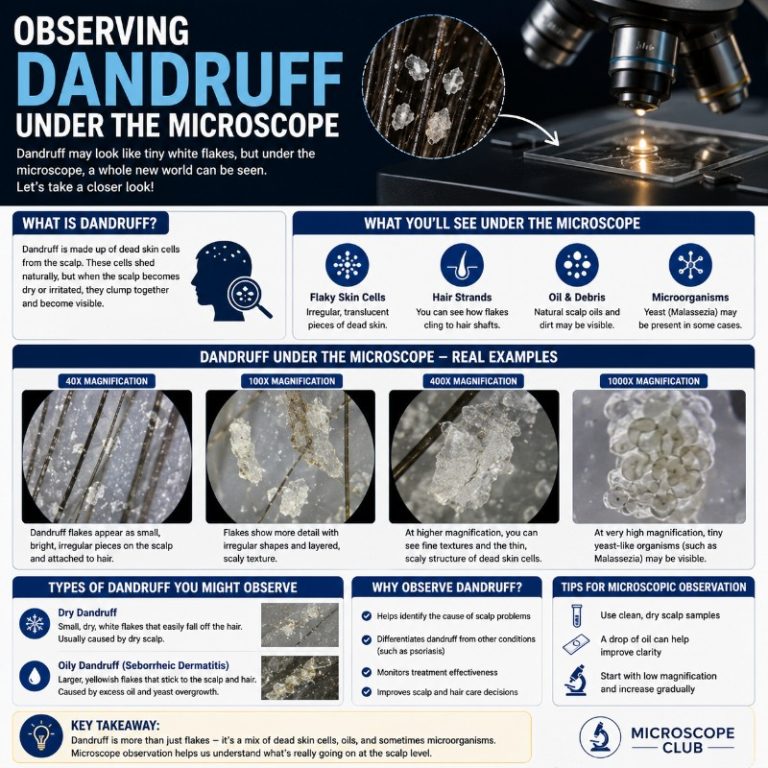
Dandruff flakes are clumped corneocytes — dead skin cells — shed from the scalp, driven by a lipophilic yeast most people have never heard of. Put one under a microscope and you stop seeing an embarrassing shoulder problem and start seeing a surprisingly detailed structure: layered, irregular plates with translucent edges that look nothing like ordinary dead skin. Here is exactly what to expect, magnification by magnification.
What Dandruff Actually Is — and What Causes It
Dandruff, medically known as pityriasis capitis, is the shedding of abnormally cohesive dead skin cells from the scalp. Healthy skin sheds corneocytes continuously and invisibly; dandruff flakes form when those cells clump together and detach in visible clusters rather than as single cells.
The cause is now well established: the primary driver is the lipophilic yeast Malassezia globosa (and to a lesser extent M. restricta), which lives on virtually every adult scalp and metabolises sebum triglycerides via lipase enzymes, releasing free fatty acids — chiefly oleic acid — that irritate susceptible skin. The result is accelerated skin cell turnover and those characteristic flakes. Three factors have to align: sebum + Malassezia metabolism + individual susceptibility. Not everyone reacts; roughly half the adult population is susceptible. [Kerr/DeAngelis et al., J Investig Dermatol Symp Proc]
Dandruff becomes noticeable after puberty, when sebaceous glands activate under hormonal influence, and is generally most prevalent between the teens and around age 40, then tends to decline. It is slightly more common in men. A compromised immune system influences susceptibility and severity — patients with HIV or other immunosuppressive conditions often experience severe seborrheic dermatitis — but immune status alone is not a standalone cause. [DermNet NZ — Malassezia infections]
What Dandruff Flakes Look Like Under the Microscope
The first time you actually look at a dandruff flake through an eyepiece, the tree-bark comparison makes immediate sense — but it undersells the detail. At low magnification (10–20x on a stereo scope) a flake appears as an irregular, jagged-edged shard, ranging from near-translucent white to a dull yellow-grey depending on how much sebum is trapped in it. The edges are not smooth; they fracture like thin mica, and you can see where the flake has cracked or laminated apart during collection.
At 40x on a compound microscope the layered structure becomes obvious. A dandruff flake is not a single sheet — it is a compressed stack of corneocytes that failed to separate normally from the stratum corneum. Each layer is polygonal and flat, roughly 25–35 µm across, and in dandruff-affected skin many of these cells are parakeratotic — they abnormally retained their nuclei, which in healthy skin would be shed before the cell reaches the surface. Those retained nuclei appear as faint dark specks within the cell body under transmitted light. Healthy shedding produces single, anucleate cells; a dandruff flake produces dense multi-layer clusters.
At 100x and 400x (oil immersion required for the higher end) you reach the practical limit for a dandruff flake rather than for the yeast itself. The cell boundaries sharpen, and you can see how tightly adjacent corneocytes interlock — the abnormal cohesion that keeps them stuck together instead of shedding individually is visible as a reduced gap between cell walls compared with a normal skin scraping.


Dandruff vs. Dry Scalp vs. Seborrheic Dermatitis — Visual Comparison
The colour and texture of a flake tells you more than its size. Use this table as a quick visual reference — it is the single most useful thing a beginner can take from a microscope session.
| What you see on the slide | Likely interpretation | Best scope + magnification |
|---|---|---|
| Thin, translucent, whitish flakes with clean fracture edges; corneocytes mostly anucleate | Dry scalp — moisture-related shedding, not Malassezia-driven | Stereo 10x or compound 40x |
| Thicker, white-to-grey irregular plates; multi-layer clumps; some parakeratotic nuclei | Common dandruff (pityriasis capitis) — Malassezia-driven corneocyte over-cohesion | Compound 40–100x |
| Thick, yellow-to-tan, greasy-looking clumps; surface appears oily; strong parakeratosis | Oily dandruff / seborrheic dermatitis — elevated sebum, strong Malassezia activity | Compound 40–100x |
| Round-to-oval yeast cells (~3–5 µm) with budding; short curved hyphae — “spaghetti and meatballs” pattern | Malassezia yeast confirmed — requires KOH prep | Compound 400x (oil immersion for detail) |
Heavy, greasy, yellow scaling with marked redness and irritation moves into seborrheic dermatitis territory. If your scalp condition matches that description, see a dermatologist or GP — this article is educational, not diagnostic, and persistent, spreading, painful, or bleeding scalp symptoms warrant clinical assessment.

Preparing and Collecting Your Sample
The biggest beginner mistake is collecting a sample on white paper. You will lose the flake entirely — white on white is invisible. Use dark paper, a dark card, or a black petri dish lid as your collection surface, and the flakes show up clearly for transfer to a slide.
For a standard observation, shampoo the hair and scalp with a mild, fragrance-free shampoo 12–24 hours before the session (not immediately before — you want a light natural sebum layer to be present, which preserves the flake’s real-world character). Towel dry. Then use a fine-toothed comb or a lice comb over the dark collection surface; a few passes will deposit enough material for several slides.
For a KOH preparation (advanced — to attempt to visualise fungal elements): place the flake on a glass slide, add one drop of 10–20% KOH solution, cover with a coverslip, and leave for 15–20 minutes. KOH dissolves the keratin in the corneocytes, clearing the background and making any fungal cells or hyphae much easier to resolve. This is the same preparation dermatologists use clinically.
Equipment You Need
- Stereo (dissecting) microscope — for first examination of the intact flake
- Compound microscope — for cell-level detail, 40x–400x objectives
- Glass slides and coverslips
- Dark card or dark petri dish for flake collection
- Fine-toothed or lice comb
- Immersion oil (if using a 100x oil-immersion objective)
- KOH solution 10–20% (optional, advanced — for fungal prep)
- Paper towels or lens paper
Step-by-Step: Stereo Microscope Observation
A stereo microscope uses reflected (incident) light and is designed for opaque specimens viewed directly — no slide required — place the flake directly on a dark surface and light it from above. A slide is only needed for the compound scope. [Nikon MicroscopyU — Reflected Episcopic Illumination]
- Place a flake directly on a dark card or dark dish on the stage — not on a glass slide. The dark background gives the contrast you need.
- Turn on the incident (top) illuminator. Start with both illuminators if available; top light alone will do.
- Set magnification to 10x. Centre the flake in the field of view.
- Use the coarse focus knob to bring the flake into sharp focus, then fine-focus for maximum detail. At 10x you will see the overall shape: jagged, irregular edges, varying translucency.
- Step up to 20x or 40x if your scope allows. The laminated, plate-like structure becomes visible — look for the way the flake appears to have layers peeling off its surface.
- Note the colour: a white or pale grey flake typically indicates low sebum content (dry scalp type); a yellow or tan tint indicates sebum saturation (oily/seb-derm type).

Step-by-Step: Compound Microscope Observation
The compound microscope uses transmitted (bottom) light and requires a slide. This is where you see the corneocyte structure — and, with a KOH prep, potentially the yeast. If you are new to wet mounts, our guide on how to prepare a microscope slide covers the basics before you start.
- Place a flake on a clean glass slide. Add one drop of water (or saline) and lower a coverslip slowly at an angle to avoid air bubbles. Press gently to flatten the flake.
- Start with the 4x objective. Place the slide on the stage, transmitted light on at medium intensity, and bring the flake into focus with the coarse knob.
- At 4x you will see the gross shape — the irregular, multi-lobular clump. Switch to 10x for your main working magnification.
- At 10x (100x total with a 10x eyepiece), the individual cell layers begin to resolve. Use the fine focus to work through the depth of the flake — it is not a single plane.
- Switch to 40x (400x total) for cell-level detail: you should see the polygonal outlines of individual corneocytes, and if the prep is good, the faint ghost of retained nuclei in parakeratotic cells.
- For the KOH prep (optional): after the 15–20 minute wait, the background clears significantly. At 400x look for round-to-oval budding cells (~3–5 µm) and short curved hyphae. The classic “spaghetti and meatballs” pattern — hyphae as spaghetti, yeast cells as meatballs — confirms Malassezia. This is at the edge of resolution for a standard home compound scope; an oil-immersion 100x objective gives the best chance.
- 1000x (100x oil objective) is possible but impractical for the flake itself — the specimen is too thick. Reserve it for a thin KOH prep if you want to image individual yeast cells at maximum resolution.
What to Record in Your Observations
Compare your dandruff flake against these benchmarks after each observation:
- Flake shape: irregular polygon, jagged edges vs. smooth rounded edges (healthy shed cell).
- Colour: white/translucent, grey, or yellow/tan — note your result against the comparison table above.
- Layering: can you see distinct stacked layers when you focus through the flake depth?
- Nuclei: any dark specks within cell bodies at 400x (parakeratotic cells — present in dandruff, rare in healthy skin).
- KOH prep (if done): presence or absence of the “spaghetti and meatballs” yeast pattern.
Photograph each magnification step. Many phone cameras can capture through an eyepiece with a steady hand — hold the phone lens directly over the eyepiece and tap to focus.
Can You See the Malassezia Yeast at Home?
The honest answer is: the flake easily, the yeast only just. Dandruff flakes (corneocyte clumps) are clearly visible from 10x upwards on any student-grade microscope. The yeast cells are 2–8 µm — at the edge of what a 400x compound scope can resolve without perfect prep and a KOH clearing step. With a fresh 10–20% KOH prep, a coverslip, and a 40x objective, you have a real chance of seeing budding yeast cells; with an oil-immersion 100x objective and good technique, you can resolve them clearly. Without KOH, the overlapping keratin layers make the yeast almost impossible to distinguish. For a broader comparison of what fungal organisms look like at home, see our guide on yeast under the microscope. [MedicalLabNotes — Malassezia morphology]
Dandruff vs. Dry Scalp — and When to See a Doctor
Regular dandruff responds to antifungal shampoos (zinc pyrithione, ketoconazole, selenium sulfide) because it targets Malassezia. Dry scalp responds to moisturising shampoos and does not involve the yeast. The microscope comparison above is the most direct way to tell them apart: greasy, yellow, parakeratotic clumps = Malassezia-driven; thin, white, anucleate cells = moisture-related. If itching, redness, or scaling is persistent, painful, spreading to the ears or face, or accompanied by hair loss, see a dermatologist — the differential includes seborrheic dermatitis, psoriasis, and tinea capitis, all of which require clinical assessment and different treatment.
Frequently Asked Questions
Is dandruff contagious?
No. Dandruff is not contagious. Malassezia yeast is normal scalp flora present on virtually everyone; dandruff arises from individual susceptibility to that yeast’s activity, not from transmission between people.
Can a home microscope show the Malassezia yeast?
Yes, but only with preparation. A plain water mount at 400x is unlikely to resolve yeast cells clearly. A KOH preparation (10–20% KOH, 15–20 min before viewing) clears the keratin and makes yeast cells and hyphae resolvable at 400x. For sharp images, oil immersion (100x objective) is needed.
Why are my dandruff flakes yellow and greasy rather than white?
Yellow, greasy flakes indicate higher sebum content in the clump — the yeast produces more free fatty acids in an oily scalp environment, accelerating irritation and turnover. Heavy yellow greasy scaling with redness is more consistent with seborrheic dermatitis than simple dandruff.
Is dandruff a fungus or dead skin?
Both — the flake itself is dead skin (clumped corneocytes), but the reason those cells shed abnormally is the activity of Malassezia yeast metabolising scalp sebum. The flake is the symptom; the yeast is the driver.
What magnification do I need to see dandruff clearly?
10–20x on a stereo scope shows the overall flake shape and texture well. 40–100x on a compound microscope reveals the corneocyte layer structure. 400x (with KOH prep) is the minimum needed to attempt to visualise Malassezia yeast cells.
Related reading on this site
Conclusion
Dandruff flakes under the microscope are clumped, parakeratotic corneocytes — layered, irregular plates with a visible structure that tells you whether you are dealing with dry scalp, common Malassezia-driven dandruff, or the oilier seborrheic dermatitis variant. A stereo scope at 10–20x gives the first useful view; a compound scope at 40–400x resolves the cell layers; a KOH preparation at 400x takes you to the edge of visualising the yeast itself. The key corrected fact to take away: dandruff has a well-established cause — Malassezia yeast acting on sebum in susceptible individuals — not an unknown one. For persistent, severe, or unusual scalp symptoms, consult a dermatologist rather than relying on educational resources alone.
Originally posted 2022-06-23 05:47:20.