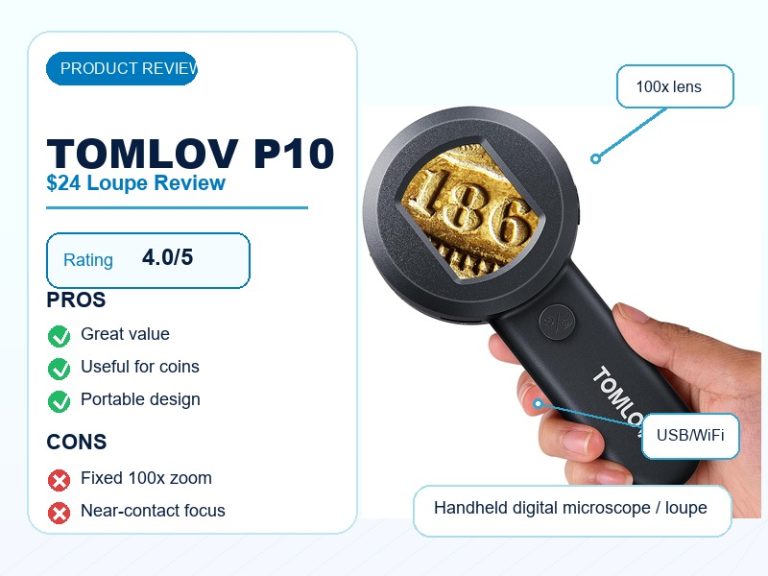
The TOMLOV P10 review comes down to a straightforward verdict: this $24 handheld digital microscope earns its spot as a coin, jewelry, and trichome inspection tool, provided you accept its fixed 100x magnification and the near-contact focus distance it demands. It’s not a lab instrument, and it won’t hold focus on anything that moves — but for flat, stationary, close-up subjects it delivers far more than the price suggests.

✅ Pros
- Exceptional value at $23.99 — reviewers call it “leagues better” than a jeweler’s loupe
- Easy to operate straight out of the box, even for first-time users
- Versatile across coins, jewelry, trichomes, splinters, and PCB inspection
- Durable enough for kids — one buyer put three of them “through the true test” of their boys
- Clean PC workflow: saves to a Micro-SD card and transfers straight to a computer
❌ Cons
- Image quality is inconsistent — some buyers report crisp shots, others struggle to focus at all
- Battery drains faster than the advertised 50-minute runtime for several reviewers
- Working distance is extremely shallow; it must sit almost directly on the subject
- No printed manual for the magnification, light, and zoom controls
- Poor for living or moving subjects like insects or plants
What to Look for in a Handheld Digital Microscope
Handheld digital microscopes live or die on a handful of specs: magnification range, working distance, illumination, and how easily images move off the device. Fixed-magnification units like the TOMLOV P10 trade flexibility for simplicity — there’s no focus ring to fumble with, but you also can’t back off to frame a wider shot. The 100x magnification and 0.3-inch working distance here mean the device is built for close, controlled inspection rather than general-purpose viewing.
Illumination matters just as much as optics. The P10’s dimmable 4 white LED plus 4 UV LED setup covers two distinct use cases — general close-up viewing and UV-reactive inspection (trichomes, certain minerals, security features on documents). Buyers comparing pocket microscopes should also weigh screen size and image storage, since a built-in display and Micro-SD card save the hassle of tethering to a phone or laptop for every shot. For a broader look at how portable models stack up against each other, see our guide to the best pocket microscopes.
Power source and battery life round out the decision. Devices that run on AC and battery power, like the P10, offer more flexibility for desk use, but reviewers consistently flag that advertised runtimes rarely match real-world use once the screen and LEDs are running at full brightness.
Who Should Buy a Handheld Digital Microscope?
Hobbyists are the core audience — coin and stamp collectors checking for mint errors, jewelers inspecting stone settings, and growers checking trichome color and maturity all need close-up, well-lit magnification more than they need lab-grade optics. For these buyers, a fixed 100x handheld unit is often more practical than a full benchtop microscope because it’s fast to deploy and doesn’t require slide prep.
Educators and parents are the second major group, using handheld scopes to introduce kids to magnified detail without the cost or fragility of a compound microscope. If that’s the primary use case, it’s worth comparing a fixed-magnification pocket scope against a full beginner setup — see our review of the My First Lab Duo-Scope microscope for a compound-microscope alternative aimed at kids.
Who This Is For
The TOMLOV P10 suits coin and stamp collectors, jewelers checking stone settings, cannabis growers inspecting trichomes, and parents who want a low-cost STEM toy for kids to use under supervision. It’s a poor fit for anyone expecting adjustable magnification, lab-grade precision, or the ability to examine anything that isn’t flat and stationary.

Full Specifications
| Spec | Value |
|---|---|
| Light Source Type | LED |
| Real Angle Of View | 178 Degrees |
| Magnification Maximum | 100x |
| Voltage | 110 Volts |
| Compatible Devices | Laptop, Personal Computer |
| Objective Lens Description | 100x |
| Power Source | AC & Battery Powered |
| Item Weight | 0.16 Kilograms |
| Enclosure Material | Plastic |
| Color | Black |
| Model Name | P10 |
| Brand | TOMLOV |
| Manufacturer Part Number | P10 |
| Unit Count | 1.0 Count |
| Warranty Description | 1 year |
| Built-In Media | 1x Manual, 1x TOMLOV P10 portable microscope, 1x USB Cable |
Optical Performance & Magnification
The TOMLOV P10 delivers 100x magnification through a fixed objective lens with a 178-degree real angle of view, requiring the device to sit roughly 0.3 inches from the subject to hold focus. That near-contact working distance is by design — it’s why the P10 excels at flat, stationary targets like coins, gem settings, and fabric, and why several reviewers were caught off guard when they expected an adjustable-zoom experience.
The TOMLOV P10 captures images through a 16MP camera sensor feeding a 2-inch LCD screen, giving buyers a live preview before saving a shot. Customer feedback on this point is split: Amazon’s aggregated review data shows 69 positive and 32 negative mentions of image quality specifically, with satisfied buyers praising “very clear pictures” and dissatisfied ones reporting difficulty getting a sharp image outside the ideal focus range. For general background on how working distance and depth of field affect handheld optics, Nikon’s MicroscopyU resource is a useful primer.
The TOMLOV P10 also removes its clear contact ring via a simple twist-and-pull mechanism, which one reviewer used to get correct focus on curved or uneven surfaces like a splinter in skin — a workaround worth knowing before purchase since it isn’t documented in the box.
Lighting, Camera & Storage
The TOMLOV P10 illuminates subjects through 4 dimmable white LEDs and 4 UV LEDs, switchable depending on whether the goal is general close-up viewing or UV-reactive inspection such as trichome color-checking. Reviewers specifically called out the UV mode as “very cool” for cannabis trichome inspection, a use case the product wasn’t originally marketed around but that shows up repeatedly in customer feedback.
The TOMLOV P10 stores captured images on an included 8GB Micro-SD card and connects to a computer over USB for PC Camera mode, Storage mode, or Charging mode. On Windows, the feed opens directly in the Camera app; on Mac, buyers report needing Photo Booth, which mirrors the image. One reviewer noted that photos and video captured while tethered to a PC save only to the computer, not the device’s own storage — a distinction worth knowing if the plan is to shoot on the go and offload later.
Build, Portability & Battery
The TOMLOV P10 weighs just 0.16 kilograms (3.9 oz) and ships with a hard-shell case and lanyard, making it genuinely pocketable for coin shows, jewelry inspection on the move, or classroom use. The plastic enclosure keeps costs down but also explains reviewer comments that the unit “feels cheap because of how light it is in weight,” even when the optics performed well.
The TOMLOV P10 charges over USB-C and runs on AC or battery power for up to 50 minutes per charge, though a meaningful share of reviewers report the real-world runtime falls short of that figure once the screen and LEDs are in constant use. The product ships with a USB-C to USB-A cable rather than a wall charger, so buyers relying on it away from a laptop or power bank should budget accordingly. Full specs and firmware notes are available on the TOMLOV manufacturer site.
What Customers Say
The TOMLOV P10 holds a 4.2 out of 5 average across 1,143 ratings. In our sampled reviews, sentiment ran roughly 80% positive with the remainder mixed rather than outright negative — no one-star or two-star reviews appeared in the sample, though three-star critiques flagged real usability limits rather than defects. As one verified buyer put it: “So much better than a jewelers loupe leagues better, worth the money for sure.” Another described a more mixed experience: “I works pretty well, but it must be placed down directly on the subject… Anything short of that will render a poor image.” A third, more critical reviewer added: “Only fell short of 5 stars because as simple as the product may be, no ‘manual.’ I ordered thinking this was adjustable magnification… 10 minutes on google looking around only to realize my mistake.”
Review integrity risk for this listing is rated LOW: all sampled reviews carry Verified Purchase badges, feedback varies meaningfully in length, tone, and star rating, and negative points are specific rather than generic. For readers who want to learn how to evaluate review authenticity themselves, the FTC’s guide to endorsements and online reviews is a solid starting point.
Final Verdict
BUY — with the caveat that the TOMLOV P10 is a near-contact inspection tool, not a general-purpose microscope. At $23.99 it beats a standard jeweler’s loupe on features (screen, camera, dual lighting, PC connectivity) for buyers checking coins, jewelry, or trichomes, but anyone expecting adjustable zoom or the ability to focus on moving subjects should look elsewhere.
Frequently Asked Questions
Does the TOMLOV P10 have adjustable magnification?
No. The P10 has a fixed 100x magnification with a 4X digital zoom option, not a variable optical zoom. Several reviewers initially expected adjustable magnification and were caught off guard, so this is worth confirming before purchase.
How close does the P10 need to be to the subject?
Around 0.3 inches. The device is designed to sit almost directly on flat, stationary subjects to hold focus, which makes it a poor fit for curved, uneven, or moving objects.
What’s included in the box?
The TOMLOV P10 ships with the microscope, a USB-C to USB-A cable, a user manual, a lanyard, sample slides, an 8GB Micro-SD card, and a hard-shell carrying case.
How long does the battery last?
TOMLOV rates it for up to 50 minutes of use per charge, but multiple reviewers report shorter real-world runtime, especially with the screen and LEDs at full brightness. It can be used while plugged in via USB-C.
Can the P10 connect to a computer?
Yes. Plugging it into a PC brings up Storage, Charging, and PC Camera modes; on Windows, the live feed opens through the Camera app. Mac users need Photo Booth, and the resulting image is mirrored on screen.
Does the UV light mode have a specific use?
Yes — reviewers use it most often for checking trichome color and maturity on plants, in addition to general UV-reactive inspection tasks. The white LEDs are dimmable and separate from the UV set.
Is the TOMLOV P10 waterproof?
No. TOMLOV’s own instructions warn against dropping the unit and it is not rated for water exposure, so it should be handled as a standard electronic device rather than a rugged field tool.
Conclusion
The TOMLOV P10 is a genuinely useful $24 tool for anyone who needs fast, well-lit close-up inspection of flat, stationary objects — coins, jewelry, trichomes, splinters, and similar detail work. It’s not the right choice for buyers who need adjustable magnification, lab-grade image quality, or the ability to examine anything that moves.
If you’ve used the TOMLOV P10 or a similar pocket microscope, share what worked (or didn’t) in the comments below. If you’re comparing brands before you buy, our roundup of the best microscope brands is a good next stop.
Originally posted 2026-07-06 08:00:00.