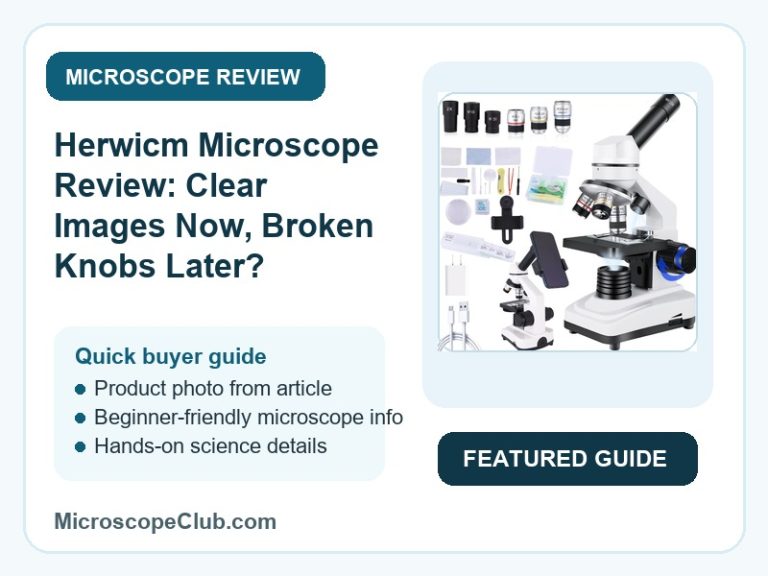
This Herwicm microscope review lands on a split verdict: the 40x-2000x compound scope delivers image clarity and a genuinely useful accessory kit that most budget-priced microscopes don’t match, but a real slice of buyers unbox a unit with a broken eyepiece, a snapped phone mount, or a focus knob that fails after a handful of uses. If you inspect the unit the moment it arrives and lean on Amazon’s return window, the odds favor a satisfying beginner scope. If you’re hoping for years of daily classroom-grade reliability, this isn’t that microscope.
✅ Pros
- Sharp, clear images at both low and high magnification, per multiple reviewers
- Dual LED illumination (incident + transmitted) handles both opaque objects and transparent slides
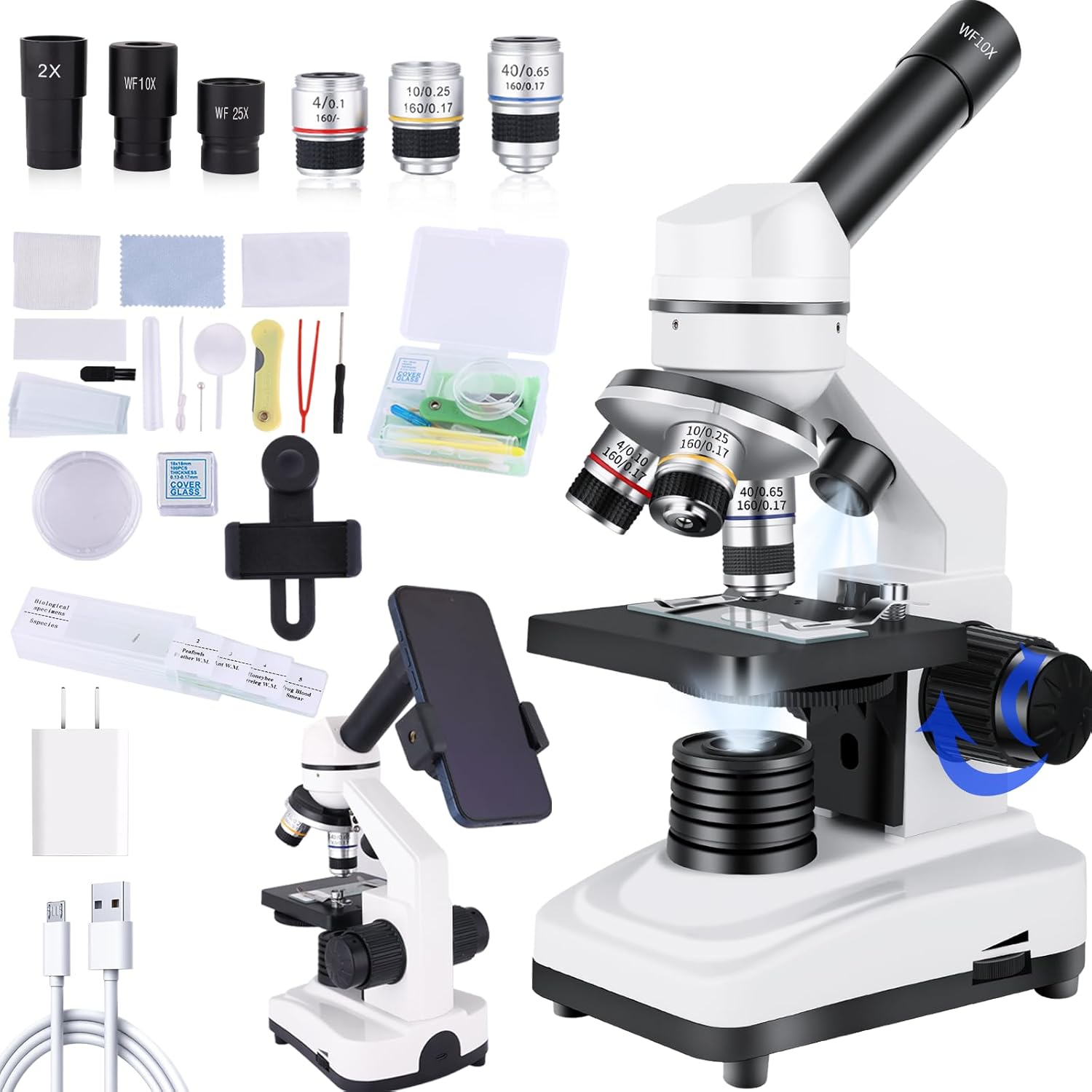
- Genuinely useful included kit — phone adapter, 5 prepared slides, 5 blank slides, tweezers, and dropper
- Five-color filter wheel adds contrast to transparent specimens without slide staining
- Strong feature-per-dollar — filters, phone mount, and a full slide kit rarely bundle together at this budget price point
❌ Cons
- A meaningful share of units arrive with a broken eyepiece housing or a missing eyepiece
- Focus knob and phone mount have failed after only light use in multiple reports
- Spec sheet lists 240 Volts on a US listing while also stating “Battery Powered” — the two power specs conflict and are worth confirming before you buy
- No real buyer Q&A is available on the listing to vet common issues in advance
What to Look for in a Compound Microscope
Magnification range is the first spec buyers chase, but it’s the least useful one on its own. The Herwicm’s stated 40x-2000x range only means something combined with its WF10X/WF25X eyepieces and 4x/10x/40x achromatic objectives — the eyepiece-times-objective math is what actually produces the six usable magnification levels, not the headline top number. A scope that quotes a huge top-end figure without naming real objective lenses is usually inflating the spec, so check that the objectives are listed by name, not just the final multiplier.
Illumination matters just as much as optics. A single bottom-mounted LED only lights transparent slides from below, which is useless for opaque specimens like rocks, coins, or insect parts. Dual illumination — one LED under the stage, one above it — lets a scope handle both jobs, and a dimmer knob to control brightness prevents washed-out images at high magnification. Filter wheels, coarse/fine focus knobs, and a metal (versus all-plastic) chassis round out the factors that separate a usable beginner scope from a toy. For a deeper walkthrough of how these specs stack up across manufacturers, see our guide to the best microscope brands.
Finally, weigh the accessory kit and the return policy together. A microscope bundled with prepared slides, a phone adapter, and basic tools is a better starting point than a bare optical tube — but only if the unit works. Budget compound scopes in this price bracket carry real quality-control variance, so a buyer’s actual protection is Amazon’s return window, not the manufacturer’s warranty page.
Who Should Buy a Compound Microscope?
Compound microscopes in this category are built for people examining thin, translucent samples — pond water, onion skin, blood smears, fabric fibers — at magnifications a stereo microscope can’t reach. That makes them the right pick for homeschool biology units, middle-and-high-school science fair projects, and curious kids who want to see what’s actually in a drop of tap water. If you’re aiming a scope at a household with kids, our post on observing volvox under the microscope is a good preview of the kind of specimen work these entry-level compound scopes are built for.
They’re the wrong pick for anyone needing daily, heavy-duty reliability — a working lab tech, a serious hobbyist doing frequent slide prep, or an adult expecting the ruggedness of a higher-end lab scope. At this end of the market, you’re buying an introduction to microscopy, not a durable instrument. That distinction should drive the purchase decision more than any single spec on the page.
Who This Is For
The Herwicm microscope fits parents and homeschoolers buying a first compound scope for a child roughly age 8-18, per reviewer feedback, especially as a gift for a school science unit or a birthday. It’s a weaker fit for younger kids using it unsupervised, and a poor fit for adult hobbyists who want lab-grade durability for regular, ongoing use.

Full Specifications
| Spec | Value |
|---|---|
| Light Source Type | LED |
| Real Angle Of View | 45 Degrees |
| Magnification Maximum | 2000 x |
| Voltage | 240 Volts |
| Compatible Devices | Personal Computer, Laptop |
| Objective Lens Description | 4x, 10x, 40x |
| Power Source | Battery Powered |
| Enclosure Material | Metal |
| Color | silver |
| Brand | Herwicm |
| Manufacturer Part Number | Herwicm |
Optical Performance and Illumination
The Herwicm microscope delivers 40x-2000x magnification through a 360-degree rotating monocular head fitted with WF10X/WF25X eyepieces and 4x/10x/40x achromatic objective lenses, giving six distinct magnification steps rather than one fixed setting. Reviewers consistently single out the image quality at these settings: Amazon’s own review-highlights note customers making out details as fine as blood cells at high magnification, and one buyer simply wrote “Amazing clarity!!” after unboxing.
The Herwicm handles both transparent and opaque specimens through its dual LED illumination system — one LED under the stage for translucent slides, one above it for solid objects like coins or insect wings — with a dimmer knob to adjust brightness for either mode. Understanding how objective lenses and illumination combine to produce usable magnification is worth a closer look if you’re new to the topic; Nikon’s MicroscopyU has a solid plain-language breakdown of the optics involved.
The Herwicm also adds contrast through a five-color filter wheel (yellow, red, blue, green, violet) mounted beneath the stage, which lets a user colorize transparent specimens without staining a slide first — useful for a beginner who doesn’t yet own lab stains. That said, not every unit performs consistently: at least one reviewer reported “images are blurry and illumination is not good,” a complaint that appears to be unit-specific rather than a universal design flaw, based on the volume of clarity-praising reviews around it.
Build Quality and Reliability
The Herwicm houses its optics in a metal enclosure rather than an all-plastic body, which is one reason a Vine reviewer described it as feeling “pretty sturdy for the price” with focus knobs that were “smooth enough to dial in without issue.” That impression, though, isn’t universal across units shipped.
The Herwicm shows a durability gap through a cluster of reports concentrated almost entirely on quality control, not day-to-day performance: Amazon’s own AI review summary shows durability mentioned by 5 customers with 0 positive and 5 negative sentiment. Specific complaints include an eyepiece housing arriving “totally busted,” a phone mount “broke when taken out of box,” and a focus knob failing “after using it just a few times.” One buyer reported a unit that “does not work at all” and was past the 30-day return window before the fault surfaced.
The Herwicm exposes this durability gap mainly after the sale rather than before it — most 5-star reviews were posted right after unboxing or gifting, while it’s the mechanical stress of repeated use that later exposes a weak focus knob or mount. Practically, that means the smart move is to test every function — focus, both LEDs, filter wheel, phone mount — within the first days of arrival, well inside the return window, rather than assuming a good first impression guarantees long-term reliability.
Ease of Use and Accessories
The Herwicm simplifies focusing through a dual-control system — a coarse knob for rapid positioning and a fine knob for locking in a sharp image — which reviewers described as approachable even for a first-time user. A 360-degree rotating eyepiece also lets viewers adjust the angle for comfort rather than hunching over a fixed monocular tube.
The Herwicm extends its usefulness through a bundled phone adapter, letting a user photograph or record what’s on the slide instead of just eyeballing it. Results here are mixed: one reviewer called the photo results “pretty good,” while another reported difficulty getting a phone to sit properly in the mount and wasn’t sure if the issue was the adapter or their own setup.
The Herwicm rounds out the package through 5 prepared specimen slides, 5 blank slides, tweezers, and a dropper, plus a carrying case with foam inserts — enough to start observing samples the same day it arrives without a separate purchase. One reviewer specifically praised the “easy set up, awesome case, and a lot of accessories” as reasons it worked well as a gift.
What Customers Say
The Herwicm holds a 4.2 out of 5 rating across 105 reviews, with sentiment splitting roughly 65% positive, 15% mixed, and 20% negative. Positive reviews cluster around image clarity, educational value, and price; negative reviews cluster almost entirely around one theme — durability and quality control on arrival.
“Amazing clarity!!” wrote one verified buyer, while another said simply, “It’s everything it said it would be.” On the other side, a verified buyer reported: “Phone mount was broke when taken out of box. After using it just a few times the focusing knob broke. This was a Christmas gift for my grand-daughter and very disappointing that it had to be returned.” A third reviewer summarized the trade-off directly: “It’s not a $1000 lab model, still for educational or casual use, it does exactly what I need.”
Review integrity risk here is LOW — the sampled reviews show specific, varied use cases (gifts, school labs, phone photography) rather than generic templated praise, and the one non-verified review in the sample was a detailed 4-star account, not an inflated 5-star. If you want a general primer on spotting manipulated reviews before trusting any product’s star rating, Consumer Reports publishes ongoing guidance on the topic.
Final Verdict
CONSIDER: the Herwicm earns its spot as a feature-rich, budget-friendly entry point into compound microscopy — dual illumination, a filter wheel, and a full slide kit are an unusually complete bundle at this price — but the non-trivial rate of broken or missing parts on arrival means buyers should inspect every function within days of delivery and lean on Amazon’s return window rather than the manufacturer, since the reward-to-risk ratio depends entirely on getting a good unit.
Frequently Asked Questions
What magnification does the Herwicm microscope reach?
It reaches 40x-2000x across six magnification levels, produced by WF10X/WF25X eyepieces combined with 4x/10x/40x achromatic objective lenses. The top-end figure only applies at the highest eyepiece-objective combination, not as a single continuous zoom.
Does it work with a phone camera?
Yes, it ships with a phone adapter for capturing photos and video through the eyepiece. Reviewer experience is mixed — some got good results immediately, while at least one reported trouble getting their phone to sit securely in the mount.
What’s included in the box?
The kit includes 5 prepared specimen slides, 5 blank slides, tweezers, a dropper, the phone adapter, and a carrying case with foam inserts, according to buyer reports and the listing’s bullet points.
Is it battery-powered or does it plug into an outlet?
The listing’s own spec table is inconsistent here — it states both “Battery Powered” and a “240 Volts” voltage rating, which conflict with each other and don’t match standard US mains voltage. Confirm the actual power setup with the seller before you buy if this matters for your use case.
What age group is this microscope best suited for?
Reviewer feedback points to roughly age 8-18 as the sweet spot, with several buyers noting it worked well as a gift for that range. It’s less suited to unsupervised use by younger children or to adults expecting lab-grade equipment.
Can it examine solid objects, not just slides?
Yes. The dual LED illumination system includes a top-mounted light for opaque objects like coins, insect parts, or fabric, in addition to the bottom-mounted light used for transparent slides.
What should I do if mine arrives damaged or missing parts?
Inspect the eyepiece, focus knobs, phone mount, and both LEDs the day it arrives. Reviewer reports show a real rate of units arriving broken or incomplete, so use Amazon’s return window immediately rather than waiting — at least one buyer lost that option by discovering a fault after 30 days.
Conclusion
The Herwicm microscope suits a parent or homeschooler buying a first compound scope for a curious kid, and it delivers a genuinely complete accessory kit and clear optics when the unit arrives intact. It’s a poor fit for anyone expecting daily heavy use or guaranteed reliability out of the box, since durability complaints — not optical complaints — account for nearly all of its negative reviews.
If you’ve bought this microscope, let us know in the comments what you looked at first and whether your unit arrived in good shape — it helps other buyers gauge the real odds. And if you’re prepping your first slides, our guide to observing dandruff under the microscope is a good, slightly gross, first experiment to try with the included slide kit.