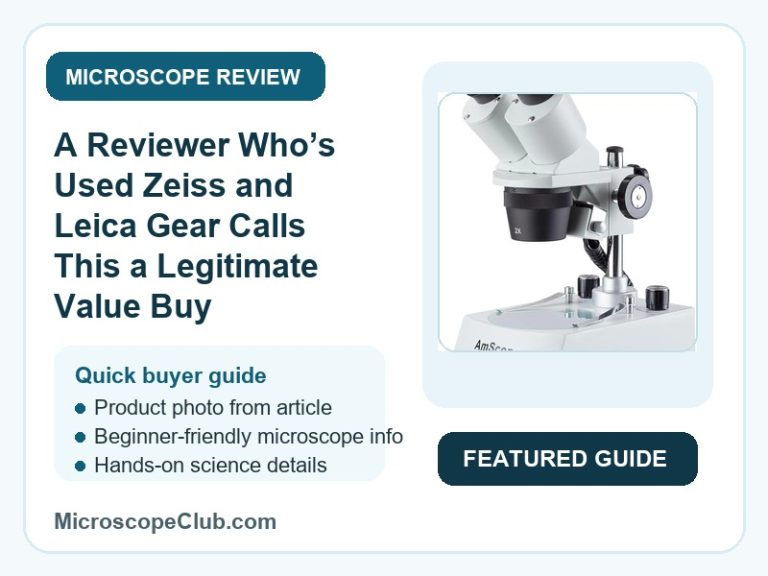
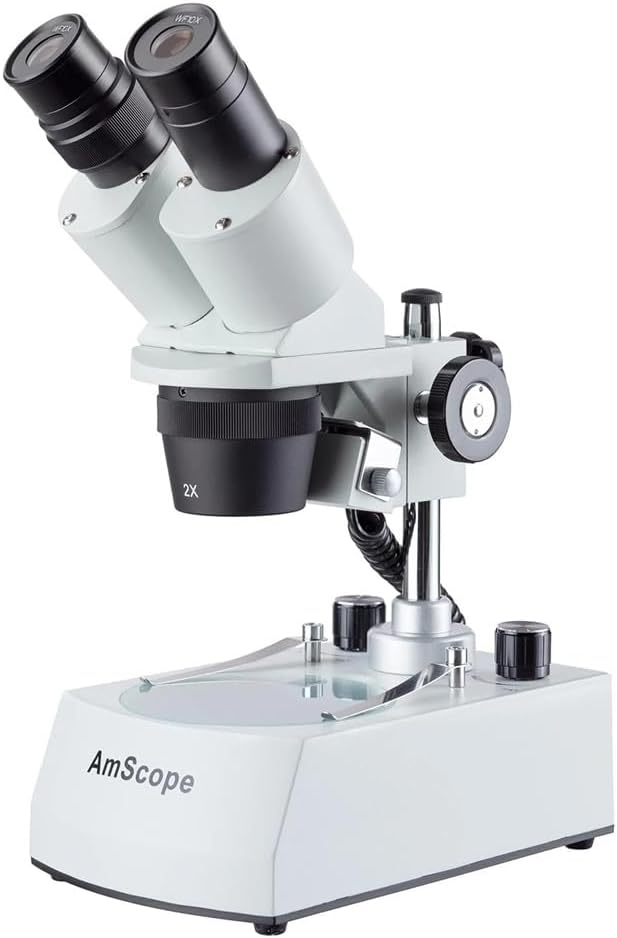
The AmScope SE306R-P-LED review verdict is that this cordless stereo microscope earns its 4.4-star average because the optics genuinely outperform its budget-friendly price, even though the LED lighting system is the one component that lets some buyers down. It delivers fixed 20X and 40X magnification through an all-metal pillar stand, dual top-and-bottom LED illumination, and battery-or-AC power, aimed squarely at hobbyists, homeschoolers, and light bench work rather than lab-grade slide microscopy. If you want a durable, portable 3D viewer and can tolerate an occasional LED hiccup, it’s a legitimate value buy — if consistent lighting matters more to you than price, weigh that tradeoff carefully before ordering.
✅ Pros
- Sharp, clear optics that punch above the price — a reviewer who has used Zeiss, Leica, Nikon, and Olympus gear called it a legitimate value buy
- Sturdy all-metal build that holds up to years of rough handling, including by kids
- Simple enough for a 5-year-old to operate solo, no manual required
- Cordless battery operation — usable away from a wall outlet, not just tethered to AC power
- Dual LED lighting (top and bottom) for viewing both solid objects and translucent samples
❌ Cons
- LED lighting is the weak link — some units flicker, dim, or fail outright, and one reviewer reported smoke from the internal wiring
- Eyepiece glass is noticeably cheaper than higher-end scopes, with poor eye relief for glasses wearers
- Magnification is fixed at 20X and 40X only — no zoom, and it struggles to focus on larger objects
- Field of view runs narrower than comparable stereo microscopes in the same class
What to Look for in a Stereo Microscope
A stereo (dissecting) microscope lives or dies on a handful of purchase factors: magnification range, illumination, focusing comfort, and build quality. Magnification matters less here than in compound microscopy — stereo scopes trade high power for a true 3D view of whole, unmounted objects, so a fixed 20X/40X range like the SE306R-P-LED offers is standard for the category rather than a limitation unique to this unit. What separates a good budget stereo scope from a mediocre one is whether the optics stay sharp at both magnification steps and whether the illumination is dependable enough for daily use.
Illumination design is the second major factor. Top (incident) lighting reveals surface detail on opaque objects like coins, insects, and circuit boards, while bottom (transmitted) lighting works for thin or translucent samples. The SE306R-P-LED includes both, powered by LED rather than the halogen bulbs older dissecting scopes use — a meaningful upgrade since halogen runs hot and burns out faster. Build quality is the third factor: an all-metal pillar stand resists the wobble and drift that plastic-framed scopes develop after repeated focus adjustments, which matters most for classrooms and households with kids handling the unit daily. For a deeper breakdown of what separates the top models in this category, see our guide to the best dissecting microscopes.
Who Should Buy a Stereo Microscope?
Stereo microscopes suit anyone who wants to examine whole, real-world objects rather than prepared slides — hobbyists inspecting coins, minerals, or insects, students doing nature-based science projects, and hands-on tinkerers working on jewelry repair, watch parts, or SMD soldering. Because no slide preparation is required, the barrier to entry is low: point it at an object, adjust the focus knob, and look. That immediacy is exactly what draws first-time buyers and parents shopping for a child’s first microscope.
Educators and homeschool parents make up a large share of this category’s buyers, since a stereo scope’s forgiving depth of field and simple two-step magnification make it easier for young or inexperienced users to get a usable image on the first try, unlike a compound microscope’s steeper learning curve. If you’re comparing brands before committing to a specific model, our guide to the most popular microscope brands covers how AmScope stacks up against the competition.
Who This Is For
The AmScope SE306R-P-LED fits hobbyists, parents of curious kids, homeschool educators, and light bench-work users — jewelry and watch repair, coin and stamp collecting, small electronics inspection — who want a durable, portable, battery-powered 3D magnifier without lab-grade cost. It is not the right pick for anyone who needs zoom magnification beyond 40X, prepared-slide compound microscopy, or precision optics with wide eye relief.
Full Specifications
| Spec | Value |
|---|---|
| Light Source Type | LED |
| Real Angle Of View | 45 Degrees |
| Magnification Maximum | 40 x |
| Voltage | 120 Volts |
| Objective Lens Description | Achromatic |
| Power Source | Battery Powered |
| Item Weight | 3.25 Pounds |
| Enclosure Material | Metal |
| Color | Multi |
| Model Name | SE306R-P / SE306R-P-LED |
| Brand | AmScope |
| UPC | 013964503401 |
| Global Trade Identification Number | 00013964503401 |
| Manufacturer Part Number | SE306R-P-LED |
| Unit Count | 1.0 Count |
| Warranty Description | 5 Year Warranty |
| Built-In Media | Stereo microscope |
Optical Performance
The AmScope SE306R-P-LED delivers 20X and 40X stereo magnification through widefield achromatic objective lenses paired with a forward-facing binocular head, giving a true three-dimensional view rather than the flattened image a compound scope produces on prepared slides. The 45-degree real angle of view keeps the image comfortable to hold over extended sessions, which matters for reviewers who describe daily use — one buyer noted finding new things to examine under the scope “daily” after purchase.

The AmScope SE306R-P-LED handles surface detail on opaque objects and light penetration through thinner samples via its dual LED illumination — a top light for incident viewing and a bottom light for transmitted viewing. A reviewer with decades of experience on high-end Zeiss, Leica, Nikon, and Olympus equipment specifically praised the “adjustable LED illumination,” calling it “well worth it, in comparison to halogen bulbs which get extremely hot and burn out.” That said, the AI-aggregated review theme data shows lighting is the one attribute with a genuinely mixed record — 7 positive mentions against 5 negative — with a minority of buyers reporting dimming, flickering, or complete LED failure. For a technical breakdown of how stereo optics differ from compound systems, Nikon’s MicroscopyU stereomicroscopy primer is a solid reference.
Build Quality & Portability
The AmScope SE306R-P-LED houses its optics in an all-metal enclosure mounted on a sturdy pillar stand, weighing in at 3.25 pounds — light enough to relocate between a workbench and a kitchen table but substantial enough to resist tipping during focus adjustments. One reviewer summed up the build as “well built, stable, excellent optics,” while another noted it “has help up over the last year+ to numerous parties and not being handled as well as it should” — a direct account of the frame surviving repeated, careless handling.
The AmScope SE306R-P-LED runs on either battery power or a 120-volt AC connection, backed by a 5-year warranty from AmScope — an unusually long coverage window for a budget-tier instrument. The cordless option is a genuine practical advantage: one buyer specifically called out that “it has a battery in it, so it can be taken wherever and used and not constrained to the house,” which matters for field use like nature walks or outdoor collecting.
Ease of Use & Versatility
The AmScope SE306R-P-LED simplifies operation down to a single main focus knob and a two-position magnification switch, which is why multiple reviewers describe young children operating it without adult help — one parent reported their 5-year-old “is able to use this stereoscope by himself,” and another said their 4-year-old had “a blast looking at all kinds of sticks and rocks and bugs.” That low learning curve extends to adult hobbyists too, with buyers using it for coin collecting, insect inspection, and SMD soldering work.
The AmScope SE306R-P-LED supports a wide range of subjects thanks to its open working area beneath the objective lenses, letting users examine anything from fingernails to circuit boards without slide preparation. The tradeoff is a narrower field of view than pricier stereo scopes and eyepieces that some reviewers describe as having “poor eye relief” — a real comfort issue for glasses wearers during longer sessions, even though the core optics remain “relatively clear.”
What Customers Say
The AmScope SE306R-P-LED holds a 4.4 out of 5 average across 222 ratings. In a sample of individually reviewed comments, sentiment ran strongly positive — 11 five-star reviews, 1 four-star, and 1 one-star, all marked as verified purchases. One reviewer with a professional optics background wrote: “I’m a professional with experience using high end microscopes from Zeiss, Leica, Nikon, and Olympus… this is a nice little stereo microscope. Very good image quality, adjustable LED illumination… compact size, and very easy to use.” A verified buyer summarized the value proposition simply: “It’s hard to imagine getting more microscope for the money, yet I’m not seeing any evidence that they cut corners in production.”
Not every account was positive — one reviewer reported the light “flickering” on a second use and no illumination at all on a third, adding “take your money and invest in a better model.” Review integrity risk on this listing is LOW: the sampled reviews show organic variance in star rating, length, and reviewer history spanning 2016 through 2026, with no signs of incentivized or templated language. For general guidance on evaluating review authenticity before you buy anything online, the FTC’s consumer guide to online reviews is a useful reference point.
Final Verdict
CONSIDER the AmScope SE306R-P-LED if you want a durable, portable stereo microscope for hobbyist, educational, or light bench-work use and can accept that the LED lighting — while praised by most buyers — has a documented minority failure rate that includes flickering, dimming, and at least one report of internal smoke. The optics, build quality, and battery-powered portability all outperform the price, which is why buyers with genuine high-end microscope experience recommend it; just budget for the possibility of troubleshooting or replacing the light module if you land in the unlucky minority.
Frequently Asked Questions
What magnification does the AmScope SE306R-P-LED offer?
It has two fixed magnification settings, 20X and 40X, switched via a lever rather than a continuous zoom. This range is standard for a dissecting/stereo microscope, which prioritizes a 3D view of whole objects over the higher magnification of a compound microscope.
Does it run on batteries, AC power, or both?
Both. The unit accepts battery power for cordless use in the field or away from an outlet, and can also run on a standard 120-volt AC connection at home or in a classroom.
Is this a good first microscope for a child?
Yes, based on multiple verified reviews. Parents report children as young as 4 to 5 years old operating it independently, thanks to the single focus knob and simple two-step magnification switch.
Can it be used for tasks like soldering, coin inspection, or jewelry repair?
Yes. Reviewers specifically cite using it for SMD soldering work, examining coins in a collection, and inspecting small parts, since the stereo design gives working clearance and a true depth-of-field view of the object.
What’s covered under the 5-year warranty?
AmScope backs the SE306R-P-LED with a 5-year warranty description on the listing, which is longer than most budget-tier microscopes offer. Check AmScope’s official site for current warranty terms and coverage specifics before purchase.
Why do some reviews mention flickering or failed LED lights?
A minority of buyers report LED reliability issues, ranging from dimming and flickering to complete failure, and one reviewer described smoke coming from the internal wiring. Most reviewers report no lighting problems, but it’s a documented risk worth being aware of before you buy.
Is this the same as a compound microscope?
No. This is a stereo (dissecting) microscope, built to view whole, unmounted objects in 3D at lower magnification. A compound microscope uses prepared slides and much higher magnification to view cells and microorganisms, which this model is not designed to do.
Conclusion
The AmScope SE306R-P-LED suits hobbyists, homeschool families, and light bench-work users who want a sturdy, portable stereo microscope without lab-grade pricing — its optics and build quality consistently outperform expectations at this price, even though a documented minority of units have LED reliability problems worth watching for after purchase.
If you pick one up, we’d love to hear what you end up examining with it — drop a comment below with your first subject under the lens, or a question if you’re still deciding. For ideas on what to look at first, our guide on what grass looks like under a microscope is a good starting point for backyard exploration.
Originally posted 2026-07-25 09:00:00.