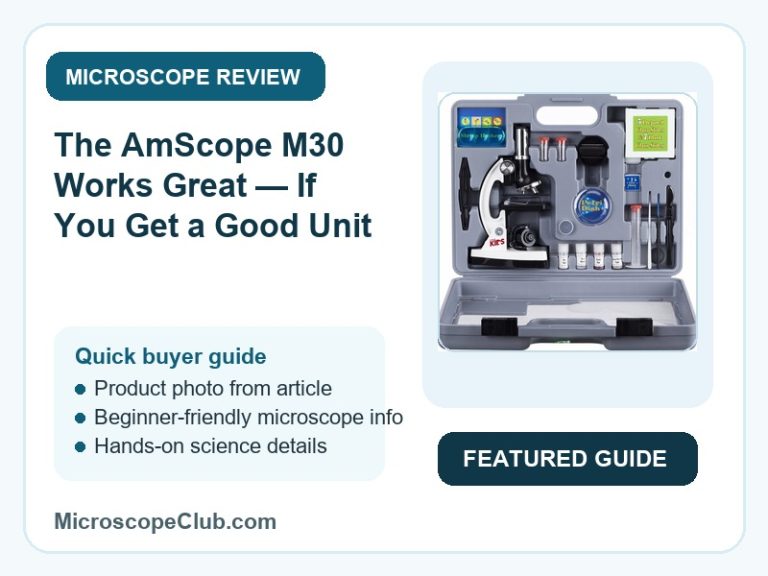
The AmScope M30 review verdict in one line: this 52-piece kids’ microscope kit delivers genuinely usable 120X-1200X views and a complete starter case for a fraction of what a “real” beginner scope costs — but a meaningful share of buyers open the box to a unit that barely focuses. If yours works out of the box, it’s an easy recommendation for a first science kit. If it doesn’t, the fix is a quick exchange, not a wasted purchase.
✅ Pros
- When properly focused, it resolves individual cells and nuclei — enough real detail for genuine biology exploration, not just a toy view
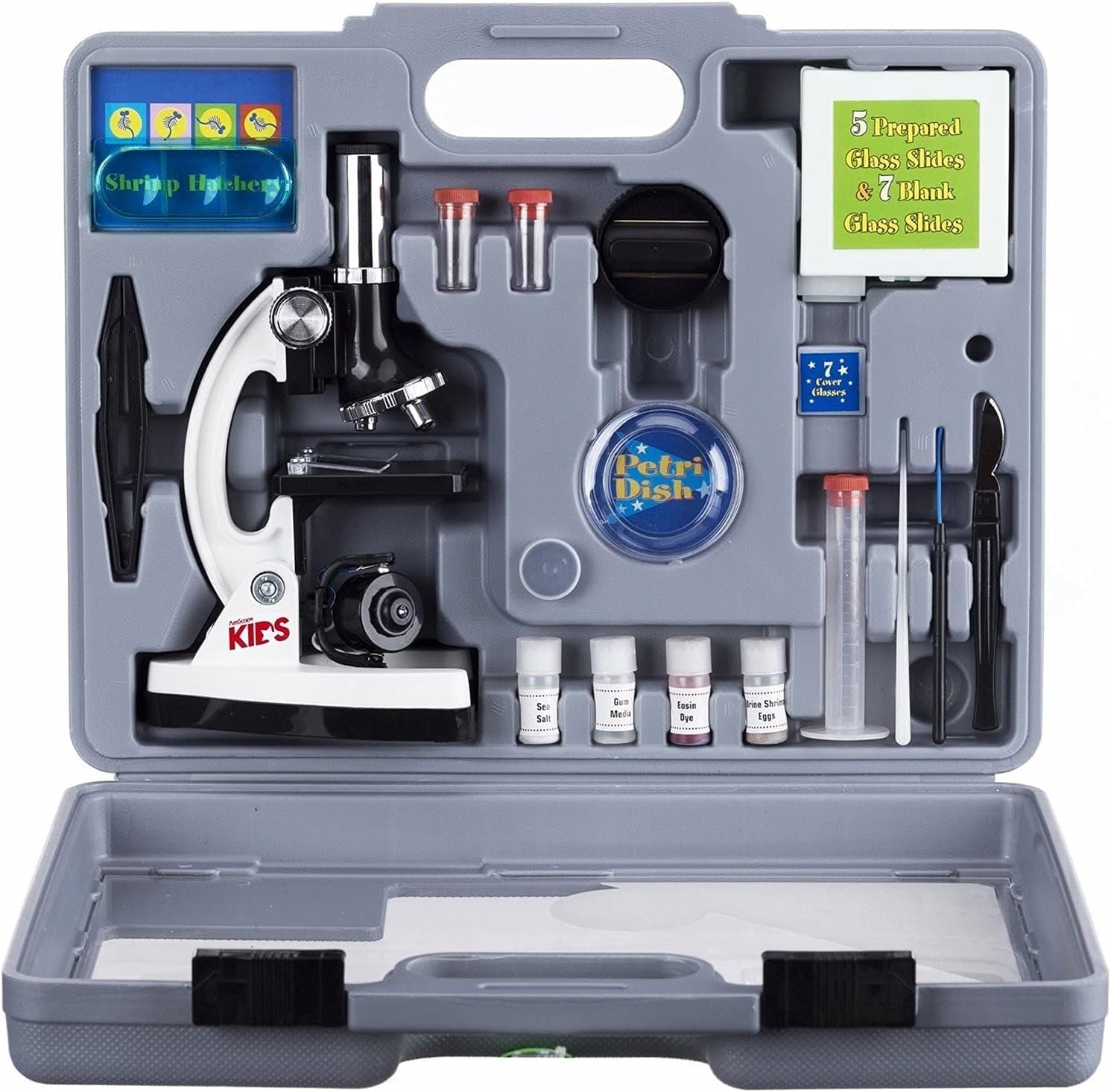
- Full 52-piece kit: hard ABS carrying case, prepared and blank slides, dissection tools, and a brine shrimp hatchery in one box
- Metal body chassis adds real heft compared to the all-plastic toy scopes at the same price
- Six magnification settings from 120X to 1200X plus a rotating color filter wheel for contrast on pale specimens
- Manufacturer support reliably replaces defective units when buyers report a problem
❌ Cons
- Unit-to-unit quality control is inconsistent — a real share of buyers report a unit where the eyepiece shows nothing usable
- Light and mirror housing is plastic and fragile, with multiple reports of it breaking within the first few uses
- No fine focus adjustment — only coarse, which makes 1200X genuinely hard to dial in
- Stage doesn’t move side to side, so you’re repositioning the slide by hand
What to Look for in a Beginner Compound Microscope
Magnification range matters less than most parents assume — a kids’ scope that jumps straight to 1200X without a usable low-power step is harder to use, not more impressive. The AmScope M30 covers this properly with six settings between 120X and 1200X, which lets a child find and center a specimen at low power before stepping up, the exact workflow that experienced reviewers say makes or breaks the experience with this class of scope.
Objective lens quality is the next filter. Achromatic objectives, which the M30 uses, correct for the color fringing that cheaper single-element lenses produce, so the image stays reasonably sharp rather than smeared with rainbow edges. Illumination type matters too — LED light sources like the M30’s stay cool and consistent far longer than the incandescent bulbs still found on some budget scopes. For a side-by-side sense of how these specs scale up at a slightly higher price point, see our AmScope M150C-I review.
Build and focusing mechanism round out the checklist. Coarse-only focus (no fine adjustment) is standard at this price tier and workable at low power, but it gets fiddly at maximum magnification — buyers should set expectations accordingly rather than assume lab-grade precision from an entry-level kit.
Who Should Buy a Beginner Microscope?
Beginner compound microscopes are built for exactly one job: turning curiosity into a habit. That makes them the right call for kids roughly 7 to 12 who are just starting to ask what things look like up close, homeschool families adding a hands-on biology component, and any parent or grandparent who wants a low-stakes gift that doesn’t require prior microscopy experience to enjoy on day one.
They’re the wrong call for anyone expecting research-grade optics or a device that needs zero setup — every scope in this category, regardless of brand, requires a few minutes of learning the low-to-high magnification workflow. If brand reputation and long-term support matter more to you than price, our guide to the popular microscope brands is worth a read before you commit.
Who This Is For
The AmScope M30 fits a parent or grandparent buying a first microscope for a curious 7-to-12-year-old — for a holiday gift, a homeschool science unit, or casual backyard specimen hunting — who wants a complete kit at a low price and is comfortable exchanging the unit if it arrives defective. It’s not the right pick for anyone who needs guaranteed first-try reliability or is buying for a child under six.

Full Specifications
| Spec | Value |
|---|---|
| Light Source Type | LED |
| Real Angle of View | 45° |
| Magnification Maximum | 1200X |
| Compatible Devices | Personal Computer, Laptop |
| Objective Lens Description | Achromatic |
| Power Source | Battery Powered |
| Item Dimensions (L x W x H) | 14.57″ x 5.12″ x 15.75″ |
| Item Weight | 3.7 Pounds |
| Enclosure Material | ABS, Metal, Plastic |
| Color | White |
| Model Name | M30 ABS KT2 W |
| Brand | AmScope |
| UPC | 608729747277 / 799198235492 / 753923248454 / 793625008246 |
| Global Trade Identification Number | 00608729747277 |
| Manufacturer Part Number | M30-ABS-KT2-W |
| Unit Count | 1.0 Count |
| Warranty Description | 1 Year Manufacturer |
| Built-In Media | Microscope Kit |
Optical Performance and Magnification Range
The AmScope M30 delivers 120X to 1200X magnification through six selectable objective and eyepiece combinations, paired with a rotating color filter wheel that helps pale or low-contrast specimens stand out under the LED light. A verified buyer with a biology degree confirmed the ceiling is real: “This microscope produces a reasonable level of clarity and magnification. Children will be able to see individual cells, and even nuclei.” That’s a meaningfully higher bar than most toy-grade scopes clear at this price.
The AmScope M30 corrects color fringing through its achromatic objective lens description, which keeps edges reasonably crisp rather than smeared with chromatic bleed — a detail explained well by Nikon’s MicroscopyU guide to objective specifications. Where the M30 struggles is fine control: it offers coarse focus only, so dialing in the full 1200X requires patience. One reviewer put it plainly: “At that power there is some issue adjusting the focus, light, and specimen. At low power 300x, it is much more forgiving.” The workflow that works, per multiple reviewers, is to always locate and center the specimen at the lowest setting first, then step up gradually.
Build Quality and Kit Completeness
The AmScope M30 combines a metal body chassis with ABS and plastic mechanicals across its enclosure, per the listed materials, which is why one buyer described it as feeling lighter than expected despite the metal frame: “The body itself I think it is metal but it just feels so light. The actual neck of the microscope is plastic so are the dials to move it up and down and the light housing is plastic as well.” At 3.7 pounds and roughly 14.6″ x 5.1″ x 15.75″, it’s substantial enough for a tabletop setup without being unwieldy for a child to carry in its case.
The AmScope M30 packages its 52 pieces — prepared and blank slides, dissection tools, and a brine shrimp hatchery kit — inside a hard-shell carrying case that multiple reviewers singled out as genuinely well made: “The case is very nice and fits all the components well and can be used to store the scope, etc for years of use.” The recurring failure point is the light and mirror assembly specifically, not the chassis: “The mirror/light is delicate and broke on first couple uses but the manufacturer was super responsive in correcting the problem quickly.” That combination — solid case, fragile light housing — shows up often enough in the review data to be a real pattern rather than a one-off complaint.
Ease of Use for Beginners
The AmScope M30 operates through a monocular viewing head, a coarse focus knob, and a fixed stage that holds slides with plastic clips but doesn’t shift side to side — repositioning the specimen means sliding the slide itself, which one long-time owner called “a bit annoying.” For a first-time user, that’s a minor learning curve rather than a dealbreaker, but it’s worth setting expectations before a child opens the box expecting instant results.
The AmScope M30 splits opinion hardest on this exact point in the aggregated review data, with ease-of-use mentions running roughly 143 positive to 84 negative. Some of the negative reports trace to the light intensity rather than the optics: “The light is so bright, you cannot use it without being blinded.” Reviewers who got the most out of it consistently mention the same two habits: clean the slide and eyepiece before viewing (dust reads as blur at high magnification), and start at the lowest setting every time before stepping up.
What Customers Say
The AmScope M30 holds a 4.4 out of 5 average across 29,781 ratings, but that headline number tells only part of the story. Looking at the aggregated aspect-level mentions behind those stars, sentiment splits closer to 65% positive and 35% negative — the star average is being pulled up by a high volume of easy 5-star gift reviews, while a real minority of buyers report a unit that simply doesn’t work.
One reviewer summed up the upside: “Great gift for a 10 yr old inspiring marine biologist. Full of exciting preassimilated slides and plenty of blanks to create and learn from.” Another summed up the downside just as clearly: “Poor optics, seem to be plastic very hard to see anything! Really sad that I bought this for my daughter for Christmas as she basically can’t use it!” A third landed in between, warning newcomers to expect an adjustment period without real frustration: “Understandably if you are not used to operating a microscope their will be a learning curve… It isn’t frustrating to use,” speaking to how new users have to learn light, focus, and magnification together.
Review integrity risk here is LOW-MEDIUM, not because of manipulated reviews — the sampled reviews are 100% verified purchases spanning a decade and multiple countries, with no repeated phrasing — but because of the gap between the 4.4-star average and the volume of genuine functional complaints. That pattern points to inconsistent manufacturing QC rather than fake reviews, and it’s worth knowing before you buy: per the FTC’s guidance on online reviews, a high star average doesn’t guarantee any individual buyer’s experience will match it. Test the unit the moment it arrives, while you’re still inside the return window.
Final Verdict
CONSIDER: the AmScope M30 earns its spot as a first microscope on price-to-content value alone — a complete 52-piece kit with real optical capability well beyond toy level — but the meaningful rate of DOA or hard-to-focus units means the smart move is to test it within minutes of unboxing and use the return window if it doesn’t perform, rather than assume the 4.4-star average guarantees a smooth experience.
Frequently Asked Questions
What age is the AmScope M30 microscope kit designed for?
Reviewers consistently point to roughly ages 7 to 12 as the sweet spot, with the kit working best when an adult helps with initial setup and focusing for younger children. Buyers describe it as “great for beginners” and “great for a 10 yr old inspiring marine biologist,” while noting kids under 6 typically need hands-on help to get a usable view.
Does the AmScope M30 have a fine focus adjustment?
No — it uses coarse focus only, based on both the product listing and multiple reviewer reports. This works fine at the lower 120X to 300X settings but makes dialing in a crisp image at the maximum 1200X noticeably harder, since there’s no fine-tuning step once coarse focus gets you close.
What’s included in the 52-piece kit?
The kit includes the microscope body with LED lighting and a rotating color filter wheel, a hard ABS carrying case, prepared and blank slides, basic dissection and slide-preparation tools, and a brine shrimp hatchery kit, according to the product listing and buyer reviews describing its contents.
Can the AmScope M30 actually show cells and living organisms?
Yes, according to a verified buyer with a biology background: “This microscope produces a reasonable level of clarity and magnification. Children will be able to see individual cells, and even nuclei.” Results depend heavily on correct setup — starting at low magnification, clean slides, and proper light adjustment.
What should I do if my AmScope M30 arrives not working?
Test it immediately, ideally within your Amazon return window, since the review data shows a real minority of units arrive with visibility or focus problems. Multiple reviewers report the manufacturer replaces defective units quickly once contacted, but that process is smoother when you catch the issue early rather than after the return window closes.
Is the AmScope M30 battery-powered or does it need to be plugged in?
It’s battery powered, per the product specifications, using its LED light source rather than a corded power supply. This makes it fully portable for use anywhere, though several reviewers note the light housing itself is the most fragile part of the kit.
Is the AmScope M30 good for homeschool science?
It’s a reasonable fit for elementary-level homeschool biology, according to reviewers who used it for remote and at-home science lessons, though buyers with more rigorous curricula may outgrow it faster than a scope with fine focus and a movable stage. For a step up in that direction, see our AmScope M150C-I review.
Conclusion
The AmScope M30 is a legitimate first microscope for a curious 7-to-12-year-old — the optics genuinely resolve cells and nuclei when the unit is working correctly, and the 52-piece kit gives a child everything needed to start exploring on day one. The catch is quality control, not design: a real share of buyers get a unit with a fragile light housing or a focus problem, so the smart play is to test it the moment it arrives and lean on the return window if something’s wrong.
If you’ve bought this kit, we’d like to hear how your unit performed out of the box — drop a comment below. And if you’re just getting started with slide work, our guide to observing blood cells under the microscope is a good next stop once your scope is up and running.