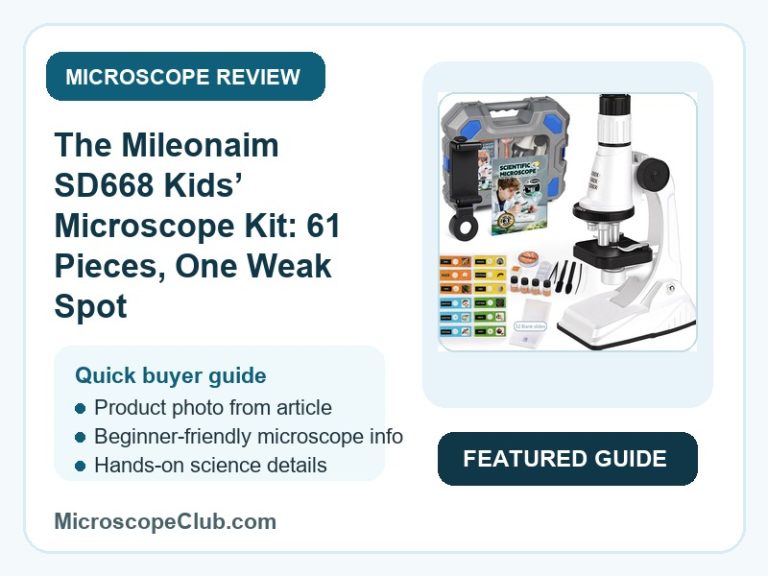
The Mileonaim SD668 review comes down to one tradeoff: this 61-piece, screen-based kids’ microscope kit punches well above its budget-friendly price point on accessories and ease of use, but its plastic build draws real complaints even from buyers who otherwise loved it. Reviewers consistently describe it as an “insane value,” praising the included slides, tools, and carrying case, while the recurring complaint centers on cheap-feeling plastic and difficulty holding focus at the maximum 1200X setting. For a gift-buyer prioritizing engagement over lab-grade durability, it delivers; for anyone expecting a rugged, precision instrument, it will disappoint.

✅ Pros
- Exceptional perceived value — reviewers repeatedly call it an “insane value” against its price point
- Genuine multi-generational appeal, engaging both young kids and adults
- Simple enough for a 6-year-old to operate and focus independently
- 61-piece accessory bundle (12 prepared + 32 blank slides, tools, microSD card) exceeds expectations
- Well-packaged with a sturdy ABS carrying case that survives shipping and storage
❌ Cons
- Flimsy plastic construction flagged by multiple reviewers, including satisfied buyers
- Focus becomes difficult to hold at the maximum 1200X magnification setting
- Listing accuracy gaps — some buyers received a microSD card despite the listing stating none is included
What to Look for in a Kids’ Digital Microscope
Magnification range is the first spec to check, and it should match how the kit will actually be used. The SD668 covers 100X, 400X, and 1200X through its objective lens setup, which spans casual household objects at the low end and cellular-level detail at the top end — though, as with most budget digital scopes, that highest setting is where focus stability gets tested hardest. A wide range looks good on a box, but the more useful question is whether the child can actually hold a clear image at each step, which is worth comparing against other digital microscope options before buying.
Illumination and screen quality matter more for a kids’ kit than they do for a traditional eyepiece microscope, since the whole point of a digital model is sharing what’s on screen. The SD668 pairs LED lighting with a 2.4-inch display and a 45-degree real angle of view, which reviewers single out as “crystal clear” for identifying fine detail like fiber texture or pollen structure. Build material is the third factor: an ABS plastic housing keeps weight and cost down for small hands, but it’s also the single most common tradeoff buyers report across this entire product category.
Finally, accessory depth decides whether a kit becomes a one-afternoon novelty or a repeat-use science tool. Prepared slides give an instant “wow” moment, while blank slides and dissection tools (tweezers, dropper, scalpel, mixing plate) let a child move from observing to preparing their own specimens — a meaningfully different, more educational activity than passive viewing alone.
Who Should Buy a Kids’ Digital Microscope?
Parents and gift-buyers shopping for children roughly ages 6 to 12 are the core audience for this category. These kits work best as a low-stakes entry point into hands-on science — birthday and holiday gifts, homeschool STEM add-ons, or classroom supplements — where the goal is sparking curiosity rather than delivering research-grade optics. Compared with the dedicated microscope brands built for serious hobbyists or lab use, budget digital kits trade precision for accessibility and instant screen-based feedback that keeps a young child engaged.
They’re a weaker fit for buyers who need durability under daily, unsupervised handling — a shared classroom set, for instance, or a child especially rough on toys — since plastic construction is the recurring failure point across this price tier. Adult hobbyists with light, occasional macro-viewing needs (checking bee frames, inspecting small household items) can also get real use out of one, as long as expectations for build quality stay realistic.
Who This Is For
The Mileonaim SD668 earns its spot on a gift list built around a specific occasion — a Christmas stocking, a birthday, a back-to-school STEM add-on, or even a Halloween novelty gift — for a child roughly 6 to 12 who responds better to hands-on discovery than another screen. It also holds up as a light-duty tool for an adult already curious about small-scale detail, the way one reviewer used it to check bee frame cells for eggs, where a clear-enough look matters more than lab-grade precision.

Full Specifications
| Spec | Value |
|---|---|
| Light Source Type | LED |
| Real Angle Of View | 45 Degrees |
| Magnification Maximum | 1200x |
| Objective Lens Description | 100X, 400X, 1200X |
| Enclosure Material | Plastic |
| Color | Black |
| Model Name | SD668 |
| Brand | Mileonaim |
| UPC | 789219257466 |
| Manufacturer Part Number | 001 |
| Warranty Description | 2 Year |
| Built-In Media | Microscope for Kids |
Optical Performance
The Mileonaim SD668 delivers 100X, 400X, and 1200X magnification through its objective lens set, paired with LED illumination and a 45-degree real angle of view on a 2.4-inch screen. One reviewer, a beekeeper, described the screen as “crystal clear” and used the built-in light to check bee frame cells for eggs — a task that requires genuinely legible detail, not just a technically high magnification number on the box. For general fundamentals on how magnification, objective design, and illumination interact in optical instruments, resources like Nikon’s MicroscopyU are a useful reference point, even though the SD668 sits at a very different price and precision tier than the lab equipment those guides typically cover.
The Mileonaim SD668 struggles specifically at its top-end 1200X setting, where at least one reviewer reported the image becoming “hard to focus and when you [do] it’s easily lost.” Amazon’s aggregated review data backs this up: image quality mentions split roughly 4 positive to 2 negative, with every negative mention tied to focus stability rather than resolution or clarity at lower zoom levels. In practice, that means the kit performs best at 100X–400X for general exploration, with 1200X best treated as a bonus rather than the primary selling point.
Build Quality & Portability
The Mileonaim SD668 houses its optics and electronics in a black ABS plastic enclosure, a material choice that keeps the unit light enough for small hands but is also the single most-cited weakness across the review sample. A four-star reviewer summed up the tension directly: “Works well enough but the quality ain’t great since he primarily flimsy plastic.” Amazon’s attribute-level data shows build quality split 4 positive to 2 negative out of 6 mentions — genuinely mixed, not uniformly bad.
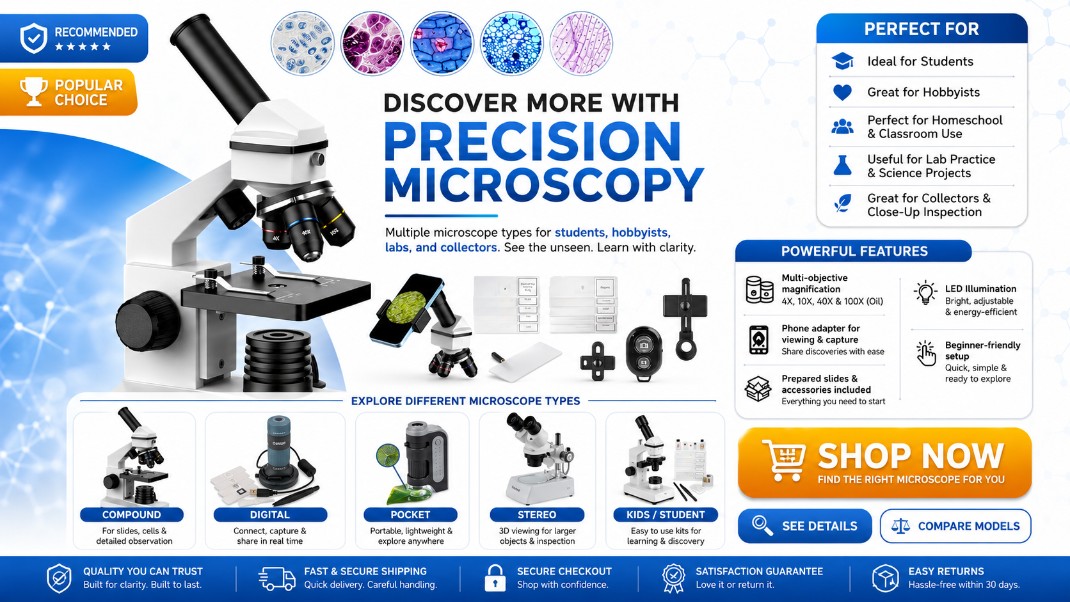
The Mileonaim SD668 offsets some of that plastic-body concern through its compact ABS carrying case, which multiple reviewers praised independent of the microscope body itself. One buyer noted it “arrived ahead of schedule … very well packaged with a well constructed carrier case,” and the case is what makes the full 61-piece kit — slides, tools, and the scope — practical to store and transport to school or a friend’s house without pieces going missing.
Ease of Use & Included Accessories
The Mileonaim SD668 targets young children directly through simple physical controls, with Amazon’s review summary reporting 6 positive mentions against just 1 negative for ease of use. One parent wrote that it’s “easy to use even my 6 year old can use it,” and another reviewer specifically credited the straightforward focus knob and buttons for making the experience approachable without adult supervision at every step.
The Mileonaim SD668 rounds out its 61-piece kit with 12 prepared specimen slides, 32 blank slides, and dissection tools (tweezers, dropper, scalpel, mixing plate), letting a child progress from viewing ready-made samples to preparing their own. Several reviewers called the accessory count a “pleasant surprise,” specifically citing the slide variety — fiber, celery leaf, pollen, insect wings — and an included microSD card for saving photos, a detail some listings omit entirely, creating the accuracy gap noted above.
What Customers Say
The SD668 holds a 4.5 out of 5 average across 143 reviews, and the extracted sample (8 reviews) skews heavily positive: 7 five-star reviews and 1 four-star, with no reviews below four stars in the sample. Sentiment is overwhelmingly favorable — one reviewer called it “amazingly way better than I expected for the price. This is an insane value!” — while a verified buyer offered the most balanced take: “Great for getting a kid into science. Works well enough but the quality ain’t great since he primarily flimsy plastic.” A third reviewer, describing it as a Christmas gift, wrote “Worth. Every. Penny.”
Review integrity risk is rated LOW in our analysis: all 8 sampled reviews carry the Verified Purchase badge, review dates span roughly nine months rather than clustering in a short burst, and genuine self-critical detail (flimsy plastic, focus loss at max zoom) appears even inside five-star reviews — a pattern consistent with organic feedback rather than manipulated review sets. Buyers wanting to understand how platforms flag manipulated reviews in general can reference the FTC’s rule on fake and deceptive reviews for context on what red flags to watch for elsewhere.
Final Verdict
BUY — for its intended audience. The Mileonaim SD668 earns its “insane value” reputation by bundling a genuinely useful 61-piece accessory set, an easy-to-use screen-based interface, and a durable carrying case into a budget-friendly kids’ microscope kit, and the plastic build and 1200X focus instability are known, well-documented tradeoffs rather than dealbreakers for casual, gift-buying use.
Frequently Asked Questions
What age range is the Mileonaim SD668 designed for?
It’s marketed for children ages 6–12, and reviewer feedback confirms kids as young as 6 can operate the focus controls and buttons independently. Older kids and adults also use it comfortably, with several reviews noting appeal beyond the target age range.
Does the SD668 include a microSD card?
Some listings state no microSD card is included, but multiple verified buyers report receiving one in the box for saving photos and videos. Treat this as a possible bonus rather than a guaranteed inclusion, since listing accuracy on this point is inconsistent.
How many slides come with the kit?
The 61-piece set includes 12 pre-prepared specimen slides (covering samples like fiber, celery leaf, pollen, and insect wings) plus 32 blank plastic slides for children to prepare their own specimens.
Is the 1200X magnification setting usable?
It works, but multiple reviewers report focus becomes difficult to hold at the maximum 1200X setting, with the image easily lost. The 100X and 400X settings are more consistently praised for clarity.
What tools are included for dissection or sample prep?
The kit includes tweezers, a dropper, a scalpel, and a mixing plate, letting children move from simply viewing prepared slides to creating and examining their own specimens.
Is the build quality durable enough for regular use?
It’s mixed. The ABS plastic carrying case is consistently praised as sturdy and well-packaged, but the microscope body itself is flagged by several reviewers, including satisfied ones, as feeling flimsy compared to its accessory count and price.
Can adults get real use out of this kids’ kit?
Yes, within limits. One verified buyer, a beekeeper, uses it to inspect bee frame cells for eggs, calling it a handy substitute for a full-size magnifier — but it’s not a replacement for lab-grade optics for serious or professional work.
Conclusion
The Mileonaim SD668 suits parents, gift-buyers, and homeschool families who want an affordable, screen-based way to get kids excited about science, and the 61-piece accessory count makes it feel like far more than its price tag suggests. It’s not the pick for anyone who needs a rugged, daily-use classroom tool or precise optics at maximum zoom — for those needs, look toward a dedicated optical microscope instead.
Have you used the SD668 or a similar kids’ digital microscope kit with your own family? Share what specimens worked best for you in the comments — and if you’re looking for your first thing to examine together, our guide to what grass looks like under a microscope is a great, easy starting point for young kids.