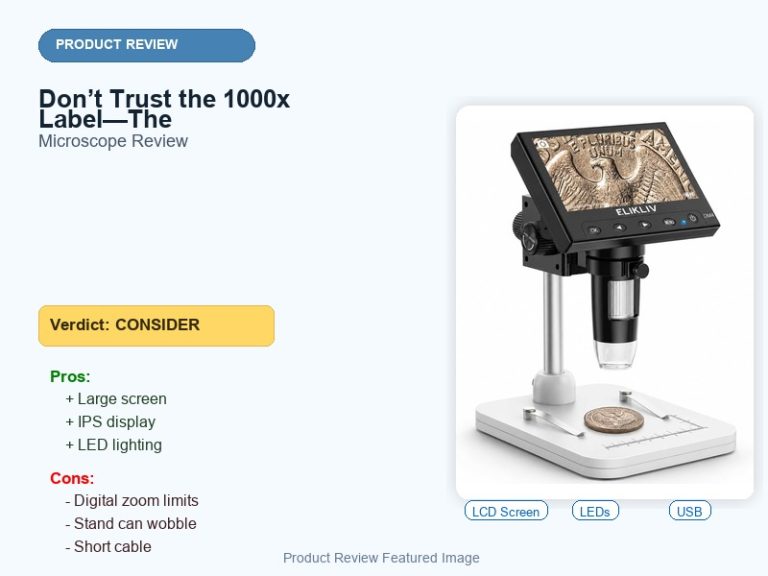
This Elikliv EDM4 review comes down to one trade: a budget digital coin microscope that delivers a bright, easy-to-read 4.3-inch screen, generous LED lighting, and simple point-and-shoot magnification for coins, stamps, and small parts — just don’t expect the advertised 1000x figure to hold up in the real world. Backed by over 10,000 ratings and a 4.5-star average, it currently ranks as the #1 lab handheld digital microscope on Amazon, and for casual hobbyists it largely earns that spot. Buyers chasing lab-grade optical precision or a rock-solid stand should look elsewhere.

✅ Pros
- Bright, crisp 4.3-inch 720P LCD screen with 8 adjustable LED lights for clear viewing even in low light
- Strong value for the price relative to competing digital microscopes in its class
- Easy setup — reviewers describe it as beginner-friendly straight out of the box
- Versatile beyond coins: reviewers use it for jewelry, stamps, electronics inspection, and even hearing-aid wax guard maintenance
- Responsive seller support on defective units, with replacement parts shipped when a battery or charging port fails
❌ Cons
- The “1000x” magnification claim is significantly overstated versus what buyers actually see on screen
- Charger is not always included in the box, despite the microscope being battery-powered
- Lightweight plastic stand is top-heavy and can wobble while adjusting focus or repositioning an object
- Stand height is short enough that a full coin often won’t fit in frame without repositioning
What to Look for in a Digital Coin Microscope
Digital coin microscopes live or die on four things: real-world magnification, illumination, focusing/stand mechanics, and screen quality. The “magnification” number printed on the box is almost always a theoretical maximum tied to digital zoom and the distance between the camera and the object, not a fixed optical multiplier the way a traditional compound microscope works — which is exactly the gap that trips up buyers of the EDM4. A more reliable way to judge a listing is to check the real angle of view and objective lens coating, both of which affect how sharp and distortion-free the image actually looks once you’re past the marketing number.
Illumination matters just as much as magnification for coin work, since raking light at the wrong angle can wash out the fine detail collectors actually care about — mint marks, die cracks, and surface wear. Adjustable LED arrays, like the EDM4’s 8-light ring, let you control shadow and glare on reflective surfaces such as silver or gold coins. Finally, check the stand: a wobbly or overly short base undermines even good optics, since any camera shake blurs the image at high zoom. If you’re comparing options before you buy, our roundup of popular microscope brands is a useful starting point for understanding how budget digital models stack up against traditional optical brands.
Who Should Buy a Digital Coin Microscope?
Coin, stamp, and small-collectible hobbyists are the core audience for this category — anyone who currently squints through a handheld magnifying glass to check mint marks, die varieties, or surface condition will get an immediate upgrade from a large, well-lit digital screen. Casual collectors evaluating a mixed lot of inherited or purchased coins particularly benefit, since a digital microscope lets you photograph and archive condition notes instead of relying on memory.
Beyond collectors, digital coin microscopes double as an accessible entry point for kids’ STEM education and general-purpose close-up inspection — small electronics, skin, textiles, or jewelry. If you’re shopping specifically for a young or first-time user rather than a serious numismatist, our guide to the best microscopes for kids covers models built around durability and simplicity rather than raw magnification.
Who This Is For
The Elikliv EDM4 suits casual coin, stamp, and jewelry collectors who want an affordable, easy-to-use digital magnifier for everyday inspection rather than lab-grade numismatic precision. It’s also a sensible low-cost STEM gift for kids and a genuinely useful tool for off-label tasks reviewers report — cleaning hearing-aid wax guards, inspecting small electronics, and checking skin or nail detail — where a large, bright screen matters more than a headline magnification spec.
Full Specifications
| Spec | Value |
|---|---|
| Light Source Type | LED |
| Real Angle Of View | 16 Degrees |
| Magnification Maximum | 1000x |
| Voltage | 3.7 Volts |
| Compatible Devices | Laptop, Personal Computer |
| Objective Lens Description | Multi-coated |
| Power Source | Battery Powered |
| Item Dimensions L x W x H | 8.58″L x 6.97″W x 3.35″H |
| Item Weight | 1.1 Pounds |
| Enclosure Material | Metal, Plastic |
| Color | White |
| Model Name | EDM4 |
| Brand | Elikliv |
| UPC | 889251639647 |
| Manufacturer Part Number | 43 |
| Unit Count | 1.0 Count |
| Item Type Name | Coin Microscope |
| Warranty Description | 1 Year Manufacturer |
| Built-In Media | Adjustable Bracket x 1, Elikliv EDM4 Digital LCD Microscope x 1, English User Manual x 1, Plastic Base x 1, USB Cable x 1 |
Optical Performance & Magnification
The Elikliv EDM4 forms its image through a multi-coated objective lens paired with a 16-degree real angle of view, projecting the result onto a 4.3-inch 720P LCD screen rather than a traditional eyepiece — a setup that trades true optical resolution for a larger, easier-to-share viewing surface. SgtHawker’s review captured the practical upshot well: after using only a magnifying glass previously, they described going “from using a magnifying glass and barely making out the dates, to being able to see the pitting on old coins.”

The Elikliv EDM4 reaches its stated magnification through digital zoom tied to the distance between the lens and the object, not a fixed optical multiplier — which is why the “1000x” figure on the box rarely matches what reviewers report seeing. One buyer was blunt about it: “This item is NOT 1000x magnification… not even close.” For collectors who rely on magnification to grade condition, resources like PCGS’s coin grading guides are a useful reminder that consistent, well-lit detail matters far more than a headline multiplier number.
Build Quality & Stability
The Elikliv EDM4 houses its electronics in a metal-and-plastic enclosure weighing 1.1 pounds, built around a height-adjustable bracket that lets users set the camera-to-object distance to suit different magnification needs. On paper this gives the setup real flexibility for framing coins, stamps, or small parts at varying working distances.
The Elikliv EDM4 loses some of that flexibility through its lightweight plastic base, which multiple reviewers describe as top-heavy relative to the camera head — one buyer noted that “even small actions, like adjusting the zoom, pressing buttons, or repositioning a coin, can cause it to shake.” The same reviewer flagged a second build limitation: the stand sits low enough that a full coin, even a small one like a dime, often won’t fit in frame without repositioning — Elikliv’s own manual reportedly suggests raising the base on a stack of books as a workaround.
Ease of Use & Accessories
The Elikliv EDM4 simplifies setup through a built-in rechargeable battery rated for roughly three hours of continuous use, letting first-time buyers start viewing within minutes of unboxing. Marshell Wooley, a self-described beginner, summed up the onboarding experience: “I was a beginner, and this was very easy to use… It is easy to set up and easy to use. It comes with instructions.”
The Elikliv EDM4 extends its usefulness through a USB connection to Windows and MacBook computers, letting users mirror the display on a larger monitor, save images and videos for later reference, and share a live feed with multiple viewers at once. Photo and video capture is supported on-device as well, though a separate memory card is required and isn’t included in the box — something to add to the order if you plan to archive coin photos rather than just view them live.
What Customers Say
With 10,444 ratings averaging 4.5 out of 5 stars, the Elikliv EDM4 sits well ahead of most budget digital microscopes in its category. Amazon’s aggregated review-attribute data skews clearly positive — categories like functionality, quality, and value for money each show roughly 80–90% positive mentions — while battery life and magnification draw the most consistent criticism, with negative mentions concentrated specifically on those two attributes rather than spread evenly across the listing.
One verified buyer, describing a month of regular use, wrote: “It provides very clear information on items with very small writing. It is a little tricky on items that are super shiny, but I can still make out the marks by adjusting the lighting.” Another reviewer repurposed the tool entirely, noting “this microscope is intended for coin collectors, but hearing aid maintenance is likely a far better use for it.” A third was more critical, calling out the magnification claim directly: “This item is NOT 1000x magnification… not even close.” Shoppers who want to sanity-check review authenticity and seller track record before buying can also cross-reference listings against resources like the Better Business Bureau.
Final Verdict
CONSIDER: the Elikliv EDM4 earns its Best Seller ranking for a reason — at its price point it delivers a genuinely clear, easy-to-use digital viewing experience for coins, stamps, and small-parts inspection. It’s worth buying if you go in treating “1000x” as marketing language rather than a spec you’ll actually see, and are willing to work around a stand that needs a steadier surface for larger objects or close-up precision work.
Frequently Asked Questions
Does the Elikliv EDM4 actually magnify 1000x?
Not in practice. The “1000x” figure is a theoretical maximum, and actual magnification depends heavily on the distance between the camera and the object. Multiple reviewers report usable magnification well below the marketed number and describe the claim as misleading.
Does the Elikliv EDM4 come with a charger?
Not always. Several buyers report their unit arrived without a charger, and the included manual reportedly states this is intentional. Confirm current box contents on the listing before ordering if you don’t already have a compatible USB charger on hand.
How long does the battery last?
Elikliv rates the built-in rechargeable battery for up to three hours of continuous use. Reviewer experience is mixed — some report long-lasting charges, while others say the battery drains faster than expected.
Can I connect the Elikliv EDM4 to a computer?
Yes. It connects via USB to both Windows PCs and MacBooks, letting you view the image on a larger monitor, save photos and videos, and share the live feed with multiple viewers at once.
Do I need a memory card to save photos and videos?
Yes. The EDM4 supports on-device photo and video capture, but a memory card is required for storage and is not included in the box.
Is the Elikliv EDM4 good for kids?
It’s a reasonable STEM gift for kids thanks to its simple controls, large screen, and low price. That said, the wobbly stand and modest real-world magnification make it better suited to casual exploration than serious classroom microscopy work.
Is the stand sturdy enough for close-up work like electronics soldering?
Not particularly. The plastic base is light relative to the camera head, and several reviewers note it wobbles when you adjust focus or reposition an object — a real limitation for precision work like PCB inspection or rework.
Conclusion
The Elikliv EDM4 is a good match for coin, stamp, and small-collectible hobbyists who want an easy, affordable way to inspect detail on a bright screen rather than through a traditional eyepiece — its clear picture quality, simple setup, and genuine off-label versatility (several buyers use it for hearing-aid maintenance and electronics inspection instead of the coins it’s marketed for) explain its Best Seller ranking. It’s a weaker fit for anyone expecting genuine 1000x optical precision or a stand steady enough for fine mechanical work.
Have you used the Elikliv EDM4 or a similar digital coin microscope? Share what magnification you actually got in the comments below — and if you’re prepping specimens rather than coins, our guide to how to prepare microscope slides covers the basics for getting a clean, focused view every time.
Originally posted 2026-07-10 08:00:00.