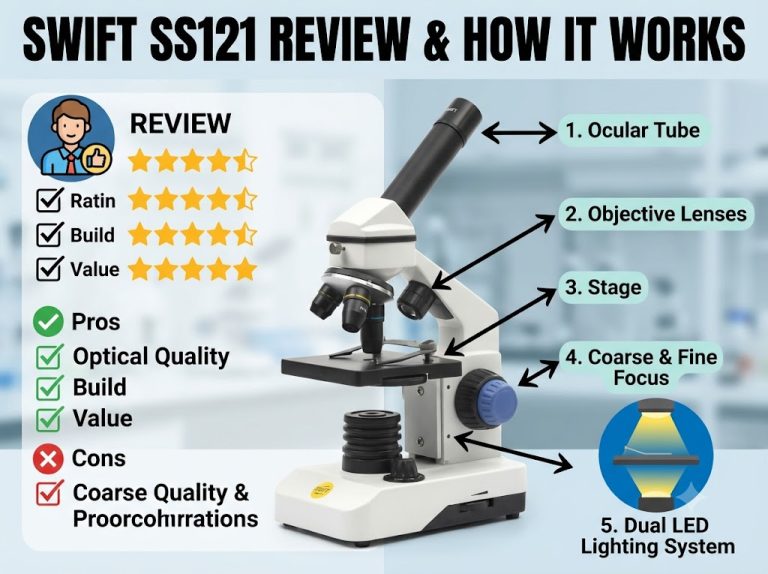
The SWIFT SS121 is an 80X–2000X compound monocular microscope that delivers solid optical performance and a complete accessory kit for students and first-time buyers at $109.99 — though recurring quality-control misses and a fragile carrying case mean you should inspect the unit on arrival before gifting or deploying it in a classroom.

✅ Pros
- Kids and first-time users respond well to it — one grandparent bought two because a grandson “loved them so much he wanted to keep both”
- Priced fairly for the feature set — “priced well, and is of decent quality” for a middle-schooler learning the basics
- Core optics perform as expected — achromatic objectives deliver sharp cellular detail for classroom biology
- Complete kit out of the box — prepared slides, phone adapter, and a metal-frame carrying case included
- 95-year SWIFT brand reputation gives first-time buyers confidence over generic no-name listings
❌ Cons
- Carrying case plastic is dried out on some units and the latches break after only a few open/close cycles
- Phone adapter doesn’t reliably work with iPhone or USB-C devices without an extra adapter cable
- Included lens-cleaning papers can scratch the lenses; a lint-free cloth works better
- Quality-control risk — at least one buyer received a unit with a broken head component
- Some kits ship incomplete or with musty-smelling components, including a report of a missing eyepiece
What to Look for in a Student Compound Microscope
Magnification range is the first spec to check — a 40X–400X range covers most biology coursework, while 80X–2000X like the SS121 adds headroom for cellular detail without the fragility of oil-immersion lenses. More magnification is not always better: high-power objectives narrow the field of view and require precisely prepared slides, which beginners often find frustrating. Match the top magnification to the actual curriculum rather than chasing the highest number on the box.
Illumination type matters more than it appears on a spec sheet. LED illumination — both top and bottom — is the standard for modern student scopes and handles transparent slide specimens (bottom LED) and opaque samples (top LED). A coarse and fine focus system with sub-millimetre precision is equally important: students who can’t dial in a sharp image quickly lose interest. Finally, look at what ships in the box — preparing microscope slides requires tools most beginners don’t own, so a kit with prepared slides and a phone adapter has real practical value for day-one use.
Who Should Buy a Compound Microscope?
Compound microscopes are the right tool for anyone studying biology at the cellular level — observing prepared slides of plant cells, bacteria, or blood under 100X–400X magnification. They suit middle and high school students following a science curriculum, homeschool families running structured STEM programs, and hobbyist adults who want to explore the microscopic world beyond what a phone camera can show. If you’re looking at options across price tiers, understanding the major microscope brands helps you separate long-standing manufacturers from generic rebrands.
Compound microscopes are not the right choice for viewing coins, insects, or circuit boards — those applications call for a stereo or digital microscope with a much wider field of view. For younger children who aren’t ready for slide preparation, a simpler kit may be more appropriate; our guide to the best microscopes for kids covers age-appropriate options at lower price points.
Who This Is For
The SS121 fits parents and educators equipping a middle-school-to-high-school-age learner with a first compound microscope for home or classroom biology — SWIFT’s brand history and the complete slide and phone-adapter kit matter more here than lab-grade precision. It also works for hobbyist adults moving up from toy-grade microscopes for casual specimen viewing, as long as seamless iPhone photomicrography isn’t a hard requirement.
Full Specifications
| Spec | Value |
|---|---|
| Light Source Type | LED |
| Real Angle Of View | 45 Degrees |
| Magnification Maximum | 2000x |
| Compatible Devices | Smartphone |
| Objective Lens Description | Achromatic |
| Power Source | Battery Powered |
| Item Weight | 3.27 Kilograms |
| Enclosure Material | Metal |
| Color | Black, Silver, White |
| Model Name | SS121-25-PPA |
| Brand | SWIFT |
Optical Performance and Magnification
The SWIFT SS121 covers an 80X–2000X magnification range through WF10X and WF25X eyepieces paired with 4X, 10X, and 40X achromatic objectives — a spread wide enough to move from low-power specimen scanning up to fine cellular detail without oil-immersion complexity. The SWIFT SS121 uses achromatic objective lenses to correct chromatic aberration at each magnification step, which keeps color fringing minimal at the 400X range where most biology coursework lives. According to Nikon’s MicroscopyU, achromatic objectives are the standard choice for educational brightfield work precisely because they balance correction quality with cost.
The SWIFT SS121 delivers dual LED illumination through separate top and bottom light sources with adjustable brightness, handling both transparent slide-mounted specimens and opaque samples in a single unit. Reviewers back up the core optics: one verified buyer summed it up as “the microscope works fine,” and another confirmed it “is priced well, and is of decent quality” while noting it “isn’t something that would be found in a laboratory” — the honest positioning for this tier.
Build Quality and Portability
The SWIFT SS121 weighs 3.27kg and uses a metal frame enclosure, which gives it a stable, non-toy feel on a desk or lab bench — significantly more rigid than plastic-bodied scopes at a similar price. The SWIFT SS121’s body construction holds up to normal student use, but the included carrying case is the weak point: one verified buyer reported the plastic “is dried out” and that “the latches will break after being opened and closed only a few times,” a direct failure of the “portable design” claim in the listing.
The SWIFT SS121 shows inconsistent quality control in a meaningful subset of reviews. One buyer received a unit with a broken head component; another reported a kit missing an eyepiece, with components that “smelled like a thrift store.” These aren’t universal — most reviews report no defects — but the frequency is high enough that inspecting the unit on arrival before gifting or classroom deployment is a sensible precaution.
Ease of Use and Included Accessories
The SWIFT SS121 uses coarse and fine focus knobs rated to 0.1mm precision, making it straightforward for a beginner to dial in a sharp image — the dual-knob system is the same approach used on lab-grade instruments and is far easier to learn than single-knob alternatives. The SWIFT SS121 ships with prepared slides, a phone adapter, and cleaning tools, so a first-time buyer can start observing specimens without sourcing accessories separately, a genuine advantage for homeschool and classroom use.
Two accessory limitations are worth flagging. The SWIFT SS121’s phone adapter does not reliably connect to iPhone or USB-C devices — one reviewer had to purchase a separate USB-to-USB-C converter and still could not get it working with a second phone type, so anyone planning photomicrography should verify compatibility before purchase. The SWIFT SS121 also ships with lens-cleaning papers that scratched at least one reviewer’s lenses; switching to a lint-free cloth is the safer default from day one.
What Customers Say
The SS121 holds a 4.0 out of 5 average across 51 reviews on Amazon. Of the sampled reviews, sentiment ran approximately 37.5% clearly positive, 50% mixed (praising the core optics while flagging a specific defect), and 12.5% negative. Review integrity risk is LOW — every sampled review cites a specific, concrete detail rather than generic praise, and all carry a Verified Purchase badge.
A verified buyer who gifted two units said her grandson “loved them so much he wanted to keep both!! One for home and one for school.” Another verified buyer summarised the trade-off directly: “Microscope is good, but the case which I received is bad quality. The plastic is dried out.” A third was blunt after a one-star experience: “The product came with head broken.”
Final Verdict
CONSIDER the SWIFT SS121 if you’re buying for a student, homeschool setup, or hobbyist adult who wants a real compound microscope with a complete accessory kit at a fair price — the core optics, focus system, and 95-year brand backing are genuine. Hold off, or budget time for a possible exchange, if you need zero quality-control risk, a durable carry case, or reliable iPhone photomicrography out of the box.
Frequently Asked Questions
What magnification do I need for a student compound microscope?
For most middle and high school biology coursework, 40X–400X covers the full range of standard slide work — cell structure, plant tissue, and bacteria at 400X are the most common applications. The SWIFT SS121’s 80X–2000X range gives additional headroom, but the 2000X setting requires perfectly prepared slides and is rarely used in classroom settings. Start at the lowest magnification and work up to find your specimen before increasing power.
Does the SWIFT SS121 work with iPhone?
Not reliably out of the box. The included phone adapter is not confirmed to work with iPhone Lightning or USB-C connections — at least one verified reviewer purchased a separate USB-to-USB-C converter and still could not achieve a stable connection with a second device type. If iPhone photomicrography is a primary use case, verify adapter compatibility before purchasing or budget for a third-party universal phone mount.
Is the SWIFT SS121 suitable for homeschooling?
Yes — the complete kit (prepared slides, phone adapter, cleaning tools, and carrying case) means a homeschool student can begin observing specimens on day one without additional purchases. The 80X–2000X range covers most K–12 biology curriculum requirements, and SWIFT’s 95-year manufacturing history provides confidence that the optics will perform as expected for basic biological observation.
What slides are included with the SWIFT SS121?
The SS121 kit includes a set of prepared slides covering common biology specimens — exact slide types vary by kit configuration, but standard inclusions for this model are plant and animal tissue slides suitable for introductory biology work. The kit also includes blank slides and coverslips for self-prepared specimens, along with a dropper and dissecting tools.
How do I clean microscope lenses without scratching them?
Use only a lint-free microfibre cloth or dedicated optical lens tissue — never the paper cleaning sheets that ship with many microscope kits, including the SS121, as at least one verified reviewer reported these scratched their lenses. For stubborn residue, apply a single drop of lens cleaning solution to the cloth rather than directly to the glass. Always wipe in a single circular motion from the centre outward and never apply pressure.
Is SWIFT a reliable microscope brand?
SWIFT Optical has been manufacturing microscopes for over 95 years and is a recognised name in educational and mid-range scientific optics. Their instruments are distributed through school supply channels and are considered a step above generic rebrands at a similar price point. That said, the SS121’s Amazon reviews show a quality-control variance rate higher than you would expect from a premium brand, so inspecting the unit on arrival remains advisable regardless of brand reputation.
What is the difference between a compound and a stereo microscope?
A compound microscope like the SS121 uses transmitted light through thin, transparent slides to magnify specimens at 40X–2000X — it is the right tool for biology: cells, bacteria, and prepared tissue sections. A stereo microscope uses reflected light and magnifies at 7X–45X, making it the right tool for viewing whole objects like insects, coins, circuit boards, or plant structures in three dimensions without slide preparation. They are not interchangeable — buy based on what you intend to observe.
Conclusion
The SWIFT SS121 is a reasonable first compound microscope for students, homeschool programs, and curious adults who want genuine optical performance without a lab-grade price tag. The achromatic optics, dual-LED illumination, and complete accessory kit deliver real value at $109.99 — but the quality-control variance and fragile carrying case mean it is a CONSIDER rather than a clean BUY. Inspect the unit on arrival, swap the included cleaning papers for a lint-free cloth, and confirm your phone adapter compatibility before wrapping it as a gift.
If you’re just getting started with slides, our step-by-step guide on how to prepare microscope slides will help you get the most out of the included blank slides from day one. Have you used the SWIFT SS121 in a classroom or at home? Share your experience in the comments below — we read every reply.
Originally posted 2026-07-03 09:00:00.