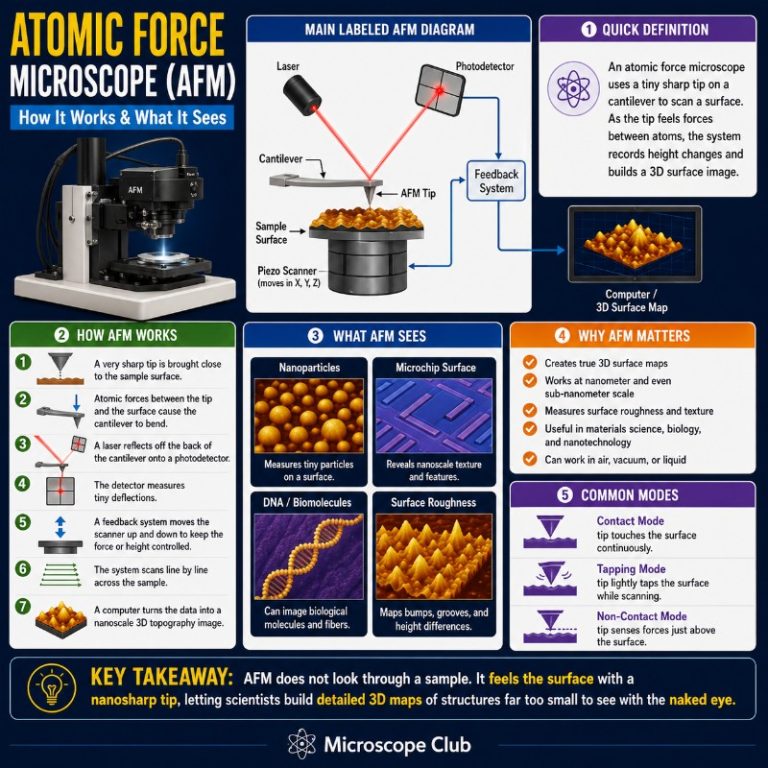
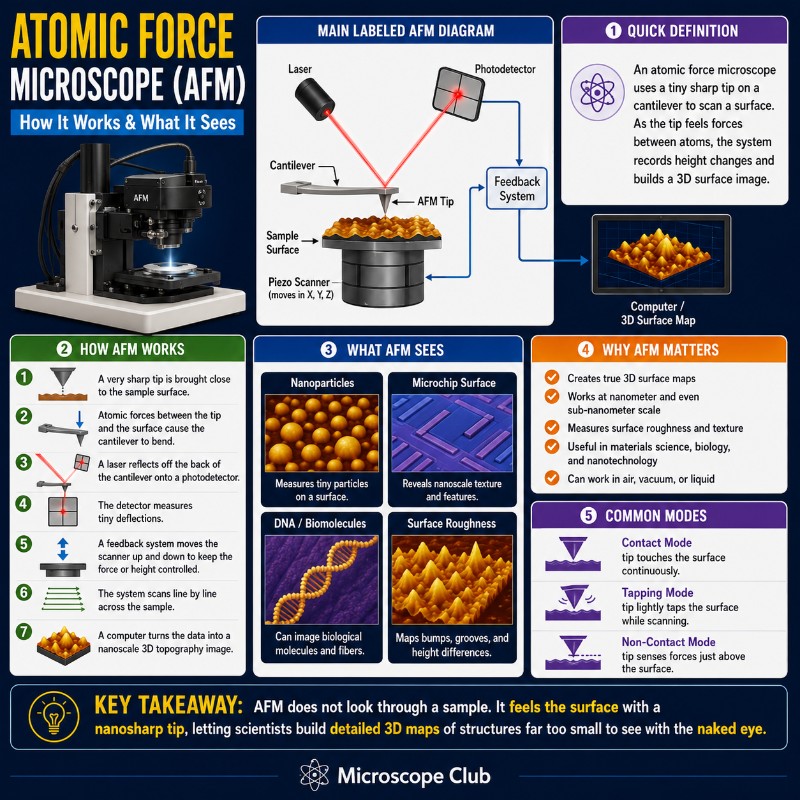
An atomic force microscope (AFM) is a scanning probe instrument that maps surfaces in three dimensions. It does this by dragging — or tapping — an ultra-sharp nanoscale tip across the sample and measuring the tiny forces between the tip and the material beneath. Unlike optical or electron microscopes, it uses no lenses and no electron beam; resolution comes entirely from the sharpness of the probe and the precision of the motion control. The result is sub-nanometer lateral resolution and vertical resolution finer than the diameter of a single atom, on samples ranging from bare silicon wafers to living cells sitting in a dish of water.
The Step-by-Step AFM Imaging Process
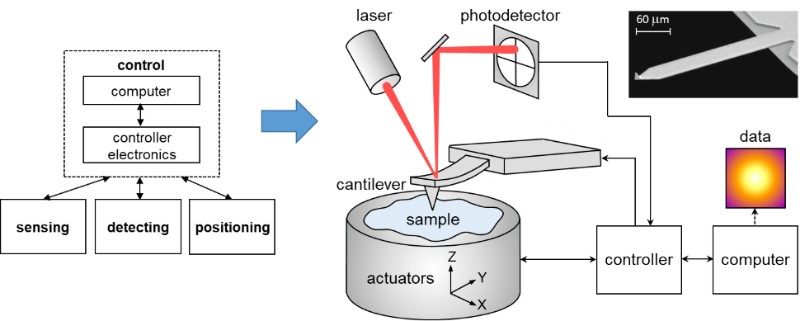
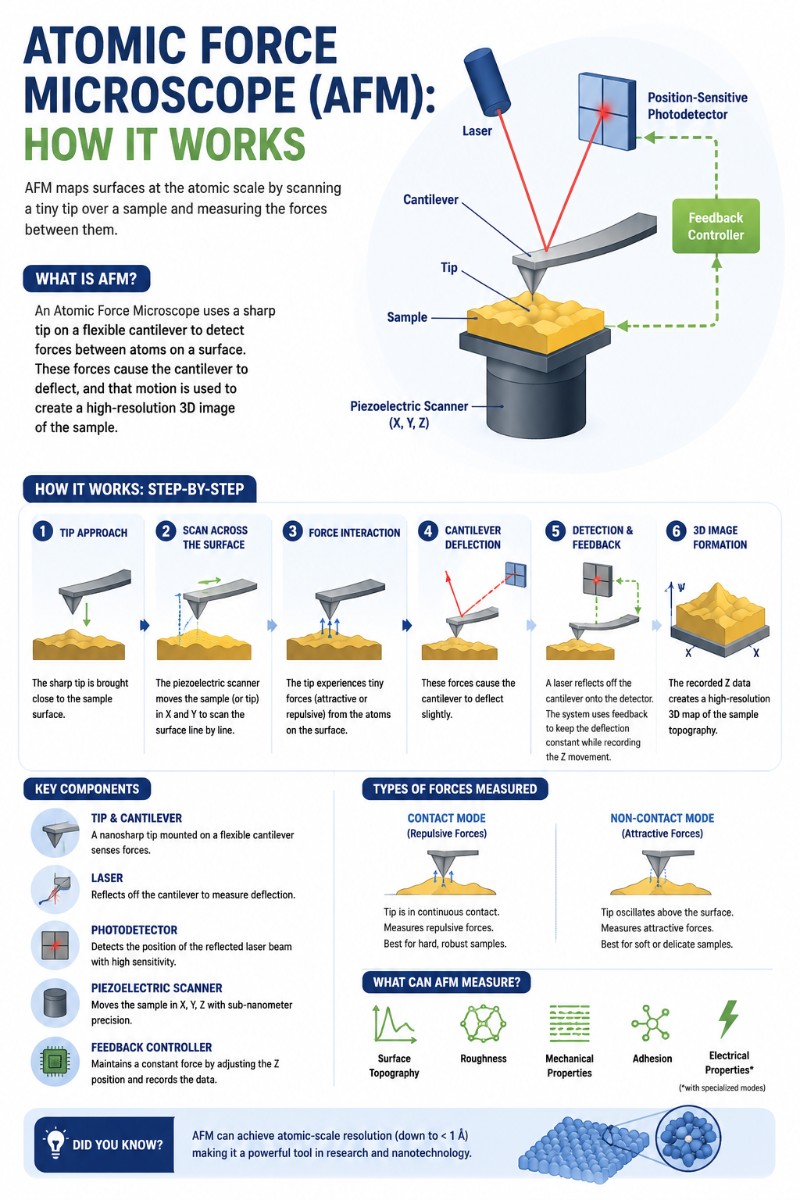
The working principle is elegantly simple: a sharp tip at the end of a flexible arm bends as it feels a surface, a laser detects that bending, and a computer keeps the bending constant by adjusting height thousands of times per second. That height record becomes the image. Here is the process step by step:
- The tip approaches the surface. A probe with an apex radius of roughly 1–10 nm (silicon or silicon nitride) is brought within nanometers of the sample. This “approach” is the most stressful moment in AFM operation — come in too fast and you snap the tip instantly.
- Forces deflect the cantilever. Attractive or repulsive forces between the tip atoms and surface atoms bend the flexible cantilever beam up or down by a tiny amount.
- A laser reads the deflection. A laser beam aimed at the reflective back of the cantilever bounces onto a split photodiode detector. A cantilever deflection of just a fraction of a nanometer shifts the laser spot enough to register a measurable signal — the “optical lever” effect amplifies tiny motion into a readable electrical signal.
- The feedback loop corrects in real time. Electronics compare the measured signal to a target setpoint (a chosen force or oscillation level) and send a correction signal to a piezoelectric actuator.
- The piezo adjusts the Z position. The piezoelectric scanner moves the sample (or tip) up or down with sub-nanometer precision to restore the setpoint.
- The tip rasters across the surface. The piezo also drives motion in X and Y, scanning the tip back and forth in a grid pattern (like mowing a lawn).
- Z-corrections build the image. The continuous record of Z adjustments is the topographic map. Color-code the height data — brighter for taller, darker for lower — and you have the false-color AFM image.
The Key Parts: Tip, Cantilever, Laser, Photodiode, Piezo Scanner
Every AFM shares the same five-component core:
- Probe (tip + cantilever): The tip is microfabricated from silicon (Si) or silicon nitride (Si₃N₄) and shaped to a point just a few nanometers wide. The cantilever is a tiny beam — typically 100–500 µm long — whose spring constant is chosen to match the measurement mode. Stiff cantilevers suit hard materials; soft, low-spring-constant cantilevers are used for fragile biological samples.
- Laser: A low-power diode laser (often red or infrared) focuses on the back of the cantilever, which is polished or gold-coated to be reflective.
- Split photodiode (position-sensitive detector): Four quadrants of a photodetector track where the reflected beam lands. Vertical deflection (bending) and lateral twist are read simultaneously.
- Piezoelectric scanner: Piezo crystals expand or contract in direct proportion to an applied voltage — precisely, repeatably, and at the sub-angstrom level. This is what gives AFM its extraordinary Z precision.
- Feedback electronics and computer: A PID (proportional-integral-derivative) feedback controller keeps the cantilever signal at its setpoint and records Z position as the image data. Modern AFM software renders this as a height map in near real-time.
The Forces It Feels: Van der Waals, Repulsive, and Capillary
AFM does not image atoms directly — it senses the forces those atoms exert on the tip. Three forces dominate:
- Van der Waals forces: Weak, short-range attractive forces between all matter, arising from fluctuating electric dipoles. They dominate when the tip is a few nanometers above the surface (the attractive regime used in non-contact mode).
- Short-range repulsive forces (Pauli repulsion): When electron clouds of tip and sample atoms begin to overlap, a steep repulsive force kicks in — this is the “contact” regime. Contact mode rides this repulsion.
- Capillary forces: In ambient air, surfaces are coated by a thin (~1–2 nm) water layer. When the tip gets close enough, a tiny liquid bridge forms and creates significant adhesion — a real source of noise and imaging artifacts. This is one reason many biologists image in liquid rather than air.
A force-distance curve — a plot of tip-sample force versus separation — captures this behavior: gentle attraction on approach, then a sharp repulsive wall at contact, then adhesion on retraction. Researchers use these curves to measure the mechanical stiffness of cells or the binding energy of single molecules.
AFM Operating Modes: Contact, Tapping & Non-Contact
The three main operating modes differ in how close the tip gets to the surface and what the feedback loop holds constant. Each has a different force regime, use case, and set of trade-offs.

| Mode | What the tip does | Feedback holds constant | Best for | Main drawbacks |
|---|---|---|---|---|
| Contact | Drags in continuous contact; repulsive regime | Cantilever deflection (force) | Hard, flat samples; fast scanning; friction/lateral force imaging | Can damage soft samples; tip wears faster; lateral forces can smear features |
| Tapping (intermittent contact) | Oscillates near cantilever resonance; lightly taps surface each cycle | Oscillation amplitude | Soft/biological samples in air; general-purpose imaging; most common mode | Slightly slower than contact; requires tuning oscillation frequency |
| Non-contact | Oscillates above the surface; attractive regime only; no contact | Frequency shift or amplitude | Ultra-high vacuum; atomically clean/hard surfaces; true atomic resolution research | Lower resolution in ambient air (water layer interferes); rarely used outside UHV |
A common confusion: tapping mode is sometimes incorrectly called “non-contact.” It is not. Tapping mode does make brief contact each oscillation cycle — that is what distinguishes it from true non-contact mode. When someone says “we imaged DNA in non-contact mode,” they almost certainly mean tapping mode.
For most practical work — imaging cells, polymers, thin films, or nanoparticles — tapping mode in air or liquid is the default. It is gentle enough not to damage soft samples and resolves features well without the complications of ultra-high vacuum.
Resolution and What an AFM Can See
AFM resolution figures routinely referenced in the literature are:

- Lateral (X/Y) resolution: approximately 0.1–1 nm, limited mainly by tip apex radius. A duller tip means poorer lateral resolution. Under optimal conditions (sharp tip, rigid sample, low noise), some instruments resolve individual atomic lattice spacings on crystalline surfaces.
- Vertical (Z) resolution: 0.01–0.1 nm — sub-angstrom under good conditions. A single hydrogen atom is roughly 0.1 nm in diameter; the AFM’s Z precision is comparable to or finer than that.
The unusual fact worth noting: AFM’s vertical resolution is better than its lateral resolution. This is the reverse of most microscopes, where resolving fine lateral detail is the core challenge. For AFM, the Z measurement is exquisitely precise because it relies on the piezo actuator’s position control, while lateral resolution is fundamentally limited by the physical size of the tip. This matters practically: you can measure the exact height of a DNA strand (about 2 nm) with extraordinary confidence, even if the apparent width looks slightly broader than reality due to tip shape. For more on how resolution works across microscope types, see how microscope resolution works and our comparison of magnification vs resolution in microscopy.
AFM also measures something most microscopies cannot: quantitative 3D topography. The output is not a projected 2D image (like a photo or an SEM micrograph) — it is a genuine height map where every pixel has a real Z value in nanometers. You can take cross-sections, measure step heights on thin films, or calculate surface roughness (Ra, RMS) directly from the data.
Perhaps the most important capability distinction: AFM images any material — conductive or not, coated or bare, alive or fixed — in air, liquid, or vacuum. No conductive coating is needed (unlike SEM/TEM). No staining is needed (unlike most optical biology). No vacuum chamber is needed. This opens the door to imaging samples that other high-resolution techniques simply cannot handle. For context on highest-resolution microscopes, AFM sits in the top tier for surface topography in ambient conditions.
What the Image Actually Looks Like
If you sit down at an AFM for the first time, the screen looks nothing like a photograph. The image builds line by line, top to bottom, like an old fax machine — you watch it paint in slowly as the tip scans across the sample. Height is usually displayed as a false-color map: a warm “fire” gradient (dark brown → orange → yellow → white) where bright areas are tall and dark areas are low.
DNA imaged in tapping mode on mica looks like faint pale threads — roughly 2 nm tall — snaking across a flat dark background. Cells look like smooth rolling hills. A polymer blend surface looks like a topographic landscape, with islands of one phase rising slightly above the matrix. The flatness of the mica substrate around the features confirms you have real topography, not noise.
What Is an AFM Used For?
AFM’s combination of nanoscale resolution, 3D quantification, and sample flexibility makes it indispensable across several fields:
Materials Science and Nanotechnology
AFM is the standard tool for characterizing surface roughness of thin films, measuring step heights at layer interfaces, inspecting polymer morphology, and mapping nanoscale defects. In nanotechnology research it also serves as a nano-manipulation tool — the tip can push nanoparticles into position or scratch patterns at the sub-100 nm scale, a technique called dip-pen nanolithography. The National Institute of Standards and Technology (NIST) uses AFM extensively for metrology and calibration standards.
Biology: Live Cells, DNA, and Proteins
This is where AFM’s no-vacuum, no-coating advantage becomes decisive. Researchers image living cells in physiological buffer, watching the cell membrane deform in real time. DNA is imaged deposited on freshly cleaved mica — the atomically flat surface provides a near-perfect contrast. Protein assemblies, viruses, and membranes are all routinely characterized.
Beyond imaging, single-molecule force spectroscopy uses the AFM tip to physically pull on a molecule — unfolding a protein or detaching a receptor-ligand pair — while recording the force-extension curve. This gives direct measurements of molecular binding energies and mechanical properties that no other technique can access at the single-molecule level. Research groups at institutions like the NIH have published extensively on AFM force spectroscopy of biological macromolecules.
Semiconductor Metrology
Chip fabrication requires monitoring feature dimensions and surface flatness at the nanometer level. AFM is used in semiconductor fabs for wafer surface roughness measurement, thin film step height verification, and defect inspection — tasks where its quantitative Z data is essential. Unlike SEM, it does not require a conductive sample or a vacuum environment, so it fits into process control workflows more easily.
Polymers and Soft Matter
Phase separation in polymer blends, domain structures in block copolymers, crystallinity mapping in semicrystalline plastics — AFM phase imaging (a variant of tapping mode that maps energy dissipation rather than height) makes these visible. The mechanical contrast between hard and soft polymer phases produces dramatic phase images that are impossible to obtain by any other means without chemical staining.
AFM vs SEM vs TEM vs STM
These are the four instruments that researchers reach for when they need nanoscale information. They are not interchangeable — each measures something different, under different conditions. For a deeper look at electron-based instruments, see our light microscope vs electron microscope guide and the broader breakdown of advantages of electron microscopes.
| Feature | AFM | SEM | TEM | STM |
|---|---|---|---|---|
| What it measures | Force → 3D topography + mechanical/electrical properties | Secondary/backscattered electrons → surface morphology | Transmitted electrons → internal structure | Tunneling current → surface electron density |
| Lateral resolution | ~0.1–1 nm | ~1–10 nm (field emission) | Sub-angstrom (atomic columns) | ~0.01 nm (atoms visible) |
| Vertical / Z data | Yes — quantitative height in nm | No true Z; only 2D projection | No (2D projection through sample) | Yes — Z feedback gives topography |
| Conductive sample required? | No | Usually (coat if not) | No (but must be ultrathin) | Yes — strictly |
| Vacuum required? | No — air, liquid, or vacuum | Yes (low vacuum or high vacuum) | Yes — high vacuum | Usually yes; best in UHV |
| Live/wet samples? | Yes | No (cryo-SEM possible but complex) | No | No |
| Scan area | Small (~100 µm max) | Large (cm scale at low mag) | Very small (µm field) | Very small (µm field) |
| Typical cost | $50k–$500k+ | $100k–$1M+ | $500k–$3M+ | $100k–$500k+ |
When to use which: Reach for AFM when you need quantitative nanoscale height, when your sample is non-conductive or biological, or when you want to image in liquid. Use SEM when you need rapid large-area surface imaging. Use TEM when you need atomic-scale internal structure of a thin section. Use STM when you need true atomic resolution of a conductive crystal surface in ultra-high vacuum. For the full context, see our overview of types of microscopes.
Limitations of AFM
No instrument does everything, and AFM’s limitations are real and worth understanding before you invest time or grant money around it:
- Slow scanning speed. A single high-resolution image can take 5–30 minutes. The tip must raster across thousands of lines; faster scanning reduces resolution or risks losing tip-sample contact. High-speed AFM (developed by Toshio Ando and colleagues) is a research frontier that can image at video rates, but it is not yet standard equipment.
- Small scan area. Most AFMs scan up to roughly 100 µm × 100 µm at most. For anything requiring a millimeter-scale overview, SEM is the better tool.
- Tip artifacts (convolution). The AFM image is a mathematical convolution of the true sample shape and the tip shape. A blunt or asymmetric tip makes sharp features appear wider or duplicated — “tip dilation.” If every bump in your image looks identically shaped, suspect the tip before suspecting the sample. Overhanging or re-entrant (undercut) surfaces cannot be tracked at all because the tip shaft contacts the sidewall before the apex reaches the bottom.
- Limited Z range. Vertical range is typically 5–15 µm on most instruments. Very rough or tall samples — thick coatings, biological cells that are many micrometers tall — push the limit of the piezo range.
- Biological sample preparation. Cells or molecules must be firmly adhered to a flat substrate — typically freshly cleaved mica for DNA/proteins, or poly-L-lysine-coated glass for cells. A sample that is even slightly loosely attached will be pushed or scraped by the tip rather than imaged. Getting reliable biological AFM images requires as much attention to surface chemistry as to instrument settings.
- Thermal drift. As the instrument equilibrates to room temperature, the piezo and frame expand and contract slightly, causing images of slow scans to appear “sheared.” Most users let the instrument thermally settle for 30–60 minutes before acquiring data.
A Brief History: Binnig, Quate & Gerber, 1986
AFM was invented in 1986 by Gerd Binnig, Calvin Quate, and Christoph Gerber. Binnig, working with Heinrich Rohrer at IBM Zürich, had already invented the scanning tunneling microscope (STM) in 1981–82 — a breakthrough that earned Binnig and Rohrer the 1986 Nobel Prize in Physics. But the STM had a fundamental constraint: it required the sample to conduct electricity well enough to sustain a quantum tunneling current between tip and surface. Insulators, polymers, and biological samples were inaccessible.
The AFM was designed specifically to solve that problem. By measuring force instead of current — using a physical cantilever rather than a tunneling junction — Binnig, Quate, and Gerber created an instrument that worked on any material, regardless of conductivity. Their original 1986 paper demonstrated resolution below 3 nm. Within a decade, commercial AFMs were imaging DNA and live cells, and the instrument had become a cornerstone tool of nanoscience. For the longer arc of microscopy innovation, see our history of the microscope.
Frequently Asked Questions
Can an AFM actually image individual atoms?
Under the right conditions — a crystalline surface, a very sharp tip, and ultra-high vacuum — yes. True atomic resolution (resolving individual atoms as distinct features) has been demonstrated on surfaces like Si(111) in non-contact mode UHV-AFM. In ambient conditions or tapping mode, you typically resolve features at the 1–5 nm scale rather than individual atoms. The distinction matters: “imaging at atomic scale” (seeing lattice periodicity) and “resolving a single atom as an individual object” are different claims. For more on what atomic-scale imaging involves, see our post on imaging individual atoms.
Who invented the atomic force microscope?
Gerd Binnig, Calvin Quate, and Christoph Gerber, at IBM and Stanford, published the first AFM paper in 1986. Binnig and his IBM colleague Heinrich Rohrer had already received the 1986 Nobel Prize in Physics for inventing the STM — the AFM was invented the same year, designed to overcome the STM’s limitation to conductive samples.
How much does an AFM cost?
Entry-level research AFMs start around $50,000–$80,000. Mid-range instruments with multiple modes and environmental control run $150,000–$300,000. High-end systems with advanced capabilities (high-speed AFM, combined optical access, cryogenic stages) can exceed $500,000. This puts AFM firmly in the institutional research instrument category — universities, national labs, and semiconductor companies, not individuals. For comparison, see our guide on how much electron microscopes cost.
Does an AFM need a vacuum to work?
No — this is one of AFM’s defining advantages over electron microscopes. AFM operates in ambient air, in liquid (important for biological imaging), or in vacuum. Most biological AFM work is done in liquid at room temperature. Vacuum (specifically ultra-high vacuum) is used for research demanding the highest resolution on clean surfaces, but it is not required for the vast majority of applications.
What is the AFM cantilever and tip made of?
AFM cantilevers and tips are microfabricated from silicon (Si) or silicon nitride (Si₃N₄). Silicon tips are stiffer and sharper, preferred for tapping mode on hard samples. Silicon nitride cantilevers are softer and more flexible, suited for contact mode on soft or biological samples. Specialized probes exist for particular measurements: diamond-coated tips for hard surface wear studies, cobalt-coated magnetic tips for magnetic force microscopy (MFM), gold-coated tips for electrochemical AFM.
Why does my AFM image look blurry or show strange repeated features?
The most common culprits are a blunt, contaminated, or broken tip. If every bump in the image looks identically shaped — especially if the pattern looks like the tip shape rather than the sample — you are seeing tip artifacts from convolution between tip geometry and sample geometry. Replace the tip. If images look smeared horizontally, you may have thermal drift (let the instrument equilibrate longer) or scanner drift (re-engage after a longer settle time). If the scan line shows high noise, check that the sample is firmly attached to the substrate.
Can AFM measure properties other than topography?
Yes — this is a major strength of modern AFM. By modifying the feedback signal or operating mode, the same instrument can map: surface stiffness and Young’s modulus (force-distance curve mapping); magnetic domains (magnetic force microscopy, MFM); surface potential and charge (Kelvin probe force microscopy, KPFM); electrical conductivity (conductive AFM); energy dissipation (phase imaging in tapping mode). These functional imaging modes are why AFM remains central to materials science beyond just topography.
Conclusion
The atomic force microscope is one of the most versatile characterization tools ever developed — a scanning probe that images surfaces atom-by-atom (or close to it) using nothing more than the forces between a nanoscale tip and the material beneath it. Its three key differentiators are hard to overstate: true 3D quantitative topography, sub-angstrom vertical resolution, and the ability to image any material — conducting or not, living or fixed, wet or dry — without vacuum, staining, or coating. Understanding the cantilever, the optical lever, the feedback loop, and the trade-offs between contact, tapping, and non-contact modes gives you the conceptual foundation to understand almost any AFM result you encounter in a research paper or lab report. The limitations are real — slow speed, small scan area, tip convolution — but for the right question, nothing else gets close.
Have you ever had a chance to sit at an AFM and watch an image build line by line on the monitor? Or maybe you have questions about which mode is right for a particular sample type? Drop a comment below — we read every one and love hearing about the samples people are trying to image.