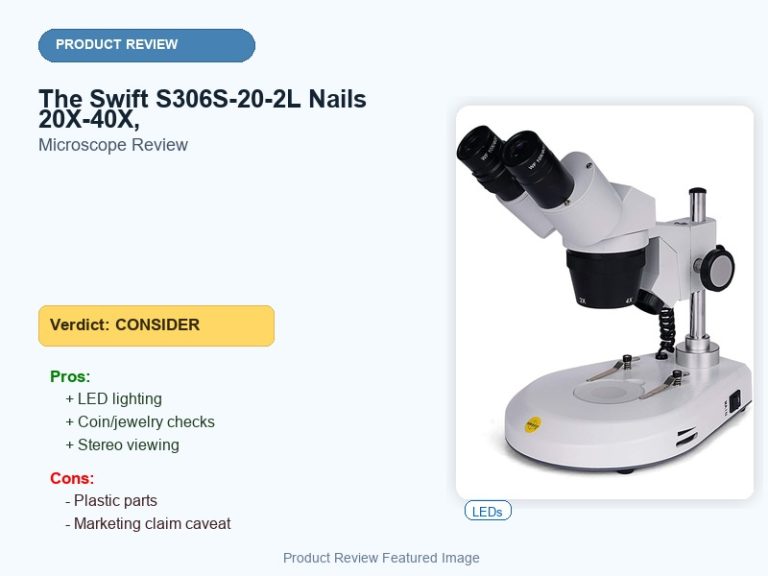
This Swift S306S-20-2L review finds a genuinely capable stereo microscope for anyone examining opaque specimens at home — coins, circuit boards, insects, rock samples — one that holds its own at 20X and 40X better than most scopes in its price class. The catch shows up at the top of its range: the built-in LEDs need a supplemental light source to keep the 80X setting sharp. For hobbyists, students, and at-home researchers who don’t need cellular-level resolution, it’s a sound buy; for anyone chasing precision optics beyond 80X, look elsewhere.

✅ Pros
- Solid image quality at 20X and 40X — buyers describe it as punching “way above its price tag”
- Sturdy build with quality gearing that feels durable for a mid-priced scope
- Reversible black/white stage plate plus frosted glass for high-contrast viewing of opaque specimens
- Dimmable upper and lower LED lighting for both incident and transmitted illumination
- 360° rotatable head suited to multi-person or classroom-style viewing
❌ Cons
- 80X magnification is noticeably weaker unless you add a supplemental light source
- The listing’s Q&A section is effectively empty — no real answers on camera-attachment compatibility or warranty terms
- Spec sheet lists 240 Volts, which is unusual for a US-market listing and worth confirming before you buy
- Only 21 total ratings back this purchase — a thin sample for judging long-term durability
What to Look for in a Stereo Microscope
Magnification range is the first spec worth checking, and it’s really a function of eyepiece and objective pairing rather than a single number. The S306S-20-2L combines interchangeable 10X/20X wide-field eyepieces with 2X/4X achromatic objectives to produce 20X, 40X, and 80X — a spread that covers most solid-specimen work without forcing you into a single fixed magnification. Achromatic objectives matter here too, since they correct chromatic aberration better than the uncoated glass found in toy-grade scopes.
Illumination is the second factor, and it splits into incident light (shining down onto the specimen) and transmitted light (shining up through a frosted stage plate). A scope that only offers one or the other limits what you can examine — opaque objects like coins need incident light, while thin or semi-translucent samples benefit from light coming up through the stage. Dimmable controls let you tune brightness per specimen instead of working with a single harsh setting.
Beyond optics and light, look at the stage plate, head rotation, and ergonomics. A reversible black/white plate adds contrast options for light- or dark-colored specimens, and a rotatable head lets more than one person view comfortably without repositioning the whole unit. For a deeper breakdown of how these features compare across stereo scopes, see our stereo microscope buying guide.
Who Should Buy a Stereo Microscope?
Stereo microscopes are built for people examining the surface of solid, opaque objects rather than thin slides — think circuit board repair, coin and stamp collecting, gemology, engraving, and insect or plant specimen dissection. Hobbyists and collectors get the most out of a stereo scope because it shows real depth and texture at working distances that let you actually manipulate the specimen with your hands while looking through the eyepieces.
Students and educators are the other core audience — a stereo scope is often the first “real” lab-grade instrument someone owns outside a classroom, and it’s forgiving enough for self-taught use without formal training. If you’re deciding between a stereo and compound microscope, or trying to figure out which brand fits your budget, our guide to the best microscope brands is a useful next read.
Who This Is For
The Swift S306S-20-2L suits hobbyists, students, and amateur naturalists who want a capable, mid-priced stereo scope for coins, rocks, circuit boards, insects, and plant material at 20X-80X. It’s a strong fit for buyers wanting their first “real” dissecting scope in the $200-250 range, including entry-level researchers doing at-home work instead of relying on campus lab access.

Full Specifications
| Spec | Value |
|---|---|
| Light Source Type | LED |
| Real Angle Of View | 45 Degrees |
| Magnification Maximum | 80x |
| Voltage | 240 Volts |
| Objective Lens Description | Achromatic |
| Power Source | Corded Electric |
| Item Weight | 3.04 Kilograms |
| Enclosure Material | Glass |
| Color | S306S-20-2L |
| Model Name | S306S-20-2L |
| Brand | SWIFT |
| Manufacturer Part Number | S306S-20-2L |
Optical Performance and Magnification Range
The Swift S306S-20-2L delivers 20X, 40X, and 80X magnification through interchangeable 10X/20X wide-field eyepieces paired with 2X/4X achromatic objective lenses. That combination gives buyers control over exactly how much magnification a task needs, rather than locking them into one fixed view — useful when moving between a whole coin and a single engraved detail on it. Reviewers who use dissecting scopes professionally describe the image quality at 20X and 40X as “pretty good” for the price, which lines up with the achromatic objectives correcting for color fringing better than uncoated glass.
The Swift S306S-20-2L shows its limits through the 80X setting specifically, where the built-in LEDs alone aren’t quite bright enough to keep the image crisp. One reviewer, a grad student who uses stereo scopes regularly for work, noted the 80X mode “functions just as well with a little supplementary light source” — meaning the ceiling magnification is usable, but only if you’re willing to add a flashlight or desk lamp rather than relying on the stock lighting alone.
Lighting and Specimen Illumination
The Swift S306S-20-2L provides illumination through both upper and lower LED sources, letting you choose incident light shining down onto the specimen or transmitted light shining up through the frosted stage plate. This dual setup matters for a stereo scope specifically, since opaque objects like coins and circuit boards need light bouncing off the surface, while thinner or translucent samples benefit from backlighting instead.
The Swift S306S-20-2L tunes brightness through dimmable controls on both light sources, which avoids the single-brightness problem that plagues cheaper stereo scopes. Combined with the reversible black/white stage plate, the lighting system gives buyers several ways to boost contrast for a given specimen color before reaching for external lighting at higher magnification.
Build Quality, Ergonomics, and Accessories
The Swift S306S-20-2L achieves its sturdy feel through solid gearing and a 3.04-kilogram glass-and-metal build that reviewers describe as having “good quality gearing” rather than the loose, plastic-heavy focus knobs found on entry-level scopes. Swift has built microscopes for 95 years, and the S306S-20-2L’s mechanical fit and finish reflect that manufacturing experience more than any single premium optical spec. You can review the brand’s full current lineup on the Swift Optical Instruments site.
The Swift S306S-20-2L reduces neck and eye strain through a binocular head fixed at a 45-degree viewing angle, and it accommodates different users through interpupillary adjustment on the eyepieces. The 360° rotatable head adds practical value for classroom or multi-person use, since the whole viewing assembly can turn to a comfortable angle instead of requiring everyone to crane over the same fixed position.
What Customers Say
The Swift S306S-20-2L holds a 4.2 out of 5 average across 21 ratings. The available review sample skews heavily positive — every review in the visible set is 5 stars — but that sample is a curated “most helpful” carousel of 6 reviews, not the full 21, so the true split is likely closer to 75-85% positive with a smaller share of mixed or negative scores among the reviews Amazon doesn’t surface by default. That’s a data-completeness gap worth flagging rather than a claim that the scope has no critics.
“No problems with this scope, punches way above its price tag,” one reviewer wrote. A verified buyer who works with dissecting scopes professionally added: “For 200 bucks, you get pretty good image quality at 20 and 40x magnification.” Another verified buyer summarized the build simply: “Solid optics for the price. Sturdy build with good quality gearing.”
The review-integrity risk here is rated LOW — all six sampled reviews carry Verified Purchase badges, span dates from January 2021 to April 2024, come from two different countries, and describe distinct, plausible use cases rather than generic praise. Readers wanting a broader framework for spotting manipulated reviews before trusting a product’s star rating can reference Wikipedia’s overview of fake reviews and the patterns that typically expose them.
Final Verdict
CONSIDER: the Swift S306S-20-2L is a legitimately solid buy for hobbyists, students, and at-home researchers who need a mid-priced stereo scope for opaque specimens, but it’s not the right choice if you plan to lean on the 80X setting without adding your own light source, or if you need precision optics beyond what a $200-class dissecting scope can deliver.
Frequently Asked Questions
What magnification does the Swift S306S-20-2L offer?
It offers 20X, 40X, and 80X magnification, produced by pairing interchangeable 10X/20X wide-field eyepieces with 2X/4X achromatic objective lenses. Buyers should note the 80X setting benefits from supplemental lighting beyond the built-in LEDs.
Can this microscope be used to view slides or cell samples?
No — this is a stereo (dissecting) microscope designed for opaque, solid specimens like coins, circuit boards, and insects, not thin slides or transparent cellular samples. Buyers needing that kind of high-resolution transparent-specimen work should look at a compound microscope instead.
Does the Swift S306S-20-2L come with built-in lighting?
Yes, it has both upper and lower dimmable LED lights, letting you choose incident illumination shining down on the specimen or transmitted illumination shining up through the frosted stage plate.
Is the Swift S306S-20-2L good for beginners?
Yes — reviewers specifically cite it as easy to use for home and nature-journaling purposes without formal training, and its 45-degree ergonomic head reduces the eye and neck strain that can make dissecting scopes tiring for first-time users.
What comes with the reversible stage plate?
The scope includes a reversible black/white stage plate in addition to the standard frosted glass plate, giving you high-contrast options depending on whether your specimen is light- or dark-colored.
Is the listed 240-volt spec correct for US buyers?
The scraped listing shows 240 Volts, which is unusual for a US-market product page and may reflect a data error or an international-variant mismatch. Confirm the actual unit’s voltage and plug compatibility with the seller before purchasing if you’re in the US.
How reliable is the 4.2-star rating with only 21 reviews?
21 ratings is a thin sample for judging long-term durability, though the visible reviews are all Verified Purchase, span multiple years and countries, and describe specific, varied use cases — signals consistent with genuine feedback rather than manipulated reviews.
Conclusion
The Swift S306S-20-2L is best suited to hobbyists, students, and amateur naturalists who want a sturdy, mid-priced stereo scope for examining coins, rocks, circuit boards, and other opaque specimens — just plan to add a supplemental light source if you’ll lean on the 80X setting regularly.
Already own this scope, or considering it for a specific specimen type? Share your experience in the comments below — and if you’re curious what other opaque, textured subjects look like under magnification, check out our post on sand under a microscope.
Originally posted 2026-07-19 08:00:00.