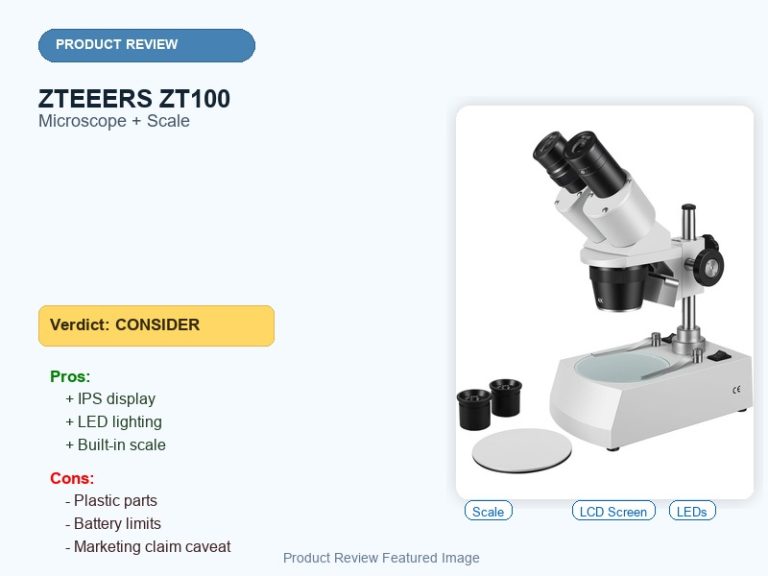
The ZTEEERS ZT100 review comes down to a split verdict on this stereo microscope: the spec sheet reads like a genuine bargain for a hobbyist-tier binocular scope, but verified buyers report inconsistent quality control, including a dead-on-arrival unit and at least one magnification claim that didn’t hold up on delivery. Dual LED illumination, a 10X-80X range through swappable WF10x/WF20x eyepieces, and both corded and lithium battery power make this a well-specced stereo microscope on paper. Whether it’s worth the risk comes down to how much tolerance you have for a rough-around-the-edges quality control record at a budget-friendly price point.

✅ Pros
- Flexible 10X-80X magnification range through swappable WF10x and WF20x eyepieces paired with 2x/4x objectives
- Dual upper and lower LED illumination lights both opaque and transparent specimens clearly
- Sturdy pillar stand and metal enclosure that reviewers describe as solid and well-crafted
- Generous accessory bundle — foam case, swappable eyepieces, rubber eye cups, and a reversible black/white stage plate
- Adjustable interpupillary distance for comfortable binocular viewing across different users
❌ Cons
- Verified buyers report dead-on-arrival units with an unfocused image that no adjustment could fix
- At least one verified buyer reported the 20x setting failed to deliver that magnification
- Included instructions are described as sparse and typo-ridden for first-time users
- One verified buyer reported a delayed or failed delivery experience
- Minor fit issues — a snug lens guard and an oversized dust cover relative to the unit
What to Look for in a Stereo Microscope
Magnification range is the first thing to check, and it’s really a combination of two parts: the eyepieces and the objectives. The ZTEEERS ZT100 pairs WF10x and WF20x eyepieces with interchangeable 2x and 4x objective lenses, which is how it reaches its stated 10X-80X range — the objectives handle the low end for large-scale specimens like rocks or jewelry, while the higher eyepiece setting pushes into finer detail work. A wider zoom range generally means fewer lens swaps mid-session, which matters more than the raw top-end number for most buyers.
Illumination is the second factor, since stereo microscopes are used on opaque, three-dimensional specimens rather than thin slides lit from below alone. Look for both upper and lower LED light sources — upper lighting reveals surface texture on solid objects, while lower lighting works for translucent samples through a frosted stage plate. A reversible black-and-white stage plate, like the one on this model, also matters more than it sounds: light-colored specimens show up better against black, and dark specimens against white.
Build quality and power flexibility round out the checklist. A pillar-stand design with a metal enclosure resists the wobble that plagues cheaper plastic stereo scopes during focus adjustments, and a dual power option — corded 120V plus a lithium battery — adds portability for classroom or field use where an outlet isn’t always nearby. If you’re comparing this category more broadly, our dissecting microscope buying guide breaks down how these same factors play out across other models in the price range.
Who Should Buy a Stereo Microscope?
Stereo microscopes serve a different job than compound microscopes: instead of thin, prepared slides, they’re built for viewing whole, opaque objects in three dimensions — rocks, coins, insects, circuit boards, jewelry, and other specimens too thick or solid for transmitted light alone. That makes them the right pick for hobbyists, collectors, and anyone doing hands-on inspection work rather than cellular-level biology.
Students and educators are the other core audience, since a stereo scope’s lower magnification range and simpler focusing system make it more forgiving for beginners than a compound microscope. If you’re weighing which brand tier fits your budget and needs, our guide to the best microscope brands is a useful next stop before you commit to a specific model.
Who This Is For
The ZTEEERS ZT100 suits budget-conscious students, hobbyists, and gift-buyers who want a genuinely feature-rich stereo scope for casual specimen viewing and are willing to test the unit on arrival and return it if it’s defective. It’s not the right call for a timed school project, a one-shot gift occasion, or any professional inspection work where day-one reliability isn’t optional.

Full Specifications
| Spec | Value |
|---|---|
| Light Source Type | LED |
| Real Angle Of View | 45 Degrees |
| Magnification Maximum | 80 x |
| Voltage | 120 Volts |
| Objective Lens Description | 2X & 4X |
| Power Source | Corded Electric |
| Item Dimensions L x W x H | 8.7″L x 4.5″W x 13″H |
| Item Weight | 2.88 Kilograms |
| Enclosure Material | Metal |
| Color | White |
| Model Name | ZT100 |
| Brand | ZTEEERS |
| UPC | 722549319046 |
| Manufacturer Part Number | ZT100 |
| Warranty Description | 1 Year Manufacturer |
| Built-In Media | Microscope, Eyepieces, base plate, adjusting wrench |
Optical Performance and Magnification Range
The ZTEEERS ZT100 delivers 10X-80X magnification through a combination of WF10x/WF20x eyepieces and interchangeable 2X/4X achromatic objectives, giving buyers a wider working range than many single-objective stereo scopes at this price. One Vine reviewer called the lenses “flawless, providing incredibly clear images,” and praised the adjustable interpupillary distance as making it “one of the nicest microscopes I’ve ever used.” For a deeper explanation of how eyepiece and objective combinations determine actual working magnification, Evident’s microscopy knowledge hub is a solid technical reference.
The ZTEEERS ZT100 does not universally hit its stated magnification claims, however — one verified buyer reported returning a unit because it “doesn’t 20x” as advertised, pointing to inconsistent optical calibration between units rather than a design flaw. That gap between the best-case optical performance praised in the Vine review and the worst-case failure reported by a paying customer is the central tension of this listing.
Dual LED Illumination System
The ZTEEERS ZT100 illuminates specimens through paired upper and lower LED light sources, letting it handle both opaque objects (metals, rocks, jewelry) lit from above and transparent samples lit from below through the frosted stage plate. A reviewer described the dual illumination as offering “clear, bright lighting for both opaque and transparent samples,” which lines up with the bullet-point claims on the listing.
The ZTEEERS ZT100 also includes a reversible black-and-white stage plate that provides contrast for light- or dark-colored specimens, plus stage clips to hold samples steady during focus adjustments — a practical detail that matters more in daily use than it does on a spec sheet.
Build Quality and Included Accessories
The ZTEEERS ZT100 uses a metal enclosure mounted on a pillar stand, a construction choice one reviewer said “feels solid and well-crafted, making adjustments smooth and precise” compared to lighter plastic-bodied competitors. At 2.88 kilograms with a 8.7″L x 4.5″W x 13″H footprint, it’s substantial enough to stay put on a desk during use without needing to be clamped down.
The ZTEEERS ZT100 ships with a fuller accessory set than its price tier typically includes — swappable eyepiece lenses, rubber eye cups, an adjusting wrench, and a base plate, all packed in foam casing according to one Vine reviewer. That same reviewer flagged two minor gripes worth knowing before you buy: the included lens guard is “a bit of a pain to get off,” and the dust cover is “comically oversized for the actual microscope.”
What Customers Say
The ZTEEERS ZT100 holds a 2.9 out of 5 star rating from 8 total reviews, with a sentiment split (from the sample recovered) of roughly 50% positive, 17% mixed, and 33% negative. One verified buyer wrote bluntly that the unit “does not work,” describing having to pay out of pocket at a repair shop just to get it functioning at all. Another verified buyer’s experience was more positive: “Everything works as it should so far… would recommend.” A third called the delivery experience a “Deception” after a long wait for nothing.
Worth flagging plainly: this listing carries a MEDIUM review integrity risk. Two of the three five-star reviews come from Amazon’s Vine program (free units given in exchange for a review), while every standard verified-purchase review in the sample skews negative or mixed. That doesn’t mean the reviews are fake — Vine is a disclosed, legitimate program — but it does mean the visible 2.9-star average likely understates the real defect rate among paying customers, since the strongest praise comes from a channel that never had to pay. For more on how disclosed review programs and incentivized reviews are supposed to work, the FTC’s Consumer Reviews and Testimonials Rule guidance is a useful reference.
Final Verdict
CONSIDER, with a clear caveat: the ZTEEERS ZT100 has a genuinely strong feature set for its price tier — dual illumination, a wide magnification range, dual power, and solid build quality — but verified buyers report a real risk of dead-on-arrival units and unmet magnification claims. Buy it if you’re budget-conscious, willing to test the unit immediately on arrival, and comfortable using Amazon’s return process if it fails; avoid it if you need guaranteed day-one reliability for a time-sensitive project.
Frequently Asked Questions
What magnification range does the ZTEEERS ZT100 offer?
It covers 10X to 80X, achieved by pairing the WF10x and WF20x eyepieces with interchangeable 2X and 4X objective lenses. The lower end suits large, whole specimens like rocks or jewelry, while the higher settings work for finer surface detail.
Does the ZTEEERS ZT100 need to stay plugged in, or does it run on battery?
It supports both. The unit runs on 120V corded power or a lithium battery, so it can be used at a desk or moved to a classroom or field setting without an outlet nearby.
Is the ZTEEERS ZT100 good for looking at rocks, coins, or jewelry?
Yes — that’s the primary use case for a stereo microscope. The upper LED illumination and reversible stage plate are specifically designed for viewing opaque, three-dimensional objects like these rather than thin transparent slides.
What’s included in the box with the ZTEEERS ZT100?
The listing and buyer photos show the microscope body, swappable eyepieces, a base plate, an adjusting wrench, rubber eye cups, a lens guard, and a dust cover, packed in foam casing.
How common are dead-on-arrival (DOA) units with the ZTEEERS ZT100?
Based on the available verified-purchase reviews, DOA and calibration issues (such as a 20x setting that didn’t actually reach 20x) are a real and recurring risk, not an isolated complaint. Test the unit immediately on arrival so you’re still within Amazon’s return window if it’s defective.
What warranty comes with the ZTEEERS ZT100?
It carries a 1-year manufacturer warranty, on top of Amazon’s standard return window for new items.
Can two people share the ZTEEERS ZT100 comfortably?
Yes — the binocular head has adjustable interpupillary distance, which one reviewer specifically praised as making it comfortable across different users without needing to readjust the whole unit each time.
Conclusion
The ZTEEERS ZT100 is worth considering if you want a genuinely well-specced stereo microscope at a budget-friendly price and you’re willing to accept some quality-control risk in exchange — test it the day it arrives, and don’t wait to raise an issue if the image doesn’t focus or the magnification undershoots the spec. For buyers who need guaranteed reliability out of the box, that risk profile is the deciding factor, not the feature list.
Have you used a stereo microscope like this one for rocks, jewelry, or hobby inspection work? Share your experience in the comments below — and if you’re curious what a stereo scope reveals on real specimens, check out our post on what a worm looks like under a microscope for a sense of what this magnification range can show.