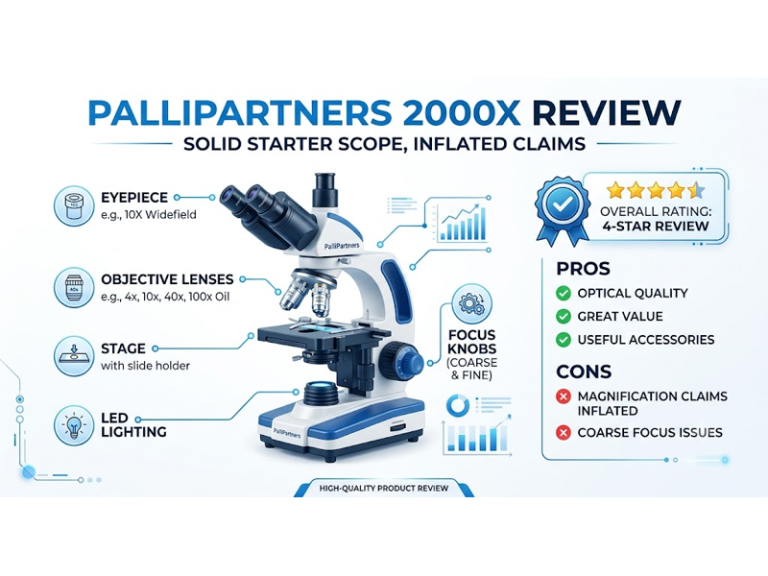
This PalliPartners 2000X microscope review found a solid first compound microscope — clear images, a metal frame, and a complete accessory kit at a fair $167.90 price — but the “2000X” headline number overstates what the optics can actually resolve. If you’re buying for a curious kid, a homeschool setup, or your own beginner hobby and you understand that the real usable magnification tops out well below the marketing figure, this is a reasonable buy.

✅ Pros
- Easy to set up and produces clear, sharp images straight out of the box
- Solid metal frame with coarse and fine focus knobs that feel well made for the price
- Genuinely sparks interest for kids and first-time users exploring biology at home
- Phone adapter and Bluetooth-camera pairing work as advertised for sharing what you see
- Complete kit (adapter, 15 slides, carrying bag, 10 accessories) removes the need for separate purchases to get started
❌ Cons
- Advertised 2000X magnification is misleading — real usable optical resolution is closer to 400X-1000X
- Regional power adapter compatibility is inconsistent for non-US buyers, including confirmed cases in Australia
- Included instructions are inadequate, particularly for phone-adapter setup
- Eyepiece and lens components are fragile and prone to damage without careful cleaning and handling
What to Look for in a Compound Biological Microscope
Magnification range is the number everyone fixates on, but it’s the least reliable spec on the box. What actually determines image quality is the objective lens set — the PalliPartners uses achromatic 4x, 10x, and 40x objectives paired with a WF25X eyepiece, which is where the true optical work happens. Eyepiece “zoom” multiplies the number on the label without adding real resolving power, so a shopper comparing two microscopes by magnification alone is comparing marketing copy, not performance.
Illumination matters just as much as the lens stack. A dual top-and-bottom LED brightfield system, like the one on this unit, lets you view both opaque specimens (top light) and transparent slide-mounted samples (bottom light) without swapping equipment. Pair that with a 0.65 NA single-lens condenser and disc diaphragm, and you get meaningful control over contrast and brightness — a feature that budget microscopes often skip entirely. Focus mechanism is the third pillar: coarse and fine focusing knobs on a metal frame hold position better than plastic gearing, which matters once kids start using the scope unsupervised.
Finally, weigh the accessory bundle against what you’d otherwise buy separately — slides, a phone adapter, and a carrying case add real cost if purchased individually. For a broader rundown of what separates entry-level scopes from lab-grade instruments, see our guide to the best digital microscopes.
Who Should Buy a Compound Biological Microscope?
Compound microscopes in this class suit students, homeschool parents, and hobbyists who want to look at prepared slides, pond water, onion skin, or cheek cells rather than photograph 3D objects like a digital or stereo microscope would. Educators running a one-on-one or small-group classroom benefit from the low price point, since it’s realistic to outfit several stations without a lab budget.
If you’re shopping across brands, it helps to know which manufacturers consistently deliver on their specs versus which ones inflate them — our guide to the best microscope brands breaks down the reputable names in this price tier.
Who This Is For
The PalliPartners 100X-2000X is best suited to US-based parents buying a first microscope for a curious child, homeschool or classroom educators who need an affordable multi-student unit, and absolute-beginner hobbyists who want to pair a phone camera with slide viewing without a large budget.

Full Specifications
| Spec | Value |
|---|---|
| Light Source Type | LED |
| Real Angle Of View | 30 Degrees |
| Magnification Maximum | 2000 x |
| Voltage | 240 Volts |
| Compatible Devices | Smartphone |
| Objective Lens Description | Achromatic; 4x, 10x, 40x |
| Power Source | Battery Powered |
| Item Weight | 1.65 Kilograms |
| Enclosure Material | Plastic |
| Color | White |
Optical Performance
The PalliPartners SWXWJ-1 delivers six magnification settings (100X, 200X, 250X, 500X, 1000X, 2000X) through a WF25X eyepiece working with achromatic 4x, 10x, and 40x objective lenses. In practice, the achromatic objectives are what actually resolve fine detail — the headline 2000X figure is reached by combining the top eyepiece magnification with the 40x objective, and one detailed customer review flagged that the true usable resolution is closer to 400X-1000X, since higher eyepiece numbers add visual zoom without adding optical resolving power.
The PalliPartners SWXWJ-1 uses a dual top-and-bottom LED brightfield illumination system alongside a 0.65 NA single-lens condenser and disc diaphragm to produce high-resolution, color-corrected images. Reviewers confirmed this works as intended on arrival — “Images are perfectly clear” was a direct quote from one verified buyer — though at least one reviewer noted that light output through the eyepiece decreased over time with continued use, which points to a component that may not hold up as well under heavy daily use as it does out of the box.
For readers who want to understand what achromatic objectives and NA (numerical aperture) actually measure — and why they matter more than the eyepiece number printed on the box — Nikon’s MicroscopyU microscopy basics reference is a useful independent primer on compound microscope optics.
Build Quality
The PalliPartners SWXWJ-1 uses a solid metal frame with coarse and fine focusing knobs to hold precise focus adjustment, a design choice that separates it from the all-plastic bodies common at this price tier. At 1.65 kilograms, the unit has enough heft to stay stable on a desk during use, which matters for a device that will get handled by kids or first-time users.
The PalliPartners SWXWJ-1 pairs that metal chassis with plastic enclosure panels and glass optics that reviewers describe as durable when handled correctly but vulnerable to damage otherwise — one buyer reported the eyepiece and inner lens getting damaged from being left uncovered and cleaned without proper care. That’s consistent with entry-level compound microscopes generally: the metal focusing mechanism is built to last, but the optical components need the same care you’d give any glass lens.
Ease of Use & Accessories
The PalliPartners SWXWJ-1 ships with a phone adapter, wire shutter, 10 operating accessories, a 15-piece slide set, and a carrying bag, covering most of what a beginner needs to start observing specimens the same day it arrives. One verified buyer described setup as straightforward: “It was easy to setup and use,” and another noted the Bluetooth camera pairing “works” for sharing images from the eyepiece to a phone screen.
The PalliPartners SWXWJ-1 falls short on documentation, however — the included manual doesn’t clearly explain phone-adapter setup, and one reviewer called it “100% useless” for that purpose. Non-US buyers should also budget for the possibility of receiving an incompatible power supply: one Australian buyer received a correct adapter automatically, while another received a US-only supply with no adapter at all, so the shipping process for regional power compatibility appears inconsistent rather than guaranteed.
What Customers Say
The PalliPartners 100X-2000X holds a 4.4 out of 5 average across 677 reviews on Amazon. In the sample of verified reviews available for this analysis, sentiment ran strongly positive (roughly 71% positive, 14% mixed, 14% negative), with every sampled review carrying a Verified Purchase badge. A verified buyer in Australia wrote: “It was easy to setup and use. Images are perfectly clear.” Another, in the US, said the microscope “ignited a young scientific mind to explore nature.” The most critical review came from a technically informed buyer who cautioned that the magnification claims outzoom the real resolving power: “it’s not 2000-1000 but 400… the objective lens(40x) is the one that magnifies, eyepieces zooms.”
Review integrity risk for this listing is rated LOW — the sampled reviews show natural variance in star rating, consistent Verified Purchase status, and non-templated, region-diverse language, including a detailed critical review that undermines the product’s own marketing rather than reinforcing it. That said, this read is based on a sample of 7 out of 677 total reviews, so treat it as directional. For readers who want to understand how to evaluate review authenticity themselves before trusting a star rating, the FTC’s guidance on truthful advertising and reviews is a solid independent reference.
Final Verdict
CONSIDER. The PalliPartners 100X-2000X is a fair buy for US-based beginners, students, and parents who want a well-built, easy-to-use first microscope with a complete accessory kit — as long as you go in expecting real usable magnification closer to 400X-1000X rather than the advertised 2000X ceiling, and you’re prepared to handle the optics carefully and source your own setup instructions if needed.
Frequently Asked Questions
Is the PalliPartners microscope really 2000X magnification?
The 2000X figure is reached by combining the WF25X eyepiece with the 40x objective lens, but reviewers report the real usable resolution is closer to 400X-1000X. The 4x, 10x, and 40x achromatic objectives are what do the actual optical resolving — higher eyepiece settings mostly add visual zoom rather than sharper detail.
Does the PalliPartners microscope work with an Australian or UK power outlet?
Not reliably. One verified Australian buyer received a compatible power adapter automatically, while another received only a US-style supply with no adapter included. Non-US buyers should confirm plug compatibility before purchase or budget for a separate voltage adapter.
What’s included in the box?
The kit includes the microscope body, a phone adapter, a wire shutter, 10 operating accessories, a 15-piece slide set, and a carrying bag — enough to start viewing specimens without buying anything else separately.
Can I connect my phone to this microscope?
Yes. It ships with a phone adapter, and at least one reviewer confirmed successful pairing with a Bluetooth camera to view and share images directly from a smartphone.
Is this microscope durable enough for kids to use unsupervised?
The metal frame and coarse/fine focus knobs are built solidly, but the eyepiece and internal lens are glass components that can be damaged without proper cleaning and cover use. Younger children should be supervised, particularly around lens handling and cleaning.
How does the light system work?
It uses a dual top-and-bottom LED brightfield system with a 0.65 NA single-lens condenser and disc diaphragm, letting you illuminate opaque specimens from above and transparent slide-mounted specimens from below.
Is this a good first microscope for a complete beginner?
Yes, for the price and included accessory kit, it’s a reasonable starting point for students, hobbyists, and kids — provided the buyer understands the true magnification limits and is prepared to handle documentation gaps around phone-adapter setup.
Conclusion
The PalliPartners 100X-2000X is a genuinely usable first compound microscope — solid metal build, clear dual-LED illumination, and a complete accessory kit that removes the friction of sourcing slides and a phone adapter separately. The catch is the magnification marketing: treat the 2000X number as a ceiling built from eyepiece zoom rather than a promise of lab-grade resolution, and this becomes a sensible buy for students, homeschoolers, and curious beginners.
If you’ve used this microscope or a similar entry-level model, share what specimens you’ve viewed with it in the comments below. For tips on getting the clearest possible images once your scope arrives, see our guide on preparing and observing your first slides.
Originally posted 2026-07-04 09:00:00.