We Compared 6 Microscopes for Kids to Find the Best STEM Gift
A microscope for kids works best when it matches the child’s age, attention span, and what they actually want to look at — a handheld digital model for quick outdoor discoveries, or a compound microscope for a deeper look at slides and cells. Below we break down six options, from pocket-sized digital cameras to full compound kits with slides and tools, so you can match the right one to the child using it.
What to Look for in a Microscope for Kids
Magnification range matters less than usability at that age. A 1000X compound microscope is useless to a 6-year-old who can’t prepare a slide, while a 200-1000X handheld digital microscope with a screen lets younger kids see results instantly. For a deeper look at how magnification and resolution actually interact, Nikon’s MicroscopyU guide breaks down why a bigger number on the box doesn’t always mean a sharper image. Consider these factors before buying:
- Screen vs. eyepiece: digital microscopes display the image on an LCD screen, so multiple kids can view at once without fighting over an eyepiece. Compound microscopes use a traditional monocular eyepiece, which builds real lab habits but requires more patience.
- Magnification range: 100X-1000X covers most home and classroom needs — insects, leaves, coins, fabric, and prepared slides. Ranges above 1200X are mostly marketing on beginner units and rarely add usable detail.
- Included kit: prepared slides, blank slides, and basic lab tools (tweezers, droppers, scalpels) turn a microscope into a full activity rather than a single toy.
- Power source: handheld digital models typically run on a rechargeable battery via USB; compound microscopes usually run on AA batteries or a mains adapter for the built-in LED light.
- Photo and video capture: digital microscopes with a camera let kids save and share what they find; compound microscopes need a phone adapter attachment to do the same.
Digital Handheld vs. Compound Microscopes: Which Type Suits Your Child
Handheld digital microscopes are built for younger children and casual exploration. They’re lightweight, screen-based, and forgiving of unsteady hands thanks to autofocus, making them a good fit for ages 3-8 who want to point-and-look at bugs, coins, or fabric without any setup — the same category we cover in our pocket microscope guide. Compound microscopes are the better choice for kids ages 8 and up who are ready to prepare their own slides, adjust focus manually, and learn the vocabulary of a real lab instrument, the fundamentals we walk through in our compound light microscope guide. They’re also the more durable option for a homeschool or classroom setting where the microscope gets used repeatedly over years rather than months.
| Model | Type | Magnification | Display/Optics | Camera | Kit Contents | Power |
|---|---|---|---|---|---|---|
| ASPOVEN 4K Handheld | Digital handheld | 200-1000X | 2.4″ IPS screen | 4K camera, photo/video | Neck strap, USB cable | Rechargeable battery / USB |
| Trigowalt Microscope Camera | Digital handheld | 1000X + 16x zoom | 2.4″ IPS screen | 1080P camera, photo/video | Storage card slot, USB cable | Rechargeable battery (3.5 hrs) |
| PalliPartners Compound | Compound (eyepiece) | 100X-2000X | 45° inclined monocular head | Phone adapter (optional) | Prepared slides, phone adapter | Mains adapter (UL-listed) |
| AmScope M30 Kit | Compound (eyepiece) | 120X-1200X | Monocular head, color filter wheel | None | 52-piece kit, plastic slides, carrying case | LED light, mains/adapter |
| Emarth Beginner Kit | Compound (eyepiece) | 40X-1000X | Rotatable head, 6 color filters | None | 52-piece kit, prepared and blank slides | Top/bottom LED, batteries not included |
| Uarzt 58-Piece Kit | Compound (eyepiece) | 100X-1200X | Metal body head | None | 58-piece kit, 13 prepared specimens, tools | LED light, 2 AA batteries not included |
1. ASPOVEN 4K Handheld Digital Microscope – instant screen viewing for young explorers
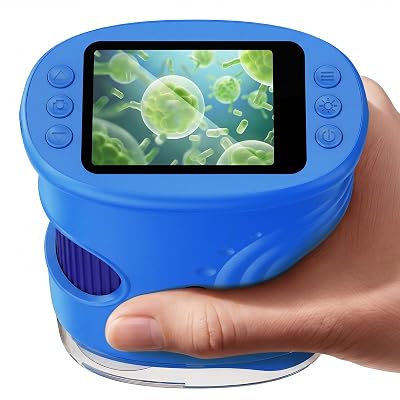
The ASPOVEN 4K Handheld Digital Microscope is a digital microscope that delivers 200-1000X magnification for kids ages 3-12. It captures images through a 4K camera and displays them on a 2.4-inch screen, with 8 built-in LED lights and 3 brightness levels for low-light specimens. The device weighs 0.5 lbs and includes a neck strap for hands-free carrying, and it connects to a PC via USB for file transfer. Unlike the compound microscopes on this list, it requires no slide preparation, letting younger children point it at leaves, coins, or fabric and see the result immediately on screen.
✅ Pros
- 200-1000X magnification range covers most everyday objects
- 4K camera with photo and video recording
- 8 built-in LED lights for low-light viewing
- Lightweight at 0.5 lbs with a neck strap
- No slide prep needed — point and view
❌ Cons
- 2.4-inch screen is small for group viewing
- Not suited to prepared-slide biology work
- USB connection needed for extended PC use
2. Trigowalt Microscope Camera – autofocus handheld with dual camera and microscope use

The Trigowalt Microscope Camera is a digital microscope that doubles as a handheld camera, giving kids ages 3-12 both a magnifier and a point-and-shoot device in one unit. It delivers 1000X magnification with an additional 16x zoom through a 2.4-inch IPS screen and a 1080P camera, and it includes 6 LED lights for indoor and outdoor use. It runs on a rechargeable battery rated for up to 3.5 hours per charge and supports photo and video capture to a storage card, with USB transfer to a computer. Its autofocus system distinguishes it from the ASPOVEN model by sharpening the image automatically, which suits kids whose grip isn’t steady yet.
✅ Pros
- Autofocus compensates for unsteady hands
- 1000X magnification plus 16x zoom
- Doubles as a general handheld camera
- Rechargeable battery lasts up to 3.5 hours
- Storage card slot for saving photos and video
❌ Cons
- Battery life caps sessions at 3.5 hours
- Storage card sold separately
- No compound-lens option for slide work
3. PalliPartners Compound Microscope – high-power optics with a phone adapter for sharing

The PalliPartners Compound Microscope is a compound microscope that delivers 100X-2000X magnification through a monocular eyepiece with a 45° inclined head for comfortable viewing. It includes a set of prepared slides and a universal phone adapter, letting kids ages 10-12 capture and share what they see through a smartphone camera. The lenses carry an anti-scratch coating, and coaxial coarse and fine focus adjustment knobs make it easier for a beginner to find a sharp image. Its 2000X top-end magnification is the highest on this list, positioning it closer to a student or homeschool instrument than a toy.
✅ Pros
- 100X-2000X range, the highest top-end magnification here
- Phone adapter included for capturing images
- Coaxial coarse and fine focus for easier control
- 45° inclined head reduces neck strain
- UL-listed power adapter and silent operation
❌ Cons
- Best suited to ages 10-12, not younger kids
- Requires mains power, no battery option
- Steeper learning curve than handheld digital models
4. AmScope M30 Series 52-Piece Kit – metal-body compound scope built for repeated classroom use

The AmScope M30 Series 52-Piece Beginner Microscope Kit is a compound microscope that delivers six magnification settings from 120X to 1200X through a monocular viewing head. It has a metal body, a built-in LED light, and a rotating color filter wheel for adjusting contrast on different specimens. The kit ships with sample slides and a hard ABS carrying case, making it a complete package rather than a scope that needs accessories bought separately. Its metal construction sets it apart from lighter plastic-bodied kits, giving it more durability for repeated classroom or homeschool use over several years. For full spec sheets and warranty details, see AmScope’s official product catalog. Read our full AmScope M30 review for the complete breakdown.

✅ Pros
- Metal body is more durable than plastic-bodied kits
- Six magnification settings from 120X to 1200X
- Rotating color filter wheel for contrast control
- Includes sample slides and a hard carrying case
- Backed by AmScope’s established microscope catalog
❌ Cons
- Monocular head only, no phone adapter included
- No digital display or camera output
- Heavier than handheld digital alternatives
5. Emarth Beginner Microscope Kit – dual top-and-bottom lighting for opaque and translucent specimens

The Emarth Beginner Microscope Kit is a compound microscope that delivers 40X-1000X magnification with dual top-and-bottom LED illumination, letting kids view both opaque and translucent specimens without swapping equipment. It includes a 52-piece kit of prepared and blank slides plus basic lab tools, and its metal frame with a rotatable head supports 6 interchangeable color filters for contrast. If your child works through the blank slides included here, our guide to preparing microscope slides walks through the process step by step. The easy focus system is built for beginners rather than assuming prior lab experience, and it runs on batteries that are not included in the box. Its dual-light setup is a specific advantage over single-light compound scopes on this list when viewing solid, non-transparent objects. Read our full EMARTH review for the complete breakdown.
✅ Pros
- Dual top and bottom LED lighting for opaque and translucent samples
- 6 interchangeable color filters for contrast
- 52-piece kit with prepared and blank slides
- Metal frame with rotatable head
- Beginner-friendly focus system
❌ Cons
- Batteries not included
- Lower top-end magnification than the PalliPartners model
- No phone adapter or digital output
6. Uarzt 58-Piece Kids Microscope Kit – the largest accessory set for guided group activities

The Uarzt 58-Piece Kids Microscope Kit is a compound microscope that delivers 100X-1200X magnification with a metal body and a built-in LED light. It ships with 13 prepared specimens, 31 blank slides, and lab tools including tweezers, a dropper, and a scalpel, making it the largest included accessory set on this list. It runs on 2 AA batteries, which are not included, and comes with a colorful illustrated guide aimed at kids using a microscope for the first time. The kit is designed for guided use between a parent or teacher and a child, and it carries Climate Pledge Friendly certification for its packaging and materials. Read our full Uarzt 58-Piece Kit review for the complete breakdown.
✅ Pros
- 58-piece kit with 13 prepared specimens
- Illustrated guide aimed at first-time users
- Metal body with built-in LED light
- Includes lab tools: tweezers, dropper, scalpel
- Climate Pledge Friendly certified packaging
❌ Cons
- Batteries not included
- Scalpel included requires adult supervision
- No digital display or phone adapter
Also Tested
A few more models from this category we’ve reviewed in full — they didn’t make the top picks above, but each has a specific strength or catch worth knowing before you buy.
- Herwicm Compound Microscope — Solid optics for the price, let down by the camera module. Full review →
- AiPoaaol 1000X — Screen-based viewing instead of an eyepiece, though focusing takes patience. Full review →
- Mileonaim SD668 Kit — 61-piece accessory set, with one specific weak spot worth knowing first. Full review →
- DOUBLE CC’s Micro World — Engaging for kids out of the box — contingent on the LED actually working. Full review →
- Xelabrion 67-Piece Kit — Strong STEM kit, though some units are reportedly inconsistent. Full review →
- 1600X Kids Microscope — our verdict on the 1600X Kids Microscope.
Frequently Asked Questions
What magnification do I need for a kids’ microscope?
For most home and beginner use, 100X-1000X is enough to see plant cells, insect parts, fabric fibers, and coin detail clearly. Ranges above 1200X are mostly marketing on entry-level units and rarely produce a usably sharp image without professional slide prep.
Can a kid use a digital microscope without a computer?
Yes. Handheld digital microscopes like the ASPOVEN and Trigowalt models have a built-in screen, so images display directly on the device. A computer or phone is only needed to transfer saved photos and videos afterward.
What is the difference between a compound and a digital microscope?
A compound microscope uses a glass eyepiece and lenses to magnify a physical slide directly, which is closer to what’s used in a real lab or classroom. A digital microscope uses a camera sensor to display the image on a screen, which is easier for young kids and allows instant photo and video capture.
Do these microscopes come with slides already prepared?
The compound kits from PalliPartners, AmScope, Emarth, and Uarzt all include a mix of prepared and blank slides. The handheld digital models from ASPOVEN and Trigowalt don’t use slides at all — they focus directly on whatever object you point them at.
My child’s microscope image looks blurry — what should I check first?
On a compound microscope, check that the slide is centered under the objective lens and adjust the coarse focus knob slowly before fine-tuning. On a digital microscope, make sure the lens is clean and the device is held at the distance specified in its manual, since most fixed-focus models have a narrow sharp-focus range.
Is a microscope with a scalpel or lab tools safe for young kids?
Kits like the Uarzt 58-piece set include a scalpel for slide preparation, which should be used only with adult supervision for children under about 10, in line with the U.S. Consumer Product Safety Commission’s guidance on sharp tools in children’s products. For younger kids, a handheld digital microscope avoids sharp tools entirely.
What’s a good budget option for a first microscope?
The AmScope M30 kit and the Emarth kit are both built around simple, durable compound scopes with a full slide-and-tools kit included, making them practical starting points without needing extra accessories purchased separately.
Conclusion
Younger kids and casual explorers get the most out of a handheld digital microscope like the ASPOVEN or Trigowalt, since both let a child point, view, and capture an image on a screen with no slide prep required. Kids ready for a more traditional lab experience — and parents or teachers planning repeated use over several years — are better served by a compound microscope such as the AmScope or Emarth kit, both of which arrive with a complete set of slides and tools out of the box. The PalliPartners model splits the difference for older kids who want higher magnification with the option to capture images through a phone adapter.
Have you used one of these microscopes with your own kids? Share which model worked best for your child’s age and interests in the comments below.
Originally posted 2020-05-24 13:08:30.