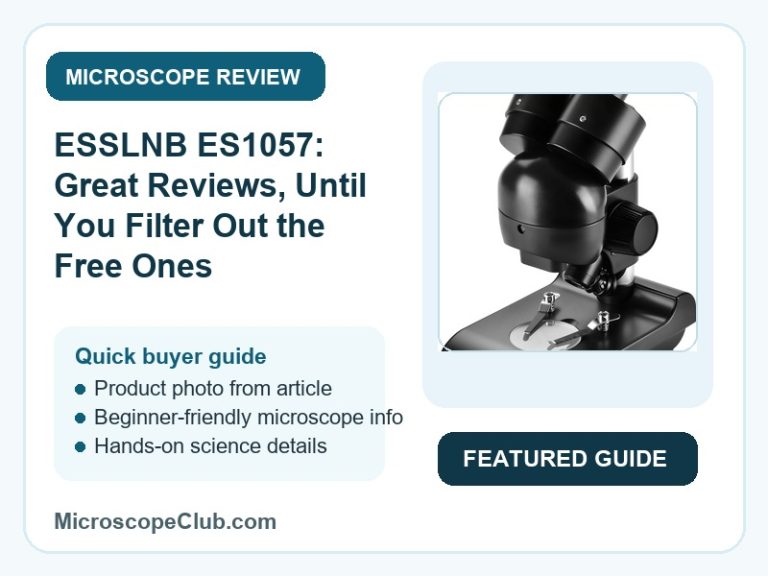
The ESSLNB ES1057 review verdict is straightforward: this is a genuine binocular stereo microscope built for a first-time buyer, not a toy pretending to be one, but it also carries a small-sample durability risk that anyone expecting lab-grade reliability should weigh before buying. At a fixed 30X magnification with dual LED illumination and a metal enclosure, it delivers real optics — long working distance, comfortable binocular viewing, and ready-to-use specimen slides in the box — for less than the cost of a toy-store magnifier. Reviewers confirm it clears the “actual microscope” bar comfortably, though a wobbly housing and one report of the unit failing on arrival mean it’s a budget pick, not a bulletproof one.

✅ Pros
- Binocular eyepieces reduce eye strain compared to single-lens toy magnifiers
- Dual top-and-bottom LED lighting handles both opaque objects and translucent slides
- Long working distance with clear imaging at the fixed 30X power
- Ships with ready-to-use specimen slides (onion, fly leg, and blanks) for immediate testing
- Strong fit as a low-cost first microscope or STEM gift for a curious child
❌ Cons
- Fixed 30X magnification — no zoom range for buyers who want flexibility
- Wobbly housing and eyepieces that aren’t very adjustable, per one paying buyer
- Eyepiece lenses aren’t secured with a retention ring and can fall out of their housing
- One verified buyer reports the unit failed shortly after purchase
What to Look for in a Stereo Microscope
Magnification range is the first decision point. A fixed single-power setup like the ES1057’s 30X (a WF10X eyepiece paired with a 3X objective) is simple to use and keeps the price down, but it can’t zoom in for finer detail or out for a wider field of view — buyers who expect to progress past casual inspection should look for a model with multiple objective steps instead. If you’re comparing fixed-power scopes against zoom or turret models, our complete stereo microscope buying guide breaks down which range fits which use case.
Illumination matters just as much as magnification for a stereo scope, since these instruments view whole objects rather than thin, backlit slides. Dual top-and-bottom LED lighting — the setup the ES1057 uses — lets you switch between reflected light for solid objects like coins or insects and transmitted light for translucent specimens on a slide. Build material is the third factor: a metal enclosure signals more durability than an all-plastic body, though as this review shows, metal housing alone doesn’t guarantee a wobble-free experience at the lowest price tiers.
Who Should Buy a Stereo Microscope?
Stereo microscopes are the right tool for anyone examining whole, opaque objects in three dimensions — insects, coins, rocks, jewelry, circuit boards, and other large specimens that don’t need to be sliced onto a slide. That makes them a natural fit for hobbyists, students learning basic observation skills, and parents or educators looking for an entry point into hands-on science that doesn’t require slide preparation. For a younger child specifically, our guide to the best microscopes for kids covers age-appropriate options and what to expect at this end of the price spectrum.
Stereo microscopes are not the right choice for anyone who needs to see cellular detail — bacteria, blood cells, or plant tissue require a compound microscope using transmitted light at much higher magnification. If your goal is biology coursework rather than object inspection, a stereo scope like the ES1057 will not get you there no matter how good its optics are for its intended purpose.
Who This Is For
The ES1057 fits parents or grandparents buying a first microscope for a curious 8–14-year-old, and hobbyists who want a low-cost tool for casually inspecting coins, rocks, jewelry, or insects. It’s not the right choice for hobbyist geologists, jewelers, or students who need more than one magnification level or lab-grade stability.
Full Specifications
| Spec | Value |
|---|---|
| Light Source Type | LED |
| Real Angle Of View | 45 Degrees |
| Magnification Maximum | 30 x |
| Objective Lens Description | Achromatic |
| Item Weight | 10 Kilograms |
| Enclosure Material | Metal |
| Color | Black |
| Model Name | Stereo Microscope |
| Brand | ESSLNB |
| Manufacturer Part Number | ES1057 |
| Warranty Description | 1 Year |
| Built-In Media | Stereo Microscope, WF10X Eyepiece |
Optical Performance and Magnification
The ESSLNB ES1057 delivers a fixed 30X magnification through a WF10X eyepiece paired with a 3X achromatic objective, a single-power setup that trades flexibility for simplicity and a low price. The ESSLNB ES1057 achieves an unusually long working distance for its class, which one verified buyer called out directly: “it has great optics with an extra long working distance… clear imaging.” A longer working distance matters in practice because it leaves room to manipulate specimens — coins, gemstones, insects — under the lens without bumping the objective, which is exactly the gemological and hobbyist use case that reviewer reported using it for. According to Nikon’s Introduction to Stereomicroscopy, stereo instruments are designed around exactly this kind of low-magnification, three-dimensional viewing of whole objects, which is where the ES1057’s fixed 30X setting is genuinely well suited.

The ESSLNB ES1057 caps out at 30X with no zoom or turret to step up further, which is the review’s most consistent complaint: “fixed magnification—no zoom range if you’re looking for high flexibility.” Buyers who want to progress toward finer detail or a wider range of specimens will outgrow this ceiling quickly, and should look at a multi-objective or zoom stereo scope instead.
Build Quality and Stability
The ESSLNB ES1057 uses a metal enclosure rated at 10 kilograms, which on paper suggests a stable, non-toy build compared to the all-plastic scopes common at this price. In practice, reviewer experience is mixed: one paying buyer described it plainly as “wobbly,” adding that “the eye pieces are not very adjustable,” and another noted the eyepiece lenses “fall out easily” because the housing lacks a rubber O-ring or gasket to hold them in place.
The ESSLNB ES1057 carries a real durability question mark: one verified buyer in the sampled reviews reported the unit “broke immediately” after purchase. With only 10 total reviews on the listing, a single failure report represents a meaningful share of the paying-customer sample rather than statistical noise, and it’s the clearest reason to treat this as a budget-tier purchase rather than a long-term instrument.
Ease of Use and Included Accessories
The ESSLNB ES1057 runs dual LED illumination through separate top and bottom light sources, letting you switch between reflected light for opaque objects and transmitted light for translucent slide specimens. One reviewer called this combination “super versatile,” and the 45-degree viewing angle with adjustable interpupillary distance is specifically built to accommodate younger users’ faces and hand span.
The ESSLNB ES1057 ships with a set of ready-to-use specimen slides — an onion slice, a fly leg, and several blanks for self-prepared samples — so a first-time buyer can start observing immediately without sourcing accessories separately. It runs on three AA batteries housed beneath the stage, and one reviewer noted the glass and translucent light-diffusing disks need to be removed before installing batteries, since the compartment is only accessible with the unit turned upside down.
What Customers Say
The ES1057 holds a 3.9 out of 5 average across 10 total reviews on Amazon. Of the 9 sampled reviews, sentiment ran roughly 78% positive, 11% mixed, and 11% negative — but that split needs a caveat: 5 of the 9 sampled reviews are Vine Customer Review of Free Product, meaning the reviewer received the unit at no cost, and every one of those Vine reviews scored 4–5 stars. The only two reviews outside that 4–5 range — a 3-star “meh” and a 1-star failure report — both came from full-price, Verified Purchase buyers. Review integrity risk is MEDIUM: with more than half the visible sample incentivized rather than organic, the blended 3.9 average likely overstates what a typical paying customer experiences. The FTC’s 2024 rule on consumer reviews and testimonials doesn’t flag Vine reviews as deceptive on their own, but it’s a useful reminder to weigh incentivized reviews differently from organic ones.
One reviewer summed up the value case: “I have seen other reviews that pooh-pooh this as a cheap beginner’s microscope, but don’t underestimate it. It has great optics with an extra long working distance.” A verified buyer took the opposite view after a rougher experience: “not good, better get a regular compound microscope, this one is wobbly and does not zoom much.” And a third, translated from Italian, was blunt about a hardware failure: “it broke immediately.”
Final Verdict
CONSIDER the ESSLNB ES1057 if you’re buying a first microscope for a curious kid, a STEM-themed gift, or a low-cost tool for casual coin, rock, or insect inspection — the binocular comfort, dual LED lighting, and included specimen slides deliver real value at this tier. AVOID it if you need adjustable magnification, guaranteed build durability, or anything beyond a casual first instrument; the wobble complaints and a reported failure among paying buyers mean this is a budget gamble, not a sure thing.
Frequently Asked Questions
What magnification does the ESSLNB ES1057 offer, and can it be changed?
The ES1057 has a single fixed magnification of 30X, produced by a WF10X eyepiece paired with a 3X objective lens. There is no zoom, turret, or second objective — what you see out of the box is the only power level available.
Is the ESSLNB ES1057 good for a child’s first microscope?
Yes, based on reviewer experience — one grandparent reported their 14-year-old granddaughter “loved it” and kept finding new things to inspect, and another titled their review “Great kids/beginning microscope” and said it’ll be “great for checking out bugs up close.” The adjustable interpupillary distance and 45-degree viewing angle are specifically designed to suit younger users.
Does the ESSLNB ES1057 come with specimen slides?
Yes. It ships with a set of ready-to-use prepared slides, including an onion slice and a fly leg, plus several blank slides for preparing your own specimens.
What power source does the ESSLNB ES1057 use?
It runs on three AA batteries. The battery compartment sits beneath the stage, and you need to turn the unit upside down and remove the glass and translucent light-diffusing disks to access it.
Is the ESSLNB ES1057 durable enough for regular use?
Durability is the biggest open question on this listing. Several reviewers describe a wobbly housing and eyepiece lenses that can fall out of their mounts without a retention ring, and one verified buyer reported the unit failed shortly after purchase. With only 10 total reviews, that failure represents a meaningful share of the paying-customer sample, so treat this as a budget-tier instrument rather than one built for heavy daily use.
What’s the difference between this stereo microscope and a compound microscope?
A stereo microscope like the ES1057 uses reflected light to view whole, opaque objects — insects, coins, rocks — in three dimensions at low magnification, with no slide preparation required. A compound microscope uses transmitted light through thin, translucent slides to magnify cellular detail at much higher power. They serve different purposes and aren’t interchangeable.
How reliable are the ESSLNB ES1057’s Amazon reviews?
Treat the 3.9-star average with some caution. More than half of the sampled reviews are Vine Customer Review of Free Product, meaning the reviewer didn’t pay for the unit, and every one of those Vine reviews scored 4 or 5 stars. The only critical reviews in the sample — a 3-star and a 1-star — both came from Verified Purchase buyers who paid full price, which suggests the true paying-customer experience skews less positive than the blended average implies.
Conclusion
The ESSLNB ES1057 is a legitimate step up from a toy magnifier for a curious kid, a gift-buyer, or a hobbyist who wants to casually inspect coins, rocks, or insects — the binocular comfort, dual LED lighting, and included specimen slides deliver on that promise. Just go in with realistic expectations about the fixed magnification and budget-tier build, and be prepared to reach out to the seller if your unit arrives with the wobble or failure issues a handful of paying buyers reported.
If you want to get more out of the included blank slides, our guide on how to prepare microscope slides walks through mounting your own specimens step by step. Have you used the ESSLNB ES1057 for a science project, gift, or hobby? Share your experience in the comments below — we read every reply.
Originally posted 2026-07-23 09:00:00.