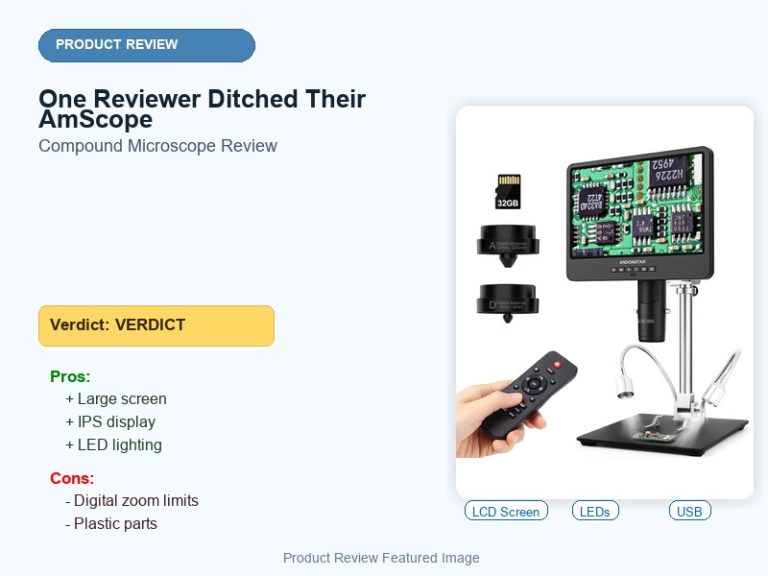
This Andonstar AD249S-M review lands on a buy recommendation for anyone who wants one digital microscope to handle soldering, coin inspection, and slide viewing without industrial-supplier pricing. Three swappable lenses, a 10.1-inch built-in screen, and HDMI output push magnification up to 2040x, and reviewers consistently say the image quality beats scopes that cost several times more. The one thing to budget for mentally: the boom-arm base can wobble under vibration, so precision solderers may want to reinforce the mounting surface.

✅ Pros
- Big 10.1″ built-in screen plus HDMI output for group viewing on any monitor
- Three swappable lenses cover soldering (15x-60x), general/coin inspection (4.5x-180x), and biological slides (450x-510x) in one kit
- Complete accessory bundle — wireless remote, 32GB microSD card, HDMI/USB cables, prepared slides, tweezers, and observation box included
- Quick assembly (around 15 minutes per one reviewer) with simple focus-wheel and digital zoom controls
- Reviewers say it out-performs pricier binocular-style soldering scopes and industrial-supplier units at a fraction of the cost
❌ Cons
- Boom-arm base can wobble under vibration or knocks during fine SMD work
- Flexible LED light arms can glare and overload the sensor if positioned too close to the subject
- Mounting-post fit tolerances vary between units, so hardware may need adjustment on arrival
- Overall build feels light and plasticky despite the sharp optics
- Ordering from third-party sellers carries some risk of receiving a used or incomplete unit
What to Look for in a Digital Microscope
Magnification range matters less than how it’s delivered. The Andonstar AD249S-M splits the job across three interchangeable objective lenses rather than one compromise lens, so screen-level magnification runs from 4.5x-180x for general inspection, 450x-510x for biological slide work, and 15x-60x for soldering — each multiplied again by up to 3x digital zoom, and doubled further when output to an HDMI monitor. That kind of lens-swapping flexibility is worth checking on any digital microscope before you buy, since a single fixed lens usually forces a trade-off between working distance and detail. Our guide to the best digital microscopes breaks down how competing models handle this same trade-off.
Illumination and field of view decide whether you can actually see what you’re magnifying. A 178-degree real angle of view keeps distortion low at the edges of the frame, and adjustable LED brightness — the AD249S-M offers eight intensity levels — prevents the image from washing out on reflective surfaces like solder joints or coin faces. Buyers should also weigh the focusing and stand mechanism: a boom-arm stand with front-to-back and side-to-side adjustment gives more working room than a fixed-column scope, though as reviewers of this unit note, a lighter stand can trade some of that flexibility for stability.
Connectivity and output options round out the decision. HDMI output to an external monitor, USB connectivity for a Windows PC, and bundled measurement software turn a microscope from a solo tool into something usable for classroom demonstrations or documented inspection work — all present on the AD249S-M alongside onboard photo and video capture to a microSD card.
Who Should Buy a Digital Microscope?
Hobbyist and prosumer electronics technicians are the core audience for this category — anyone soldering SMD components, reflowing boards, or repairing phones benefits from a large, stable screen that doesn’t require hunching over an eyepiece for hours. Coin and collectible inspectors, watchmakers, and STEM educators form the next tier, since a big built-in display lets a whole classroom or workbench group see the same detail at once, something a traditional optical microscope can’t easily do.
Parents shopping for a child’s first microscope or a STEM starter kit should weigh whether a digital screen-based unit or a traditional optical model better fits the intended use — our guide to the best microscopes for kids compares both approaches. For adult hobbyists split between soldering, coin collecting, and casual biology, a multi-lens digital unit like this one covers more ground than a single-purpose scope.
Who This Is For
The Andonstar AD249S-M suits hobbyist electronics repair technicians, PCB and SMD solderers, watchmakers, and coin or collectible inspectors who want a large-screen, HDMI-capable scope without industrial-supplier pricing. It’s a weaker fit for anyone needing lab-grade optical precision or a rock-solid, zero-vibration platform for sub-0201 SMD work — the reported base wobble points to a prosumer tool rather than a metrology-grade instrument.

Full Specifications
| Spec | Value |
|---|---|
| Light Source Type | LED |
| Real Angle Of View | 178° |
| Magnification Maximum | 2040x |
| Voltage | 240 Volts |
| Compatible Devices | Laptop, Television |
| Objective Lens Description | Achromatic |
| Power Source | DC |
| Item Dimensions L x W x H | 7.8″L x 7″W x 13″H |
| Item Weight | 2.47 Kilograms |
| Enclosure Material | 10.1” LCD display, HDMI output, Metal, Windows PC output |
| Color | Digital Microscope-10.1″(HDMI) 3 Lens AD249S-M |
| Model Name | AD249S-M |
| Brand | Andonstar |
| UPC | 616361263024 |
| Manufacturer Part Number | AD249S-M |
Optical Performance and Lens Versatility
The Andonstar AD249S-M delivers up to 2040x magnification through a stack of 3x digital zoom layered over three interchangeable objective lenses — Lens A for general inspection, Lens D for biological slides, and Lens L for soldering work. That range lets one unit substitute for what would otherwise be several single-purpose scopes, which is the core reason reviewers keep comparing it favorably to pricier dedicated soldering rigs.
The Andonstar AD249S-M frames a 178-degree real angle of view through its achromatic objective lens design, which keeps color fringing and edge distortion low across the frame — a detail that matters when inspecting fine PCB traces or coin engravings rather than casual macro shots. One reviewer working on circuit boards put it directly: “The image is very clear. I could easily work on circuit boards with 402 or smaller parts.”
The Andonstar AD249S-M earns its keep on the bench through Lens L’s 15x-60x screen-level range (60x-240x with HDMI digital zoom), which is tuned specifically for solder joint inspection rather than deep magnification. Andonstar’s official product line lists this same three-lens configuration across its soldering-focused models, confirming the lens split is a deliberate design choice rather than a one-off spec.
Build Quality and Stand Stability
The Andonstar AD249S-M supports its 10.1-inch display and lens head through a metal boom-arm stand rated for high-temperature soldering environments, with front-to-back, side-to-side, and angle adjustment built into the bracket. That range of motion is genuinely useful for positioning the lens over an oddly shaped board or coin without moving the workpiece itself.
The Andonstar AD249S-M trades some of that stability for its adjustability, though, according to multiple buyers who reported the base moving under knocks or vibration during close work. One UK-based reviewer fixed the issue by remounting the unit: “the small bed area (work area)… when knocked it moved a lot, i decided to upgrade this and i fixed it onto a nice piece of granite and now theres no movement.” Anyone doing fine SMD work should plan on a heavier mounting surface rather than relying on the stock base alone.
The Andonstar AD249S-M also shows some fit-tolerance variance between units, with a subset of buyers reporting the mounting post didn’t seat cleanly into the base on arrival. It’s a quick fix with a wrench in most cases, but it’s worth inspecting the assembly fit immediately and using the return window if parts don’t seat correctly.
Ease of Use and Included Accessories
The Andonstar AD249S-M simplifies lens changes through a screw-mount system, so switching from the soldering lens to the biological slide lens takes seconds rather than a full recalibration. Focus is handled through a single focusing wheel, and the included wireless remote controls digital zoom and image capture from across the room — useful both for one-handed soldering work and for classroom demonstrations where the operator isn’t standing at the unit.
The Andonstar AD249S-M ships with a full accessory kit rather than requiring separate purchases: a 32GB microSD card, HDMI and USB cables, five prepared biological slides, a slide holder, tweezers, an observation box, and both a printed manual and assembly sheet. One buyer summarized the out-of-box experience directly: “I found it very easy to put together, and everything worked right out of the box… Whether you’re a novice, or professional, this will get the job done.”
The Andonstar AD249S-M also connects to a Windows PC through its bundled measurement software, which adds length and area measurement, photo capture, and video recording on top of what the onboard microSD storage already provides — a feature several reviewers singled out as unusually valuable for the price point.
What Customers Say
The Andonstar AD249S-M holds a 4.7-out-of-5 rating across 434 reviews, and the sentiment in the sampled reviews skews heavily positive — image quality, build quality, and value for money are the most-mentioned attributes, each running roughly 85-95% positive. One reviewer who owns a much pricier binocular-style soldering scope said: “I find myself grabbing this over the binocular style much more expensive amscope soldering microscope when I need to solder.” A verified buyer who inspects coins for a living called it “a good investment,” citing the adjustable LED brightness and sharp focus. Lighting and stand size are the two attributes with the most mixed feedback — a handful of reviewers found the flexible LED arms glare-prone at close range, and one felt the stand base was too small for larger work.
Review integrity signals for this listing are strong: reviews are verified-purchase, geographically and temporally spread across multiple countries and years, and include specific, unscrubbed negative feedback rather than uniformly polished praise — patterns generally associated with organic review activity rather than manipulation. Readers who want to understand how fake or incentivized reviews typically differ from this pattern can reference this overview of fake review detection.
Final Verdict
BUY — the Andonstar AD249S-M’s three-lens flexibility, large HDMI-capable screen, and full accessory kit deliver more capability than its price tier suggests, and the review record backs that up with buyers directly comparing it favorably to pricier dedicated soldering scopes. The one caveat is mechanical: if your work demands a rock-solid, zero-vibration platform for very fine SMD soldering, budget for a heavier mounting surface, since the stock boom-arm base can wobble under close, repetitive work.
Frequently Asked Questions
What magnification does the Andonstar AD249S-M actually reach?
On the built-in 10.1-inch screen, magnification ranges from 4.5x-180x on the general Lens A, 450x-510x on the biological Lens D, and 15x-60x on the soldering Lens L, each with up to 3x digital zoom. Output to an external 28-inch HDMI monitor roughly doubles those ranges, topping out at 2040x on Lens D.
Is this microscope good for soldering and PCB repair?
Yes — Lens L is purpose-built for soldering and circuit board work, and multiple reviewers specifically use it for SMD component repair and fine-pitch soldering. One buyer noted the image stayed clear enough to work on parts as small as 402-size components.
Can I use the Andonstar AD249S-M for coin collecting?
Yes, Lens A is designed for observing whole coins, parts, plants, and stones, and at least one verified buyer bought it specifically for coin inspection, citing the adjustable LED brightness as helpful for avoiding glare off metal surfaces.
What’s included in the box?
The kit includes the microscope host, three lenses (A, D, L), a slide holder, a 32GB microSD card, USB and HDMI cables, a switch cable, a wireless remote control, five prepared biological slides, an observation box, tweezers, and a printed instruction manual.
Does it work with Windows PCs and Mac?
It connects to Windows PCs via USB and includes bundled measurement software for length and area measurement, photo capture, and video recording. The listing specifies Windows compatibility; Mac support is not mentioned in the manufacturer’s specifications.
What kind of after-sales support comes with this microscope?
Andonstar backs the AD249S-M with 24-hour professional after-sales service according to the listing’s bullet points, alongside a printed instruction manual and QR-code-linked setup guides in the box. Given the reported unit-to-unit fit variance, it’s worth inspecting the assembly on arrival and using that support channel if hardware doesn’t seat correctly.
Do I need the HDMI monitor, or does the built-in screen work on its own?
The 10.1-inch built-in screen is large enough for standalone use, and several reviewers use it exclusively without ever connecting an external monitor. HDMI output is there for classroom demonstrations or when a bigger group needs to view the same image at once.
Conclusion
The Andonstar AD249S-M works best for hobbyist and prosumer electronics repair, coin and collectible inspection, watchmaking, and STEM education — anyone who wants one HDMI-capable digital microscope to cover several use cases instead of buying separate single-purpose tools. The tradeoff to plan for is the stand: reinforce the mounting surface if your work involves fine, repetitive soldering close to the lens.
If you’ve used the AD249S-M or a similar Andonstar model, share how it held up for your specific use case in the comments below. Readers new to slide-based observation may also want our guide on the different types of microscopes to see how a digital HDMI scope like this one compares to traditional compound and stereo models.
Originally posted 2026-07-16 08:00:00.