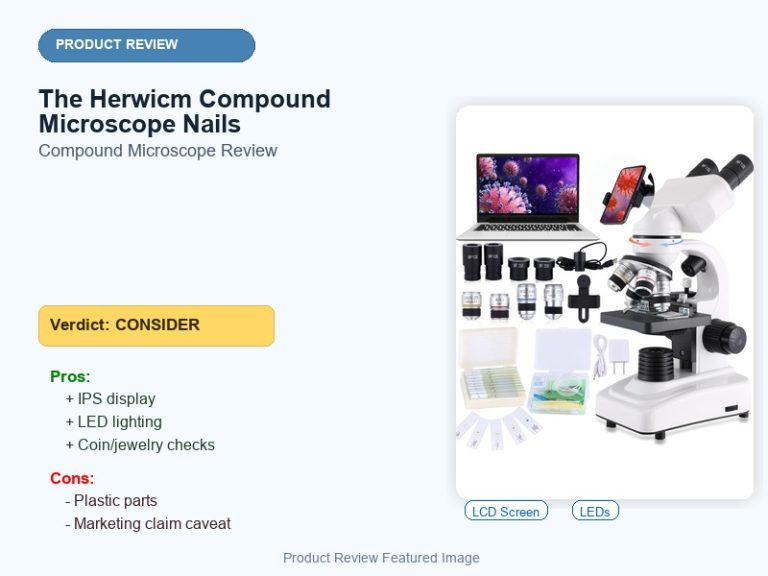
This Herwicm Compound Microscope review starts with the verdict: it earns its “legit lab scope, not a toy” reputation on optics and build, but the bundled digital camera system — a headline feature at this price — is a coin flip that some buyers report as completely non-functional. If you want a real binocular scope for hands-on viewing and can treat the camera as a bonus rather than a promise, it’s a solid pick; if the connected-imaging feature is the reason you’re buying, read the fine print below first.

✅ Pros
- Build quality feels like a genuine lab instrument rather than a toy scope
- Wide practical range — usable as a low-power magnifier and for cellular detail at higher settings
- Easy to unbox and set up, even for first-time microscope owners
- Dual top and bottom LED illumination with automatic fill-light for clearer viewing
- Ships complete with premade slides, extra blank slides, cover plates, and a phone holder for eyepiece photography
❌ Cons
- Bundled camera app is unreliable — some buyers report it doesn’t work on any computer, with no Mac support and no responsive vendor support
- Quality control is inconsistent — a minority of units arrive with non-functional objectives or no image at all
- Sharpness noticeably softens at the highest magnification settings
- Printed instructions are sparse and poorly translated, leaving buyers to self-troubleshoot software setup
What to Look for in a Compound Microscope
Magnification range is the first number shoppers chase, but it only matters alongside the objective lenses that actually produce it. The Herwicm ships with 4X, 10X, and 40X objectives paired with WF10x and WF25x eyepieces, which is how the listing arrives at its 40X-2500X headline figure — but the spec sheet itself only confirms a 40X objective maximum, a gap worth knowing about before you buy on the top-line number alone.
Illumination matters just as much as magnification. A compound microscope needs light passing through the specimen from below (transmitted light) for thin slides, and light reflecting off the surface from above (incident light) for opaque samples. Dual-LED designs like this one cover both use cases, which is a meaningful step up from single-light budget scopes that only handle one type of specimen well.
Stage design and focus mechanism decide whether a microscope is pleasant to use day-to-day. A mechanical stage with coaxial coarse and fine focus knobs — as opposed to a fixed stage where you nudge the slide by hand — makes it far easier to track a specimen at high power without losing it. Buyers weighing this against other entry-level options should also check our guide to the popular microscope brands to see how build quality and support compare across manufacturers.
Who Should Buy a Compound Microscope?
Compound microscopes are the right category for anyone who needs to see through a thin, translucent specimen rather than just at its surface — pond water, cheek cells, thin plant sections, or prepared blood smears. That makes them the standard choice for biology students, homeschool science curricula, and hobbyists curious about cellular-level detail, as opposed to stereo microscopes, which are better suited to opaque, three-dimensional objects like rocks or insects.
Educators and parents introducing kids to microscopy are a natural fit for this category, since a compound scope with premade slides gives immediate “wow” results without any specimen-prep skill required. If that’s your primary use case, see our picks for the best microscopes for kids for how this class of scope stacks up against other kid-friendly options.
Who This Is For
This is best suited to budget-conscious parents, homeschoolers, and teachers introducing kids roughly age 8 and up to microscopy, plus adult hobbyist beginners who want eyepiece viewing on a real lab-style instrument without professional pricing. It’s a weaker fit for anyone who specifically needs reliable digital capture — especially Mac users — or for advanced students who already know what a properly calibrated lab scope feels like.

Full Specifications
| Spec | Value |
|---|---|
| Light Source Type | LED |
| Real Angle Of View | 45 Degrees |
| Magnification Maximum | 40x |
| Voltage | 240 Volts |
| Compatible Devices | Laptop, Personal Computer |
| Objective Lens Description | 4X, 10X, 40X |
| Power Source | Corded Electric |
| Item Dimensions L x W x H | 14.37″L x 11.41″W x 6.49″H |
| Manufacturer Part Number | wy-462 |
| Brand | Herwicm |
| Enclosure Material | Glass (Lenses), Metal/Plastic (Body And Stage) |
| Color | Binocular Microscope 02 |
Optical Performance
The Herwicm compound microscope delivers its magnification range through a pairing of WF10x and WF25x wide-field eyepieces with 4X, 10X, and 40X achromatic objectives, the combination the listing uses to advertise 40X-2500X coverage. In practice, that range holds up well at low-to-mid power — reviewers describe using it “like a fantastic magnifying glass” on everyday specimens before switching up to examine cells — but the manufacturer’s own spec sheet lists 40X as the objective maximum, a discrepancy buyers should factor in rather than assume the top-line number is a guaranteed, calibrated figure.
The Herwicm compound microscope loses sharpness as magnification climbs, a pattern multiple reviewers flagged independently. One buyer with prior professional microscope experience noted that “as you get to the higher powers, the sharpness isn’t great,” while a separate reviewer reported the lenses “no enfocan adecuadamente” (don’t focus properly). For casual observation of slides, bugs, and plant material at low-to-mid power this is a non-issue; for anyone wanting crisp detail at the top of the range, it’s the scope’s clearest limitation.
The Herwicm compound microscope reaches its headline figures through eyepiece-objective math worth understanding before buying on the top-line number: a 10x eyepiece paired with a 40x objective yields 400x, not 2500x, at every setting. Buyers wanting a primer on how objective and eyepiece magnification actually combine can reference Nikon’s MicroscopyU objectives guide for the underlying optics.
Build Quality & Focus Mechanism
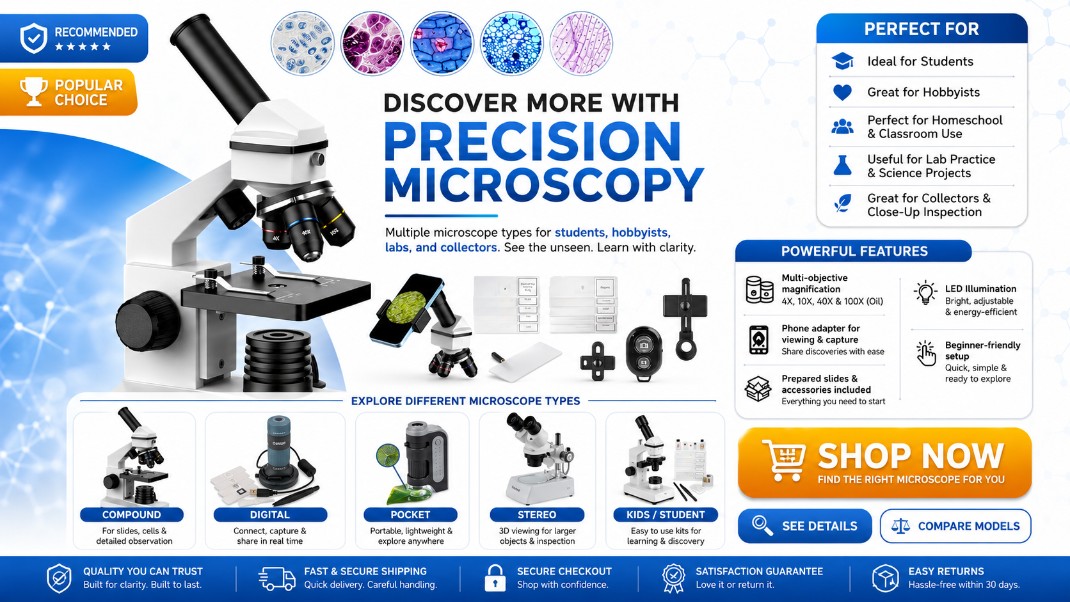
The Herwicm compound microscope uses a metal-and-plastic body with glass optics and a two-layer mechanical stage, and it’s the build quality reviewers single out most consistently as exceeding expectations. One buyer called it “a legit lab scope” with “basically all the bells and whistles,” while another contrasted it directly against toy-grade alternatives: “Feels sturdy, not like a toy.” That perception matters because build quality is the attribute most likely to justify the price gap between this and genuinely disposable starter scopes.
The Herwicm compound microscope positions its coaxial coarse and fine focus knobs on both sides of the base, which is standard practice for compound scopes and keeps focusing accessible whether a user is right- or left-handed. Quality control is the counterweight to this otherwise solid design: a minority of buyers reported receiving units where the 40X and 100X objective ranges didn’t work, or where no image appeared at all regardless of magnification adjustment. That inconsistency means it’s worth testing every objective and the focus travel immediately after unboxing, while return windows are still open.
Ease of Use & Accessories
The Herwicm compound microscope ships with premade slides, extra blank slides and cover plates, and a phone holder for eyepiece photography, which lets new users start observing specimens within minutes of opening the box. Multiple reviewers confirmed setup was straightforward even as first-time microscope owners, with one describing it as “easy to use” enough for a children’s class activity.
The Herwicm compound microscope pairs with a Windows-only camera application delivered on a mini CD rather than a modern download, and this is where the experience becomes uneven. One reviewer reported the camera app “doesn’t work” on any computer they tried, with no manufacturer support and only a German-language manual; another confirmed there’s no Mac-compatible app despite instructions implying otherwise. If digital capture and computer viewing matter to your purchase decision, budget time to track down third-party software rather than expecting a plug-and-play experience.
What Customers Say
The Herwicm compound microscope holds a 4.2 out of 5 rating across 249 ratings, and the sentiment splits into two clear camps rather than clustering in the middle: satisfied hobbyist and education buyers on one side, and a smaller but consistent group who received DOA or feature-incomplete units on the other. “Solid, this is a legit lab scope, has basically all the bells and whistles (and then some). Great value,” said one reviewer, while a verified buyer on the other end reported: “The microscope did not work at all for us. No images would show up at all.”
The Herwicm compound microscope’s split personality shows up within a single buyer’s experience too — one reviewer wrote, “Looks way better through the eye piece than it does the camera piece but it’s still worked well and is a nice option.” Review integrity risk here is rated LOW — the sample is 100% verified purchases spread across the US, Germany, Australia, Brazil, and Mexico, with specific, varied complaints (camera drivers, focus quality, Mac support) rather than generic templated praise, which argues against a manipulated review base. For general context on spotting manipulated reviews elsewhere, the FTC’s guidance on reviews and endorsements is a useful reference.
Final Verdict
CONSIDER this one with eyes open: the Herwicm Compound Microscope is a genuinely solid lab-style scope for eyepiece viewing, education, and hobbyist use, but treat the digital camera and Mac claims as unreliable bonuses rather than core features, and test every objective the moment it arrives given the reported quality-control gaps.
Frequently Asked Questions
Does the Herwicm Compound Microscope really reach 2500x magnification?
It reaches that figure on paper through a WF25x eyepiece combined with the 40X objective, but the manufacturer’s own spec sheet lists 40X as the objective maximum. Treat 2500X as a theoretical ceiling rather than a guaranteed, sharp working magnification — image quality noticeably softens at the top of the range according to multiple reviewers.
Is the camera and software compatible with Mac?
No. Despite instructions implying the companion app should load automatically, reviewers confirmed there is no Mac-compatible version, and the software ships on a mini CD rather than a modern download for Windows.
What’s included in the box?
The kit ships with the binocular microscope body, premade slides, extra blank slides and cover plates, a phone holder for eyepiece photography, and a mini CD with the Windows camera software.
Is this a good first microscope for a child?
Yes, for kids roughly age 8 and up. Reviewers specifically highlighted it as a strong fit for classroom use and as a first “real” microscope for grandchildren and homeschool students, thanks to the included premade slides and straightforward setup.
Why do some reviewers say their unit doesn’t work at all?
A minority of buyers received units with non-functional objectives (commonly the 40X or 100X range) or no image output regardless of focus adjustment. This appears to be a unit-to-unit quality control issue rather than a universal design flaw, so testing every objective immediately after unboxing is worthwhile.
Can I use my own prepared slides, or only the ones included?
The kit includes extra blank slides and cover plates specifically so you can prepare your own specimens beyond the premade set, using the two-layer mechanical stage to hold and position them under the objectives.
How does the dual LED lighting work?
The scope has both a top LED and a bottom LED with an automatic fill-light design, letting you illuminate thin, transparent slides from below or opaque surface specimens from above depending on what you’re observing.
Conclusion
The Herwicm Compound Microscope earns its keep as a genuine step up from toy-grade scopes for anyone focused on eyepiece viewing — students, homeschoolers, and hobbyist beginners will get real value from the optics, dual lighting, and included slide kit. Just don’t buy it specifically for the digital camera feature, and check every objective the day it arrives.
If you’ve used this microscope or a similar entry-level compound scope, share what you found in the comments — and if you’re just getting started with specimen prep, our guide to observing blood cells under the microscope is a good next stop.
Originally posted 2026-07-08 08:00:00.