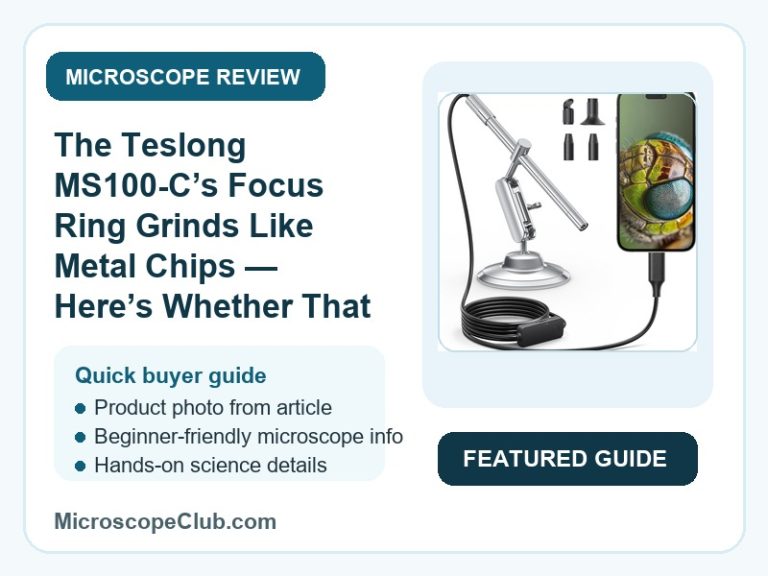
The Teslong MS100-C review verdict is straightforward: this is a genuinely useful budget USB-C microscope for coin collectors, watchmakers, and electronics hobbyists, but a mechanical quirk in the focus ring means quality control is inconsistent between units. At 10X-200X magnification with 8 adjustable LED lights and a rotating metal stand, it delivers real value for anyone treating it as a hobbyist tool rather than a precision instrument — as one reviewer put it, “you can’t beat the price.”

✅ Pros
- Connects easily to iPhone 15+, Android, Windows, and MacBook over USB-C
- Strong value for a 10X-200X handheld scope with 8 dimmable LEDs
- Compact form factor that stays out of the way during watchmaking and tight-space work
- Sturdy metal build and stand that sits flat and holds its angle
- Bright, adjustable LED ring lets you shoot handheld without the stand
❌ Cons
- Focus ring can turn gritty or jump unpredictably on some units — no autofocus fallback
- Camera feed has failed to load on some Android device/app combinations
- Requires a companion app even for Windows/Mac use, and iOS support doesn’t cover every feature
- Fixed lens with no true zoom — you move the scope itself to reframe
- Slight pink lens flare at the closest focus distances with the LED ring on
What to Look for in a USB Digital Microscope
Magnification range matters less than most listings imply. The Teslong MS100-C covers 10X to 200X through a fixed lens with a real angle of view of 70 degrees, which means you get detail by physically moving the scope closer or farther rather than twisting a zoom barrel. That’s a fine trade-off for coin inspection, circuit boards, and textures, but it’s worth knowing before you buy so you’re not expecting a parfocal zoom lens.
Illumination and focusing mechanism are the two specs that actually separate a good USB microscope from a frustrating one. The MS100-C uses 8 adjustable LEDs across three brightness levels, controlled from the cable rather than the body — a small design choice that keeps your hand steadier at high magnification. The focus ring, however, is a mechanical part, and mechanical parts vary unit to unit; several buyers reported smooth operation while others described a gritty, jumpy feel. Our USB microscope buying guide breaks down which focusing systems tend to hold up best across price tiers.
Device compatibility is the last piece, and it’s more complicated than “works with everything.” The MS100-C connects to iPhone 15 and newer, Android devices with USB-C, and Windows/Mac computers — but computer use requires installing a companion app, and iOS support doesn’t extend to every feature the app offers. Confirm your exact phone model and OS version support scope function, not just the physical port, before assuming plug-and-play.
Who Should Buy a USB Digital Microscope?
Hobbyists and light professionals get the most out of this category: coin and stamp collectors checking mint marks, electronics assemblers inspecting solder joints, watchmakers examining movements, and jewelers appraising small stones. These are all tasks where 10X-200X handheld magnification with digital capture beats a loupe, because you can photograph, share, and zoom the image on a larger screen instead of squinting through an eyepiece.
Educators, curious generalists, and anyone building a hands-on collection of tools alongside a compound scope also fit this category well. If you’re weighing a USB microscope against other formats for a classroom or household, our guide to popular microscope brands is a useful reference point for how these portable digital units stack up against traditional optical brands.
Who This Is For
The Teslong MS100-C suits buyers who want an affordable, portable inspection tool for coins, electronics, watch movements, or general curiosity, and who are primarily on Android or a laptop rather than depending on full iOS feature parity. It’s a poor fit if you need reliable autofocus, lab-grade resolution, or zero tolerance for mechanical variance in the focus ring.

Full Specifications
| Spec | Value |
|---|---|
| Light Source Type | LED |
| Real Angle Of View | 70 |
| Magnification Maximum | 200 x |
| Objective Lens Description | 10X to 200X Magnification |
| Power Source | USB rechargeable |
| Enclosure Material | Metal |
| Color | Silver |
| Model Name | MS100-C |
| Brand | Teslong |
| Unit Count | 1.0 Count |
| Warranty Description | 12 months warranty |
| Built-In Media | MS100-C, 2 Ear Specula, 1 Protective Cover, and 1 Side-viewing Mirror |
Optical Performance
The Teslong MS100-C delivers 10X to 200X magnification through a fixed objective lens rather than a true optical zoom, so framing comes from physically moving the scope closer to or farther from the subject. Reviewers consistently noted this is workable once you understand it isn’t a twist-zoom design: one buyer explained they get “great magnification range for my needs” and that depth of field “is good and can be improved by backing away from object and using digital zoom” on the connected device instead.
The Teslong MS100-C illuminates subjects through 8 adjustable LEDs spread across three brightness levels, with the dimmer control built into the cable rather than the scope body. A reviewer confirmed “the lights are bright enough so that using the scope hand held is possible” and that they’re “dimmable so you can achieve your best possible image,” which matters most at the highest magnification settings where ambient light rarely reaches the subject.
The Teslong MS100-C shows a documented weak point at its closest focus distances, where the LED ring can introduce a slight pink lens flare, and its focus ring mechanism varies between units. One reviewer described theirs as smooth and reliable, while another reported it “feels like a metal on metal pepper grinder” that “jumps from one focus point to another without warning,” attributing it to possible burrs inside the housing. For general context on how USB microscope optics are typically specified and tested, the Society for Imaging Science and Technology is a useful reference on imaging fundamentals.
Build Quality
The Teslong MS100-C houses its components in a metal enclosure that reviewers described as sturdier than the price point suggests. One buyer wrote it’s “made with quality steel materials with optics that get the job done,” while another called the barrel “well designed, well made, sturdy” and noted it’s “small enough to fit anywhere.”
The Teslong MS100-C pairs its metal body with a rotating stand that stays put once positioned, a detail multiple reviewers called out specifically: “the stand is sturdy and easy to adjust and sits well on flat surfaces.” For watchmakers and electronics assemblers, this stability under a fixed working angle is often more valuable than raw magnification, since it keeps both hands free.
The Teslong MS100-C earns repeated praise for its compact form factor as a practical advantage over bulkier alternatives, particularly for watchmaking: one reviewer noted “the main benefit over many of the other options is that it doesn’t block access for using tools to work on a watch movement because of the form factor,” adding it’s “much more compact for storage” than competing scopes.
Ease of Use & Accessories
The Teslong MS100-C connects via USB-C to iPhone 15 and newer, Android devices, Windows PCs, and MacBooks, but computer use requires installing a separate companion app rather than working as a plug-and-play webcam. Setup experience varies: one reviewer called it “super fun and easy to use — connect to laptop and iPhone is super easy too,” while another needed to enable developer mode on their device before the scope would function correctly.
The Teslong MS100-C ships with 2 ear specula, 1 protective cover, and 1 side-viewing mirror, extending its use beyond flat-surface inspection into ear checks and hard-to-reach angles right out of the box. This accessory set is a meaningful value-add at this price tier compared to bare-bones competitors that ship the camera alone.
The Teslong MS100-C has occasionally failed to deliver a camera feed on specific Android device and app combinations even after correct setup, per at least one reported case: “I downloaded the app and adjusted all relevant settings on three different android devices and could only get the light to work, nothing else.” If you’re on Android, verify your specific device model is supported before relying on this scope for a time-sensitive task.
What Customers Say
The Teslong MS100-C holds a 4.0 out of 5 star average across 186 reviews. In a sample of 8 fully-quoted reviews, sentiment splits roughly 75% positive (4-5 stars), 12.5% mixed (3 stars), and 12.5% negative (1 star) — closely tracking the site-wide average. One reviewer summarized it as a budget pocket-sized digital microscope that’s “far more powerful than a typical magnifying glass or loupe,” while another called it simply “amazing value.” A verified buyer using it for watchmaking added: “this is a great alternative for me for my watchmaking needs.”
Review integrity risk for this listing is rated LOW: all 8 sampled reviews carry the Verified Purchase badge, review dates span roughly a year rather than clustering in a suspicious burst, and star ratings are genuinely mixed (5, 5, 4, 1, 5, 5, 5, 3) rather than uniformly glowing — all signals consistent with an organic review base rather than manipulation. For readers who want to evaluate review authenticity on any Amazon listing themselves, the FTC’s endorsement guidance outlines the disclosure standards genuine reviews should meet.
Final Verdict
CONSIDER: the Teslong MS100-C is a strong buy for hobbyists — coin collectors, watchmakers, electronics assemblers — who want an affordable, portable USB-C microscope and can tolerate a fixed lens and app-dependent setup, but buyers who need guaranteed-consistent focus mechanics or full iOS feature parity should weigh the documented unit-to-unit variance in the focus ring before purchasing.
Frequently Asked Questions
Does the Teslong MS100-C have a zoom lens?
No. The lens is fixed at 10X-200X magnification, so you reframe by physically moving the scope closer to or farther from the subject rather than twisting a zoom ring. Digital zoom on the connected app can supplement this once you’ve positioned the scope.
Does the Teslong MS100-C work with iPhone?
It’s designed for iPhone 15 and newer models with USB-C ports. Reviewers note that while the scope connects and works, “Apple software doesn’t support all features” compared to the Android or computer experience.
Can I use the Teslong MS100-C with a Windows PC or MacBook?
Yes, but it requires installing a separate companion app — it does not function as a plug-and-play webcam. One reviewer specifically flagged this as a downside: “needs an app for computers OK for phone or tablet.”
Does the Teslong MS100-C have autofocus?
No, focusing is entirely manual via a physical ring. Most reviewers found this workable, though several noted the ring mechanism can become gritty or unpredictable, likely due to manufacturing variance between units.
What accessories come with the Teslong MS100-C?
The package includes 2 ear specula for ear inspections, 1 protective cover for hygiene during skin or pet checks, and 1 side-viewing mirror for hard-to-reach angles, in addition to the microscope and rotating metal stand.
Is the Teslong MS100-C good for coin collecting?
Yes, this is one of its most commonly cited uses. Buyers use it to examine mint marks and surface detail on coins, and its compact form factor and metal stand make it easy to hold a steady angle over a flat coin surface.
Why does my Teslong MS100-C camera not work on Android?
At least one verified buyer reported the camera feed failing entirely across three different Android devices despite correct app setup, while the LED light still functioned. If this happens, confirm your specific device and Android version are listed as supported before assuming a defective unit.
Conclusion
The Teslong MS100-C earns its 4.0-star average by doing exactly what it promises for hobbyists: affordable, portable, wide-range magnification with solid build quality and useful accessories. Its one real liability is a focus ring that isn’t consistently manufactured — smooth on some units, gritty on others — so buyers who depend on flawless mechanical precision should factor that risk in before purchasing.
If you pick one up, we’d love to hear how it performs on your specific device setup, especially if you’re on Android — drop a comment below. And if you’re new to handheld digital scopes, our guide on USB microscopes covers how to get the most out of one once it arrives.
Originally posted 2026-07-29 09:00:00.