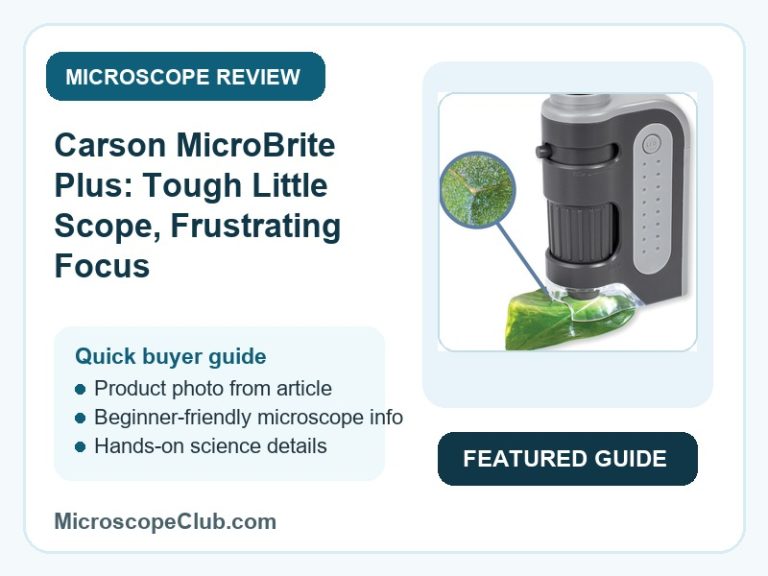
This Carson MicroBrite Plus review comes down to one trade-off: it’s a pocket microscope that’s genuinely durable, with owners reporting years of use on a single AA battery, but genuinely fiddly to focus — the single most-mentioned complaint across its tens of thousands of reviews. At 60x-120x LED-lit magnification in a 59-gram plastic shell, it’s built for casual, low-stakes viewing — bugs, coins, fabric, splinters — not precision lab work. The verdict: buyers who understand that limitation going in are consistently happy, while buyers expecting instant clarity are the ones leaving one-star reviews.

✅ Pros
- Remarkable value at this price point — well-made and user-friendly straight out of the box
- Genuinely compact and pocketable, easy to carry along on walks or trips
- Strong durability and battery life, with some owners reporting years of use on the same AA battery
- A reliable hit as a low-stakes science gift for curious kids
- Magnification that outperforms its size, with several buyers saying it beat larger scopes they already owned
❌ Cons
- Focusing is fiddly and is the single most-mentioned complaint in the review base
- Awkward to hold steady for longer viewing sessions
- Too fiddly for children under about 6 without an adult’s help
- Lower zoom ceiling than digital pocket microscopes in the same price range
- Occasional DOA units reported, including a non-functioning LED on arrival
What to Look for in a Pocket Microscope
Magnification range is the first spec buyers check, but it’s not the whole story. The Carson MicroBrite Plus tops out at 120x, which is enough to resolve fabric weave, coin detail, and insect anatomy, but well short of the 200x-plus territory where individual cells start becoming visible. If your goal is surface-level curiosity rather than biology-class cell viewing, a 60x-120x range like this one is plenty; if you’re chasing cellular detail, you’ll want a benchtop scope instead.
Illumination and focusing mechanism matter just as much as raw zoom. LED lighting, like the MicroBrite Plus uses, keeps the image bright regardless of ambient light, which is a real advantage over non-illuminated loupes. But pocket microscopes in general trade away fine focus controls for portability — most rely on a sliding barrel rather than a geared knob, so getting a crisp image takes more patience than it would on a full-size scope. Our guide to the best pocket microscopes breaks down how different models handle this tradeoff.
Build and power source round out the decision. A one-piece plastic housing running on a single AA battery, as the MicroBrite Plus does, is lighter and cheaper to keep running than a rechargeable digital unit, but it also means no screen, no photo capture, and no accessories beyond the scope itself. Weigh that against how you’ll actually use it — quick inspections on the go favor simple battery-powered designs, while anyone wanting to save or share images should look at a digital or smartphone-adapter model instead.
Who Should Buy a Pocket Microscope?
Pocket microscopes are built for casual, on-the-spot curiosity rather than structured study. Parents and grandparents looking for a novelty gift that gets a child looking closely at bugs, leaves, or bank notes are the core audience, as are hobbyists who want a cheap, always-in-the-bag magnifier for coins, fabric, or splinters. See our guide to the best microscopes for kids for how this category compares against other kid-friendly options.
Students and more serious hobbyists chasing structured specimen work — slide prep, cellular detail, repeatable measurements — are better served by a benchtop compound microscope. Pocket microscopes like this one are a complement to that kind of equipment, not a replacement for it; they’re what you reach for when you want to look at something interesting for thirty seconds, not run an experiment.
Who This Is For
The Carson MicroBrite Plus suits parents and grandparents buying a low-stakes gift for curious kids roughly 7 and up, plus hobbyists who want a cheap, pocket-sized magnifier for casual inspection of bugs, coins, fabric, or skin. It’s not the right call for children under about 6, who reviewers say struggle with the focus mechanism, or for anyone who needs to photograph or video what they’re viewing.

Full Specifications
| Spec | Value |
|---|---|
| Light Source Type | LED |
| Real Angle of View | 45° |
| Magnification Maximum | 120x |
| Voltage | 1.5 Volts |
| Compatible Devices | Smartphone |
| Objective Lens Description | Aspheric, 60x – 120x |
| Power Source | Battery Powered |
| Item Dimensions L x W x H | 5.7L x 3W x 8.9H centimetres |
| Item Weight | 59 Grams |
| Enclosure Material | Plastic |
| Color | Black |
| Model Name | Carson MicroBrite Plus |
| Brand | Carson |
| UPC | 750668011176 |
| Global Trade Identification Number | 00750668011176 |
| Manufacturer Part Number | MM-300 |
| Unit Count | 1 Pocket microscope |
| Country of Origin | China |
| Item Type Name | Pocket Microscope |
| Warranty Description | 1 year manufacturer |
| Built-In Media | Pocket microscope |
Optical Performance
The Carson MicroBrite Plus delivers 60x-120x magnification through an aspheric objective lens system paired with a built-in LED light source. That combination keeps the image bright enough to use indoors, outdoors, or in a dim room without hunting for a light source, which is the exact feature reviewers single out when comparing it to older non-illuminated loupes. One reviewer, self-described as a first-timer with pocket microscopes, called the resolution “pretty impressed… compared to the relatively low cost,” and specifically noted seeing the individual lit pixels of a phone screen.
The Carson MicroBrite Plus trades fine focus control for its compact form factor, and that tradeoff is exactly where the review base splits. Amazon’s own theme analysis flags “Focusing” as the most-discussed attribute of the product — 22 mentions, with 9 negative — more negative feedback than any other theme, including build quality or ease of use. Several reviewers describe a genuinely clear image once the scope is dialed in; the complaint isn’t that focus is impossible, it’s that it takes real trial and error, particularly with anything less than a flat, stable surface. For a broader sense of how magnification and focus mechanisms trade off across the pocket microscope category, MicroscopeMaster’s pocket microscope buyer’s guide is a useful reference point.
The Carson MicroBrite Plus caps out below the 200x threshold where cellular detail starts becoming visible, which matters for setting expectations. One reviewer put it plainly: “these dont zoom in as much as the digital ones which i knew but i guess I didnt realise how much difference it was.” Buyers coming from a phone-camera digital microscope should expect a step down in raw zoom, offset by the simplicity of a battery-only, screen-free design.

Build Quality & Durability
The Carson MicroBrite Plus houses its optics in a one-piece plastic enclosure weighing just 59 grams, small enough to disappear into a pocket or bag at 5.7 x 3 x 8.9 centimetres. That light build hasn’t translated into fragility in the review base — one long-term owner reported using the same unit for four years, including drops and sand exposure, and wrote: “I haven’t even needed to change the battery!”
The Carson MicroBrite Plus runs on a single 1.5-volt AA battery, which is both its main convenience and its main quality-control risk. Most owners report the battery lasting years under normal, intermittent use, backed by Carson’s 1-year manufacturer warranty against defects. That said, at least one buyer reported a unit arriving with a non-functioning LED, so it’s worth testing the light immediately on arrival — particularly if the unit is intended as a gift with a fixed occasion.
Portability & Everyday Use
The Carson MicroBrite Plus fits genuinely in a pocket, a feature reviewers mention more than any other positive attribute — Amazon’s theme data logs 23 mentions of “compact,” 21 of them positive. Owners describe carrying it hiking, keeping it in a bag for spontaneous use, and using the built-in LED as an improvised torch when it isn’t inspecting specimens.
The Carson MicroBrite Plus asks for a steady hand and a flat surface to get the most out of it, which is where its portability runs into its biggest limitation for younger users. One buyer summed it up directly: “Too fiddly for my 5yo, but if I get it focussed on a flat surface she likes to have a look.” Kids around 7 and older, and adults using it for quick inspection of coins, fabric, or skin, get the most consistent results; it isn’t built for photographing or filming through the eyepiece, which multiple reviewers flagged as a real limitation given how sensitive the view is to hand movement.
What Customers Say
The Carson MicroBrite Plus holds a 4.2 out of 5 average across 53,967 ratings, sustained across roughly five years of visible reviews. Sentiment splits at approximately 70% positive, 20% mixed, and 10% negative, and the review base shows the natural markers of an organic sample rather than a manipulated one: verified purchases, a spread of star ratings rather than a 5-star cluster, and specific, varied complaint language rather than repeated boilerplate. Analysis of the sampled reviews rates the review integrity risk as LOW.
“For its price, this device is remarkable… it’s well-made, user-friendly, runs on a standard battery, and is quite entertaining,” one reviewer wrote, describing it as a gift for a niece to explore bugs, plants, and bank notes. On the other end, a verified buyer summed up the recurring frustration: “Couldn’t really get a good focus with these. Kids were disappointed.” A third, more measured reviewer captured the middle ground: “I’ll stay straight up, this is a purely hobbyist/casual microscope… a little awkward to hold for long duration and the LED isn’t perfect, and focus takes a while. But it’s the cheapest kit you can buy that does a good job of everyday objects.” For readers who want a general framework for weighing review volume and sentiment against manipulation risk, the FTC’s guide to evaluating online reviews is a solid starting point.
Final Verdict
CONSIDER the Carson MicroBrite Plus if you want a durable, genuinely pocketable magnifier for casual use or as a gift for a curious child aged 7 or older — the price-to-durability ratio is hard to beat, backed by a five-year track record of consistent 4.2-star reviews. AVOID it if you need cellular-level detail, easy photo capture, or a scope simple enough for a child under 6 to focus without help; the fiddly focus mechanism is the one flaw serious enough to shape the buying decision either way.
Frequently Asked Questions
What magnification does the Carson MicroBrite Plus offer?
It offers 60x to 120x magnification through an aspheric objective lens system, which is enough to resolve surface detail on coins, fabric, and insects but below the 200x-plus range needed to see individual cells clearly.
Does the Carson MicroBrite Plus include a battery?
No. It requires one AA battery (1.5 volts), which is not included in the box.
Is the Carson MicroBrite Plus good for young children?
It works well for kids roughly 7 and older, but multiple reviewers report it’s too fiddly for children under about 6 to focus independently, even though it’s often marketed and gifted as a kids’ science toy.
Can I take photos or video through the Carson MicroBrite Plus?
Not easily. Several reviewers note the view is very sensitive to hand movement, making it difficult to photograph through the eyepiece without a dedicated phone clip accessory, which isn’t included.
Why is my Carson MicroBrite Plus hard to focus?
Focusing is the most-mentioned complaint in the review base, with reviewers describing a learning curve tied to the sliding-barrel focus mechanism. It works best on a flat, stable surface and with a steady hand; once dialed in, most reviewers describe the resulting image as clear and detailed.
How long does the battery last?
Reports vary widely, but at least one long-term owner says they used the same AA battery for four years of intermittent use without needing a replacement, suggesting the LED draws very little power in normal use.
Does the Carson MicroBrite Plus work with a smartphone?
The listing notes smartphone compatibility, but it has no built-in phone mount or clip, so using it with a phone camera means holding both devices steady by hand, which reviewers describe as difficult given how sensitive the focus is to movement.
Conclusion
The Carson MicroBrite Plus earns its long review history honestly: it’s cheap, it’s durable, and it turns bugs, coins, and fabric into a five-minute science lesson for curious kids and hobbyists alike. The one thing to go in expecting is a focus mechanism that rewards patience over instant gratification — set that expectation correctly and this is very likely to become a well-used drawer staple rather than a one-time novelty.
Have you used the Carson MicroBrite Plus or a similar pocket microscope with your kids? Let us know how you got on with the focus in the comments below. If you’re ready to go beyond casual viewing, our guide to the best microscope brands is a good next stop for comparing what else is out there.
Originally posted 2026-08-02 09:00:00.