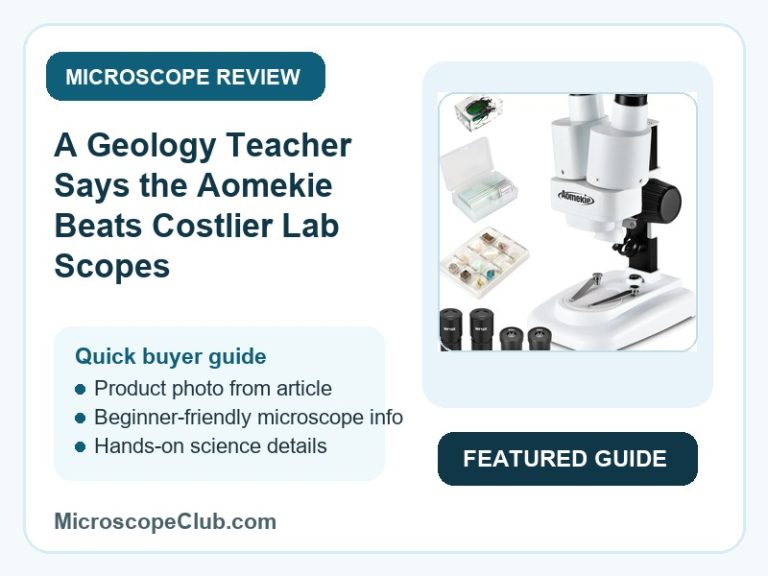
This Aomekie stereo microscope review lands on a clear verdict: it’s worth buying for kids, beginners, and light hobbyists who want a genuinely usable 20X-50X binocular scope without lab-grade pricing, but skip it if you need serious geology or biology-grade optics. It won’t replace an AmScope or Swift for advanced work, but for a first microscope, jewelry inspection, or small electronics repair, it delivers more than its budget-friendly position suggests. One buyer who owns five pricier stereo scopes said the detail and ease of use on this one were “perfect” for classroom use — a rare compliment for a scope in this price bracket.

✅ Pros
- Binocular design beats monocular alternatives — reviewers call it “far better than a monocular scope”
- Optics stay clear enough for precision hobby work like jewelry and key fob repair
- Strong value at the price point, per multiple verified buyers
- Sparks real engagement in kids — one buyer says they “use them way more than I thought I would”
- Holds up against pricier lab scopes for classroom and hobbyist use
❌ Cons
- LED light switch can fail to turn off, forcing buyers to pull the battery
- 20X-50X magnification is entry-level — not enough for advanced biology or geology work
- After-sales support has been reported as unresponsive by at least one buyer
- No lower/upward illumination option for transmitted-light viewing
What to Look for in a Stereo Microscope
Magnification range is the first thing to check, but it’s not the whole story. A stereo (dissecting) microscope like the Aomekie trades high magnification for a wide, upright, 3D view of the specimen surface — useful for insects, minerals, circuit boards, and jewelry rather than thin-sliced cell samples. The Aomekie’s WF10X and WF25X eyepieces paired with a 2X objective produce 20X and 50X, which sits at the low end of the stereo category but matches what most first-time buyers actually need. If you’re still deciding whether a stereo or compound scope fits your goals, our stereo microscope beginner’s guide breaks down the difference in more detail.
Illumination and focusing mechanics matter just as much as optics. The Aomekie runs its LED light source off two AA batteries, which keeps it cordless but also means the light switch is a mechanical wear point — exactly where one verified buyer reported a failure. A rotatable focus knob and fixed vertical inclination keep the image stable once you’ve found focus, and a 65mm-102mm working range gives enough clearance to work under the objective with tools or slides in hand.
Finally, comfort features decide whether a scope actually gets used. Binocular viewing with an adjustable 55mm-75mm interpupillary distance means both eyes stay open and relaxed, which matters more for kids and casual users than raw magnification numbers ever will.
Who Should Buy a Stereo Microscope?
Stereo microscopes are built for anyone who needs to see a whole object in 3D rather than a thin cross-section — students studying rocks or insects, hobbyists inspecting jewelry or coins, and hands-on repair work like circuit boards or small electronics. Because the field of view stays wide and the working distance is generous, you can use tools under the lens while you look, which a compound microscope doesn’t allow. If you’re shopping specifically for a child’s first scope, our guide to the best microscopes for kids covers what separates a durable pick from a disappointing one.
Educators also lean on stereo scopes for classroom sets, where budget per unit matters more than any single feature. That’s the exact use case one AOMEKIE buyer described: a geology teacher who owns five pricier stereo scopes from established brands but bought several of these for students because the per-unit value made more sense than one higher-end scope.
Who This Is For
The AOMEKIE stereo microscope fits parents and grandparents buying a first microscope for a curious child roughly 6 to 12 years old, and budget-conscious hobbyists who need basic 20X-50X magnification for jewelry inspection, small electronics or key fob repair, or casual rock and insect viewing. It’s not the right pick for serious students or professionals who need magnification beyond 50X, an all-metal build, or dependable vendor support if something breaks.

Full Specifications
| Spec | Value |
|---|---|
| Light Source Type | LED |
| Real Angle Of View | 12 Degrees |
| Magnification Maximum | 50 x |
| Voltage | 3 Volts |
| Compatible Devices | Personal Computer |
| Objective Lens Description | Semi-Apochromatic |
| Power Source | Battery Powered |
| Item Dimensions L x W x H | 17.72″L x 12.99″W x 6.3″H |
| Item Weight | 872 Grams |
| Enclosure Material | Glass, Metal |
| Color | White |
| Model Name | Stereo Microscope |
| Brand | AOMEKIE |
| Manufacturer Part Number | AO10/47 |
| Warranty Description | Two-year warranty |
| Built-In Media | 1 Insect specimens, 10Pcs Slides Insect Specimen, 12Pcs mineral specimens, Stereo Microscope |
Optical Performance
The AOMEKIE stereo microscope delivers 20X and 50X magnification through paired WF10X and WF25X eyepieces mounted over a fixed 2X objective lens. That’s a narrower range than higher-end stereo scopes, but it matches the resolution most casual users can actually put to use — inspecting insects, minerals, coins, and circuit boards rather than chasing maximum zoom.
The AOMEKIE stereo microscope maintains a 12-degree real angle of view through its semi-apochromatic objective lens, which keeps color fringing low enough for casual specimen work. Reviewers back this up directly: one buyer who owns five stereo scopes from AmScope, Swift, Boreal, and National Optical said “the detail, light intensity, ease of use… are perfect,” and another described the optics as clear enough for jewelry and electronics repair despite the low price. For readers who want a deeper technical grounding in how objective and eyepiece combinations determine resolution, Nikon’s MicroscopyU reference is a solid starting point.
The AOMEKIE stereo microscope does trade away one feature common on pricier scopes: a lower or upward transmitted-light option. One buyer specifically flagged this as the scope’s main limitation for geology use, even while rating it five stars overall.
Build Quality and Portability
The AOMEKIE stereo microscope combines a glass-and-metal enclosure with a battery-powered LED light source that runs on two AA batteries, keeping it cordless and easy to move between a desk and a classroom table. At 872 grams and roughly 17.72″ x 12.99″ x 6.3″ in its packaged footprint, it’s light enough for a child to carry but substantial enough to stay stable while focusing.
The AOMEKIE stereo microscope leans on plastic in its housing more than its “glass, metal” spec listing implies in practice — one buyer described it as “mostly plastic” and “like a kids’ toy,” though they still found the optics clear enough for their intended use. That tradeoff is consistent with the price point: the scope prioritizes portability and cost over the all-metal ruggedness of lab-grade alternatives.
The AOMEKIE stereo microscope’s one recurring build complaint centers on its LED switch: at least one verified buyer reported the light won’t turn off without pulling the battery out, a real design flaw worth knowing about before you buy, even though it didn’t stop other buyers from rating the unit highly.
Ease of Use and Included Accessories
The AOMEKIE stereo microscope adjusts its interpupillary distance from 55mm to 75mm through a binocular hinge, letting both adults and children find a comfortable two-eye view instead of squinting through a single monocular lens. A 65mm-102mm working range and rotatable focus knob give enough clearance to reposition specimens or hold tools underneath while focusing.
The AOMEKIE stereo microscope ships ready to use out of the box: 1 insect specimen, 10 prepared slides, and 12 mineral specimens come bundled in, so there’s no separate purchase needed to start exploring. One reviewer also noted the unit arrived with a plastic dust cover, a small but practical inclusion for a scope aimed at kids’ desks and shared classroom tables.
The AOMEKIE stereo microscope earns its strongest praise specifically for kid-friendliness — among customers who commented on suitability for children, the large majority described it positively, citing the bright LED light and simple focus mechanism as reasons it holds a child’s attention.
What Customers Say
The Aomekie stereo microscope holds a 4.3 out of 5 average across 189 reviews. In a sampled set of 13 reviews, sentiment ran roughly 85% positive and 15% mixed or negative, with no reviews landing in a true neutral middle. All 13 sampled reviews carried a Verified Purchase badge, and the negative reviews were specific rather than vague — a healthy sign that the rating hasn’t been scrubbed of real criticism.
On the positive side, one reviewer called it “fantastic… far better than a monocular scope,” while another said “not bad for my use and the money — good bang for the buck,” noting the optics were clear enough for jewelry, electronics, and key fob repair. On the negative side, a verified buyer reported “the LED light won’t turn off with switch — we have to pull battery out,” and a separate reviewer described the unit as “not very good, very basic… not very powerful magnification” alongside unresponsive supplier support. For buyers who want to understand how review authenticity and verified-purchase signals should factor into a purchase decision, the FTC’s endorsement guide resource is a useful reference.
Final Verdict
CONSIDER the Aomekie stereo microscope if you fit its actual target buyer: a parent, grandparent, or educator equipping a first-time or classroom user with a durable-enough, kid-friendly binocular scope backed by real specimens and slides out of the box. Its 20X-50X range and mostly-plastic build make it a poor fit for anyone who needs lab-grade optics, all-metal durability, or reliable vendor support — but for its intended audience, the combination of clear optics, adjustable comfort features, and included accessories outperforms its budget price tag.
Frequently Asked Questions
What magnification does the Aomekie stereo microscope offer?
It provides 20X and 50X magnification through interchangeable WF10X and WF25X eyepieces paired with a fixed 2X objective lens. This covers most beginner and hobbyist needs but falls short of magnification levels required for advanced biology or geology coursework.
Is this microscope actually suitable for young children?
Yes — customer feedback specifically calls out suitability for children as a strength, with several buyers describing it as a good first microscope for kids roughly 6 to 12 years old. The binocular design, adjustable interpupillary distance, and bright LED light all support easier use for smaller hands and eyes.
What’s included in the box?
The scope ships with 1 insect specimen, 10 prepared slides, and 12 mineral specimens, along with the binocular stereo microscope body and LED light source. One reviewer also received a plastic dust cover with their unit.
Does it need batteries, and which kind?
The LED light source runs on two AA batteries, which are not included. This keeps the scope fully cordless and portable, though at least one buyer reported the light switch failing to turn off without removing a battery.
Can it be used for hobbies like jewelry inspection or electronics repair?
Yes — multiple verified buyers specifically used it for jewelry inspection, small electronics repair, and key fob work, and reported the optics were clear enough for those tasks despite the scope’s budget positioning and largely plastic build.
What’s the adjustable working range and eye distance?
The working range adjusts from 65mm to 102mm, giving room to work with tools or slides under the objective, and the interpupillary distance adjusts from 55mm to 75mm to fit different users comfortably in binocular view.
Does it come with a warranty?
Yes, it includes a two-year warranty. That said, at least one buyer reported difficulty getting a response from the supplier after reaching out about a product issue, so factor that risk in if after-sales responsiveness matters to your purchase.
Conclusion
The Aomekie stereo microscope suits its target buyer well: parents, grandparents, and educators looking for a durable-enough, kid-friendly first scope with real specimens and slides included, rather than a lab-grade instrument. Its 20X-50X ceiling and mostly-plastic construction mean serious students and professionals should look elsewhere, but for casual exploration, classroom sets, or light hobby repair work, it delivers real value at its price point.
If you’ve used the Aomekie stereo microscope or a similar entry-level scope, share what worked — or didn’t — in the comments below. And if you’re comparing it against other options before you buy, our guide to the popular and best microscope brands is a good next stop.
Originally posted 2026-07-22 09:00:00.